- 1.Attach the syringe to the luer end of the infusion set tubing provided.
- 2.Apply a tourniquet and prepare the injections site by wiping the skin well with an alcohol swab provided in the kit.
- 3.Perform venipuncture. Insert the needle on the infusion set tubing into the vein, and remove the tourniquet. Inject the reconstituted BeneFIX intravenously over several minutes. Adjust the rate of administration based on the patient's comfort level.
Note: Agglutination of red blood cells in the tubing/syringe has been reported with the administration of BeneFIX. No adverse events have been reported in association with this observation. To minimize the possibility of agglutination, it is important to limit the amount of blood entering the tubing. Blood should not enter the syringe. If red blood cell agglutination is observed in the tubing or syringe, discard all material (tubing, syringe and BeneFIX solution) and resume administration with a new package. - 4.Following completion of BeneFIX treatment, remove and discard the infusion set. Dispose of all unused solution, empty vial(s), and used needles and syringes in an appropriate container.
Immunogenicity
In clinical trials with 65 PTPs (defined as having more than 50 exposure days), a low-titer inhibitor was observed in one patient. The inhibitor was transient, the patient continued on the trial and had normal factor IX recovery at the trial completion (approximately 15 months after inhibitor detection).
In clinical trials with pediatric PUPs, inhibitor development was observed in 2 out of 63 patients (3.2%), both were high-titer (>5 BU) inhibitors detected after 7 and 15 exposure days, respectively. Both patients were withdrawn from the trial.
In a clinical trial of 25 PTPs, with BeneFIX administered at 100 IU/kg once weekly, no inhibitors were detected.
The detection of antibody formation is highly dependent on the sensitivity and specificity of the assay. Additionally, the observed incidence of antibody (including neutralizing antibody) positivity in an assay may be influenced by several factors, including assay methodology, sample handling, timing of sample collection, concomitant medications, and underlying disease. For these reasons, comparison of the incidence of antibodies to BeneFIX with the incidence of antibodies to other products may be misleading.
Thromboembolic complications
All subjects participating in the PTP, PUP and surgery trials were monitored for clinical evidence of thrombosis. No thrombotic complications were reported in PUPs or surgery subjects. One PTP subject experienced a renal infarct (see Table 2). Laboratory studies of thrombogenicity (fibrinopeptide A and prothrombin fragment 1 + 2) were obtained in 41 PTPs and 7 surgery subjects prior to infusion and up to 24 hours following infusion. The results of these studies were inconclusive. Out of 29 PTP subjects noted to have elevated fibrinopeptide A levels post-infusion of BeneFIX, 22 also had elevated levels at baseline. Surgery subjects showed no evidence of significant increase in coagulation activation.
Risk Summary
There are no data with BeneFIX use in pregnant women to inform a drug-associated risk. Animal reproduction studies have not been conducted with BeneFIX. It is not known whether BeneFIX can affect reproductive capacity or cause fetal harm when given to pregnant women.
In the U.S. general population, the estimated background risk of major birth defect and miscarriage in clinically recognized pregnancies is 2–4% and 15–20%, respectively.
Risk Summary
There is no information regarding the presence of BeneFIX in human milk, the effect on the breastfed infant, and the effects on milk production. The developmental and health benefits of breastfeeding should be considered along with the mother's clinical need for BeneFIX and any potential adverse effects on the breastfed child from BeneFIX or from the underlying maternal condition.
Pediatric Patients (<12 years)
A population pharmacokinetic model was developed using data collected in patients aged 7 months to 60 years who received single doses of BeneFIX ranging from 50 to 75 IU/kg. The parameters estimated using the final 2-compartment model are shown in Table 5. Infants and children had higher clearance, larger volume of distribution, shorter half-life and lower recovery than adolescents and adults.
Table 5: Mean ± SD Pharmacokinetic Parameters Derived from Population Pharmacokinetic Analysis| Age Group | Infants (<2 years) | Children
2 to <6 yr | Children
6 to <12 yr | Adolescents and Adults (≥12 years) |
|---|
| Abbreviations: SD = standard deviation; Vss = volume of distribution at steady-state. |
Number of subjects | 7 | 16 | 1 | 43 |
Clearance (mL/h/kg) | 13.1 ± 2.1 | 13.1 ± 2.8 | 15.5 | 8.4 ± 2.4 |
Vss (mL/kg) | 252 ± 35 | 257 ± 25 | 303 | 229 ± 57 |
Half-life (h) | 15.6 ± 1.2 | 16.7 ± 1.9 | 16.3 | 23.1 ± 4.4 |
Recovery (IU/dL per IU/kg) | 0.61 ± 0.10 | 0.60 ± 0.08 | 0.47 | 0.72 ± 0.19 |
Data from 57 PUP subjects who underwent repeat recovery testing for up to 60 months demonstrated that the average recovery was consistent over time, as shown in Figure 1.
Figure 1. Average Recovery over Time
On-demand Treatment and Control of Bleeding Episodes
Fifty-six PTPs and sixty-three PUPs were treated for bleeding episodes on an on-demand treatment and control of bleeds (see Tables 6 and 7). The PTPs were followed over a median interval of 24 months (mean 23.4 ± 5.3 months) and for a median of 83.5. The PUPs were followed over a median interval of 37 months (mean 38.1 ± 16.4 months) and for a median of 89 exposure days.
Fifty-five PTPs and fifty-four PUPs received BeneFIX for the treatment of bleeding episodes (see Table 6). Bleeding episodes that were managed successfully included hemarthrosis and bleeding in soft tissue and muscle. Data concerning the severity of bleeding episodes were not reported. In the PTPs, 88% of total infusions administrated for on-demand treatment were rated as an "excellent" or "good" response.
Table 6: Efficacy of BeneFIX for On-Demand Treatment in PTPs and PUPs | Median Dose: IU/kg (range) | Rate of Bleeds Resolved with 1 Infusion | Response to 1st Infusion Rating Response ratings not provided for 1.3% and 2% of 1st infusions for PTPs and PUPs, respectively. Excellent/Good | Response to 1st Infusion Rating Moderate | Response to 1st Infusion Rating No Response |
PTPs N = 55 One subject discontinued the trial after one month of treatment due to bleeding episodes that were difficult to control; he did not have a detectable inhibitor. | 42.8
(6.5–224.6) | 81% | 90.9% | 7.1% | 0.7% |
PUPs N = 54 Three subjects were not successfully treated including one episode in a subject due to delayed time to infusion and insufficient dosing and in 2 subjects due to inhibitor formation. | 62.7
(8.2–292) | 75% | 94.1% | 2.9% | 1.0% |
A total of 20 PTPs were treated with BeneFIX for secondary prophylaxis (the regular administration of FIX replacement therapy to prevent bleeding in patients who may have already demonstrated clinical evidence of hemophilic arthropathy or joint disease) at some regular interval during the trial with a mean of 2 infusions per week (see Table 7). Thirty-two PUPs were administered BeneFIX for routine (primary and secondary) prophylaxis (see Table 7). Twenty-four PUPs were administered BeneFIX at least twice weekly, and eight PUPs were administered BeneFIX once weekly. Seven PTPs experienced a total of 26 spontaneous bleeding episodes within 48 hours after an infusion. Six spontaneous bleeds within 48 hours after an infusion were reported in 5 PUPs. Prophylaxis therapy was rated as "excellent" or "effective" in 93% of PTPs receiving prophylaxis one to two times per week.
Table 7: Efficacy of Prophylaxis of BeneFIX in PTPs and PUPs| Total Exposure (infusions) | Duration of Prophylaxis (months)
(mean ± SD) | Dose IU/kg
(mean ± SD) | Spontaneous Bleeds Within 48 hrs of Infusion | Response Rating Response ratings provided at approximately 3-month intervals. In total, 116 and 172 assessments reported for PTPs and PUPs, respectively. Response ratings not provided for 2.6% and 0.6% of intervals for PTPs and PUPs, respectively.
Excellent | Response Rating
Effective | Response Rating
Inadequate |
|---|
| Abbreviation: SD = standard deviation. |
20 PTPs | | | | | | |
2985 | 18.2 ± 8.4 N = 19. | 40.3 ± 15.2 | 28 | 56.0% | 37.1% | 4.3% |
32 PUPs | | | | | | |
3158 | 14.4 ± 8.1 | 73.3 ± 33.1 | 6 | 91.3% | 6.4% | 1.7% |
Perioperative Management
Management of hemostasis was evaluated in the surgical setting in both PTPs and PUPs (see Table 8 and Table 9). Thirty-six surgical procedures have been performed in 28 PTPs with 23 major surgical procedures performed (including 6 complicated dental extractions). Thirty surgical procedures have been performed in 23 PUPs. Twenty-eight of these procedures were considered minor. Hemostasis was maintained throughout the surgical period; however, one PTP subject required evacuation of a surgical wound-site hematoma, and another PTP subject who received BeneFIX after a tooth extraction required further surgical intervention due to oozing at the extraction site. There was no clinical evidence of thrombotic complications in any of the subjects.
Among the PTP surgery subjects, the median increase in circulating factor IX activity was 0.7 IU/dL per IU/kg infused (range 0.3–1.2 IU/dL; mean 0.8 ± 0.2 IU/dL per IU/kg). The median elimination half-life for the PTP surgery subjects was 19.4 hours (range 10–37 hours; mean 21.3 ± 8.1 hours).
Table 8: Efficacy of BeneFIX for Surgical Procedures in Previously Treated PatientsSurgery Type Some surgery types were done as a part of a single procedure. | Number of Procedures
(Number of Subjects) | Response Excellent/Good | Response Moderate | Response No Response |
Ankle surgery | 2 (2) | 2 (100%) | - | - |
Hip prosthesis implant (right) | 1 (1) | 1 (100%) | - | - |
Knee arthroplasty (2 bilateral, 1 right) | 3 (3) | 3 (100%) | - | - |
Knee arthroscopic synovectomy | 2 (2) Response assessment not provided for 1 procedure. | 1 (50%) | - | - |
Liver transplantation (orthotopic) | 1 (1) | 1 (100%) | - | - |
Splenectomy | 1 (1) | 1 (100%) | - | - |
External fixation device removal (wrist) | 1 (1) | 1 (100%) | - | - |
Hernia repair | 3 (2) | 3 (100%) | - | - |
Subacromial decompression (left) | 1 (1) | 1 (100%) | - | - |
Calf debridement, dental extraction Includes pulse and continuous-infusion regimens; CI counted as 1 procedure in this summary. | 1 (1) | 1 (100%) | - | - |
Lymph node removal, dental extraction | 1 (1) | 1 (100%) | - | - |
Left heel cord lengthening | 1 (1) | 1 (100%) | - | - |
Dental procedures Includes complicated extractions (6), clearance, and fillings. | 12 (11) | 11 (92%) | 1 (8%) | - |
Minor procedures E.g., punch biopsy of the skin. | 6 (6) | 6 (100%) | - | - |
Table 9: Efficacy of BeneFIX for Surgical Procedures in Previously Untreated PatientsSurgery Type Some surgery types were done as a part of a single procedure. | Number of Procedures (Number of Subjects) | Response Excellent/Good | Response Moderate | Response No Response |
Hernia repair | 2 (2) | 2 (100%) | - | - |
Minor procedures E.g., permanent venous access placement. | 28 (21) Response assessment not provided for 1 procedure. | 27 (96%) | - | - |
Nine of the major surgical procedures were performed in 8 PUPs using a continuous-infusion regimen. Five of the surgical procedures were performed in PUPs using a continuous-infusion regimen over 3 to 5 days. Although circulating factor IX levels targeted to restore and maintain hemostasis were achieved with both pulse replacement and continuous infusion regimens, clinical trial experience with continuous infusion of BeneFIX for perioperative management in hemophilia B has been too limited to establish the safety and clinical efficacy of administration of the product by continuous infusion.
Routine Prophylaxis
In an open-label trial of 25 patients (age range 12–54 years) comparing on-demand treatment versus prophylaxis when administered at a dose of 100 IU/kg once weekly, the annualized bleed rate (ABR) for the prophylaxis period was significantly lower (p < 0.0001) than the ABR for the on-demand period (mean ± standard deviation (SD): 3.6 ± 4.6, median: 2.0, min–max: 0–13.8 versus mean: 32.9 ± 17.4, median: 33.6, min–max: 6.1–69.0, respectively).
In an open-label crossover trial in patients aged 6–64 years, of 100 IU/kg once weekly (44 patients) and 50 IU/kg twice weekly (43 patients) with 4-month treatment periods, the ABR for the 100 IU/kg once-weekly prophylaxis period was mean 4.4 ± 10.0 episodes per year (median: 0.0, min–max: 0 – 50.5) and mean 2.8 ± 5.7 (median: 0.0, min–max: 0 – 24.1) for the 50 IU/kg twice-weekly period. Six patients aged <12 years had mean ABR of 1.6 ± 1.7 (median: 1.5, min–max: 0–3.3) in the 100 IU/kg once-weekly period, and mean ABR of 0 ± 0 (median: 0, min–max: 0–0) in the 50 IU/kg twice-weekly period.
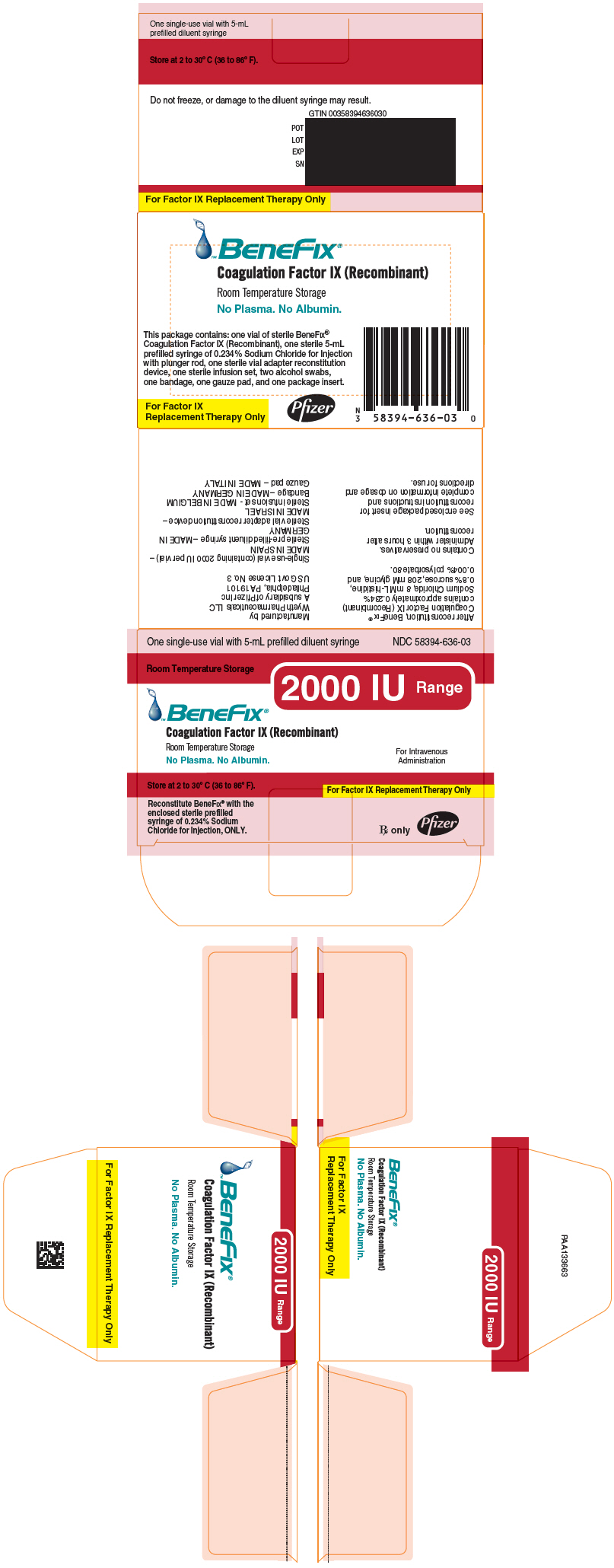
Product kit as packaged for sale
- Store BeneFIX at room temperature or under refrigeration, at a temperature of 2 to 30°C (36 to 86°F).
- Do not freeze to prevent damage to the diluent syringe.
- Do not use BeneFIX after the expiration date on the label.
Product after reconstitution
The product does not contain a preservative and should be used within 3 hours.
This product's labeling may have been updated. For the most recent prescribing information, please visit www.pfizer.com.
For Medical Information about BENEFIX, please visit www.pfizermedinfo.com or call 1-800-438-1985.