The safety and efficacy of Enbrel were assessed in four randomized, double-blind, controlled studies. The results of all four trials were expressed in percentage of patients with improvement in RA using ACR response criteria.
Study I evaluated 234 patients with active RA who were ≥ 18 years old, had failed therapy with at least one but no more than four disease-modifying antirheumatic drugs (DMARDs) (eg, hydroxychloroquine, oral or injectable gold, MTX, azathioprine, D-penicillamine, sulfasalazine), and had ≥ 12 tender joints, ≥ 10 swollen joints, and either erythrocyte sedimentation rate (ESR) ≥ 28 mm/hr, C-reactive protein (CRP) > 2.0 mg/dL, or morning stiffness for ≥ 45 minutes. Doses of 10 mg or 25 mg Enbrel or placebo were administered SC twice a week for 6 consecutive months.
Study II evaluated 89 patients and had similar inclusion criteria to Study I except that patients in Study II had additionally received MTX for at least 6 months with a stable dose (12.5 to 25 mg/week) for at least 4 weeks and they had at least 6 tender or painful joints. Patients in Study II received a dose of 25 mg Enbrel or placebo SC twice a week for 6 months in addition to their stable MTX dose.
Study III compared the efficacy of Enbrel to MTX in patients with active RA. This study evaluated 632 patients who were ≥ 18 years old with early (≤ 3 years disease duration) active RA, had never received treatment with MTX, and had ≥ 12 tender joints, ≥ 10 swollen joints, and either ESR ≥ 28 mm/hr, CRP > 2.0 mg/dL, or morning stiffness for ≥ 45 minutes. Doses of 10 mg or 25 mg Enbrel were administered SC twice a week for 12 consecutive months. The study was unblinded after all patients had completed at least 12 months (and a median of 17.3 months) of therapy. The majority of patients remained in the study on the treatment to which they were randomized through 2 years, after which they entered an extension study and received open-label 25 mg Enbrel. MTX tablets (escalated from 7.5 mg/week to a maximum of 20 mg/week over the first 8 weeks of the trial) or placebo tablets were given once a week on the same day as the injection of placebo or Enbrel doses, respectively.
Study IV evaluated 682 adult patients with active RA of 6 months to 20 years duration (mean of 7 years) who had an inadequate response to at least one DMARD other than MTX. Forty-three percent of patients had previously received MTX for a mean of 2 years prior to the trial at a mean dose of 12.9 mg. Patients were excluded from this study if MTX had been discontinued for lack of efficacy or for safety considerations. The patient baseline characteristics were similar to those of patients in Study I. Patients were randomized to MTX alone (7.5 to 20 mg weekly, dose escalated as described for Study III; median dose 20 mg), Enbrel alone (25 mg twice weekly), or the combination of Enbrel and MTX initiated concurrently (at the same doses as above). The study evaluated ACR response, Sharp radiographic score, and safety.
Clinical Response
A higher percentage of patients treated with Enbrel and Enbrel in combination with MTX achieved ACR 20, ACR 50, and ACR 70 responses and Major Clinical Responses than in the comparison groups. The results of Studies I, II, and III are summarized in Table 6. The results of Study IV are summarized in Table 7.
Table 6. ACR Responses in Placebo- and Active-Controlled Trials
(Percent of Patients) |
| Placebo Controlled | | | Active Controlled |
| Study I | | | Study II | | | Study III |
| Placebo | Enbrela | | | MTX/Placebo | MTX/Enbrela | | | MTX | Enbrela |
| Response | N = 80 | N = 78 | | | N = 30 | N = 59 | | | N = 217 | N = 207 |
| ACR 20 | | | | | | | | | | |
| Month 3 | 23% | 62%b | | | 33% | 66%b | | | 56% | 62% |
| Month 6 | 11% | 59%b | | | 27% | 71%b | | | 58% | 65% |
| Month 12 | NA | NA | | | NA | NA | | | 65% | 72% |
| ACR 50 | | | | | | | | | | |
| Month 3 | 8% | 41%b | | | 0% | 42%b | | | 24% | 29% |
| Month 6 | 5% | 40%b | | | 3% | 39%b | | | 32% | 40% |
| Month 12 | NA | NA | | | NA | NA | | | 43% | 49% |
| ACR 70 | | | | | | | | | | |
| Month 3 | 4% | 15%b | | | 0% | 15%b | | | 7% | 13%c |
| Month 6 | 1% | 15%b | | | 0% | 15%b | | | 14% | 21%c |
| Month 12 | NA | NA | | | NA | NA | | | 22% | 25% |
a 25 mg Enbrel SC twice weekly.
b p < 0.01, Enbrel vs placebo.
c p < 0.05, Enbrel vs MTX. |
| Table 7. Study IV Clinical Efficacy Results: Comparison of MTX vs Enbrel vs Enbrel in Combination With MTX in Patients With Rheumatoid Arthritis of 6 Months to 20 Years Duration (Percent of Patients) |
| Endpoint | MTX
(N = 228) | Enbrel
(N = 223) | Enbrel/MTX
(N = 231) |
| ACR Na, b | | | |
| Month 12 | 40% | 47% | 63%c |
| ACR 20 | | | |
| Month 12 | 59% | 66% | 75%c |
| ACR 50 | | | |
| Month 12 | 36% | 43% | 63%c |
| ACR 70 | | | |
| Month 12 | 17% | 22% | 40%c |
| Major Clinical Responsed | 6% | 10% | 24%c |
a Values are medians.
b ACR N is the percent improvement based on the same core variables used in defining ACR 20, ACR 50, and ACR 70.
c p < 0.05 for comparisons of Enbrel/MTX vs Enbrel alone or MTX alone.
d Major clinical response is achieving an ACR 70 response for a continuous 6-month period. |
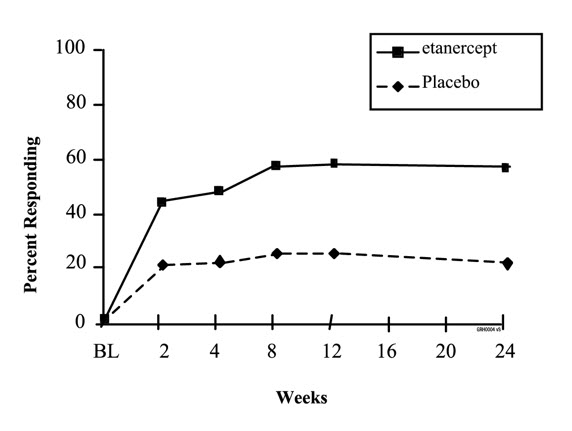
The time course for ACR 20 response rates for patients receiving placebo or 25 mg Enbrel in Studies I and II is summarized in Figure 1. The time course of responses to Enbrel in Study III was similar.
Among patients receiving Enbrel, the clinical responses generally appeared within 1 to 2 weeks after initiation of therapy and nearly always occurred by 3 months. A dose response was seen in Studies I and III: 25 mg Enbrel was more effective than 10 mg (10 mg was not evaluated in Study II). Enbrel was significantly better than placebo in all components of the ACR criteria as well as other measures of RA disease activity not included in the ACR response criteria, such as morning stiffness.
In Study III, ACR response rates and improvement in all the individual ACR response criteria were maintained through 24 months of Enbrel therapy. Over the 2-year study, 23% of Enbrel patients achieved a major clinical response, defined as maintenance of an ACR 70 response over a 6-month period.
The results of the components of the ACR response criteria for Study I are shown in Table 8. Similar results were observed for Enbrel-treated patients in Studies II and III.
| Table 8. Components of ACR Response in Study I |
| Placebo
N = 80 | | Enbrela
N = 78 |
| | | | |
| Parameter (median) | Baseline | 3 Months | Baseline | 3 Months* |
| Number of tender joints b | 34.0 | 29.5 | 31.2 | 10.0f |
| Number of swollen joints c | 24.0 | 22.0 | 23.5 | 12.6f |
| Physician global assessment d | 7.0 | 6.5 | 7.0 | 3.0f |
| Patient global assessment d | 7.0 | 7.0 | 7.0 | 3.0f |
| Pain d | 6.9 | 6.6 | 6.9 | 2.4f |
| Disability index e | 1.7 | 1.8 | 1.6 | 1.0f |
| ESR (mm/hr) | 31.0 | 32.0 | 28.0 | 15.5f |
| CRP (mg/dL) | 2.8 | 3.9 | 3.5 | 0.9f |
* Results at 6 months showed similar improvement.
a 25 mg Enbrel SC twice weekly.
b Scale 0-71.
c Scale 0-68.
d Visual analog scale: 0 = best; 10 = worst.
e Health Assessment Questionnaire: 0 = best; 3 = worst; includes eight categories: dressing
and grooming, arising, eating, walking, hygiene, reach, grip, and activities.
f p < 0.01, Enbrel vs placebo, based on mean percent change from baseline. |
After discontinuation of Enbrel, symptoms of arthritis generally returned within a month. Reintroduction of treatment with Enbrel after discontinuations of up to 18 months resulted in the same magnitudes of response as in patients who received Enbrel without interruption of therapy, based on results of open-label studies.
Continued durable responses were seen for over 60 months in open-label extension treatment trials when patients received Enbrel without interruption. A substantial number of patients who initially received concomitant MTX or corticosteroids were able to reduce their doses or discontinue these concomitant therapies while maintaining their clinical responses.
Physical Function Response
In Studies I, II, and III, physical function and disability were assessed using the Health Assessment Questionnaire (HAQ). Additionally, in Study III, patients were administered the SF-36 Health Survey. In Studies I and II, patients treated with 25 mg Enbrel twice weekly showed greater improvement from baseline in the HAQ score beginning in month 1 through month 6 in comparison to placebo (p < 0.001) for the HAQ disability domain (where 0 = none and 3 = severe). In Study I, the mean improvement in the HAQ score from baseline to month 6 was 0.6 (from 1.6 to 1.0) for the 25 mg Enbrel group and 0 (from 1.7 to 1.7) for the placebo group. In Study II, the mean improvement from baseline to month 6 was 0.6 (from 1.5 to 0.9) for the Enbrel/MTX group and 0.2 (from 1.3 to 1.2) for the placebo/MTX group. In Study III, the mean improvement in the HAQ score from baseline to month 6 was 0.7 (from 1.5 to 0.7) for 25 mg Enbrel twice weekly. All subdomains of the HAQ in Studies I and III were improved in patients treated with Enbrel.
In Study III, patients treated with 25 mg Enbrel twice weekly showed greater improvement from baseline in SF-36 physical component summary score compared to Enbrel 10 mg twice weekly and no worsening in the SF-36 mental component summary score. In open-label Enbrel studies, improvements in physical function and disability measures have been maintained for up to 4 years.
In Study IV, median HAQ scores improved from baseline levels of 1.8, 1.8, and 1.8 to 1.1, 1.0, and 0.6 at 12 months in the MTX, Enbrel, and Enbrel/MTX combination treatment groups, respectively (combination versus both MTX and Enbrel, p < 0.01). Twenty-nine percent of patients in the MTX alone treatment group had an improvement of HAQ of at least 1 unit versus 40% and 51% in the Enbrel alone and the Enbrel/MTX combination treatment groups, respectively.
Radiographic Response
In Study III, structural joint damage was assessed radiographically and expressed as change in Total Sharp Score (TSS) and its components, the erosion score and joint space narrowing (JSN) score. Radiographs of hands/wrists and forefeet were obtained at baseline, 6 months, 12 months, and 24 months and scored by readers who were unaware of treatment group. The results are shown in Table 9. A significant difference for change in erosion score was observed at 6 months and maintained at 12 months.
| Table 9. Mean Radiographic Change Over 6 and 12 Months in Study III |
| MTX | 25 mg Enbrel | MTX/Enbrel
(95% Confidence Interval*) | P Value |
| 12 Months | Total Sharp Score | 1.59 | 1.00 | 0.59 (-0.12, 1.30) | 0.1 |
|
Erosion Score | 1.03 | 0.47 | 0.56 (0.11, 1.00) | 0.002 |
|
JSN Score | 0.56 | 0.52 | 0.04 (-0.39, 0.46) | 0.5 |
| | | | | |
| 6 Months | Total Sharp Score | 1.06 | 0.57 | 0.49 (0.06, 0.91) | 0.001 |
|
Erosion Score | 0.68 | 0.30 | 0.38 (0.09, 0.66) | 0.001 |
|
JSN Score | 0.38 | 0.27 | 0.11 (-0.14, 0.35) | 0.6 |
| * 95% confidence intervals for the differences in change scores between MTX and Enbrel. |
Patients continued on the therapy to which they were randomized for the second year of Study III. Seventy-two percent of patients had x-rays obtained at 24 months. Compared to the patients in the MTX group, greater inhibition of progression in TSS and erosion score was seen in the 25 mg Enbrel group, and, in addition, less progression was noted in the JSN score.
In the open-label extension of Study III, 48% of the original patients treated with 25 mg Enbrel have been evaluated radiographically at 5 years. Patients had continued inhibition of structural damage, as measured by the TSS, and 55% of them had no progression of structural damage. Patients originally treated with MTX had further reduction in radiographic progression once they began treatment with Enbrel.
In Study IV, less radiographic progression (TSS) was observed with Enbrel in combination with MTX compared with Enbrel alone or MTX alone at month 12 (Table 10). In the MTX treatment group, 55% of patients experienced no radiographic progression (TSS change ≤ 0.0) at 12 months compared to 63% and 76% in the Enbrel alone and the Enbrel/MTX combination treatment groups, respectively.
Table 10. Mean Radiographic Change in Study IV at 12 Months
(95% Confidence Interval) |
|
MTX
(N = 212)* |
Enbrel
(N = 212)* |
Enbrel/MTX
(N = 218)* |
| Total Sharp Score (TSS) | 2.80
(1.08, 4.51) | 0.52a
(-0.10, 1.15) | -0.54b,c
(-1.00, -0.07) |
| Erosion Score (ES) | 1.68
(0.61, 2.74) | 0.21a
(-0.20, 0.61) | -0.30b
(-0.65, 0.04) |
| Joint Space Narrowing (JSN) Score | 1.12
(0.34, 1.90) | 0.32
(0.00, 0.63) | -0.23b,c
(-0.45, -0.02) |
* Analyzed radiographic ITT population.
a p < 0.05 for comparison of Enbrel vs MTX.
b p < 0.05 for comparison of Enbrel/MTX vs MTX.
c p < 0.05 for comparison of Enbrel/MTX vs Enbrel. |
Once Weekly Dosing
The safety and efficacy of 50 mg Enbrel (two 25 mg SC injections) administered once weekly were evaluated in a double-blind, placebo-controlled study of 420 patients with active RA. Fifty-three patients received placebo, 214 patients received 50 mg Enbrel once weekly, and 153 patients received 25 mg Enbrel twice weekly. The safety and efficacy profiles of the two Enbrel treatment groups were similar.