- The effect of THYROGEN on thyroid cancer recurrence greater than five years post-remnant ablation has not been evaluated [see Clinical Studies (14.2)].
Risk Summary
THYROGEN may be used in combination with radioiodine (RAI). If THYROGEN is administered with RAI, the combination regimen is contraindicated in pregnant women because fetal exposure to RAI can lead to neonatal hypothyroidism, which in some cases is severe and irreversible. Refer to the RAI prescribing information for more information on use during pregnancy.
Available data from case reports and postmarketing experience with THYROGEN use in pregnant women are insufficient to evaluate for a drug-associated risk of major birth defects, miscarriage, or adverse maternal or fetal outcomes. Animal reproduction studies have not been conducted with THYROGEN.
The estimated background risk of major birth defects and miscarriage for the indicated population is unknown. In the U.S. general population, the estimated background risk of major birth defects and miscarriage in clinically recognized pregnancies is 2% to 4% and 15% to 20%, respectively.
Risk Summary
The concomitant use of THYROGEN and therapeutic radioiodine (RAI) is contraindicated in lactating women because RAI concentrates in the breast tissue and increases the risk of radiation breast toxicity (refer to the therapeutic RAI Prescribing Information).
If THYROGEN is administered with RAI for diagnostic use, discontinue breastfeeding after RAI administration because of the potential for serious adverse reactions from RAI in the breastfed infant (refer to the diagnostic RAI Prescribing Information).
If THYROGEN is not administered with RAI, the developmental and health benefits of breastfeeding should be considered along with the mother's clinical need for THYROGEN and any potential adverse effects on the breastfed child from THYROGEN or from the underlying maternal condition.
There are no available data on the presence of thyrotropin alfa in human milk, the effects on the breastfed infant, or the effects on milk production.
Diagnostic Radioiodine Whole Body Scan Results
Study 1 enrolled 127 patients, 71% were female and 29% male, and mean age was 44 years. The study included the following forms of differentiated thyroid cancer: papillary cancer (88%), follicular cancer (9%), and Hurthle cell (2%). Study results are displayed in Table 2.
In Study 2, patients with differentiated thyroid cancer who had been thyroidectomized (n=229) were randomized into one of two THYROGEN treatment regimens: THYROGEN 0.9 mg IM daily on two consecutive days (n=117), and THYROGEN 0.9 mg IM daily on days 1, 4 and 7 (n=112). Each patient was scanned first using THYROGEN, then scanned using thyroid hormone withdrawal. The group receiving the THYROGEN 0.9 mg IM × 2 regimen was 63% female/27% male, had a mean age of 44 years, and generally had low-stage papillary or follicular cancer (AJCC/TNM Stage I 61%, Stage II 19%, Stage III 14%, Stage IV 5%). The group receiving the THYROGEN 0.9 mg IM × 3 regimen was 66% female/34% male, had a mean age of 50 years, and generally had low-stage papillary or follicular cancer (AJCC/TNM Stage I 50%, Stage II 20%, Stage III 20%, Stage IV 9%). The amount of radioiodine used for scanning was 4 mCi ± 10%, and scanning times were lengthened in some patients to capture adequate images (30 minute scans, or 140,000 counts). Scan pairs were assessed by blinded readers. Study results are presented in Table 2.
Table 2: Concordance of Positive Thyroid Scans Following THYROGEN Treatment with Scans Following Thyroid Hormone Withdrawal | Number of scan pairs by disease category | Concordance of scan pairs between THYROGEN scan and thyroid hormone withdrawal scan |
|---|
| Study 1 (0.9 mg IM qd × 2) |
| Positive for remnant or cancer in thyroid bed | 48 | 81% |
| Positive for metastatic disease | 15 | 73% |
| Total positive withdrawal scans Across both studies uptake was detected on the THYROGEN scan but not observed on the scan after thyroid hormone withdrawal in 5 patients with remnant or cancer in the thyroid bed. ,In the two clinical studies radioiodine scan results using thyroid hormone withdrawal were taken as the true clinical status of each patient and as the comparator for THYROGEN scans. Thyroid hormone withdrawal trace-positive scans were scored conservatively as positive with no allowance for false positives. | 63 | 79% |
| | | |
| Study 2 (0.9 mg IM qd × 2) |
| Positive for remnant or cancer in thyroid bed | 35 | 86% |
| Positive for metastatic Disease | 9 | 67% |
| Total positive withdrawal scans, | 44 | 82% |
Across the two clinical studies, and scoring all false positives in favor of thyroid hormone withdrawal, the majority of positive scans using THYROGEN and thyroid hormone withdrawal were concordant. The THYROGEN scan failed to detect remnant and/or cancer localized to the thyroid bed in 17% (14/83) of patients in whom it was detected by a scan after thyroid hormone withdrawal. In addition, the THYROGEN scan failed to detect metastatic disease in 29% (7/24) of patients in whom it was detected by a scan after thyroid hormone withdrawal.
Thyroglobulin (Tg) Results
THYROGEN Tg testing alone and in combination with diagnostic whole body scanning: comparison with results after thyroid hormone withdrawal
In anti-Tg antibody negative patients with a thyroid remnant or cancer (as defined by a withdrawal Tg ≥2.5 ng/mL or a positive scan [after thyroid hormone withdrawal or after radioiodine therapy]), the THYROGEN Tg was positive (≥2.5 ng/mL) in 69% (40/58) of patients after 2 doses of THYROGEN.
In these same patients, adding the whole body scan increased the detection rate of thyroid remnant or cancer to 84% (49/58) of patients after 2 doses of THYROGEN.
Among patients with metastatic disease confirmed by a post-treatment scan or by lymph node biopsy (35 patients), THYROGEN Tg was positive (≥2.5 ng/mL) in all 35 patients, while Tg on thyroid hormone suppressive therapy was positive (≥2.5 ng/mL) in 79% of these patients.
As with thyroid hormone withdrawal, the intra-patient reproducibility of THYROGEN testing with regard to both Tg stimulation and radioiodine imaging has not been studied.
Hypothyroid Signs and Symptoms
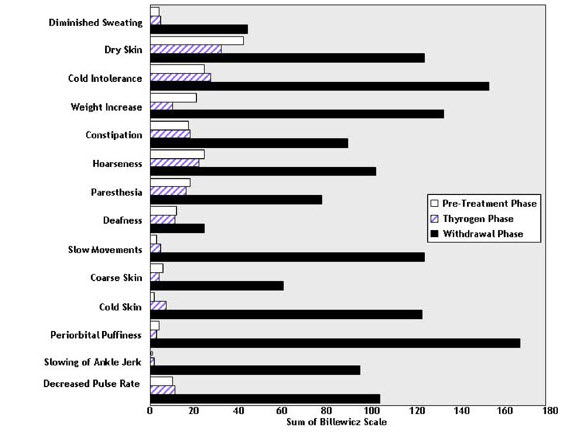
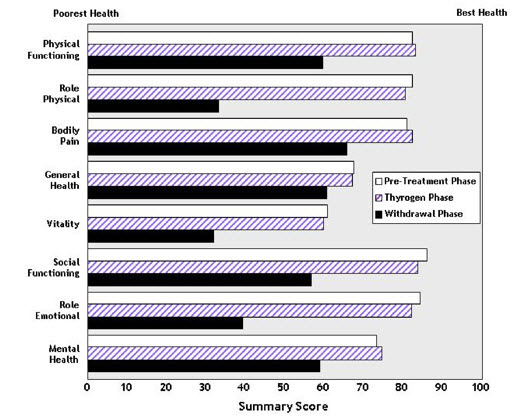
THYROGEN administration was not associated with the signs and symptoms of hypothyroidism that accompanied thyroid hormone withdrawal as measured by the Billewicz scale. Statistically significant worsening in all signs and symptoms were observed during the hypothyroid phase (p<0.01) (Figure 1).
Figure 1: Hypothyroid Symptom Assessment Billewicz Scale Diagnostic Indication 0.9 mg THYROGEN q 24 hours × 2 doses vs Thyroid Hormone Withdrawal Phase
Adverse Reactions