Clinical Trials in Infantile-Onset and Juvenile-Onset Pompe Disease
Two multicenter, open-label clinical trials were conducted in 39 infantile-onset Pompe disease patients, ages 1 month to 3.5 years old. Approximately half of the patients (54%) were male. Patients were treated with alglucosidase alfa 20 or 40 mg/kg every other week for periods ranging from 1 to 106 weeks (mean: 61 weeks).
The most serious adverse reactions reported with alglucosidase alfa treatment included anaphylaxis and acute cardiorespiratory failure.
The most common adverse reactions requiring intervention in clinical trials were hypersensitivity reactions, occurring in 20 of 39 (51%) patients treated with alglucosidase alfa, and included rash, pyrexia, urticaria, flushing, decreased oxygen saturation, cough, tachypnea, tachycardia, hypertension/increased blood pressure, pallor, rigors, vomiting, cyanosis, agitation, and tremor. These reactions were more likely to occur with higher infusion rates. Some patients who were pretreated with antihistamines, antipyretics and/or corticosteroids still experienced hypersensitivity reactions.
Table 2 summarizes all adverse reactions occurring in ≥5% of patients (2 or more patients) treated with alglucosidase alfa in clinical trials described above.
Table 2: Adverse Reactions that Occurred in at Least 5% of Infantile-Onset Patients Treated with Alglucosidase Alfa in Clinical Trials | Number of Patients
(N=39)
n (%) |
|---|
| Adverse Reaction | 20 (51) |
|---|
| Rash (including rash erythematous, rash macular and maculopapular) | 7 (18) |
| Pyrexia | 6 (15) |
| Urticaria | 5 (13) |
| Flushing | 5 (13) |
| Hypertension/Increased Blood Pressure | 4 (10) |
| Decreased Oxygen Saturation | 3 (8) |
| Cough | 3 (8) |
| Tachypnea | 3 (8) |
| Tachycardia | 3 (8) |
| Erythema | 2 (5) |
| Vomiting | 2 (5) |
| Rigors | 2 (5) |
| Pallor | 2 (5) |
| Cyanosis | 2 (5) |
| Agitation | 2 (5) |
| Tremor | 2 (5) |
An open-label, single-center trial was conducted in 18 treatment-naive infantile-onset Pompe disease patients who were treated exclusively with alglucosidase alfa. Adverse reactions observed in these patients were similar to infantile-onset Pompe disease patients who received alglucosidase alfa in other clinical trials.
Additional hypersensitivity reactions observed in infantile-onset Pompe disease patients treated in other clinical trials and expanded access programs with alglucosidase alfa included livedo reticularis, irritability, retching, increased lacrimation, ventricular extrasystoles, nodal rhythm, rales, respiratory tract irritation, and cold sweat.
Safety was also evaluated in 99 patients (51 male, 48 females) with Pompe disease in an ongoing, open-label, prospective study in patients 12 months of age and older who were previously treated with the 160 L scale of alglucosidase alfa and switched to the 4000 L scale of alglucosidase alfa. Patients were aged 1 to 18 years with a median duration of treatment of 437 days (range 13 to 466 days). No new safety findings were observed following the switch to 4000 L scale of alglucosidase alfa.
Clinical Trials in Late-Onset Pompe Disease
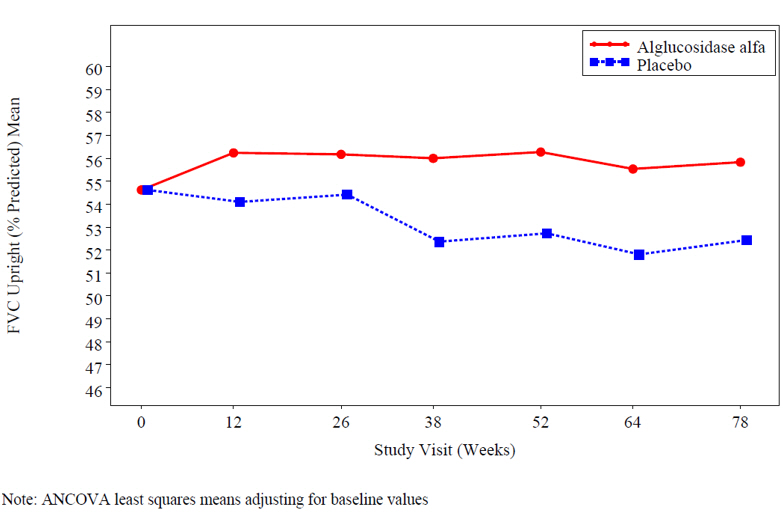
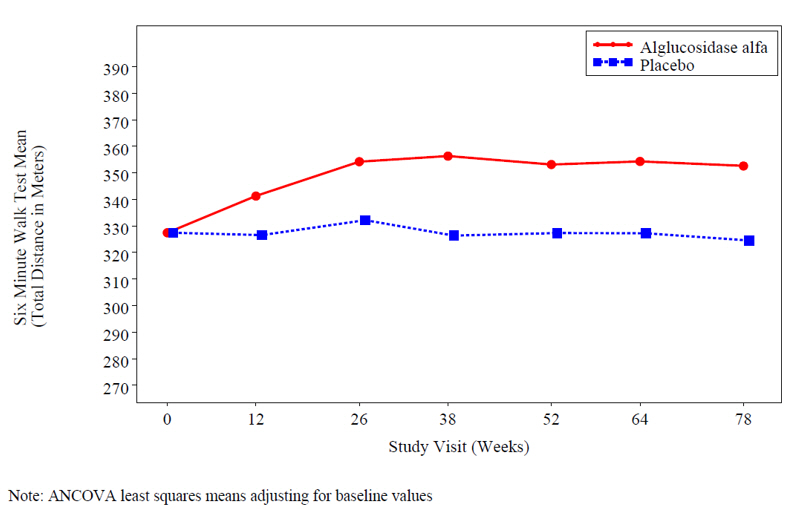
Assessment of adverse reactions in patients with late-onset Pompe disease is based on the exposure of 90 patients (45 male, 45 female), aged 10 to 70 years, to 20 mg/kg alglucosidase alfa or placebo in a randomized, double-blind, placebo-controlled trial. The youngest alglucosidase alfa-treated patient was 16 years of age, and the youngest placebo-treated patient was 10 years of age. All patients were naive to enzyme replacement therapy. Patients were randomized in a 2:1 ratio and received alglucosidase alfa or placebo every other week for 78 weeks (18 months). The study population included 34 males and 26 females (n=60) in the alglucosidase alfa group and 11 males and 19 females (n=30) in the placebo group. Two patients receiving alglucosidase alfa discontinued the trial due to anaphylactic reactions.
Serious adverse reactions reported with alglucosidase alfa included anaphylaxis, which presented as angioedema, throat tightness and chest pain/discomfort. One patient with a history of Wolff-Parkinson-White syndrome experienced a serious adverse reaction of supraventricular tachycardia.
The most common adverse reactions (≥3%; 2 or more patients) observed in alglucosidase alfa-treated patients were hypersensitivity reactions and included anaphylaxis, headache, nausea, urticaria, dizziness, chest discomfort, vomiting, hyperhidrosis, flushing/feeling hot, increased blood pressure, paresthesia, pyrexia, local swelling, diarrhea, pruritus, rash, and throat tightness.
Delayed-onset reactions, defined as adverse reactions occurring 2 to 48 hours after completion of alglucosidase alfa infusion, that were observed in ≥3% more patients in the alglucosidase alfa-treated group compared to patients in the placebo-treated group in the controlled trial, included hyperhidrosis. Additional delayed-onset reactions occurring in alglucosidase alfa-treated patients included fatigue, myalgia, and nausea. Patients should be counseled about the possibility of delayed-onset hypersensitivity reactions and given proper follow-up instructions.
Table 3 summarizes the most common adverse reactions that occurred in at least 3% of alglucosidase alfa-treated patients and with a higher incidence than the placebo-treated patients during the randomized, double-blind, placebo-controlled study described above.
Table 3: Adverse Reactions Occurring in at Least 3% of Alglucosidase Alfa-Treated Late-Onset Patients and with a Higher Incidence than the Placebo-Treated Patients| Adverse Reaction | Alglucosidase Alfa
n=60
N (%) | Placebo
n=30
N (%) |
|---|
| Hyperhidrosis | 5 (8.3) | 0 (0) |
| Urticaria | 5 (8.3) | 0 (0) |
| Anaphylaxis | 4 (6.7) | 0 (0) |
| Chest Discomfort | 4 (6.7) | 1 (3.3) |
| Muscle Twitching | 4 (6.7) | 1 (3.3) |
| Myalgia | 3 (5.0) | 1 (3.3) |
| Flushing/Feeling Hot | 3 (5.0) | 0 (0) |
| Increased Blood Pressure | 3 (5.0) | 0 (0) |
| Vomiting | 3 (5.0) | 0 (0) |
| Edema, Peripheral | 2 (3.3) | 0 (0) |
| Pruritus | 2 (3.3) | 0 (0) |
| Rash Papular | 2 (3.3) | 0 (0) |
| Throat Tightness | 2 (3.3) | 0 (0) |
In clinical trials, anaphylaxis and hypersensitivity reactions were managed with infusion interruption, decreased infusion rate, administration of antihistamines, corticosteroids, intravenous fluids, and/or oxygen, when clinically indicated. In some cases of anaphylactic reactions, epinephrine was administered. Patients who have experienced anaphylaxis or hypersensitivity reactions should be treated with caution when they are readministered alglucosidase alfa.
Risk Summary
Data from postmarketing reports and published case reports with alglucosidase alfa use in pregnant women have not identified a LUMIZYME-associated risk of major birth defects, miscarriage, or adverse maternal or fetal outcomes. The continuation of treatment for Pompe disease during pregnancy should be individualized to the pregnant woman. Untreated Pompe disease may result in worsening disease symptoms in pregnant women [see Clinical Considerations].
Reproduction studies performed in mice and rabbits at doses resulting in exposures up to 0.4 or 0.5 times the human steady-state AUC (area under the plasma concentration-time curve), respectively, during the period of organogenesis revealed no evidence of effects on embryo-fetal development. In mice there was an increase in pup mortality during lactation at maternal exposures 0.4 times the human steady-state AUC [see Data].
The estimated background risk of major birth defects and miscarriage in the indicated population is unknown. All pregnancies have a background risk of birth defect, loss or other adverse outcomes. In the U.S. general population, the estimated background risk of major birth defects and miscarriage in clinically recognized pregnancies is 2% to 4% and 15% to 20%, respectively.
Pregnant women and women of reproductive potential should be encouraged to enroll in the Pompe patient registry. The registry will monitor the effect of LUMIZYME on pregnant women and their offspring. For more information, visit www.registrynxt.com or call 1-800-745-4447, extension 15500.
Clinical Considerations
Disease-associated maternal and/or embryo-fetal risk
Untreated Pompe disease has been associated with worsening respiratory and musculoskeletal symptoms in some pregnant women.
Data
Animal data
All reproductive studies included pretreatment with diphenhydramine to prevent or minimize hypersensitivity reactions. The effects of alglucosidase alfa were evaluated based on comparison to a control group treated with diphenhydramine alone. Daily intravenous administration of alglucosidase alfa up to 40 mg/kg in mice and rabbits (0.4 and 0.5 times the human steady-state AUC, respectively, at the recommended biweekly dose) during the period of organogenesis had no effects on embryo-fetal development. Administration of 40 mg/kg intravenously every other day in mice (0.4 times the human steady-state AUC at the recommended biweekly dose) during the period of organogenesis through lactation produced an increase in mortality of offspring during the lactation period.
Risk Summary
Available published literature suggests the presence of alglucosidase alfa in human milk. There are no reports of adverse effects of alglucosidase alfa on the breastfed infant. There is no information on the effects of alglucosidase alfa on milk production. The developmental and health benefits of breastfeeding should be considered along with the mother's clinical need for LUMIZYME and any potential adverse effects on the breastfed child from LUMIZYME or from the underlying maternal condition.
Lactating women with Pompe disease treated with LUMIZYME should be encouraged to enroll in the Pompe disease registry [see Use in Specific Populations (8.1)].
Clinical Considerations
A lactating woman may consider interrupting breastfeeding, pumping and discarding breast milk during treatment and for 24 hours after LUMIZYME administration in order to minimize drug exposure to a breastfed infant.
Anaphylaxis, Hypersensitivity, and Immune-Mediated Reactions
Advise the patients and caregivers that reactions related to administration and infusion may occur during and after alglucosidase alfa treatment, including life-threatening anaphylaxis, hypersensitivity reactions, and immune-mediated reactions. Patients who have experienced anaphylaxis or hypersensitivity reactions may require close observation during and after alglucosidase alfa administration. Inform patients of the signs and symptoms of anaphylaxis, hypersensitivity reactions, and immune-mediated reactions and have them seek medical care should signs and symptoms occur.
Risk of Acute Cardiorespiratory Failure
Advise patients and caregivers that patients with underlying respiratory illness or compromised cardiac or respiratory function may be at risk of acute cardiorespiratory failure. Patients with compromised cardiac or respiratory function may require close observation during and after alglucosidase alfa administration.
Pompe Registry
Inform patients and their caregivers that the Pompe Registry has been established in order to better understand the variability and progression of Pompe disease, and to continue to monitor and evaluate long-term treatment effects of alglucosidase alfa. The Pompe Registry will also monitor the effect of alglucosidase alfa on pregnant women and their offspring [see Use in Specific Populations (8.1)]. Patients and their caregivers should be encouraged to participate in the Pompe Registry and advised that their participation is voluntary and may involve long-term follow-up. For more information regarding the registry program, visit www.registrynxt.com or call 1-800-745-4447, extension 15500.
LUMIZYME is manufactured and distributed by:
Genzyme Corporation
Cambridge, MA 02142
1-800-745-4447 (phone)
U.S. License Number: 1596
LUMIZYME and GENZYME are registered trademarks of Genzyme Corporation.