Corticosteroids
Premedicate patients with high dose corticosteroids (1,000 mg methylprednisolone or equivalent) immediately prior to LEMTRADA infusion and for the first 3 days of each treatment course [see Warnings and Precautions (5.2)].
Herpes Prophylaxis
Administer anti-viral prophylaxis for herpetic viral infections starting on the first day of each treatment course and continue for a minimum of two months following treatment with LEMTRADA or until the CD4+ lymphocyte count is ≥ 200 cells per microliter, whichever occurs later [see Warnings and Precautions (5.9)].
Thyroid Cancer
LEMTRADA may increase the risk of thyroid cancer. In controlled clinical studies, 3 of 919 (0.3%) LEMTRADA-treated patients developed thyroid cancer, compared to none in the interferon beta-1a-treated group. However, screening for thyroid cancer was performed more frequently in the LEMTRADA-treated group, because of the higher incidence of autoimmune thyroid disorders in those patients. Two additional cases of thyroid cancer in LEMTRADA-treated patients occurred in uncontrolled studies.
Patients and healthcare providers should monitor for symptoms of thyroid cancer including a new lump or swelling in the neck, pain in the front of the neck, persistent hoarseness or other voice changes, trouble swallowing or breathing, or a constant cough not due to an upper respiratory tract infection.
Melanoma
LEMTRADA may increase the risk of melanoma. In uncontrolled studies, 4 of 1486 (0.3%) LEMTRADA-treated patients developed melanoma or melanoma in situ. One of those patients had evidence of locally advanced disease.
Perform baseline and yearly skin examinations to monitor for melanoma in patients receiving LEMTRADA.
Lymphoproliferative Disorders and Lymphoma
Cases of lymphoproliferative disorders and lymphoma have occurred in LEMTRADA-treated patients with MS, including a MALT lymphoma, Castleman's Disease, and a fatality following treatment of non-Epstein Barr Virus-associated Burkitt's lymphoma. There are postmarketing reports of Epstein Barr Virus-associated lymphoproliferative disorders in non-MS patients.
Because LEMTRADA is an immunomodulatory therapy, caution should also be exercised in initiating LEMTRADA in patients with preexisting or ongoing malignancies.
LEMTRADA is available only through a restricted program under a REMS [see Warnings and Precautions (5.4)].
Herpes Viral Infections
In controlled clinical studies, 16% of LEMTRADA-treated patients developed a herpes viral infection compared to 3% of interferon beta-1a patients. These events included oral herpes (8.8%), herpes zoster (4.2%), herpes simplex (1.8%), and genital herpes (1.3%). Serious herpetic infections in LEMTRADA-treated patients included primary varicella (0.1%), herpes zoster (0.2%), and herpes meningitis (0.1%). Administer antiviral agents for herpetic prophylaxis at appropriate suppressive dosing regimens. Administer antiviral prophylaxis for herpetic viral infections starting on the first day of each treatment course and continue for a minimum of two months following treatment with LEMTRADA or until the CD4+ lymphocyte count is ≥ 200 cells per microliter, whichever occurs later [see Dosage and Administration (2.3)].
Human Papilloma Virus
Cervical human papilloma virus (HPV) infection, including cervical dysplasia, occurred in 2% of LEMTRADA-treated patients. Annual HPV screening is recommended for female patients.
Tuberculosis
Tuberculosis occurred in patients treated with LEMTRADA and interferon beta-1a in controlled clinical studies. Active and latent tuberculosis cases occurred in 0.3% of LEMTRADA-treated patients, most often in endemic regions. Perform tuberculosis screening according to local guidelines prior to initiation of LEMTRADA. For patients testing positive in tuberculosis screening, treat by standard medical practice prior to therapy with LEMTRADA.
Fungal Infections
Fungal infections, especially oral and vaginal candidiasis, occurred more commonly in LEMTRADA-treated patients (12%) than in patients treated with interferon beta-1a (3%) in controlled clinical studies in MS.
Listeria Monocytogenes Infections
Listeria monocytogenes infections (e.g., meningitis, encephalitis, sepsis, and gastroenteritis), including fatal cases of Listeria meningoencephalitis, have occurred in LEMTRADA-treated patients. Listeria infections have occurred as early as 3 days after treatment and up to 8 months after the last LEMTRADA dose. The duration of increased risk for Listeria infection after LEMTRADA treatment is unknown.
Advise patients to avoid or adequately heat foods that are potential sources of Listeria monocytogenes (e.g., deli meat, dairy products made with unpasteurized milk, soft cheeses, or undercooked meat, seafood, or poultry). Initiate these Listeria precautions prior to starting LEMTRADA treatment. The incubation period for Listeria monocytogenes ranges from 3 to 70 days. In most cases, signs and symptoms of invasive listeriosis start within 1 month of exposure to Listeria monocytogenes. Symptoms of Listeria infection include fever, chills, diarrhea, nausea, vomiting, headache, pains in joints and muscles, neck stiffness, difficulty walking, mental status changes, coma, and other neurologic changes. As is the case with many infections, treatment cannot always prevent mortality and morbidity related to Listeria infections. Therefore, advise patients to watch for symptoms of Listeria infection and seek prompt medical help if symptoms occur.
Infections in Non-MS Patients
During postmarketing use, serious and sometimes fatal viral, bacterial, protozoan, and fungal infections, including some due to reactivation of latent infections, have been reported in the treatment of patients with B-CLL, as well as other disorders, generally at higher and more frequent doses than recommended in MS.
Hepatitis
No data are available on the association of LEMTRADA with Hepatitis B virus (HBV) or Hepatitis C virus (HCV) reactivation because patients with evidence of active or chronic infections were excluded from the clinical studies. Consider screening patients at high risk of HBV and/or HCV infection before initiation of LEMTRADA and exercise caution in prescribing LEMTRADA to patients identified as carriers of HBV and/or HCV as these patients may be at risk of irreversible liver damage relative to a potential virus reactivation as a consequence of their pre-existing status.
Most Common Adverse Reactions
In clinical trials, the most common adverse reactions with LEMTRADA (in at least 10% of patients and more frequently than in interferon beta-1a) were rash, headache, pyrexia, nasopharyngitis, nausea, urinary tract infection, fatigue, insomnia, upper respiratory tract infection, herpes viral infection, urticaria, pruritus, thyroid gland disorders, fungal infection, arthralgia, pain in extremity, back pain, diarrhea, sinusitis, oropharyngeal pain, paresthesia, dizziness, abdominal pain, flushing, and vomiting.
Table 1 lists adverse reactions occurring in ≥5% of LEMTRADA-treated patients in Study 1 and 2 and at the same or at a higher rate than interferon beta-1a.
Table 1: Adverse Reactions in the Pooled 2-Year Active-Controlled Studies in Patients with Relapsing-Remitting Multiple Sclerosis | LEMTRADA
(N=811)
% | interferon beta-1a 44 mcg
(N=389)
% |
|---|
| Rash | 53 | 6 |
| Headache | 52 | 23 |
| Pyrexia | 29 | 9 |
| Nasopharyngitis | 25 | 19 |
| Nausea | 21 | 9 |
| Urinary tract infection | 19 | 8 |
| Fatigue | 18 | 13 |
| Insomnia | 16 | 15 |
| Upper respiratory tract infection | 16 | 13 |
| Herpes viral infection | 16 | 3 |
| Urticaria | 16 | 2 |
| Pruritus | 14 | 2 |
| Thyroid gland disorders | 13 | 3 |
| Fungal infection | 13 | 4 |
| Arthralgia | 12 | 9 |
| Pain in extremity | 12 | 9 |
| Back pain | 12 | 8 |
| Diarrhea | 12 | 6 |
| Sinusitis | 11 | 8 |
| Oropharyngeal pain | 11 | 5 |
| Paresthesia | 10 | 8 |
| Dizziness | 10 | 5 |
| Abdominal pain | 10 | 5 |
| Flushing | 10 | 4 |
| Vomiting | 10 | 3 |
| Cough | 9 | 4 |
| Chills | 9 | 3 |
| Dysgeusia | 8 | 7 |
| Influenza | 8 | 6 |
| Dermatitis | 8 | 5 |
| Dyspepsia | 8 | 4 |
| Blood in urine | 8 | 3 |
| Dyspnea | 8 | 1 |
| Tachycardia | 8 | 1 |
| Anxiety | 7 | 6 |
| Muscular weakness | 7 | 6 |
| Bronchitis | 7 | 4 |
| Chest discomfort | 7 | 2 |
| Muscle spasms | 6 | 5 |
| Myalgia | 6 | 5 |
| Decrease in CD4 lymphocytes | 6 | 2 |
| Decrease in CD8 lymphocytes | 6 | 2 |
| Asthenia | 5 | 4 |
| Decrease in T-lymphocyte count | 5 | 3 |
| Erythema | 5 | 2 |
| Peripheral edema | 5 | 2 |
| Epistaxis | 5 | 2 |
| Neck Pain | 5 | 2 |
| Abnormal uterine bleeding | 5 | 1 |
Postmarketing Experience with LEMTRADA
Gastrointestinal System Disorders: Acute acalculous cholecystitis.
Postmarketing Experience with CAMPATH
CAMPATH is approved for the treatment of B-cell chronic lymphocytic leukemia (B-CLL) and is generally administered at higher and more frequent doses (e.g., 30 mg) than recommended in the treatment of MS.
Cardiac Disorders: Congestive heart failure, cardiomyopathy, and decreased ejection fraction in non-MS patients previously treated with potentially cardiotoxic agents.
Animal Data
When LEMTRADA was administered to pregnant huCD52 transgenic mice during organogenesis (gestation days [GD] 6-10 or GD 11-15) at doses of 3 or 10 mg/kg IV, no teratogenic effects were observed. However, there was an increase in embryolethality (increased post-implantation loss and the number of dams with all fetuses dead or resorbed) in pregnant animals dosed during GD 11-15.
In a separate study in pregnant huCD52 transgenic mice, administration of LEMTRADA during organogenesis (GD 6-10 or GD 11-15) at doses of 3 or 10 mg/kg/IV, decreases in B lymphocytes and T-lymphocyte populations were observed in the offspring at both doses tested. The effects of LEMTRADA, administered during organogenesis, on postnatal development have not been adequately assessed.
Clinical Considerations
To avoid in utero exposure to LEMTRADA, women of child bearing potential should use effective contraceptive measures when receiving a course of treatment with LEMTRADA and for 4 months following that course of treatment.
LEMTRADA induces persistent thyroid disorders [see Warnings and Precautions (5.7)]. Untreated hypothyroidism in pregnant women increases the risk for miscarriage and may have effects on the fetus including mental retardation and dwarfism. In mothers with Graves' disease, maternal thyroid stimulating hormone receptor antibodies can be transferred to a developing fetus and can cause neonatal Graves' disease. In a patient who developed Graves' disease after treatment with alemtuzumab, placental transfer of anti-thyrotropin receptor antibodies resulted in neonatal Graves' Disease with thyroid storm in her infant who was born 1 year after alemtuzumab dosing [see Warnings and Precautions (5.1)].
Effects of LEMTRADA on the Lymphocyte Population
LEMTRADA depletes circulating T and B lymphocytes after each treatment course. In clinical trials, the lowest cell counts occurred 1 month after a course of treatment at the time of the first post-treatment blood count. Lymphocyte counts then increased over time: B cell counts usually recovered within 6 months; T cell counts increased more slowly and usually remained below baseline 12 months after treatment. Approximately 60% of patients had total lymphocyte counts below the lower limit of normal 6 months after each treatment course and 20% had counts below the lower limit of normal after 12 months.
Reconstitution of the lymphocyte population varies for the different lymphocyte subtypes. At Month 1 in clinical trials, the mean CD4+ lymphocyte count was 40 cells per microliter, and, at Month 12, 270 cells per microliter. At 30 months, approximately half of patients had CD4+ lymphocyte counts that remained below the lower limit of normal.
Cardiac Electrophysiology
In a study of 53 MS patients, alemtuzumab 12 mg per day for 5 days caused no changes in the QTc interval greater than 20 ms. An average 22 to 26 beats-per-minute increase in heart rate was observed for at least 2 hours after the first but not subsequent infusions.
Absorption
Serum concentrations increased with each consecutive dose within a treatment course, with the highest observed concentrations occurring following the last infusion of a treatment course. The mean maximum concentration was 3014 ng/mL on Day 5 of the first treatment course, and 2276 ng/mL on Day 3 of the second treatment course.
Distribution
LEMTRADA is largely confined to the blood and interstitial space with a central volume of distribution of 14.1 L.
Elimination
The elimination half-life was approximately 2 weeks and was comparable between courses. The serum concentrations were generally undetectable (<60 ng/mL) within approximately 30 days following each treatment course.
Specific Populations
Age, race, or gender had no effect on the pharmacokinetics of LEMTRADA.
Study 1
Study 1 was a 2 year randomized, open-label, rater-blinded, active comparator (interferon beta-1a 44 micrograms administered subcutaneously three times a week) controlled study in patients with RRMS. Patients entering Study 1 had Expanded Disability Status Scale (EDSS) scores of 5 or less and had to have experienced at least one relapse while on interferon beta or glatiramer acetate therapy.
Patients were randomized to receive LEMTRADA (n=426) or interferon beta-1a (n=202). At baseline, the mean age was 35 years, the mean disease duration was 4.5 years, and the mean EDSS score was 2.7.
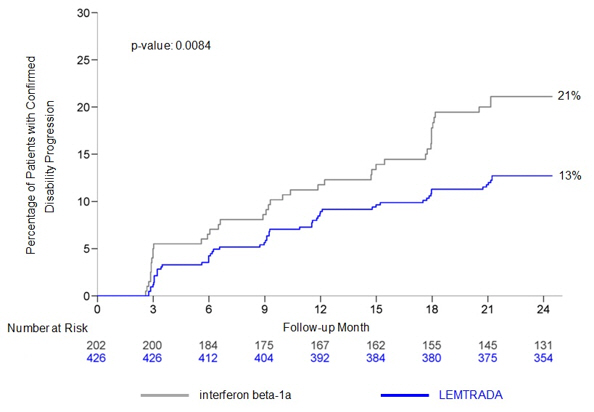
The clinical outcome measures were the annualized relapse rate (ARR) over 2 years and the time to confirmed disability progression. Confirmed disability progression was defined as at least a 1 point increase above baseline EDSS (1.5 point increase for patients with baseline EDSS of 0) sustained for 6 months. The MRI outcome measure was the change in T2 lesion volume.
The annualized relapse rate was significantly lower in patients treated with LEMTRADA than in patients who received interferon beta-1a. Time to onset of 6-month confirmed disability progression was significantly delayed with LEMTRADA treatment compared to interferon beta-1a. There was no significant difference between the treatment groups for the change in T2 lesion volume. The results of Study 1 are shown in Table 2 and Figure 1.
Table 2: Clinical and MRI Results of Study 1 | LEMTRADA
(N=426) | interferon beta-1a 44 mcg
(N=202) | p-value |
|---|
| Clinical Outcomes | |
Annualized relapse rate
Relative reduction | 0.26
49% | 0.52 | <0.0001 |
Proportion of patients with disability progression at Year 2
Relative risk reduction | 13%
42% | 21% | 0.0084 |
| Percent of patients remaining relapse-free at Year 2 | 65% | 47% | <0.0001 |
| MRI Outcomes | |
| Percent change in T2 lesion volume from baseline | -1.3 | -1.2 | 0.14 |
| Figure 1: Time to 6-month Confirmed Disability Progression (Study 1) |
|
Study 2
Study 2 was a 2-year randomized, open-label, rater-blinded, active comparator (interferon beta-1a 44 micrograms administered subcutaneously three times a week) controlled study in patients with RRMS. Patients entering Study 2 had EDSS scores of 3 or less and no prior treatment for multiple sclerosis.
Patients were randomized to receive LEMTRADA (n=376) or interferon beta-1a (n=187). At baseline, the mean age was 33 years, the mean disease duration was 2 years, and the mean EDSS score was 2.
The clinical outcome measures were the annualized relapse rate (ARR) over 2 years and the time to confirmed disability progression, as defined in Study 1. The MRI outcome measure was the change in T2 lesion volume.
The annualized relapse rate was significantly lower in patients treated with LEMTRADA than in patients who received interferon beta-1a. There was no significant difference between the treatment groups for the time to confirmed disability progression and for the primary MRI endpoint (change in T2 lesion volume). The results for Study 2 are shown in Table 3.
Table 3: Clinical and MRI Results of Study 2 | LEMTRADA | interferon beta-1a 44 mcg | p-value |
|---|
| (N=376) | (N=187) | |
|---|
| Clinical Outcomes | |
Annualized relapse rate
Relative reduction | 0.18
55% | 0.39 | <0.0001 |
Proportion of patients with disability progression at Year 2
Relative risk reduction | 8%
30% | 11% | 0.22 |
| Percent of patients remaining relapse-free at Year 2 | 78% | 59% | <0.0001 |
| MRI Outcomes | |
| Percent change in T2 lesion volume from baseline | -9.3 | -6.5 | 0.31 |
Autoimmunity
- Advise patients to contact their healthcare provider promptly if they experience any symptoms of potential autoimmune disease. Give examples of important symptoms such as bleeding, easy bruising, petechiae, purpura, hematuria, edema, jaundice, or hemoptysis [see Warnings and Precautions (5.1)].
- Advise patients of the importance of monthly blood and urine tests for 48 months following the last course of LEMTRADA to monitor for signs of autoimmunity because early detection and prompt treatment can help prevent serious and potentially fatal outcomes associated with these events. Advise patients that monitoring may need to continue past 48 months if they have signs or symptoms of autoimmunity.
- Advise patients that LEMTRADA may cause hyperthyroid or hypothyroid disorders.
- Advise patients to contact their healthcare provider if they experience symptoms reflective of a potential thyroid disorder such as unexplained weight loss or gain, fast heartbeat or palpitations, eye swelling, constipation, or feeling cold.
- Advise women of childbearing potential of the risks of pregnancy with concomitant thyroid disease. Advise women of childbearing potential to discuss pregnancy planning with their doctor.
Infusion Reactions
- Advise patients that infusion reactions can occur after they leave the infusion center [see Warnings and Precautions (5.2)].
- Instruct the patient to remain at the infusion center for 2 hours after each LEMTRADA infusion, or longer at the discretion of the physician. Advise patients that symptoms of infusion reactions may occur after they leave the infusion center and to report these symptoms to their doctor.
- Advise patients to contact their healthcare provider promptly if they experience infusion reactions, which include swelling in the mouth or throat, difficulty breathing, weakness, abnormal heart rate (fast, slow, or irregular), chest pain, and rash.
Malignancies
- Advise patients that LEMTRADA may increase their risk of malignancies including thyroid cancer and melanoma [see Warnings and Precautions (5.3)].
- Advise patients to report symptoms of thyroid cancer, including a new lump or swelling in the neck, pain in the front of the neck, hoarseness or other voice changes that do not go away, trouble swallowing or breathing, or a constant cough not due to a cold.
- Advise patients that they should have baseline and yearly skin examinations.
LEMTRADA REMS Program