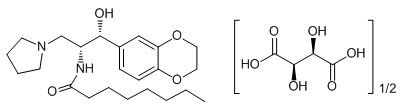
- CERDELGA is contraindicated in patients with any degree of hepatic impairment [see Contraindications (4)].
Cardiac Electrophysiology
Concentration-related increases were observed for the placebo-corrected change from baseline in the PR, QRS, and QTc intervals. At the mean peak concentration of 237 ng/mL at a dose of 800 mg eliglustat tartrate (8 times the recommended dose), CERDELGA did not prolong the QT/QTc interval to any clinically relevant extent. However, pharmacokinetic/pharmacodynamic modeling predicts mean (upper bound of the 95% one-sided confidence interval) increases in the PR, QRS, and QTcF intervals of 22 (26), 7 (10), and 13 (19) msec, respectively, at eliglustat plasma concentration of 500 ng/mL [see Warnings and Precautions (5.1)].
Absorption
The oral bioavailability of eliglustat was less than 5% in CYP2D6 EMs following a single 84 mg dose of CERDELGA.
In CYP2D6 EMs, the eliglustat pharmacokinetics is time-dependent and the systemic exposure increases in a more than dose-proportional manner over the dose range of 42 to 294 mg (0.5 to 3.5 times the recommended dosage). In addition, after multiple oral doses of 84 mg twice daily in EMs, eliglustat systemic exposure (AUC0–12) increased up to about 2-fold at steady state compared to after the first dose (AUC0–∞). The pharmacokinetics of eliglustat in CYP2D6 PMs is expected to be linear and time-independent. Compared to EMs, the systemic exposure following 84 mg twice daily at steady state is 7-fold to 9-fold higher in PMs.
Dosing of CERDELGA 84 mg once daily has not been studied in PMs. The predicted Cmax and AUC0–24hr in PMs using a physiologically based pharmacokinetic (PBPK) model with 84 mg once daily were 75 ng/mL and 956 hr∙ng/mL, respectively.
Table 7 describes the pharmacokinetic parameters for eliglustat in healthy subjects following multiple doses of 84 mg CERDELGA twice daily.
Table 7: Pharmacokinetic Parameters for Eliglustat following Multiple Doses of 84 mg CERDELGA Twice Daily| Parameter | CYP2D6 Metabolizer Status |
|---|
EMs
(n=96) | IMs
(n=1) | PMs
(n=9) |
|---|
| Cmax (ng/mL) | 12.1 (42%) to 25.0 (141%) | 44.6 | 113 (32%) to 137 (40%) |
| AUCtau (ng∙hr/mL) | 76.3 (37%) to 143 (160%) | 306 | 922 (33%) to 1057 (38%) |
| Median Tmax (hr) [min to max] | 1.5 [0.5 to 3.0] to 2 [1.5 to 2.1] | 2 | 3 [2 to 4] |
Administration of CERDELGA with a high fat meal (approximately 1000 calories with 50% calories from fat) resulted in a 15% decrease in Cmax (not clinically significant) but no change in AUC.
Distribution
Following intravenous administration, the volume of distribution of eliglustat was 835 L in EMs. Plasma protein binding of eliglustat ranges from 76% to 83%.
Elimination
Eliglustat terminal elimination half-life was approximately 6.5 hours in CYP2D6 EMs, and 8.9 hours in PMs. Following intravenous administration of 42 mg (0.5 times the recommended oral dose) in healthy subjects, the mean (range) of eliglustat total body clearance was 88 L/h (80 to 105 L/h) in EMs.
Metabolism
CERDELGA is primarily metabolized by CYP2D6 and to a lesser extent by CYP3A4.
Excretion
After oral administration of radiolabeled eliglustat, the majority of the administered dose is excreted in urine (42%) and feces (51%), mainly as metabolites.
Specific Populations
No clinically significant differences in the pharmacokinetics of eliglustat were observed based on age (18 to 71 years), sex, race (mostly were Caucasian, including those of Ashkenazi Jewish descent; however, it included the following populations: African American, American Indians, Hispanics, and Asians), or body weight (41 to 136 kg).
Patients with renal impairment
Eliglustat pharmacokinetics was similar in CYP2D6 EMs with severe renal impairment and healthy CYP2D6 EMs. Eliglustat pharmacokinetics in EMs with ESRD and in IMs or PMs with any degree of renal impairment is unknown [see Use in Specific Populations (8.6)].
Patients with hepatic impairment
Table 8 describes the effect of mild and moderate hepatic impairment on the pharmacokinetics of eliglustat in CYP2D6 EMs compared to EMs with normal hepatic function following a single 84 mg dose. The effect of hepatic impairment is highly variable with the coefficients of variation (CVs%) of 135% and 110% for Cmax and 171% and 121% for AUC in CYP2D6 EMs with mild and moderate hepatic impairment, respectively.
Table 8: Effect of Hepatic Impairment on Eliglustat Pharmacokinetics following a Single Dose of 84 mg CERDELGA in CYP2D6 EMs | Mild Hepatic Impairment (n=6) | Moderate Hepatic Impairment (n=7) |
|---|
| Cmax | ↑ 1.2-fold | ↑ 2.8-fold |
| AUC | ↑ 1.2-fold | ↑ 5.2-fold |
Steady-state pharmacokinetics of eliglustat in CYP2D6 IMs and PMs with mild and moderate hepatic impairment is unknown. The effect of severe hepatic impairment in subjects with any CYP2D6 phenotype is unknown [see Use in Specific Populations (8.7)].
Drug Interaction Studies
Effect of other drugs on CERDELGA
Table 9 describes the effect of drug interactions on the pharmacokinetics of eliglustat [see Drug Interactions (7.1)].
Table 9: Drug Interactions Affecting Eliglustat Concentrations| Concomitant Drug(s) | CYP2D6 Metabolizer Status |
|---|
| EMs | IMs | PMs |
|---|
| Cmax | AUCtau | Cmax | AUCtau | Cmax | AUCtau |
|---|
| ↑ = Increased; ↓ = Decreased |
| CYP2D6 Inhibitor |
Paroxetine
(strong) | ↑ 7.0-fold | ↑ 8.4-fold | ↑ 2.1-fold | ↑ 2.3-fold | No increase expected |
Terbinafine
(moderate) | ↑ 3.8-fold | ↑ 4.5-fold | ↑ 1.6-fold |
| CYP3A Inhibitor |
Ketoconazole
(strong) | ↑ 4.0-fold | ↑ 4.4-fold | ↑ 4.4-fold | ↑ 5.4-fold | ↑ 4.3-
fold, | ↑ 6.2-
fold, |
Fluconazole
(moderate) | ↑ 2.8-fold | ↑ 3.2-fold | ↑ 2.5-fold | ↑ 2.9-fold | ↑ 2.4-
fold, | ↑ 3.0-
fold, |
| CYP2D6 Inhibitors Concomitantly with CYP3A Inhibitors |
| Paroxetine with ketoconazole | ↑ 16.7-fold | ↑ 24.2-fold | ↑ 7.5-fold | ↑ 9.8-fold | Expected similar increase as with CYP3A inhibitors alone |
| Terbinafine with fluconazole | ↑ 10.2-fold | ↑ 13.6-fold | ↑ 4.2-fold | ↑ 5.0-fold |
| CYP3A Inducers |
Rifampin
(strong) | ↓ 90% | ↓ 95% |
No clinically significant pharmacokinetic changes were observed for eliglustat when coadministered with intravenous rifampin (an OATP inhibitor), or gastric pH modifying drugs (e.g., aluminum hydroxide, magnesium hydroxide, calcium carbonate, pantoprazole).
In vitro, eliglustat is a substrate of P-glycoprotein (P-gp). The effect of P-gp inhibitors on eliglustat pharmacokinetics is unknown.
Effect of CERDELGA on other drugs
CYP2D6 substrates
Following multiple doses of CERDELGA 127 mg twice daily (1.5 times the recommended dosage), metoprolol (a CYP2D6 substrate) mean Cmax and AUC increased by 1.7-fold and 2.3-fold in CYP2D6 EMs, respectively, and by 1.2-fold and 1.6-fold in IMs, respectively [see Drug Interactions (7.2)].
P-gp substrates
Following multiple doses of CERDELGA 127 mg twice daily (1.5 times the recommended dosage) in CYP2D6 EMs and IMs, or 84 mg twice daily in PMs, digoxin (a P-gp substrate) mean Cmax increased by 1.7-fold and AUC increased by 1.5-fold [see Drug Interactions (7.2)].
Oral contraceptives
Repeated doses of CERDELGA 84 mg twice daily did not change the exposures to norethindrone (1.0 mg) and ethinyl estradiol (0.035 mg).
Carcinogenesis
Carcinogenic potential of CERDELGA was assessed in 2-year carcinogenicity studies in rats and mice. In Sprague-Dawley rats, eliglustat was administered by oral gavage at doses up to 75 mg/kg/day in males (about 3.6 times the recommended human daily dose of 84 mg twice daily, based on body surface area) and 50 mg/kg/day in females (about 2.4 times the recommended human daily dose based on body surface area). In CD-1 mice, eliglustat was administered to males and females at up to 75 mg/kg/day (about 1.8 times the recommended human daily dose based on body surface area) via dietary admixture. Eliglustat did not produce any treatment-related neoplasms in rats or mice.
Mutagenesis
Eliglustat was negative in the Ames test, chromosome aberration test in human peripheral blood lymphocytes, mouse lymphoma gene mutation assay and in vivo oral mouse micronucleus test.
Impairment of Fertility
In a fertility and early embryonic development study in rats, eliglustat increased pre-implantation loss at 30 (about 1.5 times the recommended human oral dose based on body surface area) and 100 mg/kg/day (about 5 times the recommended human oral dose based on body surface area).
In mature male rats, eliglustat showed reversible adverse effects on sperm morphology, testes (germ cell necrosis), and sloughed cells in the epididymis at 200 mg/kg/day (about 10 times the recommended human oral dose based on body surface area). Similar effects on sperm were not seen in mature cynomolgus monkeys at 72 mg/kg/day (about 7 times the recommended human oral dose based on body surface area).
Drug Interactions
Advise patients to discuss all the medications they are taking, including any herbal supplements or vitamins with their healthcare provider [see Contraindications (4), Warnings and Precautions (5), Drug Interactions (7)].
ECG Changes and Potential for Cardiac Arrhythmias
Advise patients to inform their healthcare provider of the following: history of congestive heart failure; recent acute myocardial infarction; bradycardia; heart block; ventricular arrhythmia; and long QT syndrome [see Warnings and Precautions (5.1)].
Advise patients to inform their healthcare provider if they develop new symptoms such as palpitations, fainting, and dizziness.
Administration Instructions
[See Dosage and Administration (2.4).]
Advise patients:
- Swallow capsules whole, preferably with water, and do not crush, dissolve, or open the capsules.
- CERDELGA can be taken with or without food.
- If a dose of CERDELGA is missed, take the prescribed dose at the next scheduled time; do not double the next dose.
- Avoid consumption of grapefruit or its juice.
- For patients currently treated with imiglucerase, velaglucerase alfa, or taliglucerase alfa, CERDELGA may be administered 24 hours after the last dose of the previous enzyme replacement therapy (ERT).
Manufactured by:
Genzyme Ireland, Ltd.,
IDA Industrial Park,
Old Kilmeaden Road,
Waterford, Ireland.
CERDELGA is a registered trademark of Genzyme Corporation.