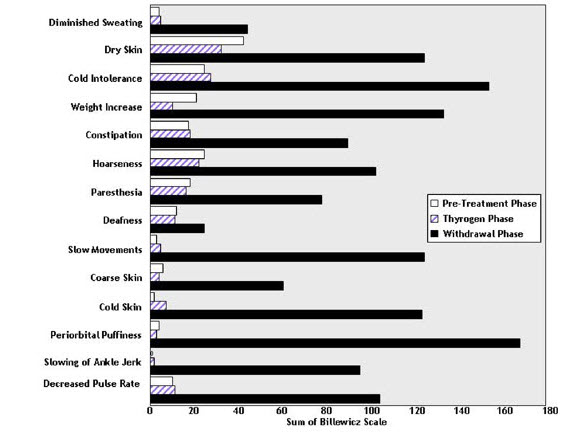
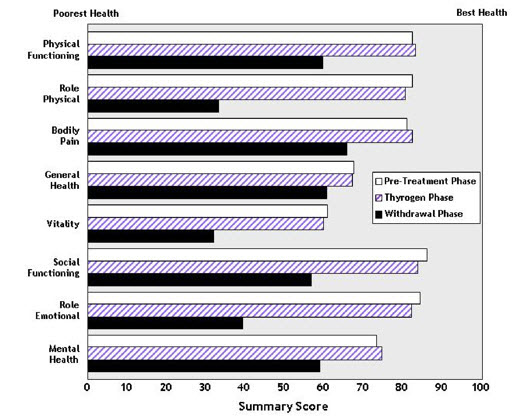
A randomized, prospective clinical trial compared the rates of thyroid remnant ablation achieved after preparation of patients with thyroid hormone withdrawal or THYROGEN. Patients (n = 63) with low-risk, well-differentiated thyroid cancer who underwent near-total thyroidectomy were made euthyroid after surgery by receiving thyroid hormone replacement and were subsequently randomized to a thyroid hormone withdrawal or THYROGEN. Patients in the THYROGEN group received THYROGEN 0.9 mg IM daily on 2 consecutive days and radioiodine 24 hours after the second dose of THYROGEN. Patients in the thyroid hormone withdrawal group had the thyroid replacement withheld until they became hypothyroid. Patients in both groups received 100 mCi 131I ± 10% with the intent to ablate any thyroid remnant tissue. The primary endpoint of the study, was the rate of successful ablation, and was assessed 8 months later by a THYROGEN-stimulated radioiodine scan. Patients were considered successfully ablated if there was no visible thyroid bed uptake on the scan, or if visible, uptake was less than 0.1%. Table 3 summarizes the results of this evaluation.
Table 3: Remnant Ablation in Clinical Trial of Patients with Well-Differentiated Thyroid Cancer| Group 60 per protocol patients with interpretable scan data.
95% CI for difference in ablation rates THYROGEN minus Thyroid Hormone Withdrawal, = 7% to 27%. | Mean Age
(Yr) | Gender
(F:M) | Cancer Type
(Pap:Fol) | Ablation Criterion
(Measure at 8 Months) |
|---|
| Abbreviations: fol = follicular, pap = papillary |
| | | | Thyroid Bed Activity <0.1% | No Visible Thyroid Bed Activity Interpretation by 2 of 3 reviewers.
95% CI for difference in ablation rates, THYROGEN minus Thyroid Hormone Withdrawal, = -31% to 9%. |
Thyroid Hormone Withdrawal
(N=28) | 43 | 24:6 | 29:1 | 28/28 (100%) | 24/28 (86%) |
THYROGEN
(N=32) | 44 | 26:7 | 30:3 | 32/32 (100%) | 24/32 (75%) |
The mean radiation dose to blood was 0.266±0.061 mGy/MBq in the THYROGEN group and 0.395±0.135 mGy/MBq in the thyroid hormone withdrawal group. Radioiodine residence time in remnant tissue was 0.9±1.3 hours in the THYROGEN group and 1.4±1.5 hours in the thyroid hormone withdrawal group. It is not known whether this difference in radiation exposure would convey a clinical benefit.
Patients who completed were followed up for a median duration of 3.7 years (range 3.4 to 4.4 years) following radioiodine ablation. Tg testing was also performed. The main objective of the follow-up study was to evaluate the status of thyroid remnant ablation by using THYROGEN-stimulated neck imaging. Of the fifty-one patients enrolled, forty eight patients received THYROGEN for remnant neck/whole body imaging and/or thyroglobulin testing. Only 43 patients had imaging. Patients were still considered to be successfully ablated if there was no visible thyroid bed uptake on the scan, or if visible, uptake was less than 0.1%. All patients from both original treatment groups who had scanning were found to still be ablated. Of 37 patients who were Tg–antibody negative, 16/17 (94%) of patients in the former thyroid hormone withdrawal group and 19/20 (95%) of patients in the former THYROGEN group maintained successful ablation measured as stimulated serum Tg levels of <2 ng/mL.
No patient had a definitive cancer recurrence during the 3.7 years of follow-up. Overall, 48/51 patients (94%) had no evidence of cancer recurrence, 1 patient had possible cancer recurrence (although it was not clear whether this patient had a true recurrence or persistent tumor from the regional disease noted at the start of the initial study), and 2 patients could not be assessed.
Two large prospective multi-center randomized studies compared THYROGEN to thyroid hormone withdrawal using two different doses of radioactive iodine in patients with differentiated thyroid cancer who had been thyroidectomized. In both studies, patients were randomized to 1 of 4 treatment groups: THYROGEN + 30 mCi 131I, THYROGEN + 100 mCi 131I, thyroid hormone withdrawal + 30 mCi 131I, or thyroid hormone withdrawal + 100 mCi 131I. Patients were assessed for efficacy (ablation success rates) at approximately 8 months.
The first study (Study A) randomized 438 patients (tumor stages T1-T3, Nx, N0 and N1, M0). Ablation success was defined as radioiodine uptake of <0.1% in the thyroid bed and stimulated thyroglobulin levels of < 2.0 ng/mL.
The second study (Study B) randomized 752 patients with low-risk thyroid cancer (tumor stages pT1 < 1 cm and N1 or Nx, pT1 >1-2 cm and any N stage, or pT2 N0, all patients M0). Ablation success was defined by neck ultrasound and stimulated thyroglobulin of ≤ 1.0 ng/mL.
Results for both trials are summarized below.
Table 4: Successful Remnant Ablation Rates in Study A | THYROGEN | Thyroid Hormone Withdrawal | Total |
|---|
95% CI of difference in ablation rate (low-dose minus high dose): -10.2% to 2.6%
95% CI of difference in ablation rate (THYROGEN - Thyroid Hormone Withdrawal): -6.0% to 6.8% |
| Low-dose radioiodine | 91/108
(84.3%) | 91/106
(85.8%) | 182/214
(85.0%) |
| High-dose Radioiodine | 92/102
(90.2%) | 92/105
(87.6%) | 184/207
(88.9%) |
| Total | 183/210
(87.1%) | 183/211
(86.7%) | 366/421
(86.9%) |
Table 5: Successful Remnant Ablation Rates in Study B | THYROGEN | Thyroid Hormone Withdrawal | Total |
|---|
95% CI of difference in ablation rate (low-dose minus high dose): -5.8% to 0.9%
95% CI of difference in ablation rate (THYROGEN minus Thyroid Hormone Withdrawal): -4.5% to 2.2% |
| Low-dose radioiodine | 160/177
(90.4%) | 156/170
(91.8%) | 316/347
(91.1%) |
| High-dose Radioiodine | 159/171
(93.0%) | 156/166
(94.0%) | 315/337
(93.5%) |
| Total | 319/348
(91.6%) | 312/336
(92.9%) | 631/684
(92.3%) |