General
Prior to initiating therapy with finasteride, appropriate evaluation should be performed to identify other conditions such as infection, prostate cancer, stricture disease, hypotonic bladder or other neurogenic disorders that might mimic BPH.
Patients with large residual urinary volume and/or severely diminished urinary flow should be carefully monitored for obstructive uropathy. These patients may not be candidates for finasteride therapy.
Caution should be used in the administration of finasteride in those patients with liver function abnormalities, as finasteride is metabolized extensively in the liver.
Effects on PSA and Prostate Cancer Detection
No clinical benefit has been demonstrated in patients with prostate cancer treated with finasteride. Patients with BPH and elevated PSA were monitored in controlled clinical studies with serial PSAs and prostate biopsies. In these BPH studies, finasteride did not appear to alter the rate of prostate cancer detection, and the overall incidence of prostate cancer was not significantly different in patients treated with finasteride or placebo.
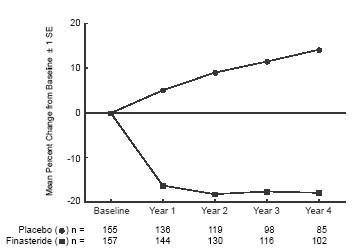
Finasteride causes a decrease in serum PSA levels by approximately 50% in patients with BPH. This decrease is predictable over the entire range of PSA values, although it may vary in individual patients. Analysis of PSA data from over 3000 patients in a long-term efficacy and safety study confirmed that in typical patients treated with finasteride for six months or more, PSA values should be doubled for comparison with normal ranges in untreated men. This adjustment preserves the sensitivity and specificity of the PSA assay and maintains its ability to detect prostate cancer. Finasteride may also cause decreases in serum PSA in the presence of prostate cancer.
Any confirmed increases in PSA levels from nadir while on finasteride may signal the presence of prostate cancer and should be carefully evaluated, even if those values are still within the normal range for men not taking a 5α-reductase inhibitor. Non-compliance with finasteride therapy may also affect PSA test results.
Percent free PSA (free to total PSA ratio) is not significantly decreased by finasteride. The ratio of free to total PSA remains constant even under the influence of finasteride. If clinicians elect to use percent free PSA as an aid in the detection of prostate cancer in men undergoing finasteride therapy, no adjustment to its value appears necessary.
Information for Patients
Women should not handle crushed or broken finasteride tablets USP, 5 mg when they are pregnant or may potentially be pregnant because of the possibility of absorption of finasteride and the subsequent potential risk to the male fetus (see CONTRAINDICATIONS; WARNINGS, EXPOSURE OF WOMEN — RISK TO MALE FETUS; PRECAUTIONS, Pregnancy and HOW SUPPLIED).
Physicians should inform patients that the volume of ejaculate may be decreased in some patients during treatment with finasteride. This decrease does not appear to interfere with normal sexual function. However, impotence and decreased libido may occur in patients treated with finasteride (see ADVERSE REACTIONS).
Physicians should instruct their patients to promptly report any changes in their breasts such as lumps, pain or nipple discharge. Breast changes including breast enlargement, tenderness and neoplasm have been reported (see ADVERSE REACTIONS).
Physicians should instruct their patients to read the patient package insert before starting therapy with finasteride and to reread it each time the prescription is renewed so that they are aware of current information for patients regarding finasteride.
Drug/Laboratory Test Interactions
In patients with BPH, finasteride has no effect on circulating levels of cortisol, estradiol, prolactin, thyroid-stimulating hormone, or thyroxine. No clinically meaningful effect was observed on the plasma lipid profile (i.e., total cholesterol, low density lipoproteins, high density lipoproteins and triglycerides) or bone mineral density. Increases of about 10% were observed in luteinizing hormone (LH) and follicle-stimulating hormone (FSH) in patients receiving finasteride, but levels remained within the normal range. In healthy volunteers, treatment with finasteride did not alter the response of LH and FSH to gonadotropin-releasing hormone indicating that the hypothalamic-pituitary-testicular axis was not affected.
Treatment with finasteride for 24 weeks to evaluate semen parameters in healthy male volunteers revealed no clinically meaningful effects on sperm concentration, mobility, morphology, or pH. A 0.6 mL (22.1%) median decrease in ejaculate volume with a concomitant reduction in total sperm per ejaculate was observed. These parameters remained within the normal range and were reversible upon discontinuation of therapy with an average time to return to baseline of 84 weeks.
Drug Interactions
No drug interactions of clinical importance have been identified. Finasteride does not appear to affect the cytochrome P450-linked drug metabolizing enzyme system. Compounds that have been tested in man have included antipyrine, digoxin, propranolol, theophylline, and warfarin and no clinically meaningful interactions were found.
Other Concomitant Therapy: Although specific interaction studies were not performed, finasteride was concomitantly used in clinical studies with acetaminophen, acetylsalicylic acid, α-blockers, angiotensin-converting enzyme (ACE) inhibitors, analgesics, anti-convulsants, beta-adrenergic blocking agents, diuretics, calcium channel blockers, cardiac nitrates, HMG-CoA reductase inhibitors, nonsteroidal anti-inflammatory drugs (NSAIDs), benzodiazepines, H2 antagonists and quinolone anti-infectives without evidence of clinically significant adverse interactions.
Carcinogenesis, Mutagenesis, Impairment of Fertility
No evidence of a tumorigenic effect was observed in a 24-month study in Sprague-Dawley rats receiving doses of finasteride up to 160 mg/kg/day in males and 320 mg/kg/day in females. These doses produced respective systemic exposure in rats of 111 and 274 times those observed in man receiving the recommended human dose of 5 mg/day. All exposure calculations were based on calculated AUC(0 to 24 hr) for animals and mean AUC(0 to 24 hr) for man (0.4 mcg•hr/mL).
In a 19-month carcinogenicity study in CD-1 mice, a statistically significant (p≤0.05) increase in the incidence of testicular Leydig cell adenomas was observed at a dose of 250 mg/kg/day (228 times the human exposure). In mice at a dose of 25 mg/kg/day (23 times the human exposure, estimated) and in rats at a dose of ≥40 mg/kg/day (39 times the human exposure) an increase in the incidence of Leydig cell hyperplasia was observed. A positive correlation between the proliferative changes in the Leydig cells and an increase in serum LH levels (2- to 3-fold above control) has been demonstrated in both rodent species treated with high doses of finasteride. No drug-related Leydig cell changes were seen in either rats or dogs treated with finasteride for 1 year at doses of 20 mg/kg/day and 45 mg/kg/day (30 and 350 times, respectively, the human exposure) or in mice treated for 19 months at a dose of 2.5 mg/kg/day (2.3 times the human exposure, estimated).
No evidence of mutagenicity was observed in an invitro bacterial mutagenesis assay, a mammalian cell mutagenesis assay, or in an in vitro alkaline elution assay. In an invitro chromosome aberration assay, using Chinese hamster ovary cells, there was a slight increase in chromosome aberrations. These concentrations correspond to 4000 to 5000 times the peak plasma levels in man given a total dose of 5 mg. In an invivo chromosome aberration assay in mice, no treatment-related increase in chromosome aberration was observed with finasteride at the maximum tolerated dose of 250 mg/kg/day (228 times the human exposure) as determined in the carcinogenicity studies.
In sexually mature male rabbits treated with finasteride at 80 mg/kg/day (543 times the human exposure) for up to 12 weeks, no effect on fertility, sperm count, or ejaculate volume was seen. In sexually mature male rats treated with 80 mg/kg/day of finasteride (61 times the human exposure), there were no significant effects on fertility after 6 or 12 weeks of treatment; however, when treatment was continued for up to 24 or 30 weeks, there was an apparent decrease in fertility, fecundity and an associated significant decrease in the weights of the seminal vesicles and prostate. All these effects were reversible within 6 weeks of discontinuation of treatment. No drug-related effect on testes or on mating performance has been seen in rats or rabbits. This decrease in fertility in finasteride-treated rats is secondary to its effect on accessory sex organs (prostate and seminal vesicles) resulting in failure to form a seminal plug. The seminal plug is essential for normal fertility in rats and is not relevant in man.