The most common adverse reactions (≥5% and greater than placebo) in the double-blind clinical trials were:
- Pediatric Patients Aged 6 to 12 Years: rash, decreased appetite (see Table 2).
- Pediatric Patients Aged 13 to 17 Years: decreased appetite, nausea, rash, headache, abdominal pain (see Table 3).
- Adults: headache, decreased appetite, insomnia, nausea, dry mouth, diarrhea (see Table 4).
The most common adverse reactions associated with discontinuation (≥1%) in the pediatric and adult double-blind clinical trials were rash, decreased appetite, nausea, and somnolence.
Adverse Reactions in Pediatric Patients 6 Years of Age and Older
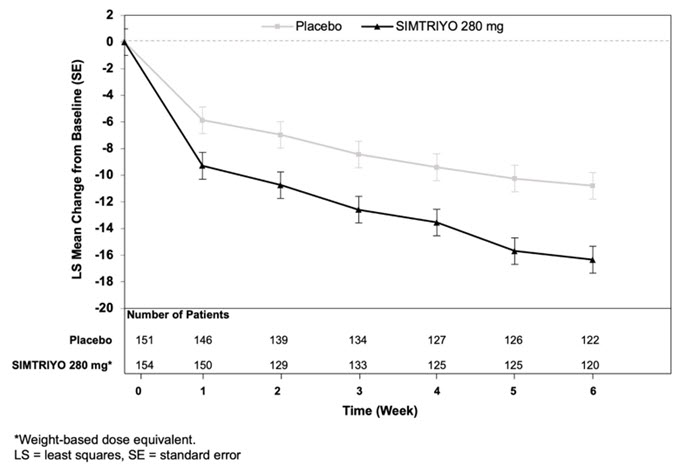
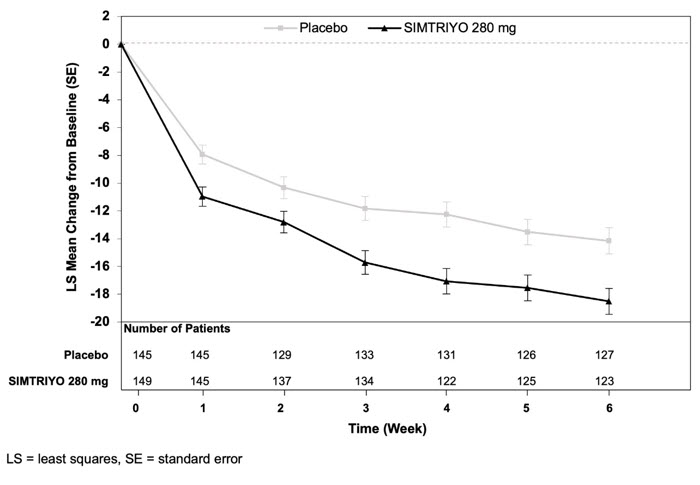
The safety data below are from pediatric patients aged 6 to 17 years in Studies 1 and 2 who received SIMTRIYO 280 mg (or weight-based equivalent) once daily [see Clinical Studies (14)].
Table 2 presents adverse reactions reported in 2% or more of SIMTRIYO-treated pediatric patients aged 6 to 12 years and more frequently than placebo-treated patients in Study 1.
Table 2: Adverse Reactions in ≥2% of Pediatric Patients 6 to 12 Years of Age Treated with SIMTRIYO and Greater than Placebo in 6-Week Placebo-Controlled ADHD Study (Study 1) | Placebo
(N=153) | SIMTRIYO
High doseWeight-based equivalent dose (targeting adult exposures at 280 mg/day) [see Dosage and Administration (2.2)]
(N=157) |
|---|
| Rash Rash includes: drug eruption, macular rash, maculo-papular rash, morbilliform rash, papular rash, and other related terms | 0% | 9% |
| Decreased appetite | 3% | 8% |
| Fatigue Fatigue includes: lethargy | 0% | 4% |
| Abdominal pain Abdominal pain includes: upper abdominal pain, abdominal discomfort | 2% | 4% |
| Nausea | 1% | 3% |
| Pharyngitis streptococcal | 2% | 3% |
| Diarrhea | 0% | 2% |
| Influenza | 0% | 2% |
Table 3 presents adverse reactions reported in 2% or more of SIMTRIYO-treated pediatric patients aged 13 to 17 years and more frequently than placebo-treated patients in Study 2.
Table 3: Adverse Reactions in ≥2% of Pediatric Patients 13 to 17 Years of Age Treated with SIMTRIYO and Greater than Placebo in 6-Week Placebo-Controlled ADHD Study (Study 2) | Placebo
(N=147) | SIMTRIYO
280 mg/day
(N=151) |
|---|
| Decreased appetite | 2% | 15% |
| Nausea | 3% | 10% |
| Rash Rash includes: drug eruption, macular rash, maculo-papular rash, morbilliform rash, papular rash, and other related terms. | 1% | 8% |
| Headache Headache includes: migraine | 6% | 7% |
| Abdominal pain Abdominal pain includes: abdominal discomfort, upper abdominal pain, abdominal tenderness, gastrointestinal pain; lower abdominal pain | 0% | 5% |
| Somnolence Somnolence includes: sedation | 3% | 4% |
| Fatigue Fatigue includes: lethargy | 1% | 3% |
| Dizziness | 0% | 3% |
| Nasopharyngitis | 1% | 3% |
| Insomnia Insomnia includes: initial insomnia | 1% | 3% |
| Irritability | 1% | 3% |
| Dry mouth | 0% | 2% |
| Weight decreased | 1% | 2% |
Adverse Reactions in Adults
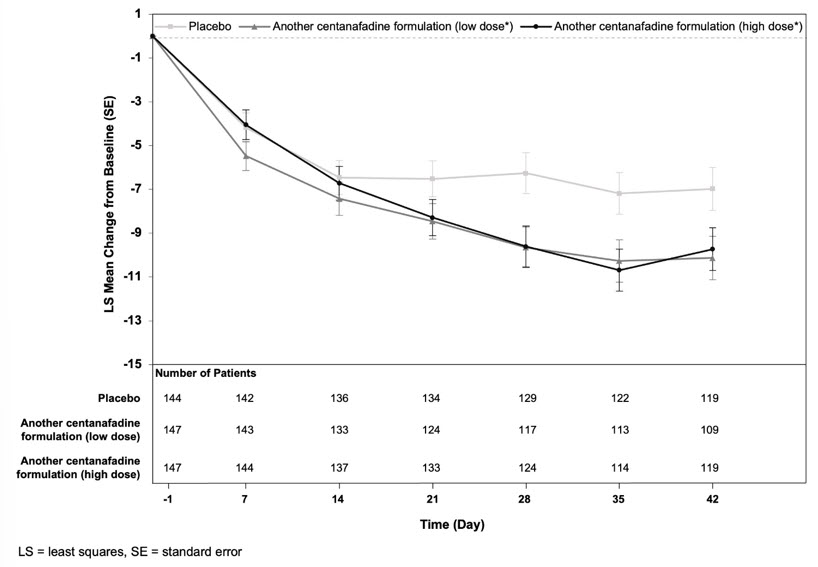
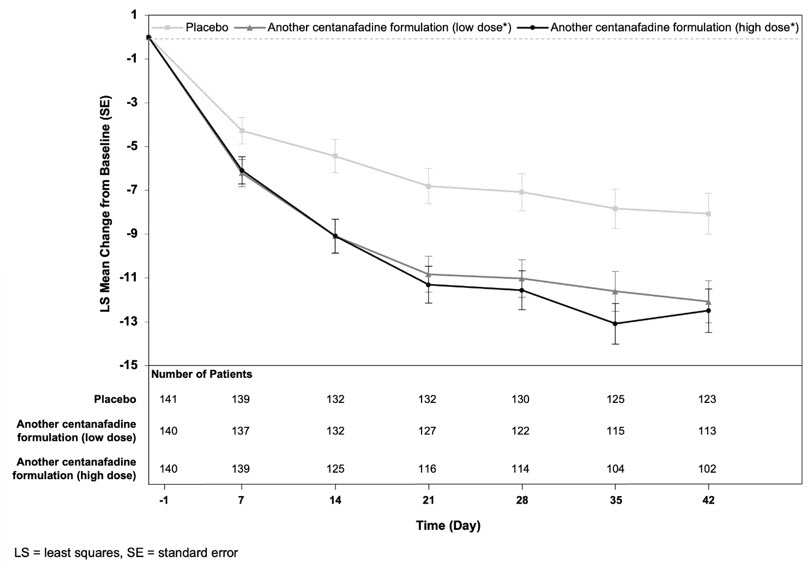
The safety data below are based on pooled data from Studies 3 and 4 in adult patients with ADHD treated with another formulation of centanafadine for 6 weeks [see Clinical Studies (14)].
Table 4 lists adverse reactions reported in ≥2% of adult patients treated with another formulation of centanafadine and more frequently than placebo-treated patients.
Table 4: Adverse Reactions in ≥2% of Adults Treated with Another Centanafadine Formulation and Greater than Placebo in 6-Week Placebo-Controlled ADHD Studies (Studies 3 and 4) | | Another Centanafadine Formulation | Another Centanafadine Formulation |
|---|
| Placebo
(N=290) | Low Dose There are no expected differences in the safety of SIMTRIYO 210 mg and 280 mg once daily compared to the low and high doses of the other centanafadine formulation, respectively, for the treatment of ADHD in adults.
(N=294) | High Dose
(N=292) |
|---|
| Headache Headache includes: cervicogenic headache, migraine with aura, migraine without aura, sinus headache, head discomfort, tension headache, migraine, and other related terms | 7% | 5% | 8% |
| Decreased appetite | 2% | 5% | 7% |
| Insomnia Insomnia includes: initial insomnia, middle insomnia, poor quality sleep, terminal insomnia, and other related terms. | 4% | 5% | 7% |
| Nausea | 2% | 2% | 7% |
| Dry mouth | 0% | 3% | 6% |
| Diarrhea | 1% | 2% | 5% |
| Irritability | 2% | 3% | 4% |
| Rash Rash includes: erythematous rash, maculo-papular rash, morbilliform rash, papular rash, pruritic rash, and other related terms. | 2% | 2% | 4% |
| Abdominal pain Abdominal pain includes: abdominal discomfort, upper abdominal pain, lower abdominal pain, abdominal tenderness, gastrointestinal pain, and other related terms. | 1% | 2% | 4% |
| Parasomnia Parasomnia includes: abnormal dreams, sleep terror, nightmare, somnambulism, and other related terms. | 1% | 1% | 3% |
| Tachycardia Tachycardia includes: sinus tachycardia, supraventricular tachycardia, postural orthostatic tachycardia syndrome, increased orthostatic heart rate response, increased heart rate, and other related terms. | 1% | 1% | 2% |
| Depressed mood Depressed mood includes: depressive symptom, depression, major depressive disorder, major depression, dysphoria, and other related terms. | 0% | 3% | 2% |
| Anxiety Anxiety includes: nervousness, panic attack, and other related terms. | 1% | 2% | 2% |
| Upper respiratory tract infection | 2% | 5% | 2% |
Adverse Reactions Associated with Discontinuation
Pediatric Patients 6 to 12 Years of Age
In Study 1, 6% (10/157) of SIMTRIYO-treated patients aged 6 to 12 years discontinued due to adverse reactions versus 1% (2/153) of placebo-treated patients. The most frequently reported adverse reaction associated with discontinuation (1% or more and twice rate of placebo) was rash (2.5%).
Pediatric Patients 13 to 17 Years of Age
In Study 2, 8% (12/151) of SIMTRIYO-treated patients aged 13 to 17 years discontinued due to adverse reactions versus 0% (0/147) of placebo-treated patients. The most frequently reported adverse reactions (1% or more and twice rate of placebo) associated with discontinuation were rash (2%), decreased appetite (2%), nausea (2%), and somnolence (1%).
Adults
In Studies 3 and 4, 6% (18/292) of adult patients treated with the high dose of another formulation of centanafadine discontinued due to adverse reactions versus 5% (14/294) of patients treated with the low dose and 1% (4/290) of placebo-treated patients. The most frequently reported adverse reaction associated with discontinuation (1% or more and twice rate of placebo) was rash (2%).
Suicidal Ideation and Behavior
Pediatric Patients Aged 6 Years and Older
In the 6-week study in pediatric patients aged 6 to 12 years (Study 1), suicide attempt was reported in 0.7% (2/304) of SIMTRIYO-treated patients versus 0% in placebo (0/153). In the long-term open-label trial in pediatric patients aged 6 to 17 years, suicidal ideation was reported in 0.8% (5/620) of patients, leading to discontinuation in 0.6% (4/620).
Increases in Blood Pressure and Heart Rate
Pediatric Patients 6 to 12 Years of Age
Compared to placebo, short-term (6-week) treatment (Study 1) with SIMTRIYO in patients 6 to 12 years of age was associated with differences, ranging from +0.1 to +2.8 mmHg, in the mean absolute change from baseline systolic blood pressure (SBP) and with differences, ranging from -0.2 mmHg to +1.6 mmHg, in the mean absolute change from baseline diastolic blood pressure (DBP).
Patients enrolled in the long-term open-label study had mean absolute changes in baseline SBP ranging from +0.7 to +2.7 mmHg and in baseline DBP ranging from +0.5 to +2.8 mmHg through Week 88.
Pediatric Patients 13 to 17 Years of Age
During the 6-week trial (Study 2), the proportion of SIMTRIYO-treated patients 13 to 17 years of age who developed new-onset hypertension was 10.7% compared to 8.9% treated with placebo. Compared to placebo, short-term (6-week) treatment with SIMTRIYO in patients 13 to 17 years of age was associated with differences, ranging from +0.5 to +2.1 mmHg, in the mean absolute change from baseline SBP and with differences, ranging from +0.6 mmHg to +1.5 mmHg, in the mean absolute change from baseline DBP.
Patients enrolled in the long-term open-label study had mean absolute changes in baseline SBP ranging from +0.9 to +3.2 mmHg and in baseline DBP ranging from +1.7 to +3.1 mmHg through Week 88.
Adults
In Studies 3 and 4 in adults (18 to 55 years of age), increases in heart rate ≥20 beat per minute (bpm) in supine position at any visit occurred in 15% (44/292) of patients on the high dose of another formulation of centanafadine and 12% (34/294) on the low dose, versus 11% (32/290) on placebo. Increases in systolic blood pressure of ≥20 mmHg in supine position at any visit occurred in 9% (25/292) of patients treated with the high dose of another centanafadine formulation and 12% (36/294) of patients treated with the low dose, versus 7% (21/290) on placebo.
Psychiatric Adverse Reactions
Pediatric Patients 6 to 12 Years of Age
In Study 1, psychiatric adverse reactions occurring in <2% of SIMTRIYO-treated patients receiving the weight-based dose equivalent of 280 mg daily and greater than placebo included suicide attempt and insomnia. In a long-term open-label safety study, psychiatric adverse reactions led to discontinuation of SIMTRIYO in 2% of pediatric patients 6 to 12 years of age. Psychiatric adverse reactions leading to discontinuation included irritability, auditory hallucination, visual hallucination, major depression, altered mood, and suicidal ideation.
Pediatric Patients 13 to 17 Years of Age
In Study 2, psychiatric adverse reactions occurred in 9% of patients receiving 280 mg daily of SIMTRIYO compared with 3% of patients who received placebo. Irritability and insomnia were the most common psychiatric adverse reactions in this age group (see Table 3). Irritability occurred in 3% of patients receiving 280 mg SIMTRIYO compared with 1% of patients receiving placebo. Insomnia occurred in 3% of patients receiving 280 mg SIMTRIYO compared with 1% of patients receiving placebo. In a long-term open-label pediatric safety study, psychiatric adverse reactions led to discontinuation in 4% of pediatric patients 13 to 17 years of age. Psychiatric adverse reactions leading to discontinuation included suicidal ideation, depression, irritability, apathy, aggression, anxiety, defiant behavior, and feelings of worthlessness.
Adults
In Studies 3 and 4, psychiatric adverse reactions occurred in 16% of patients receiving the high dose of another centanafadine formulation, 14% of patients receiving the low dose, and 8% of patients receiving placebo. The most frequent psychiatric adverse reactions were insomnia, irritability, abnormal dreams, depressed mood, and anxiety (see Table 4). In a long-term open-label study in adults, 21% of patients experienced psychiatric adverse reactions. The most common psychiatric adverse reactions were insomnia (8%), anxiety (6%), and irritability (3%).
Hypersensitivity Reactions
In two other ADHD clinical trials, and one trial in an unapproved population, two adult patients reported angioedema, and one patient reported suspected anaphylactic reaction, some of these events required urgent treatment as outpatients.
Effects on Growth in Pediatric Patients 6 Years of Age and Older
Pediatric Patients 6 to 12 Years of Age
The mean baseline BMI in SIMTRIYO-treated patients 6 to 12 years of age compared to placebo was 20.4 kg/m2 and 20.0 kg/m2, respectively. Short-term (6-week) treatment (Study 1) with SIMTRIYO was associated with a mean change from baseline weight of -0.6 kg compared to +0.8 kg in placebo-treated patients at Week 6. The mean baseline weight z-score decreased by at least 0.5 in 0.8% of SIMTRIYO-treated patients compared to none in placebo-treated patients at Week 6. The mean baseline BMI z-score decreased by at least 0.5 in 7.3% of SIMTRIYO-treated patients compared to 3.2% of placebo-treated patients at Week 6.
In the SIMTRIYO long-term open-label study, 2.2% of patients had a change from baseline weight leading to a decrease in weight z-score by at least 1, 2.2% had a decrease in BMI z-score by at least 1, and 15.6% had a decrease in height z-score by at least 1 at Week 88.
Pediatric Patients 13 to 17 Years of Age
The mean baseline BMI in both SIMTRIYO- and placebo-treated patients 13 to 17 years of age was 24.4 kg/m2; however, placebo-treated patients had higher mean baseline weight (69 kg vs. 67.7 kg) and height (167.7 cm vs. 166.7 cm). Short-term (6-week) treatment (Study 2) with SIMTRIYO was associated with a mean change from baseline weight of -1.2 kg compared to +0.6 kg in placebo-treated patients at Week 6. The mean baseline weight z score decreased by at least 0.5 in 2% of SIMTRIYO-treated patients compared to none in placebo-treated patients at Week 6. The mean baseline BMI z-score decreased by at least 0.5 in 4.9% of SIMTRIYO-treated patients compared to none in placebo-treated patients at Week 6. In the SIMTRIYO long-term open-label study, 4.6% of patients had a change from baseline weight leading to a decrease in weight z-score by at least 1, 4.6% had a decrease in BMI z-score by at least 1, and 1.5% had a decrease in height z-score by at least 1 at Week 88.