The effect of VOYXACT on proteinuria was evaluated in a randomized, double-blind, placebo-controlled, multicenter, global study (VISIONARY, NCT05248646) in adults with biopsy-confirmed IgAN, an eGFR ≥30 mL/min/1.73 m2, proteinuria (defined as either urine protein/creatinine ratio based on 24-hour urine collections [uPCR-24h] ≥0.75 g/g or urine protein ≥1.0 g/day), and on a stable and maximally tolerated dose of an angiotensin-converting enzyme inhibitor (ACEi) and/or angiotensin receptor blocker (ARB) with or without a sodium-glucose co-transporter 2 inhibitor (SGLT2i). Patients with other glomerulopathies or those who had been treated with systemic immunosuppressants in the 16 weeks prior to screening were excluded. Patients were randomized 1:1 to receive either VOYXACT or placebo injected subcutaneously once every 4 weeks.
The study enrolled a total of 510 patients. An interim analysis for efficacy was conducted on the first 320 (63%) randomized patients who had the opportunity to reach the Month 9 visit, 152 of whom were randomized to receive VOYXACT while 168 were randomized to receive placebo. Baseline demographics and disease characteristics were generally balanced between treatment groups. At baseline, the median age was 42 years (range 18 to 83 years); 63% were male, 59% were Asian, 38% were White, and 3% were of Other race.
At baseline, mean uPCR-24h was 1.5 g/g, mean estimated glomerular filtration rate (eGFR) was 63 mL/min/1.73 m2, and 74% had hematuria (based on urine dipstick). Approximately 67% of patients had a history of hypertension and 7% had a history of type 2 diabetes mellitus. At baseline, 98% were treated with an ACEi and/or ARB and 40% of patients were also on an SGLT2i.
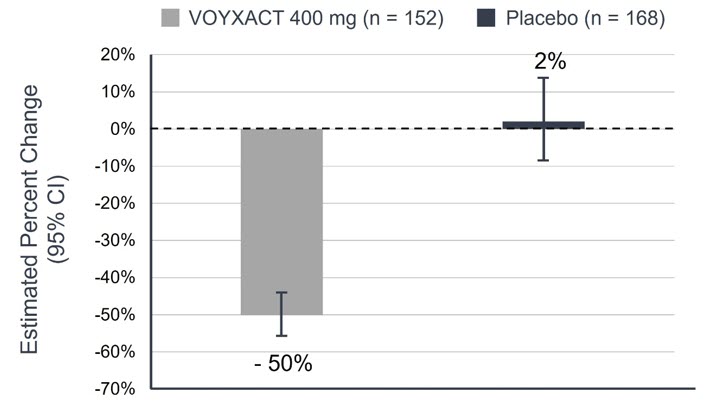
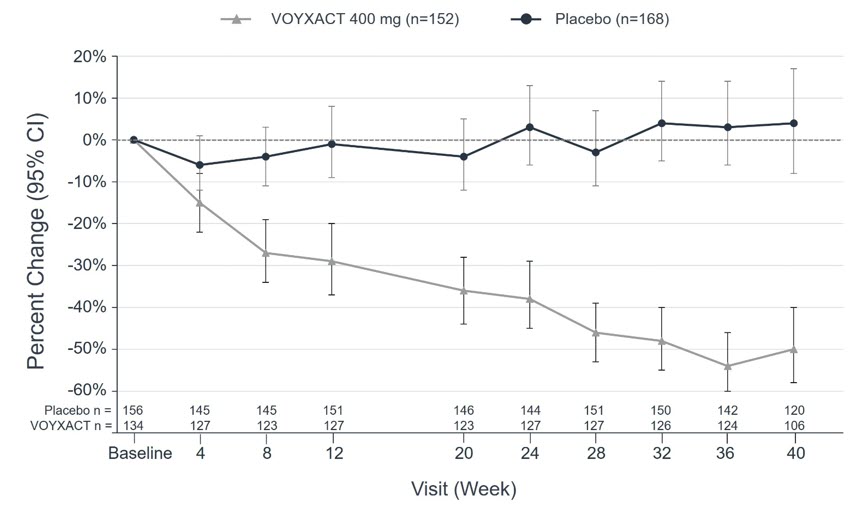
The primary endpoint was the relative change from baseline in uPCR-24h at Month 9. The mean estimated percent change from baseline in uPCR-24h is shown in Figure 1. The observed geometric mean percent change from baseline over time for uPCR from spot first morning void samples is shown in Figure 2.
Figure 1: Estimated Percent Change Compared to Baseline in uPCR-24h at Month 9 in Patients with IgAN in the VISIONARY Study
| CI = Confidence Interval |
| 24-hour uPCR at Month 9 compared to baseline is defined as uPCR-24h9months/uPCR-24hBaseline. |
| The bar indicates the geometric mean percentage change at 9 months compared with baseline, and the whiskers indicate the 95% CI. |
| Data were included in the analysis regardless of early treatment discontinuation and initiation of confounding therapy (treatment policy strategy). Missing data were imputed using multiple imputation. |
| VOYXACT | -50% |
| Placebo | 2% |
| VOYXACT vs. Placebo (96.5% CI) 96.5% CI corresponds to the two-sided significance level of 0.035 for the interim analysis (IA). | 51% (43%, 58%) |
| p-value | <0.0001 |
Figure 2: Percent Change Compared to Baseline in Spot uPCR Over Time in Patients with IgAN in the VISIONARY Study
| CI = Confidence Interval |
| Spot uPCR at specific week is defined as spot uPCR/spot uPCRbaseline |
| The dots indicate the geometric mean percentage change at specific weeks compared with baseline and the whiskers indicate the corresponding 95% CIs based on observed and non-imputed spot uPCR. |
|
The treatment effect (percentage reduction in uPCR-24h between VOYXACT and placebo) was consistent across the following subgroups and pre-specified stratification factors: sex, age, race, ethnicity, and geographic region, baseline proteinuria (uPCR-24h), baseline eGFR, and SGLT2i use.