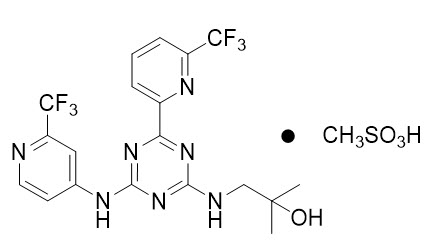
The peak plasma concentration (Cmax) is 1.3 mcg/mL [% coefficient of variation (CV%) 56.4] after a single dose of 100 mg, and 13 mcg/mL (CV% 46.3) at steady state for 100 mg daily. The area under concentration time curve (AUC) of enasidenib increases in an approximately dose proportional manner from 50 mg (0.5 times approved recommended dosage) to 450 mg (4.5 times approved recommended dosage) daily dose. Steady-state plasma levels are reached within 29 days of once-daily dosing. Accumulation is approximately 10-fold when administered once daily.
Absorption
The absolute bioavailability after 100 mg oral dose of enasidenib is approximately 57%. After a single oral dose, the median time to Cmax (Tmax) is 4 hours.
Distribution
The mean volume of distribution (Vd) of enasidenib is 55.8 L (CV% 29). Human plasma protein binding of enasidenib is 98.5% and of its metabolite AGI-16903 is 96.6% in vitro.
Enasidenib is not a substrate for P-glycoprotein or BCRP, while AGI-16903 is a substrate of both P-glycoprotein and BCRP. Enasidenib and AGI-16903 are not substrates of MRP2, OAT1, OAT3, OATP1B1, OATP1B3, and OCT2.
Elimination
Enasidenib has a terminal half-life of 137 hours (CV% 41) and a mean total body clearance (CL/F) of 0.74 L/hour (CV% 71).
Metabolism
Enasidenib accounted for 89% of the radioactivity in circulation and AGI-16903, the N-dealkylated metabolite, represented 10% of the circulating radioactivity.
In vitro studies suggest that metabolism of enasidenib is mediated by multiple CYP enzymes (e.g., CYP1A2, CYP2B6, CYP2C8, CYP2C9, CYP2C19, CYP2D6, and CYP3A4), and by multiple UGTs (e.g., UGT1A1, UGT1A3, UGT1A4, UGT1A9, UGT2B7, and UGT2B15). Further metabolism of the metabolite AGI-16903 is also mediated by multiple enzymes (e.g., CYP1A2, CYP2C19, CYP3A4, UGT1A1, UGT1A3, and UGT1A9).
Excretion
Eighty-nine percent (89%) of enasidenib is eliminated in feces and 11% in the urine. Excretion of unchanged enasidenib accounts for 34% of the radiolabeled drug in the feces and 0.4% in the urine.
Specific Populations
No clinically meaningful effect on the pharmacokinetics of enasidenib was observed for the following covariates: age (19 years to 100 years), race (White, Black, or Asian), mild hepatic impairment [defined as total bilirubin ≤ upper limit of normal (ULN) and aspartate transaminase (AST) >ULN or total bilirubin 1 to 1.5 times ULN and any AST], renal impairment (defined as creatinine clearance ≥30 mL/min by Cockcroft-Gault formula), sex, body weight (39 kg to 136 kg), and body surface area.
Drug Interaction Studies
In vitro studies suggest that enasidenib inhibits the activity of CYP1A2, CYP2B6, CYP2C8, CYP2C9, CYP2C19, CYP2D6, CYP3A4, and UGT1A1. Enasidenib inhibits P-gp, BCRP, OAT1, OATP1B1, OATP1B3, and OCT2, but not MRP2 or OAT3. Enasidenib induces CYP2B6 and CYP3A4.
In vitro studies suggest that the metabolite AGI-16903 inhibits the activity of CYP1A2, CYP2B6, CYP2C8, CYP2C9, CYP2C19, and CYP2D6. AGI-16903 inhibits BCRP, OAT1, OAT3, OATP1B1, and OCT2, but not P-gp, MRP2, or OATP1B3.
Coadministration of IDHIFA may increase or decrease the concentrations of combined hormonal contraceptives. The clinical significance of this potential drug interaction is unknown at this time.