Acute Myeloid Leukemia
The safety of ONUREG was evaluated in QUAZAR [see Clinical Studies (14)]. Patients received ONUREG 300 mg (N=236) or placebo (N=233) orally once daily on Days 1 through 14 of each 28-day cycle. Among patients who received ONUREG, 71% were exposed for 6 months or longer, and 49% were exposed for greater than one year. The median duration of exposure to ONUREG was 11.6 months (range: 0.5 to 74.3 months) and the median number of cycles was 12 (range: 1 to 82 cycles).
Serious adverse reactions occurred in 15% of patients who received ONUREG. Serious adverse reactions in ≥ 2% of patients who received ONUREG were pneumonia (8%) and febrile neutropenia (7%). One fatal adverse reaction (sepsis) occurred in a patient who received ONUREG.
Permanent discontinuation of ONUREG due to an adverse reaction occurred in 8% of patients. Adverse reactions which resulted in permanent discontinuation of ONUREG in > 1% of patients included nausea (2.1%), diarrhea (1.7%), and vomiting (1.3%). Interruptions of ONUREG due to an adverse reaction occurred in 35% of patients. Adverse reactions which required an interruption of ONUREG in > 5% of patients included neutropenia (20%), thrombocytopenia (8%), and nausea (6%).
Dose reductions of ONUREG due to an adverse reaction occurred in 14% of patients. Adverse reactions which required a dose reduction in > 1% of patients included neutropenia (6%), diarrhea (3.4%), thrombocytopenia (1.7%), and nausea (1.7%).
The most common (≥ 10%) adverse reactions were nausea, vomiting, diarrhea, fatigue/asthenia, constipation, pneumonia, abdominal pain, arthralgia, decreased appetite, febrile neutropenia, dizziness, and pain in extremity.
Table 2 summarizes the adverse reactions in QUAZAR.
Table 2: Adverse Reactions (≥ 5%) in Patients with AML Who Received ONUREG with a Difference Between Arms of > 2% Compared to Placebo in QUAZAR| Adverse Reaction | ONUREG
(N=236) | Placebo
(N=233) |
|---|
All Grades
(%) | Grade 3 or 4
(%) | All Grades
(%) | Grade 3 or 4
(%) |
|---|
| Gastrointestinal disorders |
| Nausea | 65 | 3 | 24 | < 1 |
| Vomiting | 60 | 3 | 10 | 0 |
| Diarrhea | 50 | 5 | 21 | 1 |
| Constipation | 39 | 1 | 24 | 0 |
| Abdominal pain Grouped term includes abdominal pain, abdominal pain upper, abdominal discomfort, and gastrointestinal pain. | 22 | 2 | 13 | < 1 |
| General disorders and administration site conditions |
| Fatigue / asthenia Grouped term includes fatigue and asthenia. | 44 | 4 | 25 | 1 |
| Infections |
| Pneumonia Broad scope term includes influenza, pneumonia, respiratory tract infection, respiratory tract infection viral, bronchopulmonary aspergillosis, lung infection, Staphylococcal infection, atypical pneumonia, lower respiratory tract infection, lung abscess, Pneumocystis jirovecii pneumonia, pneumonia bacterial, pneumonia fungal, Pseudomonas infection, hemoptysis, productive cough, pleural effusion, atelectasis, pleuritic pain, rales, Enterobacter test positive, and Hemophilus test positive. | 27 | 9 | 17 | 5 |
| Musculoskeletal and connective tissue disorders |
| Arthralgia | 14 | 1 | 10 | < 1 |
| Pain in extremity | 11 | < 1 | 5 | 0 |
| Metabolism and nutrition disorders |
| Decreased appetite | 13 | 1 | 6 | 1 |
| Blood and lymphatic disorders |
| Febrile neutropenia | 12 | 11 | 8 | 8 |
| Nervous system disorders |
| Dizziness | 11 | 0 | 9 | 0 |
Clinically relevant adverse reactions that did not meet criteria for inclusion in Table 2 were weight decreased (4%) in patients who received ONUREG.
Neutropenia, thrombocytopenia, and anemia of any grade occurred in 74%, 65%, and 25% of patients who received ONUREG. Table 3 summarizes select Grades 3 or 4 hematological laboratory abnormalities in QUAZAR.
Table 3: Selected Hematological Laboratory Abnormalities That Worsened from Baseline in Patients Who Received ONUREG in QUAZAR | ONUREG | Placebo |
|---|
| Laboratory Abnormality | Baseline
Grade 0-2
N | Post-Baseline
Grade 3 or 4
n (%) | Baseline
Grade 0-2
N | Post-Baseline
Grade 3 or 4
n (%) |
|---|
| Neutropenia | 223 | 109 (49) | 217 | 50 (23) |
| Thrombocytopenia | 222 | 46 (21) | 212 | 22 (10) |
| Anemia | 229 | 10 (4) | 223 | 7 (3) |
Risk Summary
Based on its mechanism of action [see Clinical Pharmacology (12.1)] and findings in animals, ONUREG can cause fetal harm when administered to a pregnant woman. There are no available data on ONUREG use in pregnant women to evaluate for a drug-associated risk. Azacitidine was teratogenic and caused embryo-fetal lethality in animals at doses less than the recommended human daily dose of oral azacitidine on a mg/m2 basis (see Data). Advise pregnant women of the potential risk to the fetus.
The estimated background of major birth defects and miscarriage for the indicated population is unknown. All pregnancies have a background risk of birth defect, loss, or other adverse outcomes. In the U.S. general population, the estimated background risk of major birth defects and miscarriage in clinically recognized pregnancies is 2% to 4% and 15% to 20%, respectively.
Data
Animal Data
No reproductive or developmental toxicity studies have been conducted with oral azacitidine.
Early embryotoxicity studies in mice revealed a 44% frequency of intrauterine embryonal death (increased resorption) after a single intraperitoneal injection of 6 mg/m2 azacitidine (at doses less than the recommended human daily dose of oral azacitidine on a mg/m2 basis) on gestation Day 10. Developmental abnormalities in the brain have been detected in mice given azacitidine on or before gestation Day 15 at doses of approximately 3 to 12 mg/m2 (at doses less than the recommended human daily dose on a mg/m2 basis).
In rats, azacitidine was clearly embryotoxic when given an intraperitoneal injection on gestation Days 4 to 8 (postimplantation) at a dose of 6 mg/m2 (at doses less than the recommended human daily dose on a mg/m2 basis), although treatment in the preimplantation period (on gestation Days 1 to 3) had no adverse effect on the embryos. Azacitidine caused multiple fetal abnormalities in rats after a single intraperitoneal dose of 3 to 12 mg/m2 (at doses less than the recommended human daily dose on a mg/m2 basis) given on gestation Days 9, 10, 11, or 12. In this study, azacitidine caused fetal death when administered at 3 to 12 mg/m2 on gestation Days 9 and 10; average live animals per litter was reduced to 9% of control at the highest dose on gestation Day 9. Fetal anomalies included: CNS anomalies (exencephaly/encephalocele), limb anomalies (micromelia, club foot, syndactyly, oligodactyly), and others (micrognathia, gastroschisis, edema, and rib abnormalities).
Risk Summary
There are no data regarding the presence of azacitidine in human milk or the effects on the breastfed child or milk production. Because of the potential for serious adverse reactions in the breastfed child, advise women not to breastfeed during treatment with ONUREG and for 1 week after the last dose.
Pregnancy Testing
Pregnancy testing is recommended for females of reproductive potential before starting ONUREG.
Contraception
Females
Advise females of reproductive potential to use effective contraception during treatment with ONUREG and for at least 6 months after the last dose.
Males
Advise males with female partners of reproductive potential to use effective contraception during treatment with ONUREG and for at least 3 months after the last dose.
Infertility
Based on animal data, ONUREG may impair male or female fertility [see Nonclinical Toxicology (13.1)].
Absorption
The mean oral bioavailability is approximately 11% relative to subcutaneous administration. The median time to peak plasma concentration of azacitidine is 1 hour.
Effect of Food
A high-fat, high-calorie meal (approximately 800 to 1000 calories, 50% fat) did not affect AUC0-INF and decreased Cmax by 21%.
Distribution
The mean (CV%) apparent volume of distribution (Vz/F) of azacitidine is 881 L (67%). The in vitro serum protein binding of azacitidine is approximately 6% to 12%. The blood-to-plasma ratio is approximately 0.3.
Elimination
The mean (CV%) terminal half-life is approximately 0.5 hours (27%) and the apparent clearance (CL/F) is 1240 L/hour (64%).
Metabolism
Azacitidine undergoes spontaneous hydrolysis and deamination mediated by cytidine deaminase.
Excretion
Following the administration of ONUREG 300 mg orally once daily, < 2% of the dose was recovered unchanged in the urine.
Specific Populations
Age (46 years to 93 years), sex, body weight (39.3 kg to 129 kg), mild hepatic impairment (total bilirubin ≤ ULN and AST > ULN, or total bilirubin 1 to 1.5 × ULN and any AST), and mild to moderate renal impairment (CLcr 30 to 89 mL/min) have no clinically meaningful effect on the pharmacokinetics of oral azacitidine. The effects of race/ethnicity, moderate to severe hepatic impairment (total bilirubin > 1.5 × ULN and any AST), and severe renal impairment (CLcr 15 to 29 mL/min) on the pharmacokinetics of oral azacitidine is unknown.
Severe renal impairment increased azacitidine exposure by approximately 70% after a single or 41% after multiple subcutaneous daily administration.
Drug Interaction Studies
Effect of Gastric Acid Reducing Agents on Azacitidine:
Coadministration of omeprazole (a proton pump inhibitor) with ONUREG increased azacitidine AUC0-INF by 19% and had no effect on Cmax.
In Vitro Studies
Cytochrome P450 (CYP) Enzymes: Azacitidine does not inhibit CYP1A2, CYP2B6, CYP2C8, CYP2C9, CYP2C19, CYP2D6, CYP3A4, or CYP2E1 at clinically relevant concentrations. Azacitidine is not an inducer of CYP1A2, CYP2C19, or CYP3A.
Transporter Systems: Azacitidine is not a substrate of P-glycoprotein (P-gp). Azacitidine does not inhibit P-gp, breast cancer resistance protein (BCRP), organic anion transporters (OAT) OAT1 and OAT3, organic anion transporting polypeptides (OATP) OATP1B1 and OATP1B3, or organic cation transporter (OCT) OCT2 at clinically relevant concentrations.
How Supplied
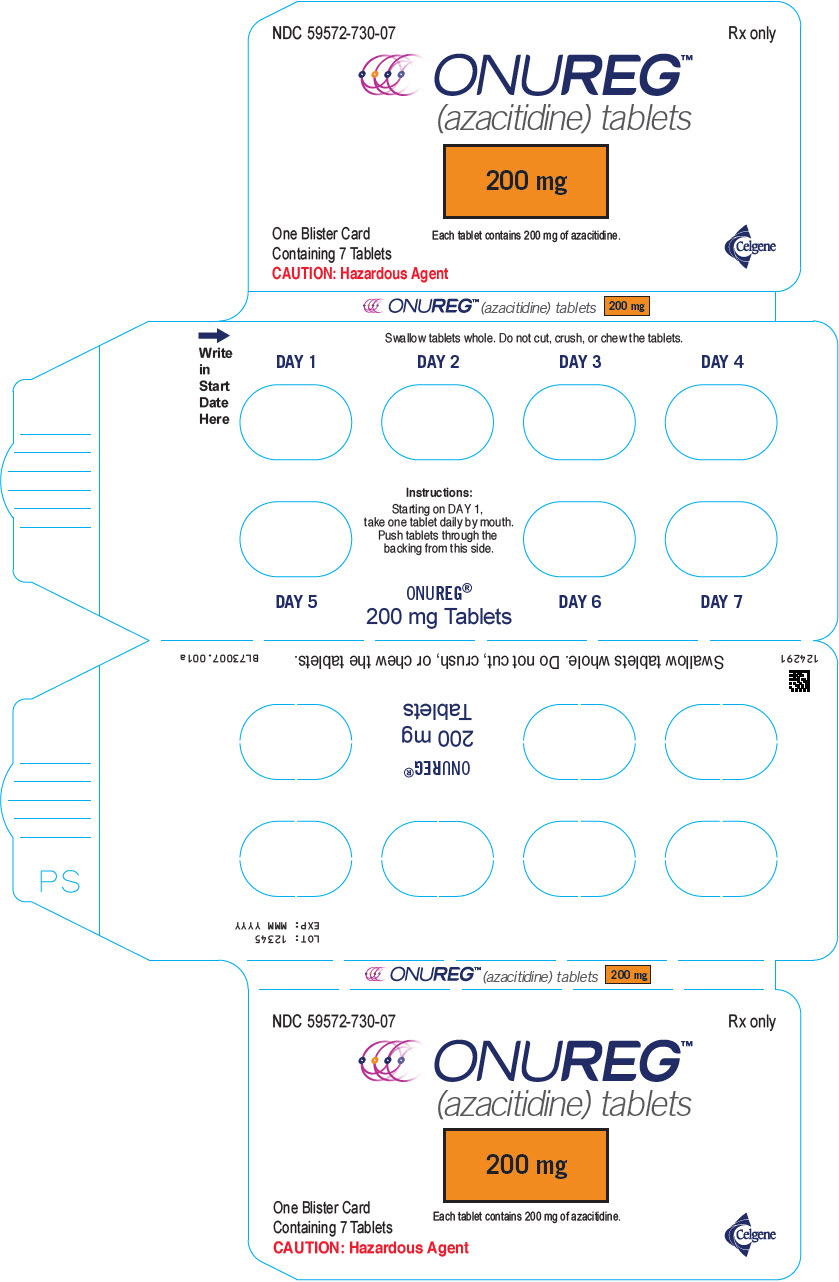
ONUREG tablets are available as:
- 200 mg: pink, oval, film-coated tablets with debossed "200" on one side and "ONU" on the other side.
- 300 mg: brown, oval, film-coated tablets with debossed "300" on one side and "ONU" on the other side.
Table 6 lists the package configurations and strengths.
Table 6: ONUREG Package Configurations and NDC Numbers| Package Configuration | Tablet Strength | NDC Number |
|---|
| Bottles of 14 with two desiccant cannisters | 200 mg | 59572-730-14 |
| Bottles of 14 with two desiccant cannisters | 300 mg | 59572-740-14 |
Myelosuppression
Advise patients of the risk of myelosuppression with ONUREG and of the need to monitor complete blood counts before and during treatment [see Warnings and Precautions (5.2)].
Gastrointestinal Toxicity
Advise patients of the risk of gastrointestinal toxicity with ONUREG and of the potential need to use anti-emetic or anti-diarrheal medications during treatment [see Adverse Reactions (6.1)].
Embryo-Fetal Toxicity
Advise pregnant women of the potential risk to a fetus. Advise females of reproductive potential to inform their healthcare provider of a known or suspected pregnancy [see Warnings and Precautions (5.4), Use in Specific Populations (8.1)].
Advise females of reproductive potential to use effective contraception during treatment with ONUREG and for at least 6 months after the last dose [see Use in Specific Populations (8.3)].
Advise males with female partners of reproductive potential to use effective contraception during treatment with ONUREG and for at least 3 months after the last dose [see Use in Specific Populations (8.3)].
Lactation
Advise women not to breastfeed during treatment with ONUREG and for 1 week after the last dose [see Use in Specific Populations (8.2)].
Administration
Advise patients to take ONUREG with or without food at about the same time each day and how to make up a missed or vomited dose. Advise patients to swallow tablets whole. Advise patients not to cut, split, crush, or chew the tablets [see Dosage and Administration (2.2)].
Storage Instructions
Advise patients to keep ONUREG in the original container. Advise patients to keep the container tightly closed with both desiccant canisters inside and to not eat the desiccant canisters [see How Supplied/Storage and Handling (16)].
Manufactured by:
Celgene Corporation
A Wholly Owned Subsidiary of Bristol-Myers Squibb
86 Morris Avenue
Summit, NJ 07901
ONUREG® is a registered trademark of Celgene Corporation.
© 2020 Celgene Corporation.
All Rights Reserved.
ONUPI.001