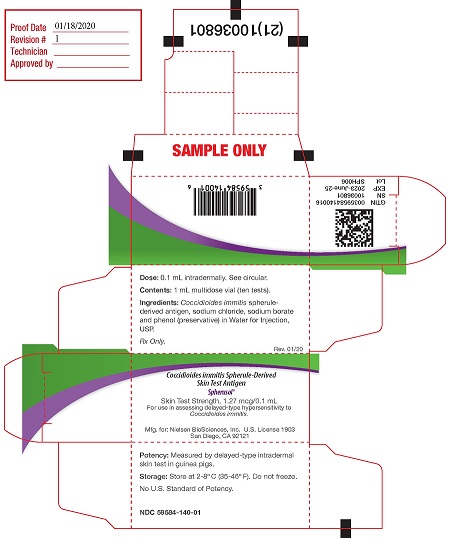
2.2 Administration:
Spherusol
® is administered as a 0.1 mL dose by intradermal injection to the volar surface of the forearm using a tuberculin syringe (0.5 or 1.0 mL) and a ½ inch 26-27 gauge needle. The needle should be inserted bevel side up in the skin at a 15-20 degree angle. Intradermal injection of 0.1 mL Spherusol
® will result in a bleb 5-10 mm in diameter at the injection site.
2.3 Skin Test Assessment
The injection site should be assessed for induration at 48 hours (±4 hours) following administration. The response to the skin test should be measured by taking the mean of the orthogonal diameters of the area of induration. A mean induration of ≥ 5 mm is considered a positive delayed-type hypersensitivity response to Spherusol
®.
Repeat administration of Spherusol
® has not been evaluated.
5.1 Prevention and Management of Acute Hypersensitivity Reactions
Prior to administration, the healthcare provider should review the medical history for possible skin test sensitivity and previous skin test related adverse reactions to assess the risks and benefits. Immediate hypersensitivity, to include severe systemic reactions, may occur following administration of skin test antigens. Medications and equipment to manage possible anaphylactic reactions should be available for immediate use. Patients should be observed for a minimum of 30 minutes following administration to assess for adverse reactions.
5.2 Patients on Beta Blockers
Patients receiving beta blockers may be unresponsive to the usual doses of epinephrine used to treat serious systemic reactions, including anaphylaxis.
5.3 Immunosuppression
Any condition or agent that impairs or attenuates delayed-type hypersensitivity reactions, including infections and use of immunosuppressive drugs, can potentially cause a false negative reaction to Spherusol
®. [see Drug Interactions (
7.1)]
6.1 Clinical Trials Experience
Because clinical trials are conducted under widely varying conditions, adverse reaction rates observed in the clinical trials of a skin test antigen cannot be directly compared to rates in the clinical trials of another skin test antigen, and may not reflect the rates observed in practice. As with any skin test antigen, there is the possibility that broad use of Spherusol
® could reveal adverse reactions not observed in clinical trials.
In a double-blinded placebo-controlled clinical trial conducted in areas of the U.S. endemic for
C. immitis (Bakersfield, CA and Tucson, AZ), 54 adults (23-64 years of age) with a history of pulmonary coccidioidomycosis of at least 45 days duration, diagnosed by clinical findings, radiography and serological and/or mycological evidence of the disease, received a single dose of Spherusol
® concomitantly with two licensed skin test extracts (Candin
® and Trichophyton) and two controls (product diluent [thimerosal ≤0.0001%] and saline). Each intradermal injection of 0.1 mL of reagent was given at pre-determined sites on the right and left forearms. Solicited local adverse reactions and systemic adverse events occurring within 7 days after injection were recorded by study subjects via diary card. These events were also recorded on case report forms (CRFs) by study personnel during clinical visits 48 hours and 7 days following injections. Diary cards and CRFs did not record solicited local reactions by specific site. Local adverse reactions and systemic adverse events that occurred within 7 days were monitored until resolution. Reports of unsolicited adverse events and serious adverse events that occurred within 7 days after administration were collected on the diary cards or reported at study visits.
Table 1 lists the percentage of subjects reporting solicited local reactions (at any site) and solicited systemic adverse events within 7 days following the administration of Spherusol
®, Candin
®, Trichophyton, diluent control and placebo control.
Table 1. Frequency of Solicited Local Reactions and Systemic Adverse Events within 7 days of Administration of Spherusol
®, Candin
®, Trichophyton, Diluent Control and Saline Control in Subjects with a History of Pulmonary Coccidioidomycosis (N=53)
| Symptom | Frequency (%) |
|---|
| Local ∗ | Any | Mild | Moderate | Severe |
|---|
| Itching | 85 | 36 | 47 | 2 |
| Swelling | 79 | 36 | 41 | 2 |
| Pain | 17 | 13 | 4 | 0 |
| Necrosis/Ulceration | 4 | 2 | 0 | 2 |
| Systemic | | | | |
| Increased heart rate | 4 | 2 | 2 | 0 |
| Weakness | 6 | 2 | 4 | 0 |
| Faintness | 0 | 0 | 0 | 0 |
| Dizziness | 2 | 2 | 0 | 0 |
| Nausea/cramps | 2 | 2 | 0 | 0 |
| Flu-like symptoms | 7 | 2 | 6 | 0 |
| Difficulty breathing/shortness of breath | 0 | 0 | 0 | 0 |
| Any = Percentage of subjects experiencing adverse event of any intensity; Mild = Barely noticeable, not bothersome; Moderate = Distinctly noticeable discomfort; Severe = Needs medical attention. ∗ Local reactions occurring at any injection site |
|---|
Of subjects with severe reactions, one subject required treatment with oral corticosteroids for ulceration and swelling. Based on investigator's determination the reaction was at the site of Trichophyton injection. All severe reactions resolved without sequelae.
During the 7 days following administration two subjects reported unsolicited adverse events: one subject reported joint pain, fatigue, cough, sensitivity at a test site (test site not specified), and one subject with erythema immediately after administration (test site not specified). The intensities of these unsolicited adverse events were not recorded.
No serious adverse events or deaths were reported during the clinical study.
6.2 To report SUSPECTED ADVERSE REACTIONS, contact Nielsen BioSciences, Inc. at (855) 855-1212 or MEDWATCH, Food and Drug Administration (FDA), 5600 Fishers Lane, Rockville, MD 20852-9782. Telephone: (800) 332-1088 or
www.vaers.hhs.gov.
7.1 Corticosteroids and Immunosuppressives
Corticosteroids and Immunosuppressive agents may suppress the response to the skin test. Pharmacologic doses of corticosteroids may suppress the response to skin test antigens after two weeks of therapy. The mechanism of suppression is thought to involve a decrease in monocytes and lymphocytes, particularly T-cells. The normal DTH response usually returns to pre-treatment levels within several weeks after steroid therapy is discontinued.
(5) The use of Spherusol
® has not been evaluated during or following the use of corticosteroids or immunosuppressive agents.
7.2 Antifungal Medications
It is not known if concurrent treatment with antifungal medications interferes with delayed-type hypersensitivity responses to Spherusol
® in patients with a history of pulmonary coccidioidomycosis.
14.1 Induration Response in Subjects With a History of Pulmonary Coccidioidomycosis
A multicenter, double-blinded study in endemic areas (Bakersfield, CA and Tucson, AZ) enrolled 54 adults with a history of pulmonary coccidioidomycosis diagnosed by radiography, laboratory serologies (e.g., complement fixation, immunodiffusion) and/or culture. Subjects were 23-64 years of age; 28% women; 70% Caucasian, 11% Hispanic, 2% Asian, 2% Native American and 4% who did not specify race or ethnicity. Of the 51 subjects with valid skin test results, 50 subjects [98.0%; 2-sided 95% CI (89.6%, 100%)] had a mean induration of ≥ 5 mm at the Spherusol
® injection site. Among subjects with valid skin test results the average size of induration at the Spherusol
® injection site was 17 mm (range 5 mm-39 mm).
The receipt of concurrent or previous antifungal therapy did not appear to interfere with or accentuate the induration response to Spherusol
®.
14.2 Induration Response in Subjects Without a History of Pulmonary Coccidioidomycosis or Known Exposure to C. immitis.
A single site, double-blind study conducted in a non-endemic area for
C. immitis (Spokane, WA) enrolled 60 adult subjects (18-56 years of age) with no known exposure to
C. immitis by travel to or residency in an endemic area. Subjects had negative serologies to
C. immitis by complement fixation, immunodiffusion and/or ELISA. Subjects enrolled in the study were 65% women; 96% Caucasian, 2% Hispanic and 2% Native American. At the 48 hour (± 4 hours) assessment, a total of 55 subjects had valid skin test results (5 subjects had negative skin test results to all reagents and were considered un-interpretable). One subject (1/55) had a 5 mm mean induration response to Spherusol
® and 54 subjects with demonstrated negative responses (< 5mm mean induration) to Spherusol
®. Fifty-four of the 55 subjects with valid skin test responses [98.2%; 2-sided 95% CI (90.3%, > 99.9%)] demonstrated a negative induration response to Spherusol
®. When the five subjects who had un-interpretable responses were analyzed as if these responses represented positive reactions to Spherusol
®, 54 of 60 subjects 90.0% (CI 79.5%, 96.2%) demonstrated a negative induration response.
14.3 Induration Response in Subjects With a History of Pulmonary Histoplasmosis
A single site, double-blind study conducted in a non-endemic area for
C. immitis, but endemic for
H. capsulatum (Blair, NE) enrolled 12 adult subjects (33 to 60 years of age) with no known exposure to
C. immitis by travel to or residency in an endemic area. All subjects had a history of pulmonary Histoplasmosis. Subjects had negative serologies to
C. immitis by complement fixation, immunodiffusion and/or ELISA. Subjects were 42% women and 100% Caucasian. At the 48 hour (± 4 hours) assessment, all 12 subjects reacted to at least one of the positive controls with ≥ 5mm mean induration and demonstrated negative (< 5mm) induration responses to thimerosal and saline controls. No positive induration responses to Spherusol
® were observed [1-sided 97.5% CI; (0%, 26.5%)] among subjects who had a previous history of disease caused by
H. capsulatum and no history of travel to areas endemic for
C. immitis. These findings support the lack of cross-reaction between the cellular immune responses induced by the two fungal species.