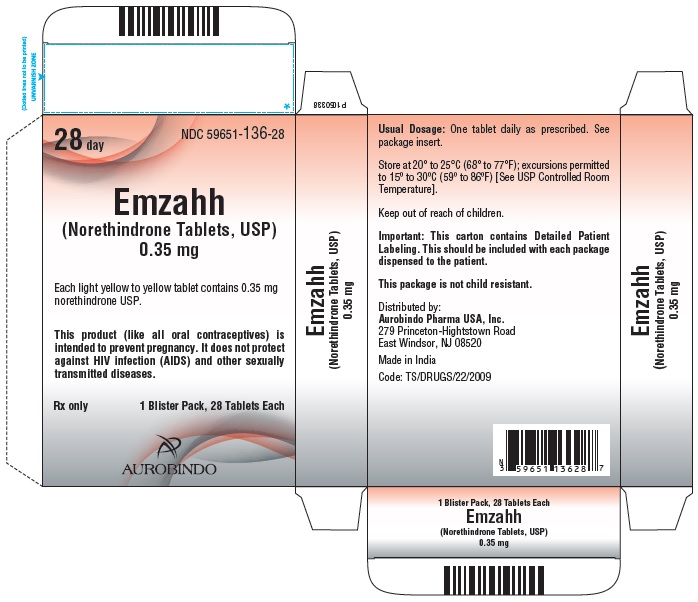
Emzahh
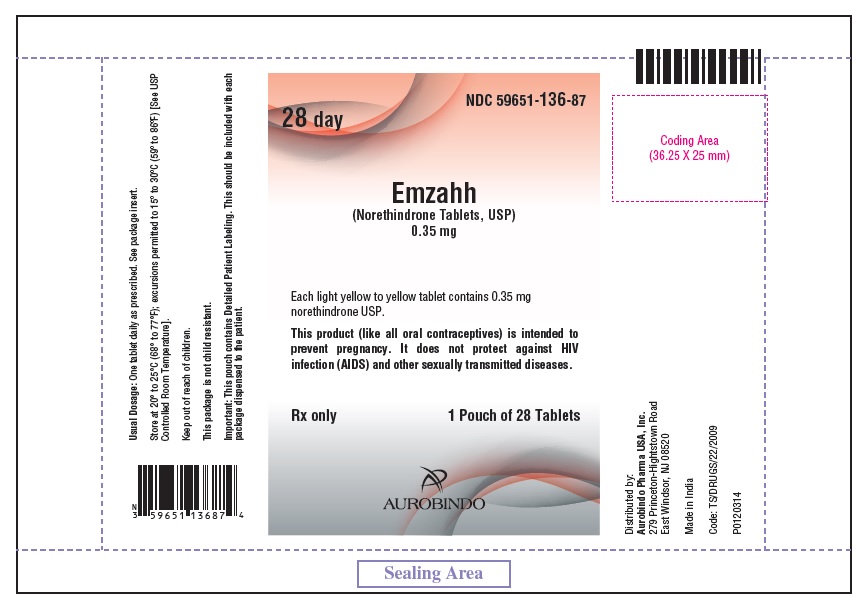
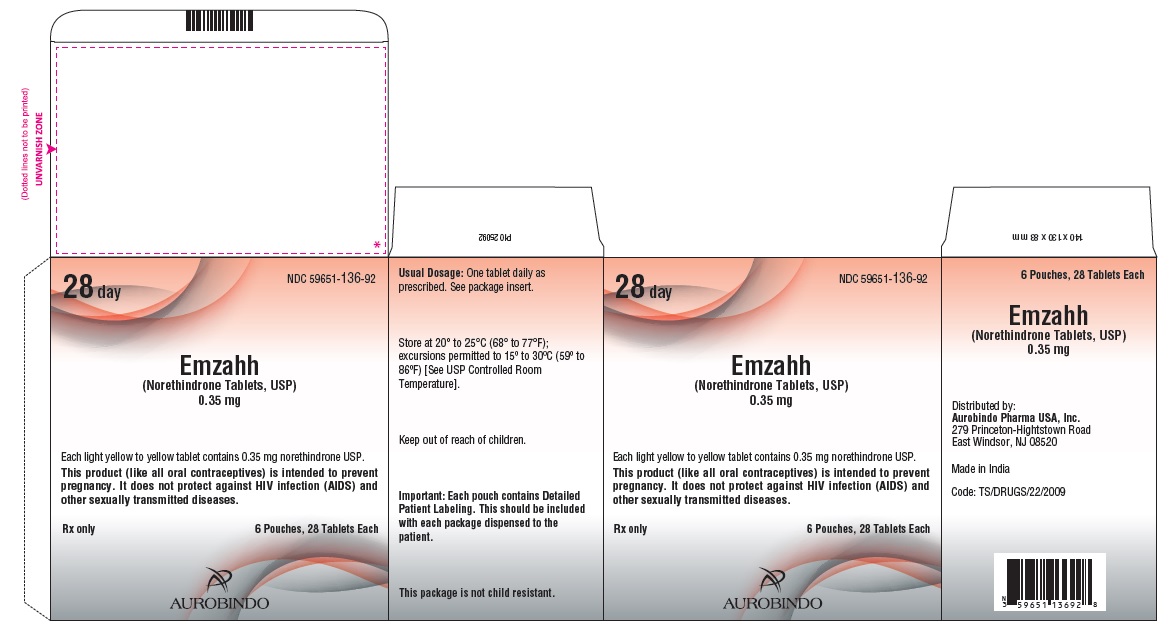
(Norethindrone Tablets, USP)
This product (like all oral contraceptives) is used to prevent pregnancy. It does not protect against HIV infection (AIDS) or other sexually transmitted diseases.
DESCRIPTION
Emzahh Tablets
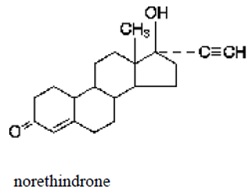
Each tablet contains 0.35 mg norethindrone USP. Inactive ingredients include anhydrous lactose, corn starch, D&C Yellow No. 10 aluminum lake, ethylcellulose, magnesium stearate, microcrystalline cellulose, povidone, sodium starch glycolate, and talc.
INTRODUCTION
This leaflet is about birth control pills that contain one hormone, a progestin. Please read this leaflet before you begin to take your pills. It is meant to be used along with talking with your healthcare professional.
Progestin-only pills are often called “POPs” or “the minipill.” POPs have less progestin than the combined birth control pill (or “the pill”) which contains both an estrogen and a progestin.
HOW EFFECTIVE ARE POPs?
About 1 in 200 POP users will get pregnant in the first year if they all take POPs perfectly (that is, on time, every day). About 1 in 20 “typical” POP users (including women who are late taking pills or miss pills) gets pregnant in the first year of use. Table 2 will help you compare the efficacy of different methods.
Table 2: Percentage of Women Experiencing an Unintended Pregnancy During the First Year of Typical Use and the First Year of Perfect Use of Contraception and the Percentage Continuing Use at the End of the First Year. United States.
Method
(1)
| % of Women Experiencing an Unintended Pregnancy within the First Year of Use
| % of Women Continuing Use at One Year3
|
Typical Use1
(2)
| Perfect Use2
(3)
|
(4)
|
No method4
| 85
| 85
|
|
Spermicides5
| 28
| 18
| 42
|
Fertility awareness-based methods
| 24
|
| 47
|
Standard Days method6
|
| 5
|
|
TwoDay method6
|
| 4
|
|
Ovulation method6
|
| 3
|
|
Symptothermal method6
|
| 0.4
|
|
Withdrawal
| 22
| 4
| 46
|
Sponge
|
|
| 36
|
Parous Women
| 24
| 20
|
|
Nulliparous Women
| 12
| 9
|
|
Condom7
|
|
|
|
Female (fc)
| 21
| 5
| 41
|
Male
| 18
| 2
| 43
|
Diaphragm8
| 12
| 6
| 57
|
Combined pill and progestin-only pill
| 9
| 0.3
| 67
|
Norelgestromin and ethinyl estradiol patch
| 9
| 0.3
| 67
|
NuvaRing
| 9
| 0.3
| 67
|
Depo-Provera
| 6
| 0.2
| 56
|
Intrauterine contraceptives
|
|
|
|
ParaGard (copper T)
| 0.8
| 0.6
| 78
|
Mirena (LNg)
| 0.2
| 0.2
| 80
|
Implanon
| 0.05
| 0.05
| 84
|
Female Sterilization
| 0.5
| 0.5
| 100
|
Male Sterilization
| 0.15
| 0.10
| 100
|
Emergency Contraception: Emergency contraceptive pills or insertion of a copper intrauterine contraceptive after unprotected intercourse substantially reduces the risk of pregnancy.9 (See Chapter 6.).
Lactational Amenorrhea Method: LAM is a highly effective, temporary method of contraception.10 (See Chapter 18.)
Source: Trussell J. Contraceptive Efficacy. In Hatcher RA, Trussell J, Nelson AL, Cates W, Kowal D, Policar M. Contraceptive Techology: Twentieth Revised Edition. New York NY: Ardent Media, 2011.
__________________________________________________________________________________________________________________________________________________________
Notes:
1 Among typical couples who initiate use of a method (not necessarily for the first time), the percentage who experience an accidental pregnancy during the first year if they do not stop use for any other reason. Estimates of the probability of pregnancy during the first year of typical use for spermicides, withdrawal, fertility awareness-based methods, the diaphragm, the male condom, the oral contraceptive pill, and Depo-Provera are taken from the 1995 National Survey of Family Growth corrected for underreporting of abortion; see the text for the derivation of estimates for the other methods.
2 Among couples who initiate use of a method (not necessarily for the first time) and who use it perfectly (both consistently and correctly), the percentage who experience an accidental pregnancy during the first year if they do not stop use for any other reason. See the text for the derivation of the estimate for each method.
3 Among couples attempting to avoid pregnancy, the percentage who continue to use a method for 1 year.
4 The percentages becoming pregnant in columns (2) and (3) are based on data from populations where contraception is not used and from women who cease using contraception in order to become pregnant. Among such populations, about 89% become pregnant within 1 year. This estimate was lowered slightly (to 85%) to represent the percentage who would become pregnant within 1 year among women now relying on reversible methods of contraception if they abandoned contraception altogether.
5 Foams, creams, gels, vaginal suppositories, and vaginal film.
6 The Ovulation and TwoDay methods are based on evaluation of cervical mucus. The Standard Days method avoids intercourse on cycle days 8 through 19. The Symptothermal method is a double-check method based on evaluation of cervical mucus to determine the first fertile day and evaluation of cervical mucus and temperature to determine the last fertile day.
7 Without spermicides.
8 With spermicidal cream or jelly.
9 ella, Plan B One-Step and Next Choice are the only dedicated products specifically marketed for emergency contraception. The label for Plan B One-Step (one dose is 1 white pill) says to take the pill within 72 hours after unprotected intercourse. Research has shown that all of the brands listed here are effective when used within 120 hours after unprotected sex. The label for Next Choice (one dose is 1 peach pill) says to take 1 pill within 72 hours after unprotected intercourse and another pill 12 hours later. Research has shown that both pills can be taken at the same time with no decrease in efficacy or increase in side effects and that they are effective when used within 120 hours after unprotected sex. The FDA has in addition declared the following 19 brands of oral contraceptives to be safe and effective for emergency contraception: Ogestrel (1 dose is 2 white pills), Nordette (1 dose is 4 light-orange pills), Cryselle, Levora, Low-Ogestrel, Lo/Ovral, or Quasence (1 dose is 4 white pills), Jolessa, Portia, Seasonale or Trivora (1 dose is 4 pink pills), Seasonique (1 dose is 4 light-blue-green pills), Enpresse (one dose is 4 orange pills), Lessina (1 dose is 5 pink pills), Aviane or LoSeasonique (one dose is 5 orange pills), Lutera or Sronyx (one dose is 5 white pills), and Lybrel (one dose is 6 yellow pills).
10 However, to maintain effective protection against pregnancy, another method of contraception must be used as soon as menstruation resumes, the frequency or duration of breastfeeds is reduced, bottle feeds are introduced, or the baby reaches 6 months of age.
Emzahh Tablets have not been studied for and are not indicated for use in emergency contraception.
HOW DO POPs WORK?
POPs can prevent pregnancy in different ways including:
- They make the cervical mucus at the entrance to the womb (the uterus) too thick for the sperm to get through to the egg.
- They prevent ovulation (release of the egg from the ovary) in about half of the cycles.
- They also affect other hormones, the fallopian tubes and the lining of the uterus.
YOU SHOULD NOT TAKE POPs
- If there is any chance you may be pregnant.
- If you have breast cancer.
- If you have bleeding between your periods that has not been diagnosed.
- If you are hypersensitive, or allergic, to any component of this product.
- If you have liver tumors, either benign or cancerous.
- If you have acute liver disease.
RISKS OF TAKING POPs
Cigarette smoking greatly increases the possibility of suffering heart attacks and strokes. Women who use oral contraceptives are strongly advised not to smoke.
WARNING:
If you have sudden or severe pain in your lower abdomen or stomach area, you may have an ectopic pregnancy or an ovarian cyst. If this happens, you should contact your healthcare professional immediately.
Ectopic Pregnancy
An ectopic pregnancy is a pregnancy outside the womb. Because POPs protect against pregnancy, the chance of having a pregnancy outside the womb is very low. If you do get pregnant while taking POPs, you have a slightly higher chance that the pregnancy will be ectopic than do users of some other birth control methods.
Ovarian Cysts
These cysts are small sacs of fluid in the ovary. They are more common among POP users than among users of most other birth control methods. They usually disappear without treatment and rarely cause problems.
Cancer of the Reproductive Organs and Breasts
Some studies in women who use combined oral contraceptives that contain both estrogen and a progestin have reported an increase in the risk of developing breast cancer, particularly at a younger age and apparently related to duration of use. There is insufficient data to determine whether the use of POPs similarly increases this risk.
A meta-analysis of 54 studies found a small increase in the frequency of having breast cancer diagnosed for women who were currently using combined oral contraceptives or had used them within the past ten years. This increase in the frequency of breast cancer diagnosis, within ten years of stopping use, was generally accounted for by cancers localized to the breast. There was no increase in the frequency of having breast cancer diagnosed ten or more years after cessation of use.
Some studies have found an increase in the incidence of cancer of the cervix in women who use oral contraceptives. However, this finding may be related to factors other than the use of oral contraceptives and there is insufficient data to determine whether the use of POPs increases the risk of developing cancer of the cervix.
Liver Tumors
In rare cases, combined oral contraceptives can cause benign but dangerous liver tumors. These benign liver tumors can rupture and cause fatal internal bleeding. In addition, some studies report an increased risk of developing liver cancer among women who use combined oral contraceptives. However, liver cancers are rare. There is insufficient data to determine whether POPs increase the risk of liver tumors.
Diabetic Women
Diabetic women taking POPs do not generally require changes in the amount of insulin they are taking. However, your healthcare professional may monitor you more closely under these conditions.
SEXUALLY TRANSMITTED DISEASES (STDs)
WARNING: POPs do not protect against getting or giving someone HIV (AIDS) or any other STD, such as chlamydia, gonorrhea, genital warts or herpes.
SIDE EFFECTS
Irregular Bleeding:
The most common side effect of POPs is a change in menstrual bleeding. Your periods may be either early or late, and you may have some spotting between periods. Taking pills late or missing pills can result in some spotting or bleeding.
Other Side Effects:
Less common side effects include headaches, tender breasts, nausea, vomiting, dizziness, and fatigue. Depression, nervousness, leg pain, vaginal discharge, fluid retention, allergic reactions, jaundice or a yellowing of the skin or eyeballs, loss of scalp hair, rash/itchy rash, weight gain, acne and extra hair on your face and body have been reported, but are rare.
If you are concerned about any of these side effects, check with your healthcare professional.
USING POPs WITH OTHER MEDICINES
Before taking a POP, inform your healthcare professional of any other medication, including over-the-counter medicine, that you may be taking.
These medicines can make POPs less effective:
Medicines for seizures such as:
- Phenytoin
- Carbamazepine
- Phenobarbital
- Felbamate
- Oxcarbazepine
- Rufinamide
Medicine for nausea and vomiting caused by certain anti-cancer (chemotherapy) medicines:
- (Fos)aprepitant
Medicines for tuberculosis (TB):
- Rifampin and rifabutin
Medicine for fungal infections such as:
- Griseofulvin
Medicine for pulmonary hypertension such as:
- Bosentan
Medicines used for the treatment of HIV infections or AIDS and infections due to Hepatitis C such as: