The effect of macitentan on progression of PAH was demonstrated in a multi-center, long-term (average duration of exposure approximately 2 years), placebo-controlled study in 742 patients with symptomatic [WHO functional class (FC) II to IV] PAH who were randomized to placebo (n=250), 3 mg macitentan (n=250), or 10 mg macitentan (n=242) once daily. Patients were treated with macitentan monotherapy or in combination with phosphodiesterase-5 inhibitors or inhaled prostanoids.
The primary study endpoint was time to the first occurrence of death, a significant morbidity event, defined as atrial septostomy, lung transplantation, initiation of IV or subcutaneous (SC) prostanoids, or “other worsening of PAH” during double-blind treatment plus 7 days. Other worsening was defined as all of the following: 1) a sustained ≥15% decrease from baseline in 6 minute walk distance (6MWD), 2) worsening of PAH symptoms (worsening of WHO FC), and 3) need for additional treatment for PAH. All of these other worsening events were confirmed by an independent adjudication committee, blinded to treatment allocation. A critical secondary endpoint was time to PAH death or PAH hospitalization.
The mean patient age was 46 years (14% were age 65 or above). Most patients were white (55%) or Asian (29%) and female (77%). Approximately 52%, 46%, and 2% of patients were in WHO FC II, III, and IV, respectively.
Idiopathic or heritable PAH was the most common etiology in the study population (57%) followed by PAH caused by connective tissue disorders (31%), PAH caused by congenital heart disease with repaired shunts (8%), and PAH caused by other etiologies [drugs and toxins (3%) and HIV (1%)].
At baseline, the majority of enrolled patients (64%) were being treated with a stable dose of specific therapy for PAH, either oral phosphodiesterase inhibitors (61%) and/or inhaled/oral prostanoids (6%).
Study results are described for the placebo and macitentan 10 mg groups. The median treatment durations were 101 and 118 weeks in the placebo and macitentan 10 mg groups, respectively, up to a maximum of 188 weeks.
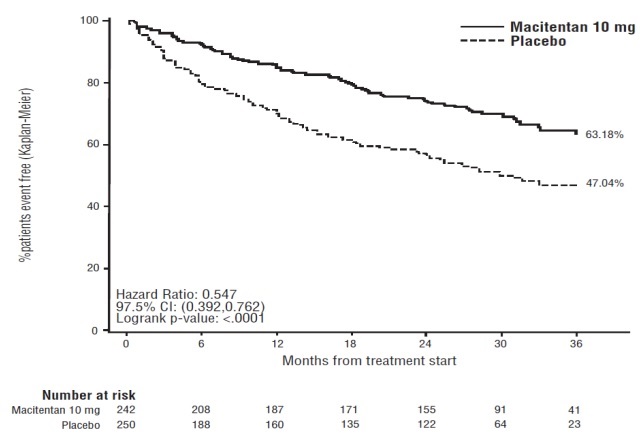
Treatment with macitentan 10 mg resulted in a 45% reduction (HR 0.55, 97.5% CI 0.39 to 0.76; logrank p<0.0001) in the occurrence of the primary endpoint up to end of double-blind treatment compared to placebo (Table 3 and Figure 2). The beneficial effect of macitentan 10 mg was primarily attributable to a reduction in clinical worsening events (deterioration in 6MWD and worsening of PAH symptoms and need for additional PAH treatment).
Figure 2 Kaplan-Meier Estimates of the Occurrence of the Primary Endpoint Event in the SERAPHIN Study
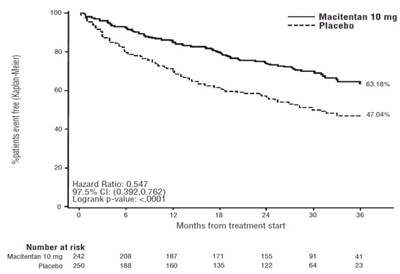
Figure-2 (Macitentan Fig2)
Table 3: Summary of Primary Endpoint Events
| Placebo
N=250
n (%)
| Macitentan 10 mg
N=242
n (%)
|
Patients with a primary endpoint event*
| 116 (46.4)
| 76 (31.4)
|
Component as first event
Worsening PAH
Death
IV/SC prostanoid
| 93 (37.2)
17 (6.8)
6 (2.4)
| 59 (24.4)
16 (6.6)
1 (0.4)
|
* No patients experienced an event of lung transplantation or atrial septostomy in the placebo or macitentan 10 mg treatment groups.
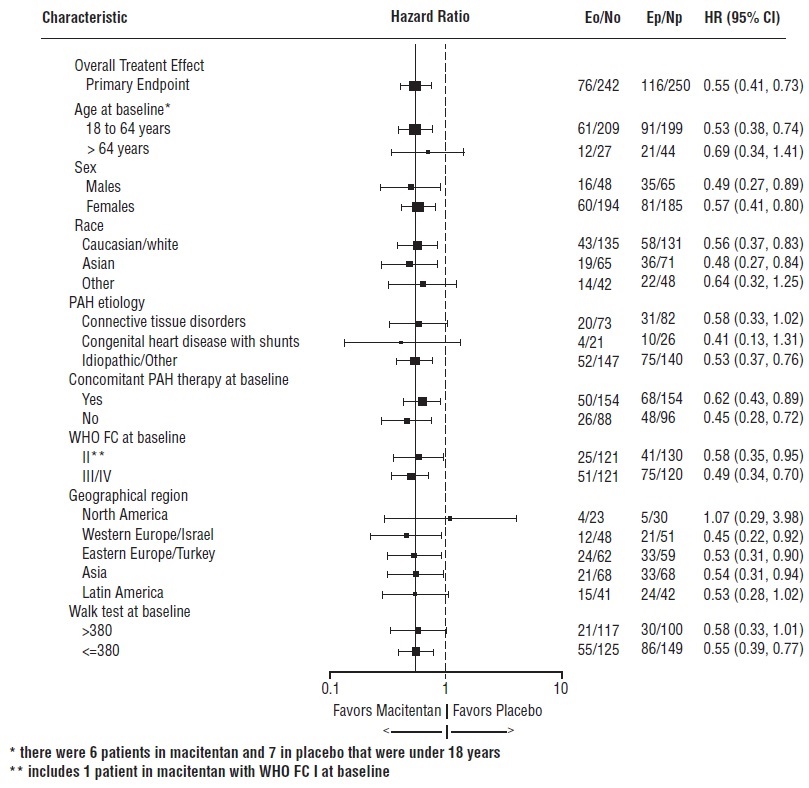
Subgroup analyses were performed to examine their influence on outcome as shown in Figure 3. Consistent efficacy of macitentan 10 mg on the primary endpoint was seen across subgroups of age, sex, race, etiology, by monotherapy or in combination with another PAH therapy, baseline 6MWD, and baseline WHO FC.
Figure 3 Subgroup Analysis of the SERAPHIN Study
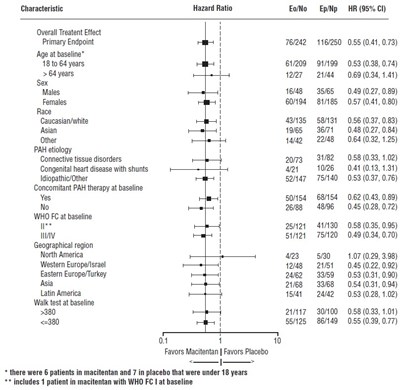
Figure-3 (Macitentan Fig3)
Eo = Number of events macitentan 10 mg; No = Number of patients randomized to macitentan 10 mg
Ep = Number of events placebo; Np = Number of patients randomized to placebo
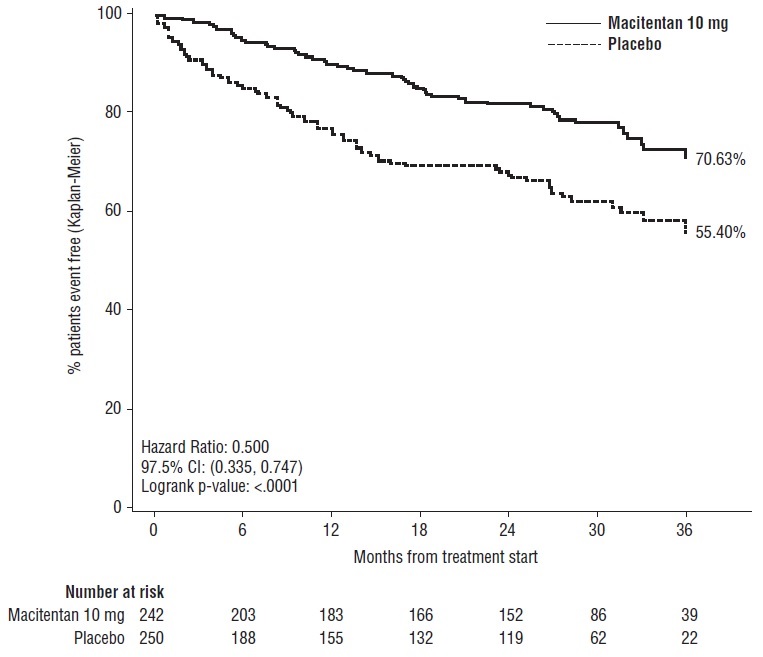
PAH related death or hospitalization for PAH was assessed as a secondary endpoint. The risk of PAH related death or hospitalization for PAH was reduced by 50% in patients receiving macitentan 10 mg compared to placebo (HR 0.50, 97.5% CI 0.34 to 0.75; logrank p<0.0001) (Table 4 and Figure 4).
Figure 4 Kaplan-Meier Estimates of the Occurrence of Death due to PAH or Hospitalization for PAH in SERAPHIN
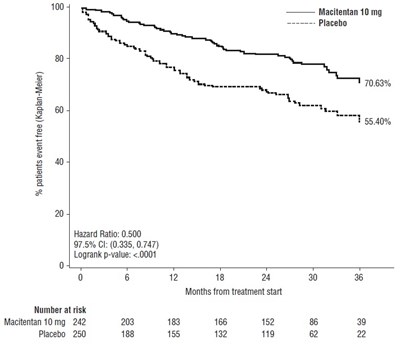
Figure-4 (Macitentan Fig4)
Table 4: Summary of Death due to PAH and Hospitalization due to PAH
| Placebo
(N=250)
n (%)
| Macitentan 10 mg
(N=242)
n (%)
|
Death due to PAH or hospitalization for PAH
| 84 (33.6)
| 50 (20.7)
|
Component as first event
Death due to PAH
Hospitalization for PAH
| 5 (2.0)
79 (31.6)
| 5 (2.1)
45 (18.6)
|
Treatment with macitentan 10 mg resulted in a placebo-corrected mean increase in 6MWD of 22 meters at Month 6 (97.5% CI 3 to 41; p=0.0078), with significant improvement in 6MWD by Month 3. 6MWD increased more in patients with worse baseline WHO Functional Class (37 meters and 12 meters placebo-corrected mean increase in WHO FC III/IV and FC I/II, respectively). The increase in 6MWD achieved with macitentan was maintained for the duration of the study.
Treatment with macitentan 10 mg led to an improvement of at least one WHO Functional Class at Month 6 in 22% of patients compared to 13% of patients treated with placebo.
Long-Term Treatment of PAH
In long-term follow-up of patients who were treated with macitentan 10 mg in the placebo-controlled study (N=242) and the open-label extension study, Kaplan-Meier estimates of survival at 1, 2, 5, and 7 years were 95%, 89%, 73%, and 63% respectively. The median exposure to macitentan was 4.6 years. These uncontrolled observations do not allow comparison with a group not given macitentan and cannot be used to determine the long term-effect of macitentan on mortality.