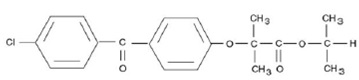
Hepatotoxicity: Serious drug-induced liver injury (DILI), including liver transplantation and death, have been reported postmarketing with fenofibrate. DILI has been reported within the first few weeks of treatment or after several months of therapy and in some cases has reversed with discontinuation of fenofibrate treatment. Patients with DILI have experienced signs and symptoms including dark urine, abnormal stool, jaundice, malaise, abdominal pain, myalgia, weight loss, pruritus, and nausea. Many patients had concurrent elevations of total bilirubin, serum alanine transaminase (ALT), and aspartate transaminase (AST). DILI has been characterized as hepatocellular, chronic active, and cholestatic hepatitis, and cirrhosis has occurred in association with chronic active hepatitis.
In clinical trials, fenofibrate at doses equivalent to 134 mg to 200 mg fenofibrate daily has been associated with increases in serum AST or ALT. The incidence of increases in transaminases may be dose-related.
Fenofibrate is contraindicated in patients with active liver disease, including those with primary biliary cirrhosis and unexplained persistent liver function abnormalities (see CONTRAINDICATIONS). Monitor patient’s liver function, including serum ALT, AST, and total bilirubin, at baseline and periodically for the duration of therapy with fenofibrate. Discontinue fenofibrate if signs or symptoms of liver injury develop or if elevated enzyme levels persist (ALT or AST > 3 times the upper limit of normal, or if accompanied by elevation of bilirubin). Do not restart fenofibrate in these patients if there is no alternative explanation for the liver injury.
Cholelithiasis: Fenofibrate, like clofibrate and gemfibrozil, may increase cholesterol excretion into the bile, leading to cholelithiasis. If cholelithiasis is suspected, gallbladder studies are indicated. Fenofibrate therapy should be discontinued if gallstones are found.
Concomitant Oral Anticoagulants: Caution should be exercised when anticoagulants are given in conjunction with fenofibrate because of the potentiation of coumarin-type anticoagulants in prolonging the prothrombin time/INR. The dosage of the anticoagulant should be reduced to maintain the prothrombin time/INR at the desired level to prevent bleeding complications. Frequent prothrombin time/INR determinations are advisable until it has been definitely determined that the prothrombin time/INR has stabilized.
Concomitant HMG-CoA reductase inhibitors: The combined use of fenofibrate and HMG-CoA reductase inhibitors should be avoided unless the benefit of further alterations in lipid levels is likely to outweigh the increased risk of this drug combination.
Concomitant administration of fenofibrate (equivalent to fenofibrate 200 mg) and pravastatin (40 mg) once daily for 10 days increased the mean Cmax and AUC values for pravastatin by 36% (range from 69% decrease to 321% increase) and 28% (range from 54% decrease to 128% increase), respectively, and for 3α-hydroxy-iso-pravastatin by 55% (range from 32% decrease to 314% increase) and 39% (range from 24% decrease to 261% increase), respectively. (See also CLINICAL PHARMACOLOGY, Drug-drug Interactions).
The combined use of fibric acid derivatives and HMG-CoA reductase inhibitors has been associated, in the absences of a marked pharmacokinetic interaction, in numerous case reports, with rhabdomyolysis, markedly elevated creatine kinase (CK) levels and myoglobinuria, leading in a high proportion of cases to acute renal failure.
The use of fibrates alone, including fenofibrate, may occasionally be associated with myositis, myopathy, or rhabdomyolysis. Patients receiving fenofibrate and complaining of muscle pain, tenderness, or weakness should have prompt medical evaluation for myopathy, including serum creatine kinase level determination. If myopathy/myositis is suspected or diagnosed, fenofibrate therapy should be stopped.
Mortality: The effect of fenofibrate on coronary heart disease morbidity and mortality and non- cardiovascular mortality has not been established.
Other Considerations: The Fenofibrate Intervention and Event Lowering in Diabetes (FIELD) study was a 5-year randomized, placebo-controlled study of 9,795 patients with type 2 diabetes mellitus treated with fenofibrate.
Fenofibrate demonstrated a non-significant 11% relative reduction in the primary outcome of coronary heart disease events (hazard ratio [HR] 0.89, 95% CI 0.75 to 1.05, p = 0.16) and a significant 11% reduction in the secondary outcome of total cardiovascular disease events (HR 0.89 [0.80 to 0.99], p = 0.04). There was a non-significant 11% (HR 1.11 [0.95, 1.29], p = 0.18) and 19% (HR 1.19 [0.90, 1.57], p = 0.22) increase in total and coronary heart disease mortality, respectively, with fenofibrate as compared to placebo.
In the Coronary Drug Project, a large study of post myocardial infarction of patients treated for 5 years with clofibrate, there was no difference in mortality seen between the clofibrate group and the placebo group. There was however, a difference in the rate of cholelithiasis and cholecystitis requiring surgery between the two groups (3.0% vs. 1.8%).
Because of chemical, pharmacological, and clinical similarities between fenofibrate capsules, Atromid-S (clofibrate), and Lopid (gemfibrozil), the adverse findings in 4 large randomized, placebo-controlled clinical studies with these other fibrate drugs may also apply to fenofibrate.
In a study conducted by the World Health Organization (WHO), 5000 subjects without known coronary artery disease were treated with placebo or clofibrate for 5 years and followed for an additional one year. There was a statistically significant, higher age-adjusted all-cause mortality in the clofibrate group compared with the placebo group (5.70% vs. 3.96%, p=<0.01). Excess mortality was due to a 33% increase in non-cardiovascular causes, including malignancy, post-cholecystectomy complications, and pancreatitis. This appeared to confirm the higher risk of gallbladder disease seen in clofibrate-treated patients studied in the Coronary Drug Project.
The Helsinki Heart Study was a large (n=4081) study of middle-aged men without a history of coronary artery disease. Subjects received either placebo or gemfibrozil for 5 years, with a 3.5 year open extension afterward. Total mortality was numerically higher in the gemfibrozil randomization group but did not achieve statistical significance (p=0.19, 95% confidence interval for relative risk G:P=0.91 to 1.64). Although cancer deaths trended higher in the gemfibrozil group (p=0.11), cancers (excluding basal cell carcinoma) were diagnosed with equal frequency in both study groups. Due to the limited size of the study, the relative risk of death from any cause was not shown to be different than that seen in the 9 year follow-up data from World Health Organization study (RR=1.29). Similarly, the numerical excess of gallbladder surgeries in the gemfibrozil group did not differ statistically from that observed in the WHO study.
A secondary prevention component of the Helsinki Heart Study enrolled middle-aged men excluded from the primary prevention study because of known or suspected coronary heart disease. Subjects received gemfibrozil or placebo for 5 years. Although cardiac deaths trended higher in the gemfibrozil group, this was not statistically significant (hazard ratio 2.2, 95% confidence interval: 0.94 to 5.05). The rate of gallbladder surgery was not statistically significant between study groups, but did trend higher in the gemfibrozil group, (1.9% vs. 0.3%, p=0.07). There was a statistically significant difference in the number of appendectomies in the gemfibrozil group (6/311 vs. 0/317, p=0.029).