Duloxetine Capsule, Delayed Release
Product Images NDC 59651-280
View Photos of Packaging, Regulatory Labels, and Product Appearance
Product Visual Gallery
This gallery contains 16 technical images submitted to the FDA as part of the official labeling for Duloxetine (NDC 59651-280). Unlike standard consumer photos, these assets often include clinical data figures, molecular chemical structures, and official manufacturer packaging layouts.
As provided by Aurobindo Pharma Limited, these visuals offer a comprehensive scientific overview of the product's physical and chemical identity, aiding pharmacists and researchers in product verification and study.
Product Images & Figures Index
Package Label-principal Display Panel (30 mg (30 Capsules Bottle))
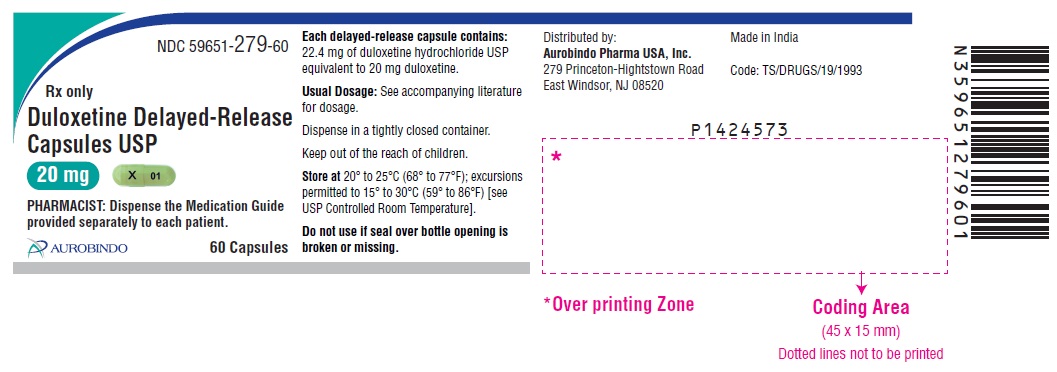
This is a medication description for Duloxetine Delayed-Release Capsules USP which contain 594 mg of et ytrocionds USP, equivalent to 20 mg dulovetine. The medication is distributed by Aurinda Pharma USA and has a unique code TY/DRUGS/19/1093. The usual dosage instructions are provided in accompanying literature, and the medication should be stored in a closed container at the recommended temperature of 20 °C to 25 °C (66 °F to 77 °F). The pharmacist should dispense the medication guide to the patient separately. The text also mentions a manufacturer and a batch number.*
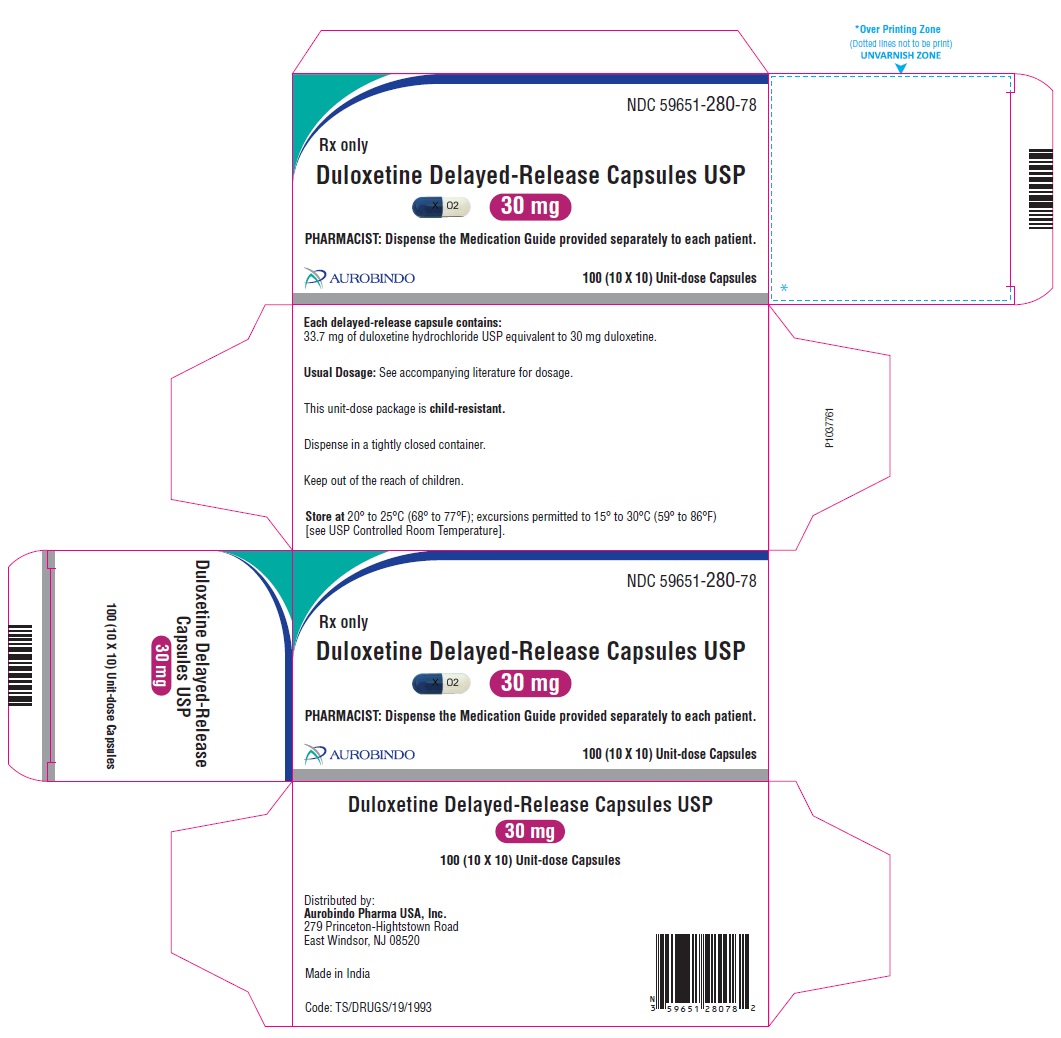
Package Label-principal Display Panel (30 mg Blister Carton (10 x 10 Unit-dose))
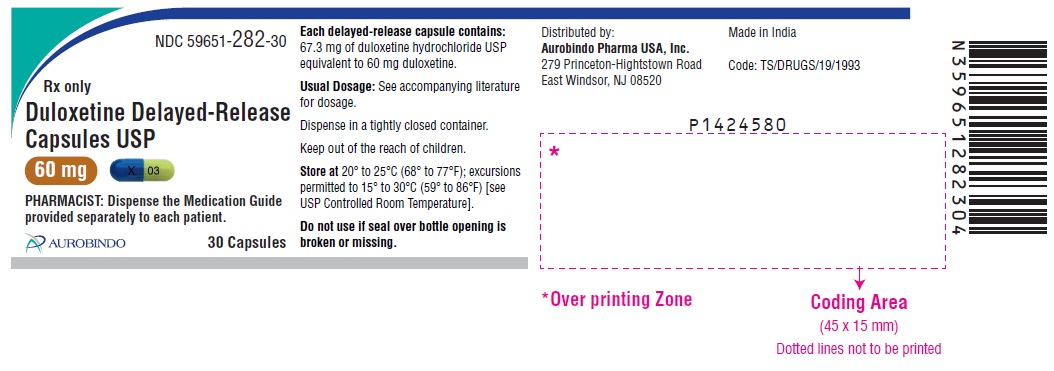
Package Label-principal Display Panel (60 mg (30 Capsules Bottle))
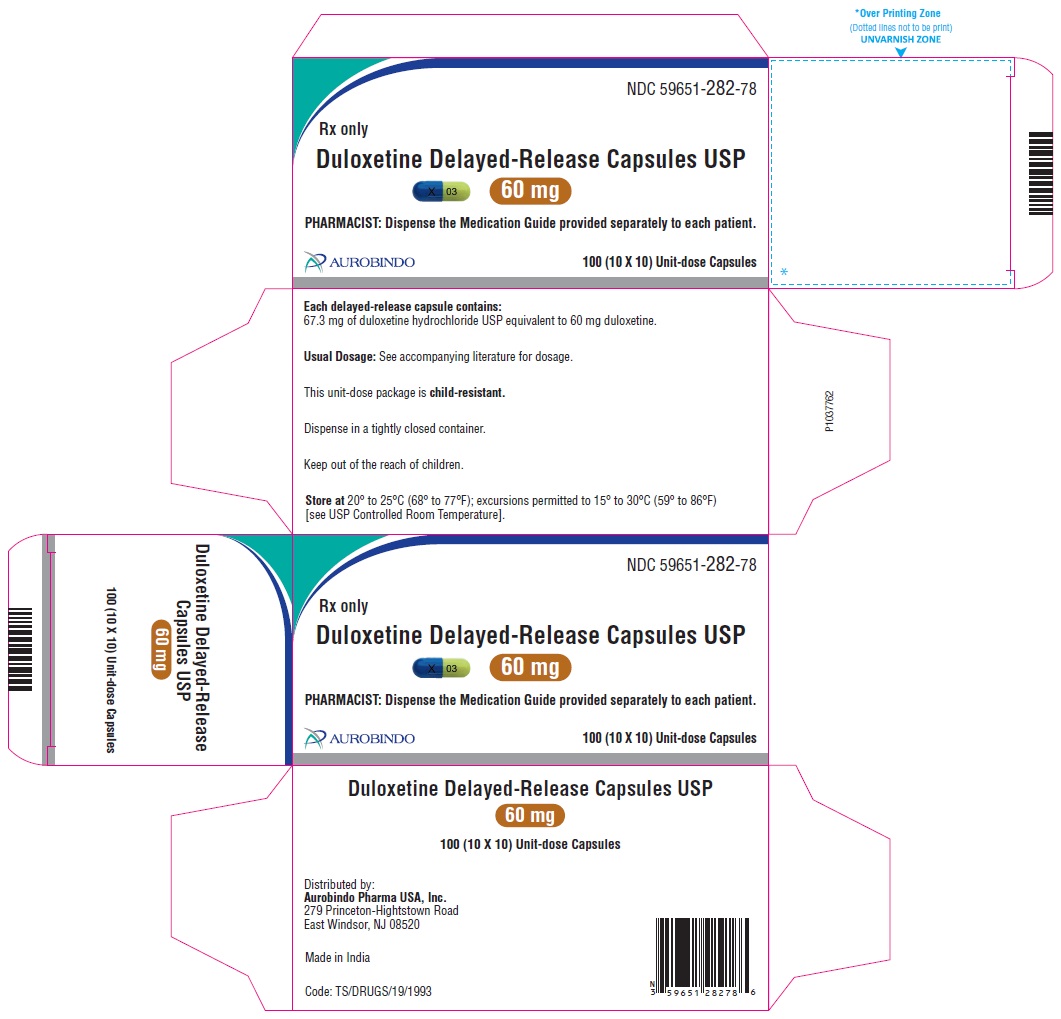
Package Label-principal Display Panel (60 mg Blister Carton (10 x 10 Unit-dose))
This is a description of a medication called Duloxetine Delayed-Release Capsules. The package contains 100 unit-dose capsules, and each capsule contains 337mg of duloxetine hydrochloride USP equivalent to 30mg of duloxetine. The medication is intended for prescription-only use, and the pharmacist is required to dispense the medication guide provided separately with each patient. The package is child-resistant, and the medication should be kept out of reach of children in a tightly closed container. The recommended storage temperature is between 20°C to 25°C (68°F to 77°F), with permitted excursions to 15°C to 30°C (59°F to 86°F). The medicine is distributed by Aurobindo Pharma USA, Inc. and made in India.*
Duloxetine Fig14
This is a medication guide for Duloxetine Delayed-Release Capsules USP, distributed by Aurobindo Pharma USA, Inc. Each capsule contains 67.3mg of duloxetine hydrochloride USP, equivalent to 60 mg duloxetine. The usual dosage is provided in the accompanying literature. It's important to dispense the medication guide to each patient. The medication should be stored at 20° to 25°C (68° to 77°F) with permitted excursions of 15° to 30°C (59 to 86°F). The drug should be kept in a tightly closed container and out of reach of children. Do not use if seal over the bottle opening is broken or missing. Code: TSDRUGS/9/1993.*
Duloxetine Fig15
This is a description of a medication called Duloxetine Delayed-Release Capsules. The package contains 100 (10 X 10) unit-dose capsules, and each capsule contains 67.3mg of duloxetine hydrochloride USP, equivalent to 60mg duloxetine. The usual dosage amount can be found in the accompanying literature. The medication guide should be provided separately to each patient when dispensing. The package is child-resistant and should be stored in a tightly closed container at a controlled room temperature between 20°C-25°C (68°F-77°F), with permitted excursions to 15°C-30°C (59°F-86°F). The medication is distributed by Aurobindo Pharma USA, Inc. from their East Windsor location, and it was made in India.*
Figure-2 (Duloxetine Fig2)
Figure-3 (Duloxetine Fig3)
Figure-4 (Duloxetine Fig4)
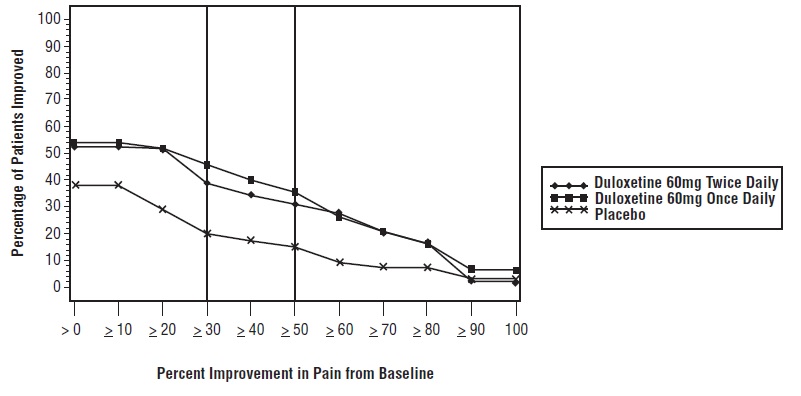
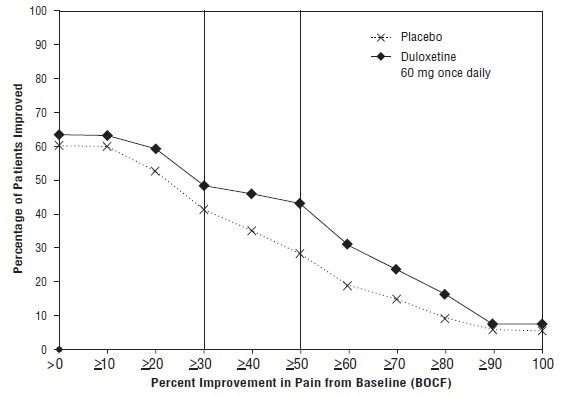
The text appears to be a graph depicting the percentage of patients who improved with different medication dosages. The medications being compared include Duloxetine at 60 mg twice a day, Duloxetine at 60 mg once a day, and a placebo. The x-axis shows the percent improvement in pain from baseline, while the y-axis represents the percentage of patients who saw an improvement.*
Figure-5 (Duloxetine Fig5)
Figure-6 (Duloxetine Fig6)
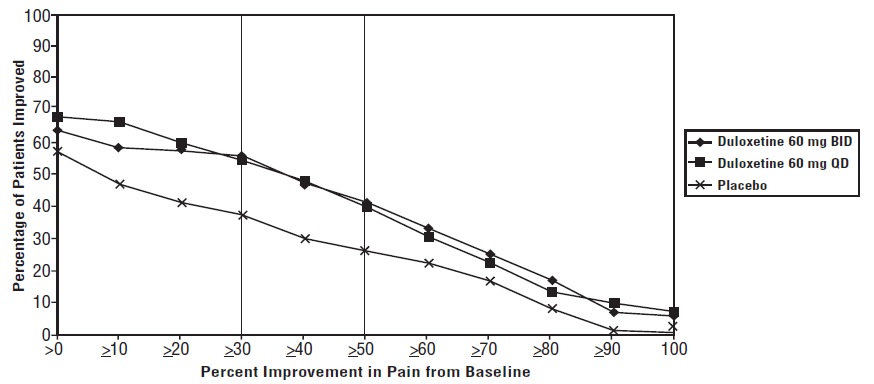
This appears to be a graph showing the percent of patients improved and the percent improvement in pain from baseline for a medication called Duloxetine, which is compared against a placebo. The x-axis shows the percent improvement in pain from baseline (ranging from 0 to 100), while the y-axis shows the percent of patients improved (ranging from 0 to 100). There are also tick marks at 10 increments for both axes. The graph compares the effectiveness of three different doses of Duloxetine (20mg, 60mg, and 120mg once daily) against a placebo.*
Figure-7 (Duloxetine Fig7)
Package Label-principal Display Panel (20 mg (60 Capsules Bottle))
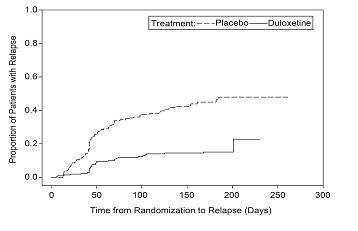
The text appears to be a graph plotting the percentage of patients who improved, with Duloxetine (presumably a medication) and Placebo being compared. The X-axis appears to show a range of values from 0 to 290, possibly indicating the length of the study or the severity of patients' conditions. The Y-axis shows the percentage of patients who improved. However, without further context or a clearer image, it's difficult to determine the exact meaning or significance of the data presented.*
Package Label-principal Display Panel (20 mg Blister Carton (10 x 10 Unit-dose))
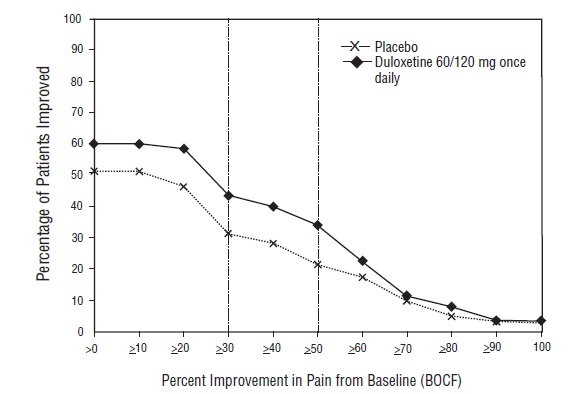
This text seems to be a table or a graph with some numerical values related to a medical treatment. It mentions some medication called "Dulowetine" and shows the dosage of 60/120 mg once daily. It also refers to a measure of percentage improvement in pain from baseline with values ranging from 0 to 100. Without further context, it is difficult to understand the purpose of the table/graph or its significance.*
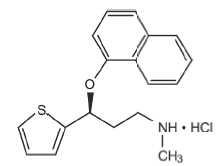
Chemical Structure (Duloxetine Str)
* These product label images have been analyzed using experimental machine learning. Please verify findings with the primary label text.