Because clinical trials are conducted under widely varying conditions, adverse reaction rates observed in the clinical trials of a drug cannot be directly compared to rates in the clinical trials of another drug and may not reflect the rates observed in practice.
Newly Diagnosed MM – Lenalidomide Combination Therapy:
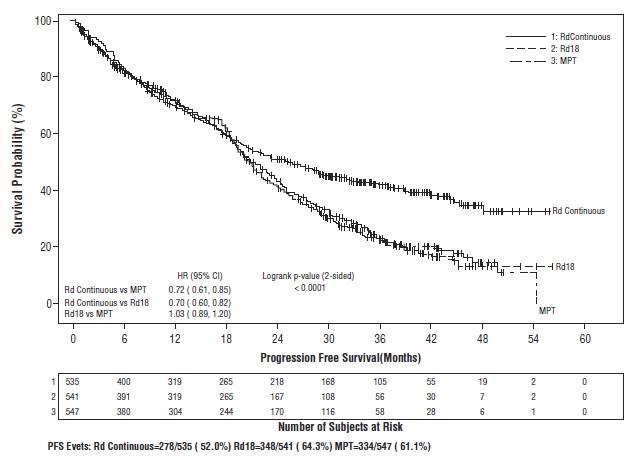
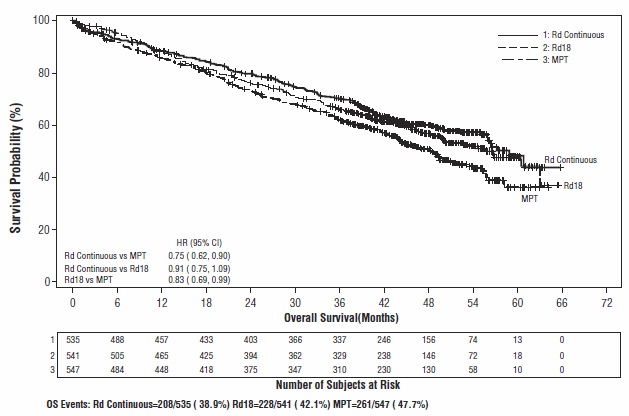
Data were evaluated from 1613 patients in a large phase 3 study who received at least one dose of lenalidomide with low dose dexamethasone (Rd) given for 2 different durations of time (i.e., until progressive disease [Arm Rd Continuous; N=532] or for up to eighteen 28-day cycles [72 weeks, Arm Rd18; N=540] or who received melphalan, prednisone and thalidomide (Arm MPT; N=541) for a maximum of twelve 42-day cycles (72 weeks). The median treatment duration in the Rd Continuous arm was 80.2 weeks (range 0.7 to 246.7) or 18.4 months (range 0.16 to 56.7).
In general, the most frequently reported adverse reactions were comparable in Arm Rd Continuous and Arm Rd18, and included diarrhea, anemia, constipation, peripheral edema, neutropenia, fatigue, back pain, nausea, asthenia, and insomnia. The most frequently reported Grade 3 or 4 reactions included neutropenia, anemia, thrombocytopenia, pneumonia, asthenia, fatigue, back pain, hypokalemia, rash, cataract, lymphopenia, dyspnea, DVT, hyperglycemia, and leukopenia. The highest frequency of infections occurred in Arm Rd Continuous (75%) compared to Arm MPT (56%). There were more grade 3 and 4 and serious adverse reactions of infection in Arm Rd Continuous than either Arm MPT or Rd18.
In the Rd Continuous arm, the most common adverse reactions leading to dose interruption of lenalidomide were infection events (28.8%); overall, the median time to the first dose interruption of lenalidomide was 7 weeks. The most common adverse reactions leading to dose reduction of lenalidomide in the Rd Continuous arm were hematologic events (10.7%); overall, the median time to the first dose reduction of lenalidomide was 16 weeks. In the Rd Continuous arm, the most common adverse reactions leading to discontinuation of lenalidomide were infection events (3.4%).
In both Rd arms, the frequencies of onset of adverse reactions were generally highest in the first 6 months of treatment and then the frequencies decreased over time or remained stable throughout treatment, except for cataracts. The frequency of onset of cataracts increased over time with 0.7% during the first 6 months and up to 9.6% by the 2nd year of treatment with Rd Continuous.
Table 4 summarizes the adverse reactions reported for the Rd Continuous, Rd18, and MPT treatment arms.
Table 4: All Adverse Reactions in ≥5% and Grade 3/4 Adverse Reactions in ≥1% of Patients with MM in the Rd Continuous or Rd18 Arms* Body System
Adverse Reaction
| All Adverse Reactionsa
| Grade 3/4 Adverse Reactionsb
|
|---|
Rd
Continuous
(N= 532)
| Rd18
(N= 540)
| MPT
(N= 541)
| Rd
Continuous
(N= 532)
| Rd18
(N= 540)
| MPT
(N= 541)
|
|---|
Note: A subject with multiple occurrences of an adverse reaction is counted only once under the applicable Body System/Adverse Reaction.
a All treatment-emergent adverse events in at least 5% of subjects in the Rd Continuous or Rd18 Arms and at least a 2% higher frequency (%) in either the Rd Continuous or Rd18 Arms compared to the MPT Arm.
b All grade 3 or 4 treatment-emergent adverse events in at least 1% of subjects in the Rd Continuous or Rd18 Arms and at least a 1% higher frequency (%) in either the Rd Continuous or Rd18 Arms compared to the MPT Arm.
c Serious treatment-emergent adverse events in at least 1% of subjects in the Rd Continuous or Rd18 Arms and at least a 1% higher frequency (%) in either the Rd Continuous or Rd18 Arms compared to the MPT Arm.
d Preferred terms for the blood and lymphatic system disorders body system were included by medical judgment as known adverse reactions for Rd Continuous/Rd18, and have also been reported as serious.
e Footnote “a” not applicable.
f Footnote “b” not applicable.
@ - adverse reactions in which at least one resulted in a fatal outcome.
% - adverse reactions in which at least one was considered to be life threatening (if the outcome of the reaction was death, it is included with death cases).
*Adverse reactions included in combined adverse reaction terms:
Abdominal Pain: Abdominal pain, abdominal pain upper, abdominal pain lower, gastrointestinal pain
Pneumonias: Pneumonia, lobar pneumonia, pneumonia pneumococcal, bronchopneumonia, pneumocystis jiroveci pneumonia, pneumonia legionella, pneumonia staphylococcal, pneumonia klebsiella, atypical pneumonia, pneumonia bacterial, pneumonia escherichia, pneumonia streptococcal, pneumonia viral
Sepsis: Sepsis, septic shock, urosepsis, escherichia sepsis, neutropenic sepsis, pneumococcal sepsis, staphylococcal sepsis, bacterial sepsis, meningococcal sepsis, enterococcal sepsis, klebsiella sepsis, pseudomonal sepsis
Rash: Rash, rash pruritic, rash erythematous, rash maculo-papular, rash generalized, rash papular, exfoliative rash, rash follicular, rash macular, drug rash with eosinophilia and systemic symptoms, erythema multiforme, rash pustular
Deep Vein Thrombosis: Deep vein thrombosis, venous thrombosis limb, venous thrombosis
|
General disorders and administration site conditions
|
Fatigue%
| 173 (33)
| 177 (33)
| 154 (28)
| 39 ( 7)
| 46 ( 9)
| 31 ( 6)
|
Asthenia
| 150 (28)
| 123 (23)
| 124 (23)
| 41 ( 8)
| 33 ( 6)
| 32 ( 6)
|
Pyrexiac
| 114 (21)
| 102 (19)
| 76 (14)
| 13 ( 2)
| 7 ( 1)
| 7 ( 1)
|
Non-cardiac chest painf
| 29 ( 5)
| 31 ( 6)
| 18 ( 3)
| <1%
| < 1%
| < 1%
|
Gastrointestinal disorders
|
Diarrhea
| 242 (45)
| 208 (39)
| 89 (16)
| 21 ( 4)
| 18 ( 3)
| 8 ( 1)
|
Abdominal pain% f
| 109 (20)
| 78 (14)
| 60 (11)
| 7 ( 1)
| 9 ( 2)
| < 1%
|
Dyspepsia f
| 57 (11)
| 28 ( 5)
| 36 ( 7)
| <1%
| < 1%
| 0 ( 0)
|
Musculoskeletal and connective tissue disorders
|
Back painc
| 170 (32)
| 145 (27)
| 116 (21)
| 37 ( 7)
| 34 ( 6)
| 28 ( 5)
|
Muscle spasms f
| 109 (20)
| 102 (19)
| 61 (11)
| < 1%
| < 1%
| < 1%
|
Arthralgia f
| 101 (19)
| 71 (13)
| 66 (12)
| 9 ( 2)
| 8 ( 1)
| 8 ( 1)
|
Bone pain f
| 87 (16)
| 77 (14)
| 62 (11)
| 16 ( 3)
| 15 ( 3)
| 14 ( 3)
|
Pain in extremity f
| 79 (15)
| 66 (12)
| 61 (11)
| 8 ( 2)
| 8 ( 1)
| 7 ( 1)
|
Musculoskeletal pain f
| 67 (13)
| 59 (11)
| 36 ( 7)
| < 1%
| < 1%
| < 1%
|
Musculoskeletal chest pain f
| 60 (11)
| 51 ( 9)
| 39 ( 7)
| 6 ( 1)
| < 1%
| < 1%
|
Muscular weakness f
| 43 ( 8)
| 35 ( 6)
| 29 ( 5)
| < 1%
| 8 ( 1)
| < 1%
|
Neck painf
| 40 ( 8)
| 19 ( 4)
| 10 ( 2)
| < 1%
| < 1%
| < 1%
|
Infections and infestations
|
Bronchitisc
| 90 (17)
| 59 (11)
| 43 ( 8)
| 9 ( 2)
| 6 ( 1)
| < 1%
|
Nasopharyngitisf
| 80 (15)
| 54 (10)
| 33 ( 6)
| 0 ( 0)
| 0 ( 0)
| 0 ( 0)
|
Urinary tract infection f
| 76 (14)
| 63 (12)
| 41 ( 8)
| 8 ( 2)
| 8 ( 1)
| < 1%
|
Upper respiratory tract infectionc% f
| 69 (13)
| 53 ( 10)
| 31 ( 6)
| < 1%
| 8 ( 1)
| < 1%
|
Pneumoniac@
| 93 (17)
| 87 (16)
| 56 (10)
| 60 (11)
| 57 (11)
| 41 ( 8)
|
Respiratory tract infection%
| 35 ( 7)
| 25 ( 5)
| 21 ( 4)
| 7 ( 1)
| < 1%
| < 1%
|
Influenzaf
| 33 ( 6)
| 23 ( 4)
| 15 ( 3)
| < 1%
| < 1%
| 0 ( 0)
|
Gastroenteritis f
| 32 ( 6)
| 17 ( 3)
| 13 ( 2)
| 0 ( 0)
| < 1%
| < 1%
|
Lower respiratory tract infection
| 29 ( 5)
| 14 ( 3)
| 16 ( 3)
| 10 ( 2)
| < 1%
| < 1%
|
Rhinitisf
| 29 ( 5)
| 24 ( 4)
| 14 ( 3)
| 0 ( 0)
| 0 ( 0)
| 0 ( 0)
|
Cellulitisc
| < 5%
| < 5%
| < 5%
| 8 ( 2)
| < 1%
| < 1%
|
Sepsisc@
| 33 ( 6)
| 26 ( 5)
| 18 ( 3)
| 26 ( 5)
| 20 ( 4)
| 13 ( 2)
|
Nervous system disorders
|
Headache f
| 75 (14)
| 52 ( 10)
| 56 (10)
| < 1%
| < 1%
| < 1%
|
Dysgeusia f
| 39 ( 7)
| 45 ( 8)
| 22 ( 4)
| < 1%
| 0 ( 0.0)
| < 1%
|
Blood and lymphatic system disordersd
|
Anemia
| 233 (44)
| 193 (36)
| 229 (42)
| 97 (18)
| 85 (16)
| 102 (19)
|
Neutropenia
| 186 (35)
| 178 (33)
| 328 (61)
| 148 (28)
| 143 (26)
| 243 (45)
|
Thrombocytopenia
| 104 (20)
| 100 (19)
| 135 (25)
| 44 ( 8)
| 43 ( 8)
| 60 (11)
|
Febrile neutropenia
| 7 ( 1)
| 17 ( 3)
| 15 ( 3)
| 6 ( 1)
| 16 ( 3)
| 14 ( 3)
|
Pancytopenia
| < 1%
| 6 ( 1)
| 7 ( 1)
| < 1%
| < 1%
| < 1%
|
Respiratory, thoracic and mediastinal disorders
|
Cough f
| 121 (23)
| 94 (17)
| 68 (13)
| < 1%
| < 1%
| < 1%
|
Dyspneac,e
| 117 (22)
| 89 (16)
| 113 (21)
| 30 ( 6)
| 22 ( 4)
| 18 ( 3)
|
Epistaxis f
| 32 ( 6)
| 31 ( 6)
| 17 ( 3)
| < 1%
| < 1%
| 0 ( 0)
|
Oropharyngeal pain f
| 30 ( 6)
| 22 ( 4)
| 14 ( 3)
| 0 ( 0)
| 0 ( 0)
| 0 ( 0)
|
Dyspnea exertional e
| 27 ( 5)
| 29 ( 5)
| < 5%
| 6 ( 1)
| < 1%
| 0 ( 0)
|
Metabolism and nutrition disorders
|
Decreased appetite
| 123 (23)
| 115 (21)
| 72 (13)
| 14 ( 3)
| 7 ( 1)
| < 1%
|
Hypokalemia%
| 91 (17)
| 62 (11)
| 38 ( 7)
| 35 ( 7)
| 20 ( 4)
| 11 ( 2)
|
Hyperglycemia
| 62 (12)
| 52 ( 10)
| 19 ( 4)
| 28 ( 5)
| 23 ( 4)
| 9 ( 2)
|
Hypocalcemia
| 57 (11)
| 56 (10)
| 31 ( 6)
| 23 ( 4)
| 19 ( 4)
| 8 ( 1)
|
Dehydration%
| 25 ( 5)
| 29 ( 5)
| 17 ( 3)
| 8 ( 2)
| 13 ( 2)
| 9 ( 2)
|
Gout e
| < 5%
| < 5%
| < 5%
| 8 ( 2)
| 0 ( 0)
| 0 ( 0)
|
Diabetes mellitus% e
| < 5%
| < 5%
| < 5%
| 8 ( 2)
| < 1%
| < 1%
|
Hypophosphatemia e
| < 5%
| < 5%
| < 5%
| 7 ( 1)
| < 1%
| < 1%
|
Hyponatremia% e
| < 5%
| < 5%
| < 5%
| 7 ( 1)
| 13 ( 2)
| 6 ( 1)
|
Skin and subcutaneous tissue disorders
|
Rash
| 139 (26)
| 151 (28)
| 105 (19)
| 39 ( 7)
| 38 ( 7)
| 33 ( 6)
|
Pruritus f
| 47 ( 9)
| 49 ( 9)
| 24 ( 4)
| < 1%
| < 1%
| < 1%
|
Psychiatric disorders
|
Insomnia
| 147 (28)
| 127 (24)
| 53 ( 10)
| < 1%
| 6 ( 1)
| 0 ( 0)
|
Depression
| 58 (11)
| 46 ( 9)
| 30 ( 6)
| 10 ( 2)
| < 1%
| < 1%
|
Vascular disorders
|
Deep vein thrombosisc%
| 55 (10)
| 39 ( 7)
| 22 ( 4)
| 30 ( 6)
| 20 ( 4)
| 15 ( 3)
|
Hypotensionc%
| 51 ( 10)
| 35 ( 6)
| 36 ( 7)
| 11 ( 2)
| 8 ( 1)
| 6 ( 1)
|
Injury, Poisoning, and Procedural Complications
|
Fall f
| 43 ( 8)
| 25 ( 5)
| 25 ( 5)
| < 1%
| 6 ( 1)
| 6 ( 1)
|
Contusion f
| 33 ( 6)
| 24 ( 4)
| 15 ( 3)
| < 1%
| < 1%
| 0 ( 0)
|
Eye disorders
|
Cataract
| 73 (14)
| 31 ( 6)
| < 1%
| 31 ( 6)
| 14 ( 3)
| < 1%
|
Cataract subcapsular e
| < 5%
| < 5%
| < 5%
| 7 ( 1)
| 0 ( 0)
| 0 ( 0)
|
Investigations
|
|
|
|
|
|
|
Weight decreased
| 72 (14)
| 78 (14)
| 48 ( 9)
| 11 ( 2)
| < 1%
| < 1%
|
Cardiac disorders
|
Atrial fibrillationc
| 37 ( 7)
| 25 ( 5)
| 25 ( 5)
| 13 ( 2)
| 9 ( 2)
| 6 ( 1)
|
Myocardial infarction
(including acute)c,e
| < 5%
| < 5%
| < 5%
| 10 ( 2)
| < 1%
| < 1%
|
Renal and Urinary disorders
|
Renal failure (including acute)c@,f
| 49 ( 9)
| 54 (10)
| 37 ( 7)
| 28 ( 5)
| 33 ( 6)
| 29 ( 5)
|
Neoplasms benign, malignant and unspecified (Including cysts and polyps)
|
Squamous cell carcinomac,e
| < 5%
| < 5%
| < 5%
| 8 ( 2)
| < 1%
| 0 ( 0)
|
Basal cell carcinomac e,f
| < 5%
| < 5%
| < 5%
| < 1%
| < 1%
| 0 ( 0)
|
After At Least One Prior Therapy for MM:
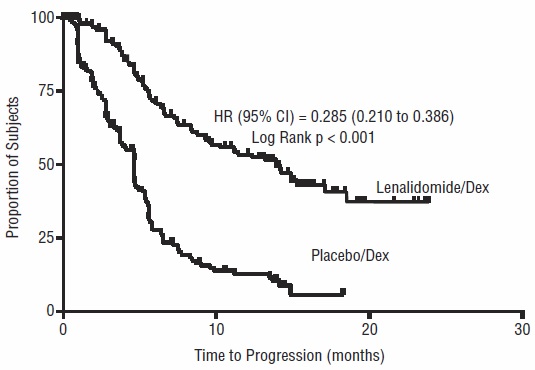
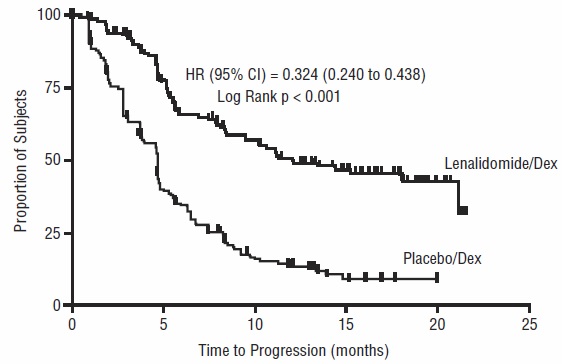
Data were evaluated from 703 patients in two studies who received at least one dose of lenalidomide/dexamethasone (353 patients) or placebo/dexamethasone (350 patients).
In the lenalidomide/dexamethasone treatment group, 269 patients (76%) had at least one dose interruption with or without a dose reduction of lenalidomide compared to 199 patients (57%) in the placebo/dexamethasone treatment group. Of these patients who had one dose interruption with or without a dose reduction, 50% in the lenalidomide/dexamethasone treatment group had at least one additional dose interruption with or without a dose reduction compared to 21% in the placebo/dexamethasone treatment group. Most adverse reactions and Grade 3/4 adverse reactions were more frequent in patients who received the combination of lenalidomide/dexamethasone compared to placebo/dexamethasone.
Tables 6, 7, and 8 summarize the adverse reactions reported for lenalidomide/dexamethasone and placebo/dexamethasone groups.
Table 6: Adverse Reactions Reported in ≥5% of Patients and with a ≥2% Difference in Proportion of Patients with MM between the Lenalidomide/dexamethasone and Placebo/dexamethasone Groups Body System
Adverse Reaction
| Lenalidomide/Dex
(N=353)
n (%)
| Placebo/Dex
(N=350)
n (%)
|
Blood and lymphatic system disorders
|
Neutropenia%
| 149 (42)
| 22 ( 6)
|
Anemia@
| 111 (31)
| 83 (24)
|
Thrombocytopenia@
| 76 (22)
| 37 (11)
|
Leukopenia
| 28 ( 8)
| 4 ( 1)
|
Lymphopenia
| 19 ( 5)
| 5 ( 1)
|
General disorders and administration site conditions
|
Fatigue
| 155 (44)
| 146 (42)
|
Pyrexia
| 97 (27)
| 82 (23)
|
Peripheral edema
| 93 (26)
| 74 (21)
|
Chest pain
| 29 ( 8)
| 20 ( 6)
|
Lethargy
| 24 ( 7)
| 8 ( 2)
|
Gastrointestinal disorders
|
Constipation
| 143 (41)
| 74 (21)
|
Diarrhea@
| 136 (39)
| 96 (27)
|
Nausea@
| 92 (26)
| 75 (21)
|
Vomiting@
| 43 (12)
| 33 ( 9)
|
Abdominal pain@
| 35 ( 10)
| 22 ( 6)
|
Dry mouth
| 25 ( 7)
| 13 ( 4)
|
Musculoskeletal and connective tissue disorders
|
Muscle cramp
| 118 (33)
| 74 (21)
|
Back pain
| 91 (26)
| 65 (19)
|
Bone pain
| 48 (14)
| 39 (11)
|
Pain in limb
| 42 (12)
| 32 ( 9)
|
Nervous system disorders
|
Dizziness
| 82 (23)
| 59 (17)
|
Tremor
| 75 (21)
| 26 ( 7)
|
Dysgeusia
| 54 (15)
| 34 ( 10)
|
Hypoesthesia
| 36 (10)
| 25 ( 7)
|
Neuropathyª
| 23 ( 7)
| 13 ( 4)
|
Respiratory, thoracic and mediastinal disorders
|
Dyspnea
| 83 (24)
| 60 (17)
|
Nasopharyngitis
| 62 (18)
| 31 ( 9)
|
Pharyngitis
| 48 (14)
| 33 ( 9)
|
Bronchitis
| 40 (11)
| 30 ( 9)
|
Infectionsb and infestations
|
Upper respiratory tract infection
| 87 (25)
| 55 (16)
|
Pneumonia@
| 48 (14)
| 29 ( 8)
|
Urinary tract infection
| 30 ( 8)
| 19 ( 5)
|
Sinusitis
| 26 ( 7)
| 16 ( 5)
|
Skin and subcutaneous system disorders
|
Rashc
| 75 (21)
| 33 ( 9)
|
Sweating increased
| 35 ( 10)
| 25 ( 7)
|
Dry skin
| 33 ( 9)
| 14 ( 4)
|
Pruritus
| 27 ( 8)
| 18 ( 5)
|
Metabolism and nutrition disorders
|
Anorexia
| 55 (16)
| 34 ( 10)
|
Hypokalemia
| 48 (14)
| 21 ( 6)
|
Hypocalcemia
| 31 ( 9)
| 10 ( 3)
|
Appetite decreased
| 24 ( 7)
| 14 ( 4)
|
Dehydration
| 23 ( 7)
| 15 ( 4)
|
Hypomagnesemia
| 24 ( 7)
| 10 ( 3)
|
Investigations
|
Weight decreased
| 69 (20)
| 52 (15)
|
Eye disorders
|
Blurred vision
| 61 (17)
| 40 (11)
|
Vascular disorders
|
Deep vein thrombosis%
| 33 ( 9)
| 15 ( 4)
|
Hypertension
| 28 ( 8)
| 20 ( 6)
|
Hypotension
| 25 ( 7)
| 15 ( 4)
|
Table 7: Grade 3/4 Adverse Reactions Reported in ≥2% Patients and with a ≥1% Difference in Proportion of Patients with MM between the Lenalidomide /dexamethasone and Placebo/dexamethasone groups Body System
Adverse Reaction
| Lenalidomide/Dex
(N=353)
n (%)
| Placebo/Dex
(N=350)
n (%)
|
Blood and lymphatic system disorders
|
Neutropenia%
| 118 (33)
| 12 ( 3)
|
Thrombocytopenia@
| 43 (12)
| 22 ( 6)
|
Anemia@
| 35 ( 10)
| 20 ( 6)
|
Leukopenia
| 14 ( 4)
| < 1%
|
Lymphopenia
| 10 ( 3)
| 4 ( 1)
|
Febrile neutropenia%
| 8 ( 2)
| 0 ( 0)
|
General disorders and administration site conditions
|
Fatigue
| 23 ( 7)
| 17 ( 5)
|
Vascular disorders
|
Deep vein thrombosis%
| 29 ( 8)
| 12 ( 3)
|
Infections and infestations
|
Pneumonia@
| 30 ( 8)
| 19 ( 5)
|
Urinary tract infection
| 5 ( 1)
| < 1%
|
Metabolism and nutrition disorders
|
Hypokalemia
| 17 ( 5)
| 5 ( 1)
|
Hypocalcemia
| 13 ( 4)
| 6 ( 2)
|
Hypophosphatemia
| 9 ( 3)
| 0 ( 0)
|
Respiratory, thoracic and mediastinal disorders
|
Pulmonary embolism@
| 14 ( 4)
| < 1%
|
Respiratory distress@
| 4 ( 1)
| 0 ( 0)
|
Musculoskeletal and connective tissue disorders
|
Muscle weakness
| 20 ( 6)
| 10 ( 3)
|
Gastrointestinal disorders
|
Diarrhea@
| 11 ( 3)
| 4 ( 1)
|
Constipation
| 7 ( 2)
| < 1%
|
Nausea@
| 6 ( 2)
| < 1%
|
Cardiac disorders
|
Atrial fibrillation@
| 13 ( 4)
| 4 ( 1)
|
Tachycardia
| 6 ( 2)
| < 1%
|
Cardiac failure congestive@
| 5 ( 1)
| < 1%
|
Nervous system disorders
|
Syncope
| 10 ( 3)
| < 1%
|
Dizziness
| 7 ( 2)
| < 1%
|
Eye disorders
|
|
|
Cataract
| 6 ( 2)
| < 1%
|
Cataract unilateral
| 5 ( 1)
| 0 ( 0)
|
Psychiatric disorder
|
|
|
Depression
| 10 ( 3)
| 6 ( 2)
|
Table 8: Serious Adverse Reactions Reported in ≥1% Patients and with a ≥1% Difference in Proportion of Patients with MM between the Lenalidomide/dexamethasone and Placebo/dexamethasone GroupsFor Tables 6, 7 and 8 above:
@ - adverse reactions in which at least one resulted in a fatal outcome.
% - adverse reactions in which at least one was considered to be life threatening (if the outcome of the reaction was death, it is included with death cases).
Median duration of exposure among patients treated with lenalidomide/dexamethasone was 44 weeks while median duration of exposure among patients treated with placebo/dexamethasone was 23 weeks. This should be taken into consideration when comparing frequency of adverse reactions between two treatment groups lenalidomide/dexamethasone vs. placebo/dexamethasone.
|
Body System
Adverse Reaction
| Lenalidomide/Dex
(N=353)
n (%)
| Placebo/Dex
(N=350)
n (%)
|
Blood and lymphatic system disorders
|
Febrile neutropenia%
| 6 ( 2)
| 0 ( 0)
|
Vascular disorders
|
Deep vein thrombosis%
| 26 ( 7)
| 11 ( 3)
|
Infections and infestations
|
Pneumonia@
| 33 ( 9)
| 21 ( 6)
|
Respiratory, thoracic, and mediastinal disorders
|
Pulmonary embolism@
| 13 ( 4)
| < 1%
|
Cardiac disorders
|
Atrial fibrillation@
| 11 ( 3)
| < 1%
|
Cardiac failure congestive@
| 5 ( 1)
| 0 ( 0)
|
Nervous system disorders
|
Cerebrovascular accident@
| 7 ( 2)
| < 1%
|
Gastrointestinal disorders
|
|
|
Diarrhea@
| 6 ( 2)
| < 1%
|
Musculoskeletal and connective tissue disorders
|
|
|
Bone pain
| 4 ( 1)
| 0 ( 0)
|
Venous and Arterial Thromboembolism [see Boxed Warning, Warnings and Precautions (5.4)]
VTE and ATE are increased in patients treated with lenalidomide.
Deep vein thrombosis (DVT) was reported as a serious (7.4%) or severe (8.2%) adverse drug reaction at a higher rate in the lenalidomide/dexamethasone group compared to 3.1 % and 3.4% in the placebo/dexamethasone group, respectively in the 2 studies in patients with at least 1 prior therapy with discontinuations due to DVT adverse reactions reported at comparable rates between groups. In the NDMM study, DVT was reported as an adverse reaction (all grades: 10.3%, 7.2%, 4.1%), as a serious adverse reaction (3.6%, 2.0%, 1.7%), and as a Grade 3/4 adverse reaction (5.6%, 3.7%, 2.8%) in the Rd Continuous, Rd18, and MPT Arms, respectively. Discontinuations and dose reductions due to DVT adverse reactions were reported at comparable rates between the Rd Continuous and Rd18 Arms (both <1%). Interruption of lenalidomide treatment due to DVT adverse reactions was reported at comparable rates between the Rd Continuous (2.3%) and Rd18 (1.5%) arms. Pulmonary embolism (PE) was reported as a serious adverse drug reaction (3.7%) or Grade 3/4 (4.0%) at a higher rate in the lenalidomide/dexamethasone group compared to 0.9% (serious or grade 3/4) in the placebo/dexamethasone group in the 2 studies in patients with, at least 1 prior therapy, with discontinuations due to PE adverse reactions reported at comparable rates between groups. In the NDMM study, the frequency of adverse reactions of PE was similar between the Rd Continuous, Rd18, and MPT Arms for adverse reactions (all grades: 3.9%, 3.3%, and 4.3%, respectively), serious adverse reactions (3.8%, 2.8%, and 3.7%, respectively), and grade 3/4 adverse reactions (3.8%, 3.0%, and 3.7%, respectively).
Myocardial infarction was reported as a serious (1.7%) or severe (1.7%) adverse drug reaction at a higher rate in the lenalidomide/dexamethasone group compared to 0.6 % and 0.6% respectively in the placebo/dexamethasone group. Discontinuation due to MI (including acute) adverse reactions was 0.8% in lenalidomide/dexamethasone group and none in the placebo/dexamethasone group. In the NDMM study, myocardial infarction (including acute) was reported as an adverse reaction (all grades: 2.4%, 0.6%, and 1.1%), as a serious adverse reaction, (2.3%, 0.6%, and 1.1%), or as a severe adverse reaction (1.9%, 0.6%, and 0.9%) in the Rd Continuous, Rd18, and MPT Arms, respectively.
Stroke (CVA) was reported as a serious (2.3%) or severe (2.0%) adverse drug reaction in the lenalidomide/dexamethasone group compared to 0.9% and 0.9% respectively in the placebo/dexamethasone group. Discontinuation due to stroke (CVA) was 1.4% in lenalidomide/ dexamethasone group and 0.3% in the placebo/dexamethasone group. In the NDMM study, CVA was reported as an adverse reaction (all grades: 0.8%, 0.6%, and 0.6%), as a serious adverse reaction (0.8%, 0.6 %, and 0.6%), or as a severe adverse reaction (0.6%, 0.6%, 0.2%) in the Rd Continuous, Rd18, and MPT arms respectively.
Other Adverse Reactions: After At Least One Prior Therapy for MM
In these 2 studies, the following adverse drug reactions (ADRs) not described above that occurred at ≥1% rate and of at least twice of the placebo percentage rate were reported:
Blood and lymphatic system disorders: pancytopenia, autoimmune hemolytic anemia
Cardiac disorders: bradycardia, myocardial infarction, angina pectoris
Endocrine disorders: hirsutism
Eye disorders: blindness, ocular hypertension
Gastrointestinal disorders: gastrointestinal hemorrhage, glossodynia
General disorders and administration site conditions: malaise
Investigations: liver function tests abnormal, alanine aminotransferase increased
Nervous system disorders: cerebral ischemia
Psychiatric disorders: mood swings, hallucination, loss of libido
Reproductive system and breast disorders: erectile dysfunction
Respiratory, thoracic and mediastinal disorders: cough, hoarseness
Skin and subcutaneous tissue disorders: exanthem, skin hyperpigmentation