Tofacitinib Tablet, Extended Release
Product Images NDC 59651-685

View Photos of Packaging, Regulatory Labels, and Product Appearance

Product Visual Gallery

This gallery contains 8 technical images submitted to the FDA as part of the official labeling for Tofacitinib (NDC 59651-685). Unlike standard consumer photos, these assets often include clinical data figures, molecular chemical structures, and official manufacturer packaging layouts.

As provided by Aurobindo Pharma Limited, these visuals offer a comprehensive scientific overview of the product's physical and chemical identity, aiding pharmacists and researchers in product verification and study.

FDA Label Image

Figure 1 (Tofacitinib Fig1)
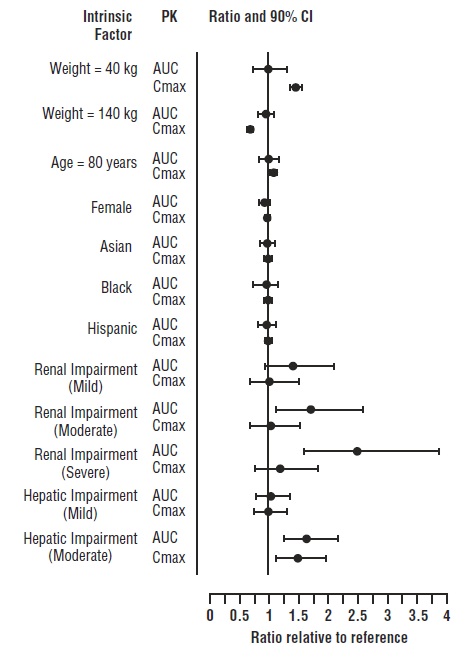
Figure 1 (Tofacitinib Fig1)
A pharmacokinetic ratio and 90% confidence interval chart displaying intrinsic factors such as weight, age, sex, race, and levels of renal and hepatic impairment. The plot shows AUC and Cmax values with their ratios relative to a reference across these factors.*
FDA Label Image

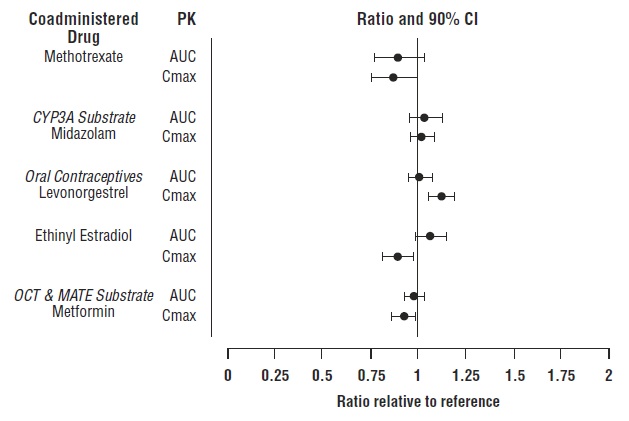
Figure 2 (Tofacitinib Fig2)

Figure 2 (Tofacitinib Fig2)
A horizontal dot plot chart showing pharmacokinetic ratios and 90% confidence intervals for area under the curve (AUC) and peak concentration (Cmax) of various coadministered drugs relative to reference values. Drugs listed include Methotrexate, Midazolam (CYP3A substrate), Levonorgestrel (oral contraceptive), Ethinyl Estradiol, and Metformin (OCT & MATE substrate), with ratios plotted on a scale from 0 to 2.*
FDA Label Image

Figure 3 (Tofacitinib Fig3)

Figure 3 (Tofacitinib Fig3)
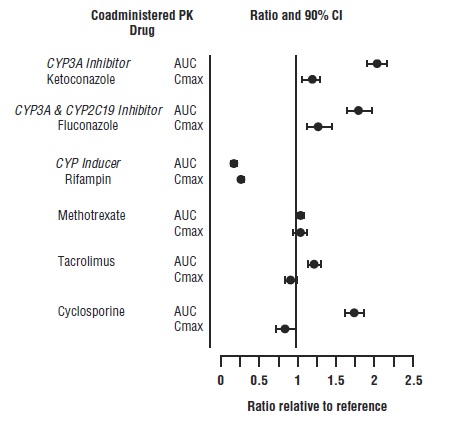
A pharmacokinetic graph showing ratios and 90% confidence intervals for area under the curve (AUC) and maximum concentration (Cmax) of various coadministered drugs relative to a reference. The drugs included are ketoconazole, fluconazole, rifampin, methotrexate, tacrolimus, and cyclosporine. The x-axis represents the ratio relative to the reference from 0 to 2.5.*
FDA Label Image

Figure (Tofacitinib Fig4)

Figure (Tofacitinib Fig4)
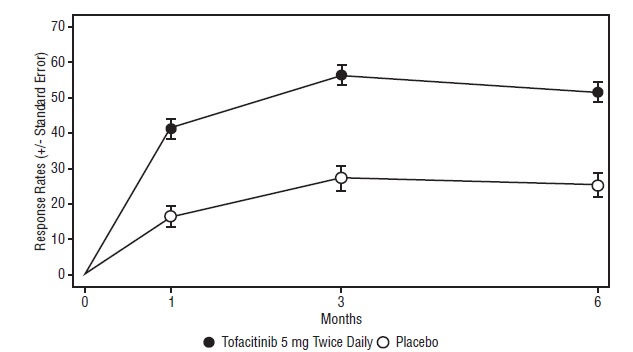
A line graph depicting response rates with standard error over a 6-month period. The x-axis represents months (0, 1, 3, 6) and the y-axis shows response rates from 0 to 70. Two series are plotted: Tofacitinib 5 mg twice daily (solid circles) shows higher response rates peaking around month 3, while placebo (open circles) shows lower and relatively stable response rates over time.*
FDA Label Image

Figure (Tofacitinib Fig5)

Figure (Tofacitinib Fig5)
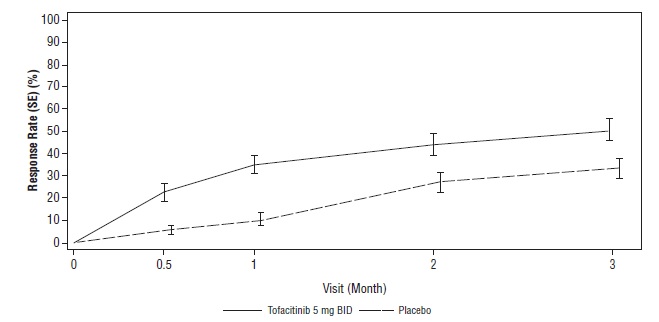
A line graph showing response rates over a 3-month period for Tofacitinib 5 mg BID versus placebo. The x-axis represents visit months (0, 0.5, 1, 2, 3), and the y-axis shows response rate percentage with standard error bars. Two lines illustrate increasing response rates for both groups, with Tofacitinib consistently higher than placebo.*
FDA Label Image

Figure 6 (Tofacitinib Fig6)

Figure 6 (Tofacitinib Fig6)
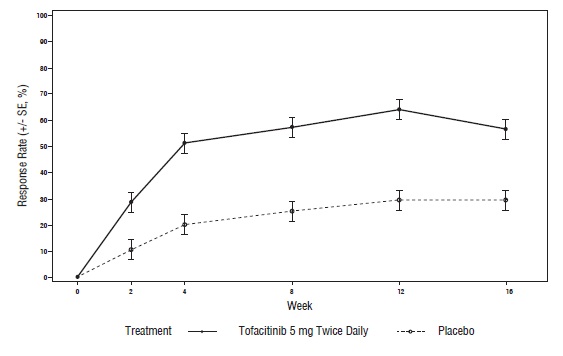
A line graph plotting response rate (%) with standard error on the y-axis against weeks on the x-axis. It compares the treatment effect of Tofacitinib 5 mg twice daily versus placebo over 16 weeks, showing response rates increasing over time with Tofacitinib treatment notably higher than placebo.*
FDA Label Image

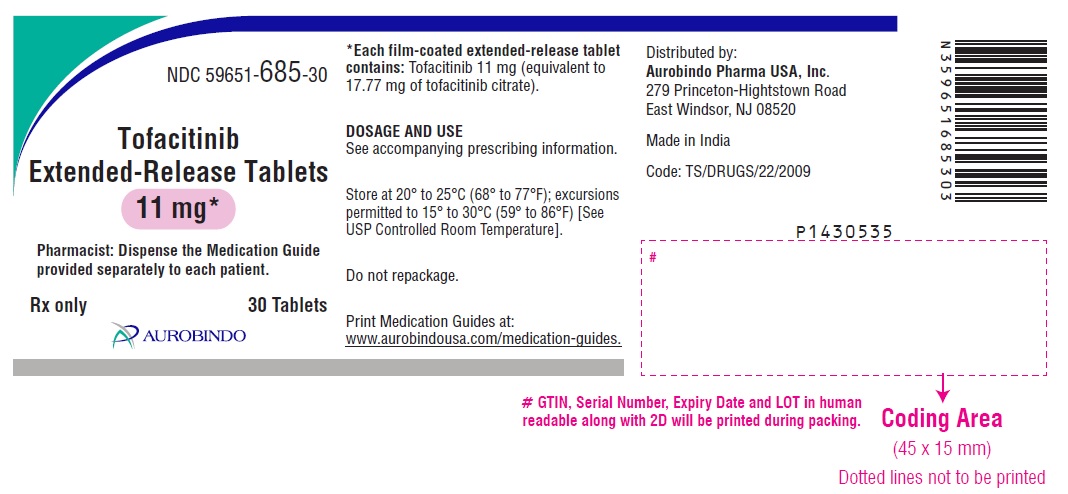
Package Label-principal Display Panel (11 mg)

Package Label-principal Display Panel (11 mg)
Label for Tofacitinib Extended-Release Tablets 11 mg, oral tablets in a pack of 30, distributed by Aurobindo Pharma USA, Inc. The label includes storage instructions, prescribing guidance, and manufacturing details. It features a barcode and a designated coding area for GTIN, serial number, expiry date, and lot number printing.*
FDA Label Image

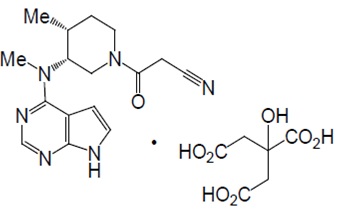
Str (Tofacitinib Str)

Str (Tofacitinib Str)
Chemical structure diagram of tofacitinib citrate, the active ingredient in tofacitinib extended release tablets. The structure includes the tofacitinib molecule bonded with citrate, showing relevant functional groups and molecular arrangement.*

* About these descriptions: Image descriptions on this page are generated by automated AI analysis of the product label images from the manufacturer's FDA label submission (SPL). They are provided for reference only and may contain errors or omissions. Always rely on the printed label itself and the official FDA labeling, and consult a pharmacist or healthcare professional with any questions about this product.