Sotalol hydrochloride has been studied in patients with symptomatic AFIB/AFL in two principal studies, one in patients with primarily paroxysmal AFIB/AFL, the other in patients with primarily chronic AFIB.
In one study, a U.S. multicenter, randomized, placebo-controlled, double-blind, dose-response trial of patients with symptomatic primarily paroxysmal AFIB/AFL, three fixed dose levels of sotalol hydrochloride (80 mg, 120 mg, and 160 mg) twice daily and placebo were compared in 253 patients. In patients with reduced creatinine clearance (40 to 60 mL/min) the same doses were given once daily. Patients were excluded for the following reasons: QT >450 msec; creatinine clearance <40 mL/min; intolerance to beta-blockers; bradycardia-tachycardia syndrome in the absence of an implanted pacemaker; AFIB/AFL was asymptomatic or was associated with syncope, embolic CVA or TIA; acute myocardial infarction within the previous 2 months; congestive heart failure; bronchial asthma or other contraindications to beta-blocker therapy; receiving potassium-losing diuretics without potassium replacement or without concurrent use of ACE-inhibitors; uncorrected hypokalemia (serum potassium <3.5 MEq/L) or hypomagnesemia (serum magnesium <1.5 MEq/L); received chronic oral amiodarone therapy for >1 month within previous 12 weeks; congenital or acquired long QT syndromes; history of Torsade de Pointes with other antiarrhythmic agents, which increase the duration of ventricular repolarization; sinus rate <50 bpm during waking hours; unstable angina pectoris; receiving treatment with other drugs that prolong the QT interval; and AFIB/AFL associated with the Wolff-Parkinson-White (WPW) syndrome. If the QT interval increased to ≥520 msec (or JT ≥430 msec if QRS >100 msec) the drug was discontinued. The patient population in this trial was 64% male, and the mean age was 62 years. No structural heart disease was present in 43% of the patients. Doses were administered once daily in 20% of the patients because of reduced creatinine clearance.
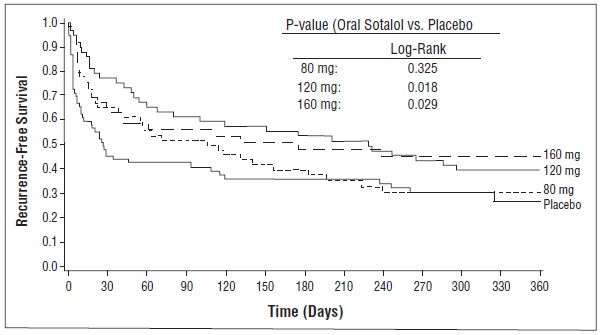
Sotalol hydrochloride was shown to prolong the time to the first symptomatic, ECG-documented recurrence of AFIB/AFL, as well as to reduce the risk of such recurrences at both 6 and 12 months. The 120 mg dose was more effective than 80 mg, but 160 mg did not appear to have an added benefit. Note that these doses were given twice or once daily, depending on renal function. The results are shown in Figure 1, Table 3, and Table 4.
Figure 1: Study 1 – Time to First ECG-Documented Recurrence of Symptomatic AFIB/AFL Since Randomization
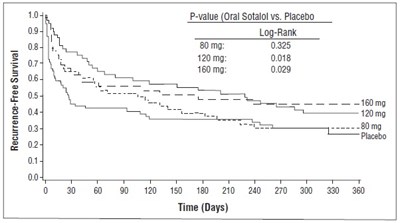
Figure 1: Study 1 (Sotalol Fig2)
Table 3: Study 1 – Patient Status at 12 Months
| Placebo
| Sotalol hydrochloride Dose
|
|
80 mg
| 120 mg
| 160 mg
|
Randomized
| 69
| 59
| 63
| 62
|
On treatment in NSR at 12 months without recurrencea
| 23%
| 22%
| 29%
| 23%
|
Recurrenceab
| 67%
| 58%
| 49%
| 42%
|
D/C for AEs
| 6%
| 12%
| 18%
| 29%
|
a Symptomatic AFIB/AFL
|
|
b Efficacy endpoint of Study 1; study treatment stopped.
|
|
Note that columns do not add up to 100% due to discontinuations (D/C) for “other” reasons.
Table 4: Study 1 – Median Time to Recurrence of Symptomatic AFIB/AFL and Relative Risk (vs. Placebo) at 12 Months
| Placebo n=69
| Sotalol hydrochloride Dose
|
80 mg
n=59
| 120 mg
n=63
| 160 mg
n=62
|
P-value vs. placebo
|
| 0.325
| 0.018
| 0.029
|
Relative Risk (RR) to placebo
|
| 0.81
| 0.59
| 0.59
|
Median time to recurrence (days)
| 27
| 106
| 229
| 175
|
Discontinuation because of adverse events was dose-related.
In a second multicenter, randomized, placebo-controlled, double-blind study of 6 months duration in 232 patients with chronic AFIB, sotalol hydrochloride was titrated over a dose range from 80 mg/day to 320 mg/day. The patient population of this trial was 70% male with a mean age of 65 years. Structural heart disease was present in 49% of the patients. All patients had chronic AFIB for >2 weeks but <1 year at entry with a mean duration of 4.1 months. Patients were excluded if they had significant electrolyte imbalance, QTc >460 msec, QRS >140 msec, any degree of AV block or functioning pacemaker, uncompensated cardiac failure, asthma, significant renal disease (estimated creatinine clearance <50 mL/min), heart rate <50 bpm, myocardial infarction or open heart surgery in past 2 months, unstable angina, infective endocarditis, active pericarditis or myocarditis, ≥3 DC cardioversions in the past, medications that prolonged QT interval, and previous amiodarone treatment.
After successful cardioversion patients were randomized to receive placebo (n=114) or sotalol hydrochloride (n=118) at a starting dose of 80 mg twice daily. If the initial dose was not tolerated it was decreased to 80 mg once daily, but if it was tolerated, it was increased to 160 mg twice daily. During the maintenance period 67% of treated patients received a dose of 160 mg twice daily, and the remainder received doses of 80 mg once daily (17%) and 80 mg twice daily (16%).
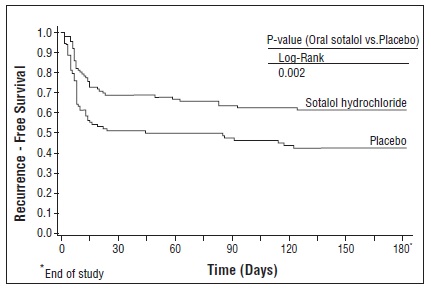
Tables 5 and 6 show the results of the trial. There was a longer time to ECG-documented recurrence of AFIB and a reduced risk of recurrence at 6 months compared to placebo.
Table 5: Study 2 – Patient Status at 6 Months
| Placebo
n=114
| Sotalol hydrochloride
n=118
|
On treatment in NSR at 6 months without
recurrencea
| 29%
| 45%
|
Recurrenceab
| 67%
| 49%
|
D/C for AEs
| 3%
| 6%
|
Death
| 1%
|
|
a Symptomatic or asymptomatic AFIB/AFL
b Efficacy endpoint of Study 2; study treatment stopped.
| .
|
Table 6: Study 2 – Median Time to Recurrence of Symptomatic AFIB/AFL/Death and Relative Risk (vs. Placebo) at 6 Months
| Placebo n=114
| Sotalol hydrochloride n=118
| Relative Risk
| P-value
|
Median time to recurrence (days)
| 44
| >180
| 0.55
| 0.002
|
Figure 2: Study 2 – Time to First ECG-Documented Recurrence of Symptomatic AFIB/AFL/Death Since Randomization
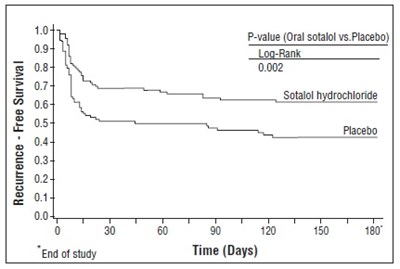
Figure 2: Study 2 (Sotalol Fig3)