Primary Hyperlipidemia in Adults
Ezetimibe and Simvastatin
Ezetimibe and simvastatin reduces LDL-C in adult patients with primary hyperlipidemia. Maximal to near maximal response is generally achieved within 2 weeks and maintained during chronic therapy.
Ezetimibe and simvastatin is effective in males and females with primary hyperlipidemia. There were insufficient numbers of patients who self-identified as Black or African American, Asian, or other races to determine if these patients responded differently than White patients.
Five multicenter, double-blind trials conducted with either ezetimibe and simvastatin or coadministered ezetimibe and simvastatin equivalent to ezetimibe and simvastatin in patients with primary hyperlipidemia are reported: two were comparisons with simvastatin, two were comparisons with atorvastatin, and one was a comparison with rosuvastatin.
In a multicenter, double-blind, placebo-controlled, 12-week trial, 1528 patients with primary hyperlipidemia were randomized to one of ten treatment groups: placebo, ezetimibe (10 mg), simvastatin (10 mg, 20 mg, 40 mg, or 80 mg), or ezetimibe and simvastatin (10/10, 10/20, 10/40, or 10/80).
When patients receiving ezetimibe and simvastatin were compared to those receiving all doses of simvastatin, ezetimibe and simvastatin significantly lowered total-C, LDL-C, Apo B, TG, and non-HDL-C. The effects of ezetimibe and simvastatin on HDL-C were similar to the effects seen with simvastatin. Further analysis showed ezetimibe and simvastatin significantly increased HDL-C compared with placebo. (See Table 8.) The lipid response to ezetimibe and simvastatin was similar in patients with TG levels greater than or less than 200 mg/dL.
Table 8: Response to Ezetimibe and Simvastatin in Patients with Primary Hyperlipidemia (Mean* % Change from Untreated Baseline†)
Treatment
|
|
|
|
|
|
|
|
(Daily Dose)
| N
| Total-C
| LDL-C
| Apo B
| HDL-C
| TG*
| Non-HDL-C
|
Pooled data (All ezetimibe and simvastatin doses)‡
| 609
| -38
| -53
| -42
| +7
| -24
| -49
|
Pooled data (All simvastatin doses)‡
| 622
| -28
| -39
| -32
| +7
| -21
| -36
|
Ezetimibe 10 mg
| 149
| -13
| -19
| -15
| +5
| -11
| -18
|
Placebo
| 148
| -1
| -2
| 0
| 0
| -2
| -2
|
Ezetimibe and simvastatin by dose
|
|
|
|
|
|
|
|
10/10
| 152
| -31
| -45
| -35
| +8
| -23
| -41
|
10/20
| 156
| -36
| -52
| -41
| +10
| -24
| -47
|
10/40
| 147
| -39
| -55
| -44
| +6
| -23
| -51
|
10/80
| 154
| -43
| -60
| -49
| +6
| -31
| -56
|
Simvastatin by dose
|
|
|
|
|
|
|
|
10 mg
| 158
| -23
| -33
| -26
| +5
| -17
| -30
|
20 mg
| 150
| -24
| -34
| -28
| +7
| -18
| -32
|
40 mg
| 156
| -29
| -41
| -33
| +8
| -21
| -38
|
80 mg
| 158
| -35
| -49
| -39
| +7
| -27
| -45
|
*For triglycerides, median % change from baseline.
† Baseline - on no lipid-lowering drug.
‡ Ezetimibe and simvastatin doses pooled (10/10 to 10/80) significantly reduced total-C, LDL-C, Apo B, TG, and non-HDL-C compared to simvastatin and significantly increased HDL-C compared to placebo.
In a multicenter, double-blind, controlled, 23-week trial, 710 patients with known CHD or CHD risk equivalents, as defined by the NCEP ATP III guidelines, and an LDL-C ≥130 mg/dL were randomized to one of four treatment groups: coadministered ezetimibe and simvastatin equivalent to ezetimibe and simvastatin (10/10, 10/20, and 10/40) or simvastatin 20 mg. Patients not reaching an LDL-C <100 mg/dL had their simvastatin dose titrated at 6-week intervals to a maximal dose of 80 mg. At Week 5, the LDL-C reductions with ezetimibe and simvastatin 10/10, 10/20, or 10/40 were significantly larger than with simvastatin 20 mg (see Table 9).
Table 9: Response to Ezetimibe and Simvastatin after 5 Weeks in Patients with CHD or CHD Risk Equivalents and an LDL-C ≥130 mg/dL
| Simvastatin
20 mg
| Ezetimibe and simvastatin
10/10
| Ezetimibe and simvastatin
10/20
| Ezetimibe and simvastatin
10/40
|
N
| 253
| 251
| 109
| 97
|
Mean baseline LDL-C
| 174
| 165
| 167
| 171
|
Percent change LDL-C
| -38
| -47
| -53
| -59
|
In a multicenter, double-blind, 6-week trial, 1902 patients with primary hyperlipidemia were randomized to one of eight treatment groups: ezetimibe and simvastatin (10/10, 10/20, 10/40, or 10/80) or atorvastatin (10 mg, 20 mg, 40 mg, or 80 mg).
Across the dosage range, when patients receiving ezetimibe and simvastatin were compared to those receiving milligramequivalent statin doses of atorvastatin, ezetimibe and simvastatin lowered total-C, LDL-C, Apo B, and non-HDL-C significantly more than atorvastatin. Only the 10/40 mg and 10/80 mg ezetimibe and simvastatin doses increased HDL-C significantly more than the corresponding milligram-equivalent statin dose of atorvastatin. The effects of ezetimibe and simvastatin on TG were similar to the effects seen with atorvastatin. (See Table 10.)
Table 10: Response to Ezetimibe and Simvastatin and Atorvastatin in Patients with Primary Hyperlipidemia (Mean* % Change from Untreated Baseline†)
Treatment
|
|
|
|
|
|
|
|
(Daily Dose)
| N
| Total-C‡
| LDL-C‡
| Apo B‡
| HDL-C
| TG*
| Non-HDL-
C‡
|
Ezetimibe and simvastatin by dose
|
|
|
|
|
|
|
|
10/10
| 230
| -34§
| -47§
| -37§
| +8
| -26
| -43§
|
10/20
| 233
| -37§
| -51§
| -40§
| +7
| -25
| -46§
|
10/40
| 236
| -41§
| -57§
| -46§
| +9§
| -27
| -52§
|
10/80
| 224
| -43§
| -59§
| -48§
| +8§
| -31
| -54§
|
Atorvastatin by dose
|
|
|
|
|
|
|
|
10 mg
| 235
| -27
| -36
| -31
| +7
| -21
| -34
|
20 mg
| 230
| -32
| -44
| -37
| +5
| -25
| -41
|
40 mg
| 232
| -36
| -48
| -40
| +4
| -24
| -45
|
80 mg
| 230
| -40
| -53
| -44
| +1
| -32
| -50
|
* For triglycerides, median % change from baseline.
† Baseline - on no lipid-lowering drug.
‡ Ezetimibe and simvastatin doses pooled (10/10 to 10/80) provided significantly greater reductions in total-C, LDL-C, Apo B, and non-HDL-C compared to atorvastatin doses pooled (10 to 80).
§ p<0.05 for difference with atorvastatin at equal mg doses of the simvastatin component.
In a multicenter, double-blind, 24-week, forced-titration trial, 788 patients with primary hyperlipidemia were randomized to receive coadministered ezetimibe and simvastatin equivalent to ezetimibe and simvastatin (10/10 and 10/20) or atorvastatin 10 mg. For all three treatment groups, the dose of the statin was titrated at 6-week intervals to 80 mg. At each pre-specified dose comparison, ezetimibe and simvastatin lowered LDL-C to a greater degree than atorvastatin (see Table 11).
Table 11: Response to Ezetimibe and Simvastatin and Atorvastatin in Patients with Primary Hyperlipidemia (Mean* % Change from Untreated Baseline†)
Treatment
| N
| Total-C
| LDL-C
| Apo B
| HDL-C
| TG*
| Non-HDL-C
|
Week 6
|
|
|
|
|
|
|
|
Atorvastatin 10 mg‡
| 262
| -28
| -37
| -32
| +5
| -23
| -35
|
Ezetimibe and simvastatin 10/10§
| 263
| -34¶
| -46¶
| -38¶
| +8¶
| -26
| -43¶
|
Ezetimibe and simvastatin 10/20#
| 263
| -36¶
| -50¶
| -41¶
| +10¶
| -25
| -46¶
|
Week 12
|
|
|
|
|
|
|
|
Atorvastatin 20 mg
| 246
| -33
| -44
| -38
| +7
| -28
| -42
|
Ezetimibe and simvastatin 10/20
| 250
| -37¶
| -50¶
| -41¶
| +9
| -28
| -46¶
|
Ezetimibe and simvastatin 10/40
| 252
| -39¶
| -54¶
| -45¶
| +12¶
| -31
| -50¶
|
Week 18
|
|
|
|
|
|
|
|
Atorvastatin 40 mg
| 237
| -37
| -49
| -42
| +8
| -31
| -47
|
Ezetimibe and simvastatin 10/40Þ
| 482
| -40¶
| -56¶
| -45¶
| +11¶
| -32
| -52¶
|
Week 24
|
|
|
|
|
|
|
|
Atorvastatin 80 mg
| 228
| -40
| -53
| -45
| +6
| -35
| -50
|
Ezetimibe and simvastatin 10/80Þ
| 459
| -43¶
| -59¶
| -49¶
| +12¶
| -35
| -55¶
|
* For triglycerides, median % change from baseline.
† Baseline - on no lipid-lowering drug.
‡ Atorvastatin: 10 mg start dose titrated to 20 mg, 40 mg, and 80 mg through Weeks 6, 12, 18, and 24.
§ Ezetimibe and simvastatin: 10/10 start dose titrated to 10/20, 10/40, and 10/80 through Weeks 6, 12, 18, and 24.
¶p≤0.05 for difference with atorvastatin in the specified week.
# Ezetimibe and simvastatin: 10/20 start dose titrated to 10/40, 10/40, and 10/80 through Weeks 6, 12, 18, and 24.
Þ Data pooled for common doses of ezetimibe and simvastatin at Weeks 18 and 24.
In a multicenter, double-blind, 6-week trial, 2959 patients with primary hyperlipidemia, were randomized to one of six treatment groups: ezetimibe and simvastatin (10/20, 10/40, or 10/80) or rosuvastatin (10 mg, 20 mg, or 40 mg).
The effects of ezetimibe and simvastatin and rosuvastatin on total-C, LDL-C, Apo B, TG, non-HDL-C and HDL-C are shown in Table 12.
Table 12: Response to Ezetimibe and Simvastatin and Rosuvastatin in Patients with Primary Hyperlipidemia (Mean* % Change from Untreated Baseline†)
Treatment
|
|
|
|
|
|
|
|
(Daily Dose)
| N
| Total-C‡
| LDL-C‡
| Apo B‡
| HDL-C
| TG*
| Non-HDL-C‡
|
Ezetimibe and simvastatin by dose
|
|
|
|
|
|
|
|
10/20
| 476
| -37§
| -52§
| -42§
| +7
| -23§
| -47§
|
10/40
| 477
| -39¶
| -55¶
| -44¶
| +8
| -27
| -50¶
|
10/80
| 474
| -44#
| -61#
| -50#
| +8
| -30#
| -56#
|
Rosuvastatin by dose
|
|
|
|
|
|
|
|
10 mg
| 475
| -32
| -46
| -37
| +7
| -20
| -42
|
20 mg
| 478
| -37
| -52
| -43
| +8
| -26
| -48
|
40 mg
| 475
| -41
| -57
| -47
| +8
| -28
| -52
|
*For triglycerides, median % change from baseline.
† Baseline - on no lipid-lowering drug.
‡ Ezetimibe and simvastatin doses pooled (10/20 to 10/80) provided significantly greater reductions in total-C, LDL-C, Apo B, and non-HDL-C compared to rosuvastatin doses pooled (10 to 40 mg).
§ p<0.05 vs. rosuvastatin 10 mg.
¶ p<0.05 vs. rosuvastatin 20 mg.
# p<0.05 vs. rosuvastatin 40 mg.
In a multicenter, double-blind, 24-week trial, 214 patients with type 2 diabetes mellitus treated with thiazolidinediones (rosiglitazone or pioglitazone) for a minimum of 3 months and simvastatin 20 mg for a minimum of 6 weeks were randomized to receive either simvastatin 40 mg or the coadministered active ingredients equivalent to ezetimibe and simvastatin 10/20. The median LDL-C and HbA1c levels at baseline were 89 mg/dL and 7.1%, respectively.
Ezetimibe and simvastatin 10/20 was significantly more effective than doubling the dose of simvastatin to 40 mg. The median percent changes from baseline for ezetimibe and simvastatin vs. simvastatin were: LDL-C -25% and -5%; total-C -16% and -5%; Apo B -19% and -5%; and non-HDL-C -23% and -5%. Results for HDL-C and TG between the two treatment groups were not significantly different.
Ezetimibe
In two multicenter, double-blind, placebo-controlled, 12-week trials in 1719 patients with primary hyperlipidemia, ezetimibe significantly lowered total-C (-13%), LDL-C (-19%), Apo B (-14%), and TG (-8%), and increased HDL-C (+3%) compared to placebo. Reduction in LDL-C was consistent across age, sex, and baseline LDL-C.
Simvastatin
In two large, placebo-controlled clinical trials, the Scandinavian Simvastatin Survival Trial (N=4,444 patients) and the Heart Protection Trial (N=20,536 patients), the effects of treatment with simvastatin were assessed in patients at high risk of coronary events because of existing coronary heart disease, diabetes, peripheral vessel disease, history of stroke or other cerebrovascular disease. Simvastatin was proven to reduce: the risk of total mortality by reducing CHD deaths; the risk of non-fatal myocardial infarction and stroke; and the need for coronary and non-coronary revascularization procedures.
No incremental benefit of ezetimibe and simvastatin on cardiovascular morbidity and mortality over and above that demonstrated for simvastatin has been established.
Heterozygous Familial Hypercholesterolemia (HeFH) in Pediatric Patients
The effects of ezetimibe coadministered with simvastatin (n=126) compared to simvastatin monotherapy (n=122) have been evaluated in males and females with HeFH. In a multicenter, doubleblind, controlled trial followed by an open-label phase, 142 males and 106 postmenarchal females, 10 to 17 years of age (mean age 14.2 years, 43% females, 82% White, 4% Asian, 2% Black or African American, 13% multi- racial; 14% identified as Hispanic or Latino ethnicity) with HeFH were randomized to receive either ezetimibe coadministered with simvastatin or simvastatin monotherapy. Inclusion in the trial required 1) a baseline LDL-C level between 160 and 400 mg/dL and 2) a medical history and clinical presentation consistent with HeFH. The mean baseline LDL-C value was 225 mg/dL (range: 161 to 351 mg/dL) in the ezetimibe coadministered with simvastatin group compared to 219 mg/dL (range: 149 to 336 mg/dL) in the simvastatin monotherapy group. The patients received coadministered ezetimibe and simvastatin (10 mg, 20 mg, or 40 mg) or simvastatin monotherapy (10 mg, 20 mg, or 40 mg) for 6 weeks, coadministered ezetimibe and 40- mg simvastatin or 40-mg simvastatin monotherapy for the next 27 weeks, and open-label coadministered ezetimibe and simvastatin (10 mg, 20 mg, or 40 mg) for 20 weeks thereafter.
The results of the trial at Week 6 are summarized in Table 13. Results at Week 33 were consistent with those at Week 6.
Table 13: Mean Percent Difference at Week 6 Between the Pooled ZETIA Coadministered with Simvastatin Group and the Pooled Simvastatin Monotherapy Group in Adolescent Patients with HeFH
| Total-C
| LDL-C
| Apo B
| Non-HDL-C
|
Mean percent difference between treatment groups
| -12%
| -15%
| -12%
| -14%
|
95% Confidence Interval
| (-15%,-9%)
| (-18%,-12%)
| (-15%,-9%)
| (-17%,-11%)
|
Homozygous Familial Hypercholesterolemia (HoFH) in Adults
A double-blind, randomized, 12-week trial was performed in patients with a clinical and/or genotypic diagnosis of HoFH. Data were analyzed from a subgroup of patients (n=14) receiving simvastatin 40 mg at baseline. Increasing the dose of simvastatin from 40 to 80 mg (n=5) produced a reduction of LDL-C of 13% from baseline on simvastatin 40 mg. Coadministered ezetimibe and simvastatin equivalent to ezetimibe and simvastatin (10/40 and 10/80 pooled, n=9), produced a reduction of LDL-C of 23% from baseline on simvastatin 40 mg. In those patients coadministered ezetimibe and simvastatin equivalent to ezetimibe and simvastatin (10/80, n=5), a reduction of LDL-C of 29% from baseline on simvastatin 40 mg was produced.
Chronic Kidney Disease (CKD) in Adults
The Trial of Heart and Renal Protection (SHARP) was a multinational, randomized, placebo-controlled, double-blind trial that investigated the effect of ezetimibe and simvastatin on the time to a first major vascular event (MVE) among 9438 patients with moderate to severe chronic kidney disease (approximately one-third on dialysis at baseline) who did not have a history of myocardial infarction or coronary revascularization. An MVE was defined as nonfatal MI, cardiac death, stroke, or any revascularization procedure. Patients were allocated to treatment using a method that took into account the distribution of 8 important baseline characteristics of patients already enrolled and minimized the imbalance of those characteristics across the groups.
For the first year, 9438 patients were allocated 4:4:1, to ezetimibe and simvastatin 10/20, placebo, or simvastatin 20 mg daily, respectively. The 1-year simvastatin arm enabled the comparison of ezetimibe and simvastatin to simvastatin with regard to safety and effect on lipid levels. At 1 year the simvastatin-only arm was re-allocated 1:1 to ezetimibe and simvastatin 10/20 or placebo. A total of 9270 patients were ever allocated to ezetimibe and simvastatin 10/20 (n=4650) or placebo (n=4620) during the trial. The median follow-up duration was 4.9 years. Patients had a mean age of 61 years; 63% were male, 72% were White, and 23% were diabetic; and, for those not on dialysis at baseline, the median serum creatinine was 2.5 mg/dL and the median estimated glomerular filtration rate (eGFR) was 25.6 mL/min/1.73 m2, with 94% of patients having an eGFR < 45 mL/min/1.73m2. Eligibility did not depend on lipid levels. Mean LDL-C at baseline was 108 mg/dL. At 1 year, the mean LDL-C was 26% lower in the simvastatin arm and 38% lower in the ezetimibe and simvastatin arm relative to placebo. At the midpoint of the trial (2.5 years), the mean LDL-C was 32% lower for ezetimibe and simvastatin relative to placebo. Patients no longer taking trial medication were included in all lipid measurements.
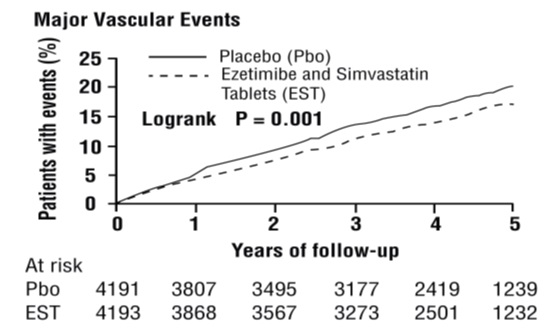
In the primary intent-to-treat analysis, 639 (15.2%) of 4193 patients initially allocated to ezetimibe and simvastatin and 749 (17.9%) of 4191 patients initially allocated to placebo experienced an MVE. This corresponded to a relative risk reduction of 16% (p=0.001) (see Figure 1). Similarly, 526 (11.3%) of 4650 patients ever allocated to ezetimibe and simvastatin and 619 (13.4%) of 4620 patients ever allocated to placebo experienced a major atherosclerotic event (MAE; a subset of the MVE composite that excluded non-coronary cardiac deaths and hemorrhagic stroke), corresponding to a relative risk reduction of 17% (p=0.002). The trial demonstrated that treatment with ezetimibe and simvastatin 10/20 mg versus placebo reduced the risk for MVE and MAE in this CKD population. The trial design precluded drawing conclusions regarding the independent contribution of either ezetimibe or simvastatin to the observed effect.
The treatment effect of ezetimibe and simvastatin on MVE was attenuated among patients on dialysis at baseline compared with those not on dialysis at baseline. Among 3023 patients on dialysis at baseline, ezetimibe and simvastatin reduced the risk of MVE by 6% (RR 0.94: 95% CI 0.80 to 1.09) compared with 22% (RR 0.78: 95% CI 0.69 to 0.89) among 6247 patients not on dialysis at baseline (interaction P=0.08).
Figure 1: Effect of Ezetimibe and Simvastatin on the Primary Endpoint of Risk of Major Vascular Events

Figure (Ezetim Simvast Fig1)
The individual components of MVE in all patients ever allocated to ezetimibe and simvastatin or placebo are presented in Table 14.
Table 14: Number of First Events for Each Component of the Major Vascular Event Composite Endpoint in SHARP*
Outcome
| Ezetimibe and simvastatin 10/20
(N=4650)
| Placebo (N=4620)
| Risk Ratio (95% CI)
| P-value
|
Major Vascular Events
| 701 (15.1%)
| 814 (17.6%)
| 0.85 (0.77 to 0.94)
| 0.001
|
Nonfatal MI
| 134 (2.9%)
| 159 (3.4%)
| 0.84 (0.66 to 1.05)
| 0.12
|
Cardiac Death
| 253 (5.4%)
| 272 (5.9%)
| 0.93 (0.78 to 1.10)
| 0.38
|
Any Stroke
| 171 (3.7%)
| 210 (4.5%)
| 0.81 (0.66 to 0.99)
| 0.038
|
Non-hemorrhagic Stroke
| 131 (2.8%)
| 174 (3.8%)
| 0.75 (0.60 to 0.94)
| 0.011
|
Hemorrhagic Stroke
| 45 (1.0%)
| 37 (0.8%)
| 1.21 (0.78 to 1.86)
| 0.40
|
Any Revascularization
| 284 (6.1%)
| 352 (7.6%)
| 0.79 (0.68 to 0.93)
| 0.004
|
*Intention-to-treat analysis on all SHARP patients ever allocated to ezetimibe and simvastatin or placebo.
Among patients not on dialysis at baseline, ezetimibe and simvastatin did not reduce the risk of progressing to end-stage renal disease compared with placebo (RR 0.97: 95% CI 0.89 to 1.05).
Simvastatin Cardiovascular Outcome Trials in Adults at High Risk of Coronary Heart Disease Events
In a randomized, double-blind, placebo-controlled, multi-centered trial [the Scandinavian Simvastatin Survival Trial (Trial 4S)], the effect of therapy with simvastatin on total mortality was assessed in 4,444 adult patients with CHD (history of angina and/or a previous myocardial infarction) and baseline total cholesterol (total-C) between 212 and 309 mg/dL who were on a lipid-lowering diet. In Trial 4S, patients were treated with standard care, including lipid-lowering diet, and randomized to either simvastatin 20 to 40 mg/day (n=2,221) or placebo (n=2,223) for a median duration of 5.4 years.
- Simvastatin significantly reduced the risk of mortality by 30% (p=0.0003, 182 deaths in the simvastatin group vs 256 deaths in the placebo group). The risk of CHD mortality was significantly reduced by 42% (p=0.00001, 111 deaths in the simvastatin group vs 189 deaths in the placebo group). There was no statistically significant difference between groups in non-cardiovascular mortality.
- Simvastatin significantly reduced the risk for the secondary composite endpoint (time to first occurrence of CHD death, definite or probable hospital verified non-fatal MI, silent MI verified by ECG, or resuscitated cardiac arrest) by 34% (p<0.00001, 431 vs 622 patients with one or more events). Simvastatin reduced the risk of major coronary events to a similar extent across the range of baseline total and LDL cholesterol levels. The risk of having a hospital-verified non-fatal MI was reduced by 37%.
- Simvastatin significantly reduced the risk for undergoing myocardial revascularization procedures (coronary artery bypass grafting or percutaneous transluminal coronary angioplasty) by 37% (p<0.00001, 252 vs 383 patients).
- Simvastatin significantly reduced the risk of fatal plus non-fatal cerebrovascular events (combined stroke and transient ischemic attacks) by 28% (p=0.033, 75 vs 102 patients).
- Over the course of the trial, treatment with simvastatin led to mean reductions in total-C, LDL-C and triglycerides (TG) of 25%, 35%, and 10%, respectively, and a mean increase in high-density lipoprotein cholesterol (HDL-C) of 8%. In contrast, treatment with placebo led to increases in total- C, LDL-C and TG of 1%, 1%, and 7%, respectively.
- Because there were only 53 female deaths (approximately 18% of the trial population was female), the effect of simvastatin on mortality in females could not be adequately assessed. However, simvastatin significantly reduced the risk of having major coronary events in females by 34% (60 vs 91 women with one or more event).
- Simvastatin resulted in similar decreases in relative risk for total mortality, CHD mortality, and major coronary events in geriatric patients (≥65 years) compared with younger adults.
The Heart Protection Trial (Trial HPS) was a randomized, placebo-controlled, double-blind, multi- centered trial with a mean duration of 5 years conducted in 10,269 patients on simvastatin 40 mg and 10,267 on placebo. Patients had a mean age of 64 years (range 40 to 80 years old), 97% were White, and were at high risk of developing a major coronary event because of existing CHD (65%), diabetes (Type 2, 26%; Type 1, 3%), history of stroke or other cerebrovascular disease (16%), peripheral vascular disease (33%), or they were males ≥65 years with hypertension in (6%). At baseline:
- 3,421 patients (17%) had LDL-C levels below 100 mg/dL, including 953 (5%) below 80 mg/dL; and
- 10,047 patients (49%) had levels greater than 130 mg/dL.
Patients were randomized to simvastatin or placebo using a covariate adaptive method which considered the distribution of 10 important baseline characteristics of patients already enrolled.
The Trial HPS results showed that simvastatin 40 mg/day significantly reduced: total and CHD mortality; and non-fatal MI, stroke, and revascularization procedures (coronary and non-coronary) (see Table 15).
Table 15: CHD Mortality and Cardiovascular Events in Adult Patients with High Risk of Developing a Major Coronary Event in Trial HPS
Endpoint
| Simvastatin
(N=10,269) n (%)*
| Placebo
(N=10,267) n (%)*
| Risk
Reduction
(%) (95% CI)
| p-Value
|
Primary
Mortality
CHD mortality
| 1,328
(12.9%)
587 (5.7%)
| 1,507
(14.7%)
707 (6.9%)
|
13% (6 to 19%)
18% (8 to 26%)
|
p=0.0003
p=0.0005
|
Secondary
Non-fatal MI
Stroke
|
357 (3.5%)
444 (4.3%)
|
574 (5.6%)
585 (5.7%)
|
38% (30 to 46%)
25% (15 to 34%)
|
p<0.0001
p<0.0001
|
Tertiary
Coronary revascularization
Peripheral and other non-coronary revascularization
|
513 (5%)
450 (4.4%)
|
725 (7.1%)
532 (5.2%)
|
30% (22 to 38%)
16% (5 to 26%)
|
p<0.0001
p=0.006
|
* n = number of patients with indicated event
Two composite endpoints were defined to have enough events to assess relative risk reductions across a range of baseline characteristics:
- Major coronary events (MCE) was comprised of CHD mortality and non-fatal MI. Analyzed by time-to-first event; 898 patients (8.7%) treated with simvastatin had events and 1,212 patients (11.8%) treated with placebo had events.
- Major vascular events (MVE) was comprised of MCE, stroke, and revascularization procedures including coronary, peripheral and other non-coronary procedures. Analyzed by time-to-first event; 2,033 patients (19.8%) treated with simvastatin had events and 2,585 patients (25.2%) on placebo had events.
Simvastatin use led to significant relative risk reductions for both composite endpoints (27% for MCE and 24% for MVE, p<0.0001) and for all components of the composite endpoints. The risk reductions produced by simvastatin in both MCE and MVE were evident and consistent regardless of cardiovascular disease related medical history at trial entry (i.e., CHD alone; or peripheral vascular disease, cerebrovascular disease, diabetes or treated hypertension, with or without CHD), gender, age, baseline levels of LDL-C, baseline concomitant cardiovascular medications (i.e., aspirin, beta blockers, or calcium channel blockers), smoking status, or obesity. Patients with diabetes showed risk reductions for MCE and MVE due to simvastatin treatment regardless of baseline HbA1c levels or obesity.