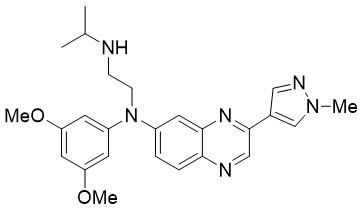
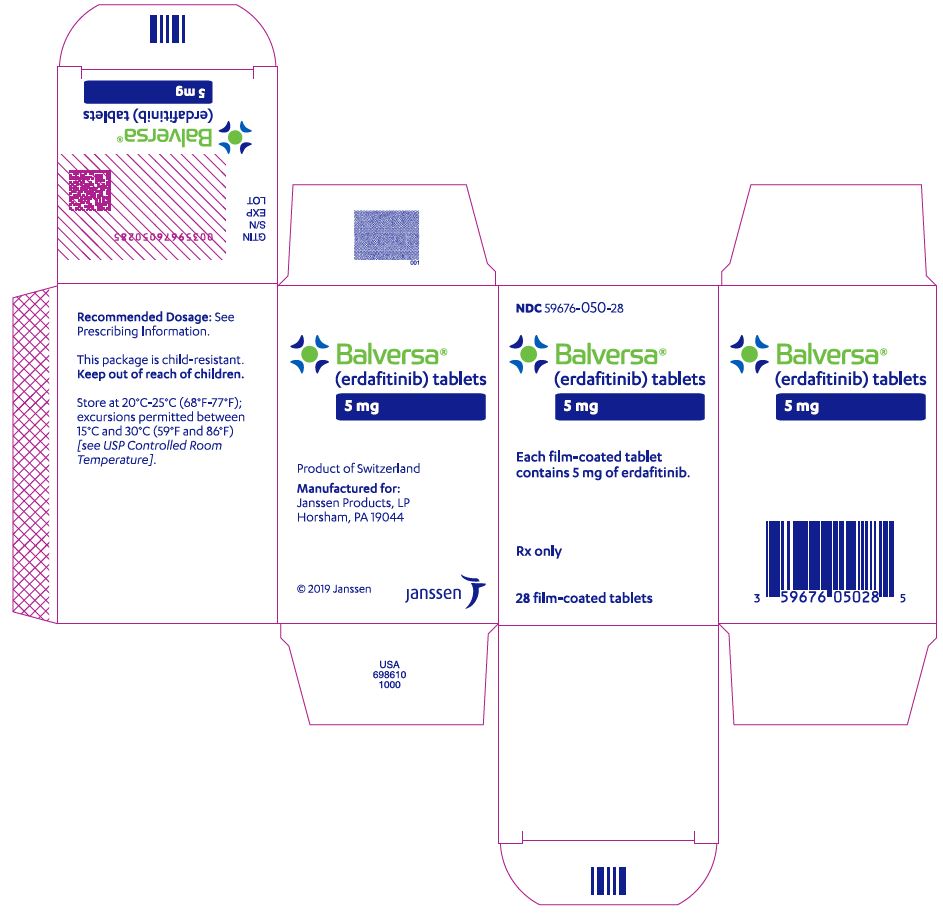
Assess serum phosphate levels 14 to 21 days after initiating treatment. Increase the dose of BALVERSA to 9 mg once daily if serum phosphate level is < 5.5 mg/dL and there are no ocular disorders or Grade 2 or greater adverse reactions. Monitor phosphate levels monthly for hyperphosphatemia [see Pharmacodynamics (12.2)].
- 3 mg: Yellow, round biconvex, film-coated, debossed with "3" on one side; and "EF" on the other side.
- 4 mg: Orange, round biconvex, film-coated, debossed with "4" on one side; and "EF" on the other side.
- 5 mg: Brown, round biconvex, film-coated, debossed with "5" on one side; and "EF" on the other side.
Risk Summary
Based on the mechanism of action and findings in animal reproduction studies, BALVERSA can cause fetal harm when administered to a pregnant woman [see Clinical Pharmacology (12.1)]. There are no available data on BALVERSA use in pregnant women to inform a drug-associated risk. Oral administration of erdafitinib to pregnant rats during organogenesis caused malformations and embryo-fetal death at maternal exposures that were less than the human exposures at the maximum recommended human dose based on AUC (see Data). Advise pregnant women and females of reproductive potential of the potential risk to the fetus.
The estimated background risk of major birth defects and miscarriage for the indicated population is unknown. All pregnancies have a background risk of birth defect, loss, or other adverse outcomes. In the U.S. general population, the estimated background risk of major birth defects and miscarriage in clinically recognized pregnancies is 2–4% and 15–20%, respectively.
Data
Animal Data
In an embryo-fetal toxicity study, erdafitinib was orally administered to pregnant rats during the period of organogenesis. Doses ≥4mg/kg/day (at total maternal exposures <0.1% of total human exposures at the maximum recommended human dose based on AUC) produced embryo-fetal death, major blood vessel malformations and other vascular anomalies, limb malformations (ectrodactyly, absent or misshapen long bones), an increased incidence of skeletal anomalies in multiple bones (vertebrae, sternebrae, ribs), and decreased fetal weight.
Risk Summary
There are no data on the presence of erdafitinib in human milk, or the effects of erdafitinib on the breastfed child, or on milk production. Because of the potential for serious adverse reactions from erdafitinib in a breastfed child, advise lactating women not to breastfeed during treatment with BALVERSA and for one month following the last dose.
Pregnancy Testing
Pregnancy testing is recommended for females of reproductive potential prior to initiating treatment with BALVERSA.
Contraception
Females
BALVERSA can cause fetal harm when administered to a pregnant woman. Advise females of reproductive potential to use effective contraception during treatment with BALVERSA and for one month after the last dose [see Use in Specific Population (8.1)].
Males
Advise male patients with female partners of reproductive potential to use effective contraception during treatment with BALVERSA and for one month after the last dose [see Use in Specific Populations (8.1)].
Infertility
Females
Based on findings from animal studies, BALVERSA may impair fertility in females of reproductive potential [see Nonclinical Toxicology (13.1)].
CYP2C9*3/*3 Genotype: Erdafitinib plasma concentrations were predicted to be higher in patients with the CYP2C9*3/*3 genotype. Monitor for increased adverse reactions in patients who are known or suspected to have CYP2C9*3/*3 genotype [see Pharmacogenomics (12.5)].
Cardiac Electrophysiology
Based on evaluation of QTc interval in an open-label, dose escalation and dose expansion study in 187 patients with cancer, erdafitinib had no large effect (i.e., > 20 ms) on the QTc interval.
Serum Phosphate
Erdafitinib increased serum phosphate level as a consequence of FGFR inhibition. BALVERSA should be increased to the maximum recommended dose to achieve target serum phosphate levels of 5.5–7.0 mg/dL in early cycles with continuous daily dosing [see Dosage and Administration (2.3)].
In erdafitinib clinical trials, the use of drugs which can increase serum phosphate levels, such as potassium phosphate supplements, vitamin D supplements, antacids, phosphate-containing enemas or laxatives, and medications known to have phosphate as an excipient were prohibited unless no alternatives exist. To manage phosphate elevation, phosphate binders were permitted. Avoid concomitant use with agents that can alter serum phosphate levels before the initial dose increase period based on serum phosphate levels [see Drug Interactions (7.1)].
Absorption
Median time to achieve peak plasma concentration (tmax) was 2.5 hours (range: 2 to 6 hours).
Effect of Food
No clinically meaningful differences with erdafitinib pharmacokinetics were observed following administration of a high-fat and high-calorie meal (800 calories to 1,000 calories with approximately 50% of total caloric content of the meal from fat) in healthy subjects.
Distribution
The mean apparent volume of distribution of erdafitinib was 29 L in patients.
Erdafitinib protein binding was 99.8% in patients, primarily to alpha-1-acid glycoprotein.
Elimination
The mean total apparent clearance (CL/F) of erdafitinib was 0.362 L/h in patients.
The mean effective half-life of erdafitinib was 59 hours in patients.
Metabolism
Erdafitinib is primarily metabolized by CYP2C9 and CYP3A4. The contribution of CYP2C9 and CYP3A4 in the total clearance of erdafitinib is estimated to be 39% and 20% respectively. Unchanged erdafitinib was the major drug-related moiety in plasma, there were no circulating metabolites.
Excretion
Following a single oral dose of radiolabeled erdafitinib, approximately 69% of the dose was recovered in feces (19% as unchanged) and 19% in urine (13% as unchanged).
Specific Populations
No clinically meaningful trends in the pharmacokinetics of erdafitinib were observed based on age (21–88 years), sex, race, body weight (36–132 kg), mild (eGFR [estimated glomerular filtration rate, using modification of diet in renal disease equation] 60 to 89 mL/min/1.73 m2) or moderate (eGFR 30–59 mL/min/1.73 m2) renal impairment or mild hepatic impairment (total bilirubin ≤ ULN and AST > ULN, or total bilirubin > 1.0–1.5 × ULN and any AST).
The pharmacokinetics of erdafitinib in patients with severe renal impairment, renal impairment requiring dialysis, moderate or severe hepatic impairment is unknown.
Drug Interaction Studies
Clinical Studies and Model-Based Approaches Strong CYP2C9 Inhibitors:
Erdafitinib mean ratios (90% CI) for Cmax and AUCinf were 121% (99.9, 147) and 148% (120, 182), respectively, when co-administered with fluconazole, a strong CYP2C9 inhibitor and moderate CYP3A4 inhibitor, relative to erdafitinib alone.
Strong CYP3A4 Inhibitors:
Erdafitinib mean ratios (90% CI) for Cmax and AUCinf were 105% (86.7, 127) and 134% (109, 164), respectively, when co-administered with itraconazole (a strong CYP3A4 inhibitor and P-gp inhibitor) relative to erdafitinib alone.
Strong CYP3A4/2C9 Inducers:
Simulations suggested that rifampicin (a strong CYP3A4/2C9 inducer) may significantly decrease erdafitinib Cmax and AUC.
In Vitro Studies
CYP Substrates:
Erdafitinib is a time dependent inhibitor and inducer of CYP3A4. The effect of erdafitinib on a sensitive CYP3A4 substrate is unknown. Erdafitinib is not an inhibitor of other major CYP isozymes at clinically relevant concentrations.
Transporters:
Erdafitinib is a substrate and inhibitor of P-gp. P-gp inhibitors are not expected to affect erdafitinib exposure to a clinically relevant extent. Erdafitinib is an inhibitor of OCT2.
Erdafitinib does not inhibit BCRP, OATP1B, OATP1B3, OAT1, OAT3, OCT1, MATE-1, or MATE-2K at clinically relevant concentrations.
Acid-Lowering Agents:
Erdafitinib has adequate solubility across the pH range of 1 to 7.4. Acid-lowering agents (e.g., antacids, H2-antagonists, proton pump inhibitors) are not expected to affect the bioavailability of erdafitinib.
FGFR genetic alterations: Advise patients that evidence of a susceptible FGFR3 or FGFR2 mutation or gene fusion within the tumor specimen is necessary to identify patients for whom treatment is indicated [see Dosage and Administration (2.1)].
Ocular disorders: Advise patients to contact their healthcare provider if they experience any visual changes [see Warnings and Precautions (5.1)]. In order to prevent or treat dry eyes, advise patients to use artificial tear substitutes, hydrating or lubricating eye gels or ointments frequently, at least every 2 hours during waking hours [see Dosage and Administration (2.3)].
Skin, mucous or nail disorders: Advise patients to contact their healthcare provider if they experience progressive or intolerable skin, mucous or nail disorders [see Adverse Reactions (6.1)].
Hyperphosphatemia: Advise patients that their healthcare provider will assess their serum phosphate level between 14 and 21 days of initiating treatment and will adjust the dose if needed [see Warnings and Precautions (5.2)]. During this initial phosphate-assessment period, advise patients to avoid concomitant use with agents that can alter serum phosphate levels. Advise patients that, after the initial phosphate assessment period, monthly phosphate level monitoring for hyperphosphatemia should be performed during treatment with BALVERSA [see Drug Interactions (7.1)].
Drug Interactions: Advise patients to inform their healthcare providers of all concomitant medications, including prescription medicines, over-the-counter drugs, and herbal products [see Drug Interactions (7.1, 7.2)].
Dosing Instructions: Instruct patients to swallow the tablets whole once daily with or without food. If vomiting occurs any time after taking BALVERSA, advise patients to take the next dose the next day. [see Dosage and Administration (2.1)].
Missed dose: If a dose is missed, advise patients to take the missed as soon as possible. Resume the regular daily dose schedule for BALVERSA the next day. Extra tablets should not be taken to make up for the missed dose [see Dosage and Administration (2.3)].
Embryo-Fetal Toxicity: Advise pregnant women and females of reproductive potential of the potential risk to the fetus. Advise females to inform their healthcare providers of a known or suspected pregnancy [see Warning and Precautions (5.3) and Use in Specific Population (8.1)]. Advise female patients of reproductive potential to use effective contraception during treatment and for one month after the last dose of BALVERSA. Advise male patients with female partners of reproductive potential to use effective contraception during treatment and for one month after the last dose of BALVERSA [see Use in Specific Populations (8.3)].
Lactation: Advise females not to breastfeed during treatment with BALVERSA and for one month after the last dose [see Use in Specific Populations (8.2)].
Product of Switzerland
Manufactured for:
Janssen Products, LP
Horsham, PA 19044
Under license from Astex Therapeutics Limited.
©2019 Janssen Pharmaceutical Companies