Eplerenone is contraindicated for the treatment of hypertension in patients with:
- type 2 diabetes with microalbuminuria,
- serum creatinine >2.0 mg/dL in males or >1.8 mg/dL in females,
- creatinine clearance <50 mL/min, or
- concomitant administration of potassium supplements or potassium-sparing diuretics (e.g., amiloride, spironolactone, or triamterene) [see Warnings and Precautions (5.1), Adverse Reactions (6.2), Drug Interactions (7), and Clinical Pharmacology (12.3)].
Congestive Heart Failure Post-Myocardial Infarction
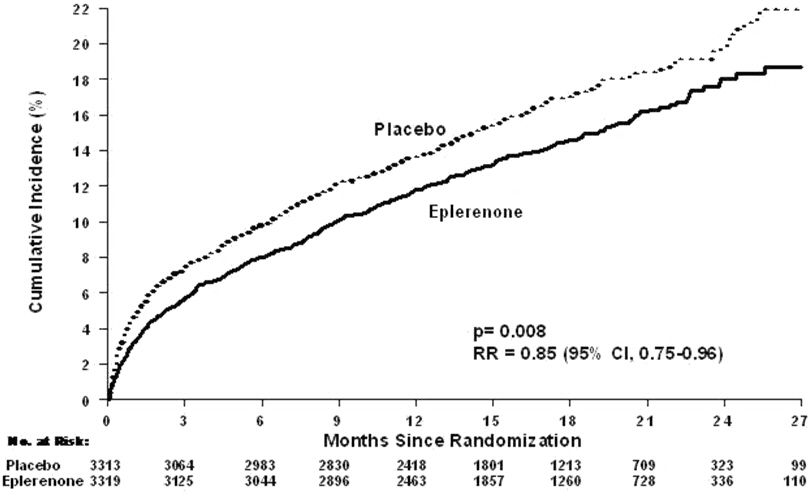
In EPHESUS, safety was evaluated in 3307 patients treated with eplerenone and 3301 placebo-treated patients. The overall incidence of adverse events reported with eplerenone (78.9%) was similar to placebo (79.5%). Adverse events occurred at a similar rate regardless of age, gender, or race. Patients discontinued treatment due to an adverse event at similar rates in either treatment group (4.4% eplerenone vs. 4.3% placebo), with the most common reasons for discontinuation being hyperkalemia, MI, and abnormal renal function.
Adverse reactions that occurred more frequently in patients treated with eplerenone than placebo were hyperkalemia (3.4% vs. 2.0%) and increased creatinine (2.4% vs. 1.5%). Discontinuations due to hyperkalemia or abnormal renal function were less than 1.0% in both groups.
Hypertension
Eplerenone has been evaluated for safety in 3091 patients treated for hypertension. A total of 690 patients were treated for over 6 months and 106 patients were treated for over 1 year.
In placebo-controlled studies, the overall rates of adverse events were 47% with eplerenone and 45% with placebo. Adverse events occurred at a similar rate regardless of age, gender, or race. Therapy was discontinued due to an adverse event in 3% of patients treated with eplerenone and 3% of patients given placebo. The most common reasons for discontinuation of eplerenone were headache, dizziness, angina pectoris/MI, and increased GGT.
Gynecomastia and abnormal vaginal bleeding were reported with eplerenone but not with placebo. The rates increased with increasing duration of therapy.
Congestive Heart Failure Post-Myocardial Infarction
Creatinine: Increases of more than 0.5 mg/dL were reported for 6.5% of patients administered eplerenone and for 4.9% of placebo-treated patients.
Potassium: In EPHESUS [see Clinical Studies (14.1)], the frequencies of patients with changes in potassium (<3.5 mEq/L or >5.5 mEq/L or ≥6.0 mEq/L) receiving eplerenone compared with placebo are displayed in Table 2.
Table 2. Hypokalemia (<3.5 mEq/L) or Hyperkalemia (>5.5 or ≥6.0 mEq/L) in EPHESUS| Potassium (mEq/L) | Eplerenone
(N=3251)
n (%) | Placebo
(N=3237)
n (%) |
|---|
| < 3.5 | 273 (8.4) | 424 (13.1) |
| >5.5 | 508 (15.6) | 363 (11.2) |
| ≥ 6.0 | 180 (5.5) | 126 (3.9) |
Rates of hyperkalemia increased with decreasing renal function.
Table 3. Rates of Hyperkalemia ( >5.5 mEq/L) in EPHESUS by Baseline Creatinine ClearanceEstimated using the Cockroft-Gault formula.
| Baseline Creatinine Clearance | Eplerenone
(N=508)
n (%) | Placebo
(N=363)
n (%) |
|---|
| ≤30 mL/min | 160 (32) | 82 (23) |
| 31–50 mL/min | 122 (24) | 46 (13) |
| 51–70 mL/min | 86 (17) | 48 (13) |
| >70 mL/min | 56 (11) | 32 (9) |
The rates of hyperkalemia in EPHESUS in the eplerenone treated group vs. placebo were increased in patients with proteinuria (16% vs 11%), diabetes (18% vs. 13%) or both (26% vs. 16%).
Hypertension
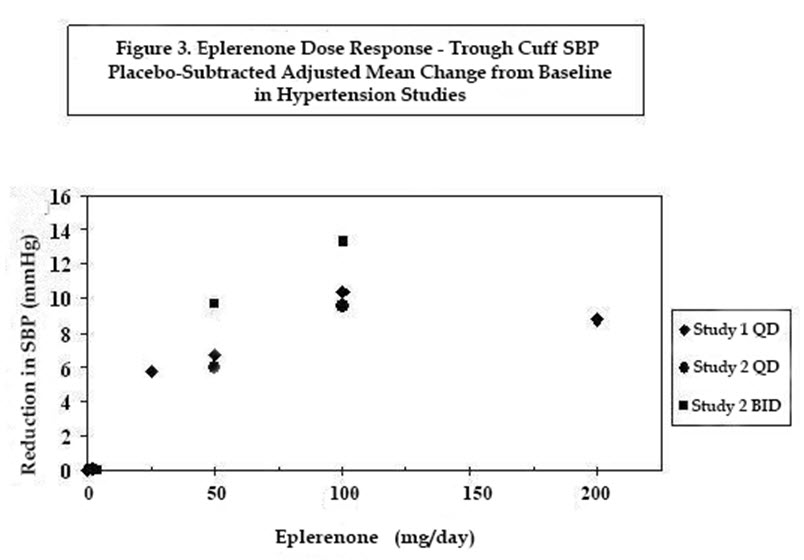
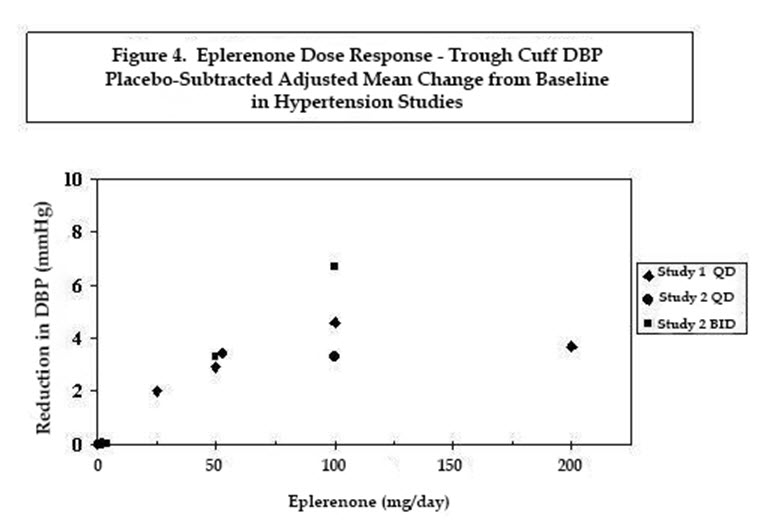
Potassium: In placebo-controlled fixed-dose studies, the mean increases in serum potassium were dose-related and are shown in Table 4 along with the frequencies of values >5.5 mEq/L.
Table 4. Increases in Serum Potassium in the Placebo-Controlled, Fixed-Dose Hypertension Studies of Eplerenone | Mean Increase mEq/L | % >5.5 mEq/L |
|---|
| Daily Dosage | n | | |
|---|
| Placebo | 194 | 0 | 1 |
| 25 | 97 | 0.08 | 0 |
| 50 | 245 | 0.14 | 0 |
| 100 | 193 | 0.09 | 1 |
Pregnancy Category B
There are no adequate and well-controlled studies in pregnant women. Eplerenone should be used during pregnancy only if the potential benefit justifies the potential risk to the fetus.
Congestive Heart Failure Post-Myocardial Infarction
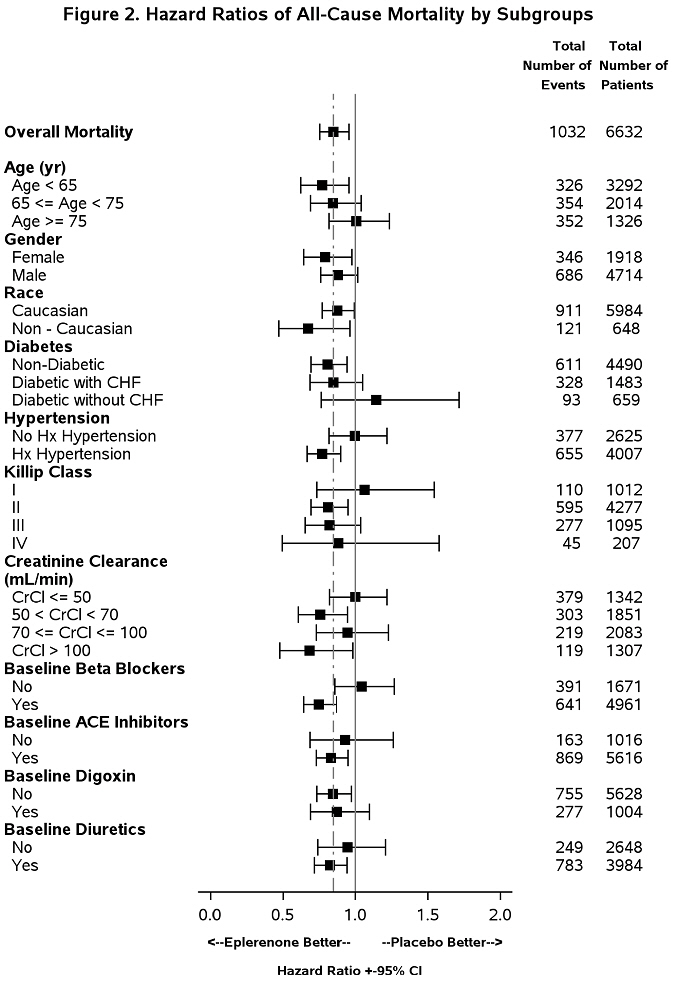
Of the total number of patients in EPHESUS, 3340 (50%) were 65 and over, while 1326 (20%) were 75 and over. Patients greater than 75 years did not appear to benefit from the use of eplerenone [see Clinical Studies (14.1)].
No differences in overall incidence of adverse events were observed between elderly and younger patients. However, due to age-related decreases in creatinine clearance, the incidence of laboratory-documented hyperkalemia was increased in patients 65 and older [see Warnings and Precautions (5.1)].
Hypertension
Of the total number of subjects in clinical hypertension studies of eplerenone, 1123 (23%) were 65 and over, while 212 (4%) were 75 and over. No overall differences in safety or effectiveness were observed between elderly subjects and younger subjects, however due to age-related decreases in creatine clearance, the risk of hyperkalemia may be increased [see Warnings and Precautions (5.1)].
Absorption and Distribution
Mean peak plasma concentrations of eplerenone are reached approximately 1.5 to 2 hours following oral administration. Absorption is not affected by food. The absolute bioavailability of eplerenone is 69% following administration of a 100 mg oral tablet. Both peak plasma levels (Cmax) and area under the curve (AUC) are dose proportional for doses of 25 mg to 100 mg and less than proportional at doses above 100 mg. Upon repeat dosing, steady state levels are reached within 2 days.
The plasma protein binding of eplerenone is about 50% and it is primarily bound to alpha 1-acid glycoproteins. The apparent volume of distribution at steady state ranged from 42 to 90 L. Eplerenone does not preferentially bind to red blood cells.
Metabolism and Excretion
Eplerenone metabolism is primarily mediated via CYP3A4. No active metabolites of eplerenone have been identified in human plasma.
Less than 5% of an eplerenone dose is recovered as unchanged drug in the urine and feces. Following a single oral dose of radiolabeled drug, approximately 32% of the dose was excreted in the feces and approximately 67% was excreted in the urine. The elimination half-life of eplerenone is approximately 3 to 6 hours. The apparent plasma clearance is approximately 10 L/hr.
Age, Gender, and Race
The pharmacokinetics of eplerenone at a dose of 100 mg once daily has been investigated in the elderly (≥65 years), in males and females, and in Blacks. At steady state, elderly subjects had increases in Cmax (22%) and AUC (45%) compared with younger subjects (18 to 45 years). The pharmacokinetics of eplerenone did not differ significantly between males and females. At steady state, Cmax was 19% lower and AUC was 26% lower in Blacks [see Dosage and Administration (2.4) and Use in Specific Populations (8.5)].
Renal Impairment
The pharmacokinetics of eplerenone was evaluated in patients with varying degrees of renal impairment and in patients undergoing hemodialysis. Compared with control subjects, steady state AUC and Cmax were increased by 38% and 24%, respectively, in patients with severe renal impairment and were decreased by 26% and 3%, respectively, in patients undergoing hemodialysis. No correlation was observed between plasma clearance of eplerenone and creatinine clearance. Eplerenone is not removed by hemodialysis [see Warnings and Precautions (5.1)].
Hepatic Impairment
The pharmacokinetics of eplerenone 400 mg has been investigated in patients with moderate (Child-Pugh Class B) hepatic impairment and compared with normal subjects. Steady state Cmax and AUC of eplerenone were increased by 3.6% and 42%, respectively.
Heart Failure
The pharmacokinetics of eplerenone 50 mg was evaluated in 8 patients with heart failure (NYHA classification II–IV) and 8 matched (gender, age, weight) healthy controls. Compared with the controls, steady state AUC and Cmax in patients with stable heart failure were 38% and 30% higher, respectively.
Drug-Drug Interactions
Eplerenone is metabolized primarily by CYP3A4. Inhibitors of CYP3A cause increased exposure [see Drug Interactions (7.1)].
Drug-drug interaction studies were conducted with a 100 mg dose of eplerenone.
Following a single dose of eplerenone 100 mg and CYP3A inhibitor ketoconazole 200 mg twice a day, eplerenone's Cmax was 1.7-fold and AUC was 5.4-fold compared with eplerenone alone.
Administration of eplerenone with moderate CYP3A inhibitors (e.g., erythromycin 500 mg BID, verapamil 240 mg once daily, saquinavir 1200 mg three times a day, fluconazole 200 mg once daily) resulted in increases in Cmax of eplerenone ranging from 40% to 60% and AUC from 100% to 190%.
Grapefruit juice caused a 25% increase in exposure.
Eplerenone is not an inhibitor of CYP1A2, CYP3A4, CYP2C19, CYP2C9, or CYP2D6. Eplerenone did not inhibit the metabolism of amiodarone, amlodipine, astemizole, chlorzoxazone, cisapride, dexamethasone, dextromethorphan, diclofenac, 17α-ethinyl estradiol, fluoxetine, losartan, lovastatin, mephobarbital, methylphenidate, methylprednisolone, metoprolol, midazolam, nifedipine, phenacetin, phenytoin, simvastatin, tolbutamide, triazolam, verapamil, or warfarin in vitro. Eplerenone is not a substrate or an inhibitor of P-Glycoprotein at clinically relevant doses.
No clinically significant drug-drug pharmacokinetic interactions were observed when eplerenone was administered with cisapride, cyclosporine, digoxin, glyburide, midazolam, oral contraceptives (norethindrone/ethinyl estradiol), simvastatin, or warfarin. St. John's wort (a CYP3A inducer) caused a small (about 30%) decrease in eplerenone AUC.
No significant changes in eplerenone pharmacokinetics were observed when eplerenone was administered with aluminum- and magnesium-containing antacids.

Greenstone Signature (Eplerenone 06)
LAB-0376-7.0