Vadadustat AUC and observed peak concentration (Cmax) increased proportionally after single doses from 80 mg to 1200 mg (0.27 to 4 times the approved recommended starting dosage). Vadadustat is expected to reach steady state by day 3 following once daily dosing, with no significant accumulation.
Absorption
The time to peak plasma concentration (Tmax) of vadadustat is approximately 2 to 3 hours.
Effect of Food
No clinically significant differences in vadadustat pharmacokinetics were observed following administration of a high-fat meal.
Distribution
Protein binding of vadadustat is ≥99.5% in human plasma. Vadadustat does not distribute into red blood cells.
Elimination
The mean half-life of vadadustat in patients on chronic hemodialysis was 9.2 hours.
Metabolism
Vadadustat is primarily metabolized via glucuronidation by UDP-glucuronosyltransferase (UGT) enzymes.
Excretion
After a single radiolabeled oral dose to healthy adults, 85.9% of the total dose was recovered; 58.9% in urine (<1% of total dose unchanged); and 26.9% in feces (9% of total dose unchanged).
Specific Populations
There were no clinically significant differences in the pharmacokinetics of vadadustat based on age, sex, race/ethnicity, or moderate hepatic impairment (Child-Pugh Class B). The effect of severe hepatic impairment (Child-Pugh Class C) on the pharmacokinetics of vadadustat is unknown.
Patients with Renal Impairment
Vadadustat clearance decreased with decreasing renal function and exposures in DD-CKD were approximately 2-fold higher compared to healthy adults. In patients with Stage 5 DD-CKD, no significant differences in pharmacokinetics (Cmax, AUC or mean half-life) were observed when VAFSEO was administered 4 hours before dialysis or 2 hours after dialysis.
Drug Interaction Studies
The impact of co-administered drugs on vadadustat exposure was examined in several drug-drug interaction (DDI) studies in healthy adults. The change in vadadustat exposure with coadministration compared to VAFSEO alone is summarized in Figure 1.
Figure 1 Impact of Other Drugs on Pharmacokinetics of Vadadustat

Figure 1 (Vafseo Figure 02)
BCRP: breast cancer resistance protein; CI: confidence interval; OAT: organic anion transporter; OATP: organic anion-transporting polypeptide. The solid vertical line represents geometric mean ratio of 1 and dotted vertical lines represent the 0.80 to 1.25 boundary.
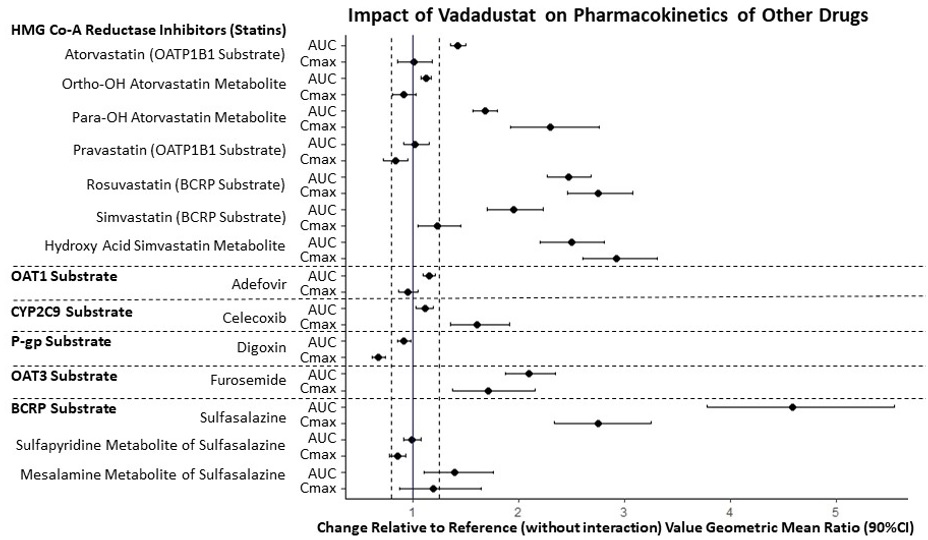
The impact of vadadustat on the exposure of other drugs was examined in several DDI studies in healthy adults. The change in drug exposure when coadministered with VAFSEO compared to the drug alone is summarized in Figure 2.
Figure 2 Effect of Vadadustat on Pharmacokinetics of Other Drugs

Figure 2 (Vafseo Figure 03)
BCRP: breast cancer resistance protein; CI: confidence interval; OAT: organic anion transporter; OATP: organic anion-transporting polypeptide. The solid vertical line represents geometric mean ratio of 1 and dotted vertical lines represent the 0.80 to 1.25 boundary.