Capecitabine
Product Images NDC 59923-721

9 FDA label images from Areva Pharmaceuticals · Packaging, Regulatory Labels, and Product Appearance

Product Visual Gallery

This gallery contains 9 technical images submitted to the FDA as part of the official labeling for Capecitabine (NDC 59923-721). Unlike standard consumer photos, these assets often include clinical data figures, molecular chemical structures, and official manufacturer packaging layouts.

As provided by Areva Pharmaceuticals, these visuals offer a comprehensive scientific overview of the product's physical and chemical identity, aiding pharmacists and researchers in product verification and study.

FDA Label Image

Bottle-label (150mg Label)
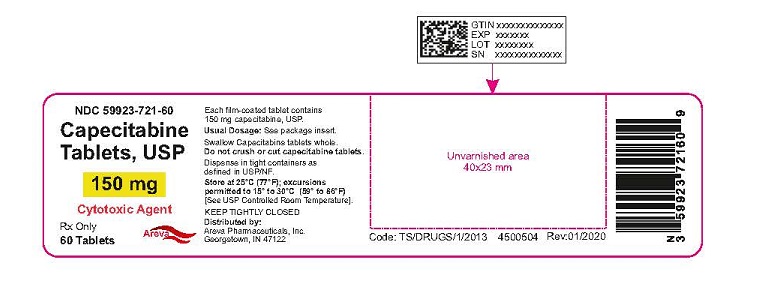
Bottle-label (150mg Label)
Capecitabine Tablets, USP 150 mg packaging label from Areva Pharmaceuticals. The label states each film-coated tablet contains 150 mg of capecitabine and includes usage instructions and storage conditions. The package contains 60 tablets and is marked as Rx only and cytotoxic agent. A barcode and other regulatory information are present on the label.*
FDA Label Image

Bottle-label (500mg Label)

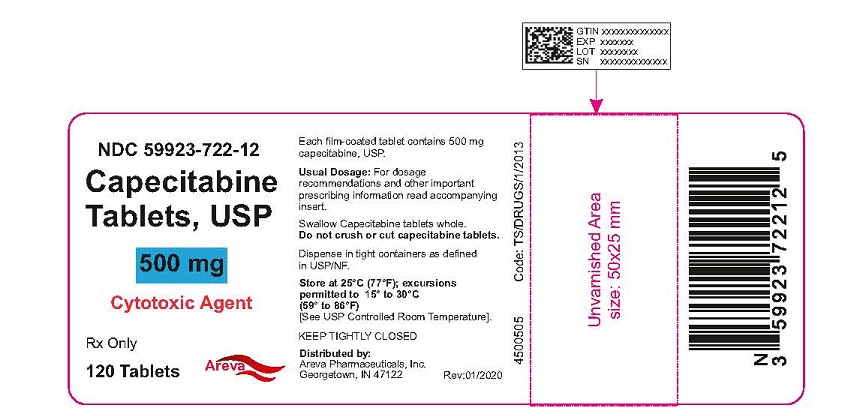
Bottle-label (500mg Label)
Label for Capecitabine Tablets, USP 500 mg by Areva Pharmaceuticals. The package contains 120 film-coated tablets. The label includes storage instructions, dosage advice, and a warning not to crush or cut the tablets. It also features the NDC 59923-722-12 and distributor information.*
FDA Label Image

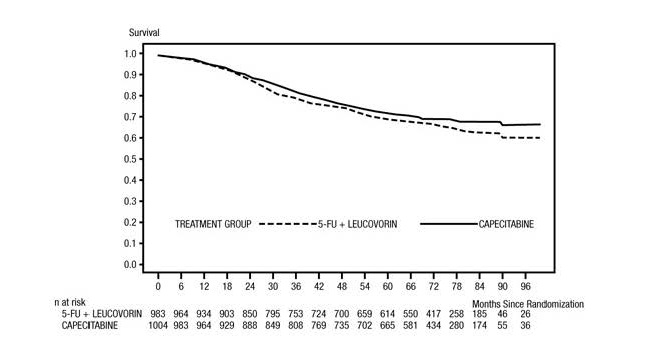
Figure-1 (Figure 1)

Figure-1 (Figure 1)
A line graph comparing survival rates over time in months for two treatment groups: Capecitabine and 5-FU + Leucovorin. The x-axis represents months since randomization, ranging from 0 to 96, and the y-axis shows survival probability from 0.1 to 1.0. The graph includes a table of the number of patients at risk for each group at various time points.*
FDA Label Image

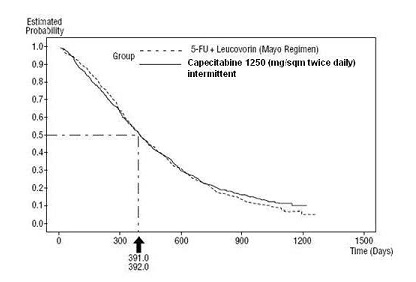
Figure-2 (Figure 2)

Figure-2 (Figure 2)
A survival curve comparing two treatment groups: 5-FU + Leucovorin (dashed line) and Capecitabine (solid line). The x-axis represents months since randomization, and the y-axis shows survival probability. Numbers at risk are listed for each group below the graph across time points.*
FDA Label Image

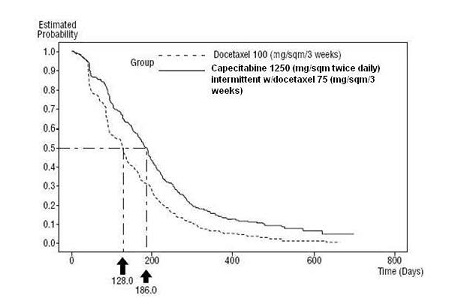
Figure-3 (Figure 3)

Figure-3 (Figure 3)
A line graph depicting estimated probability over time (days) for two groups: one receiving 5-FU plus Leucovorin (Mayo Regimen) and the other receiving Capecitabine 1250 mg/sqm twice daily intermittently. The graph shows probability decreasing over time, with a marked point around day 391 to 392.*
FDA Label Image

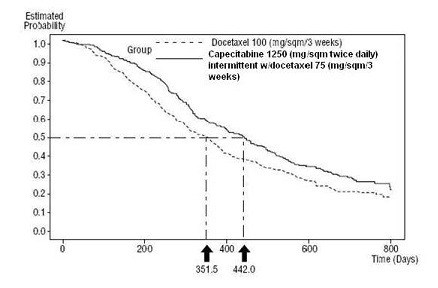
Figure-4 (Figure 4)

Figure-4 (Figure 4)
A survival curve chart comparing two treatment groups: Docetaxel 100 (mg/sqm/3 weeks) and Capecitabine 1250 (mg/sqm twice daily) intermittent with Docetaxel 75 (mg/sqm/3 weeks). The chart plots estimated probability on the y-axis against time in days on the x-axis, showing survival trends over approximately 800 days with marked points at 128 and 186 days.*
FDA Label Image

Figure-5 (Figure 5)

Figure-5 (Figure 5)
A time-to-event Kaplan-Meier survival curve chart comparing estimated probability over time (days) among three groups: Docetaxel 100 mg/sqm every 3 weeks, Capecitabine 1250 mg/sqm twice daily, and Intermittent with docetaxel 75 mg/sqm every 3 weeks. The x-axis represents time in days, and the y-axis shows estimated probability.*
FDA Label Image

Metabolic-pathway (Metabolic Pathway)

Metabolic-pathway (Metabolic Pathway)
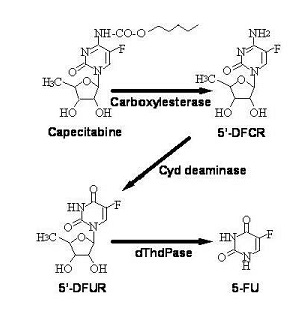
An illustration diagram depicting the metabolic pathway of Capecitabine involving enzymatic conversions. The diagram shows Capecitabine transformed by carboxylesterase into 5'-DFCR, which is then converted by Cyd deaminase to 5'-DFUR, and subsequently by dThdPase to 5-FU.*
FDA Label Image

Structure (Structure)

Structure (Structure)
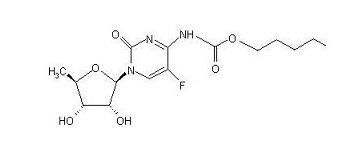
Chemical structure of the active ingredient capecitabine showing its molecular components and bonds.*

* About these descriptions: Image descriptions on this page are generated by automated AI analysis of the product label images from the manufacturer's FDA label submission (SPL). They are provided for reference only and may contain errors or omissions. Always rely on the printed label itself and the official FDA labeling, and consult a pharmacist or healthcare professional with any questions about this product.