Use in Patients with Prior Endothelin Receptor Antagonist (ERA) Related Serum Liver Enzyme Abnormalities
In an uncontrolled, open-label study, 36 patients who had previously discontinued endothelin receptor antagonists (ERAs: bosentan, an investigational drug, or both) due to aminotransferase elevations >3 x ULN were treated with ambrisentan tablets. Prior elevations were predominantly moderate, with 64% of the ALT elevations <5 x ULN, but 9 patients had elevations >8 x ULN. Eight patients had been re-challenged with bosentan and/or the investigational ERA and all eight had a recurrence of aminotransferase abnormalities that required discontinuation of ERA therapy. All patients had to have normal aminotransferase levels on entry to this study. Twenty-five of the 36 patients were also receiving prostanoid and/or phosphodiesterase type 5 (PDE5) inhibitor therapy. Two patients discontinued early (including one of the patients with a prior 8 x ULN elevation). Of the remaining 34 patients, one patient experienced a mild aminotransferase elevation at 12 weeks on ambrisentan tablets 5 mg that resolved with decreasing the dosage to 2.5 mg, and that did not recur with later escalations to 10 mg. With a median follow up of 13 months and with 50% of patients increasing the dose of ambrisentan tablets to 10 mg, no patients were discontinued for aminotransferase elevations. While the uncontrolled study design does not provide information about what would have occurred with re-administration of previously used ERAs or show that ambrisentan led to fewer aminotransferase elevations than would have been seen with those drugs, the study indicates that ambrisentan may be tried in patients who have experienced asymptomatic aminotransferase elevations on other ERAs after aminotransferase levels have returned to normal.
Pre-existing Hepatic Impairment
The influence of pre-existing hepatic impairment on the pharmacokinetics of ambrisentan has not been evaluated. Because there is in vitro and in vivo evidence of significant metabolic and biliary contribution to the elimination of ambrisentan, hepatic impairment might be expected to have significant effects on the pharmacokinetics of ambrisentan [see Clinical Pharmacology (12.3)]. Ambrisentan is not recommended in patients with moderate or severe hepatic impairment. There is no information on the use of ambrisentan in patients with mild pre-existing impaired liver function; however, exposure to ambrisentan may be increased in these patients.
Elevation of Liver Transaminases
Other endothelin receptor antagonists (ERAs) have been associated with aminotransferase (AST, ALT) elevations, hepatotoxicity, and cases of liver failure [see Adverse Reactions (6.1, 6.2)]. In patients who develop hepatic impairment after ambrisentan tablets initiation, the cause of liver injury should be fully investigated. Discontinue ambrisentan tablets if elevations of liver aminotransferases are >5 × ULN or if elevations are accompanied by bilirubin >2 × ULN, or by signs or symptoms of liver dysfunction and other causes are excluded.
Cardiac Electrophysiology
In a randomized, positive- and placebo-controlled, parallel-group study, healthy subjects received either ambrisentan tablets 10 mg daily followed by a single dose of 40 mg, placebo followed by a single dose of moxifloxacin 400 mg, or placebo alone. Ambrisentan tablets 10 mg daily had no significant effect on the QTc interval. The 40 mg dose of ambrisentan tablets increased mean QTc at tmax by 5 ms with an upper 95% confidence limit of 9 ms. For patients receiving ambrisentan tablets 5–10 mg daily and not taking metabolic inhibitors, no significant QT prolongation is expected.
Drug Interactions
In Vitro Studies
Studies with human liver tissue indicate that ambrisentan is metabolized by CYP3A, CYP2C19, and uridine 5'-diphosphate glucuronosyltransferases (UGTs) 1A9S, 2B7S, and 1A3S. In vitro studies suggest that ambrisentan is a substrate of the Organic Anion Transporting Polypeptides OATP1B1 and OATP1B3, and P-glycoprotein (P-gp). Drug interactions might be expected because of these factors; however, a clinically relevant interaction has been demonstrated only with cyclosporine [see Drug Interactions (7)]. In vitro studies found ambrisentan to have little to no inhibition of human hepatic transporters. Ambrisentan demonstrated weak dose-dependent inhibition of OATP1B1, OATP1B3, and NTCP (IC50 of 47 mcM, 45 mcM, and approximately 100 mcM, respectively) and no transporter-specific inhibition of BSEP, BRCP, P-gp, or MRP2. Ambrisentan does not inhibit or induce drug metabolizing enzymes at clinically relevant concentrations.
In Vivo Studies
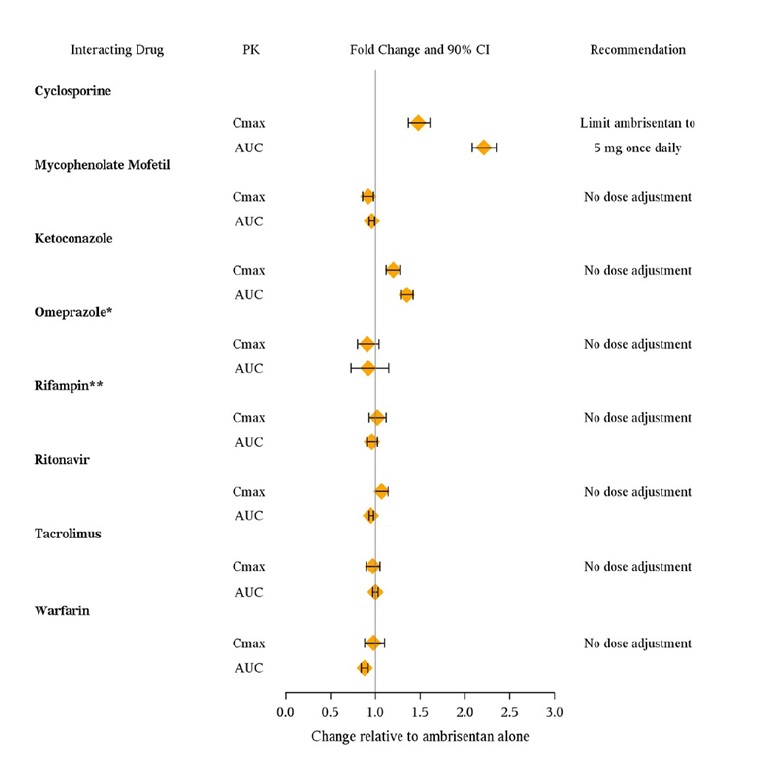
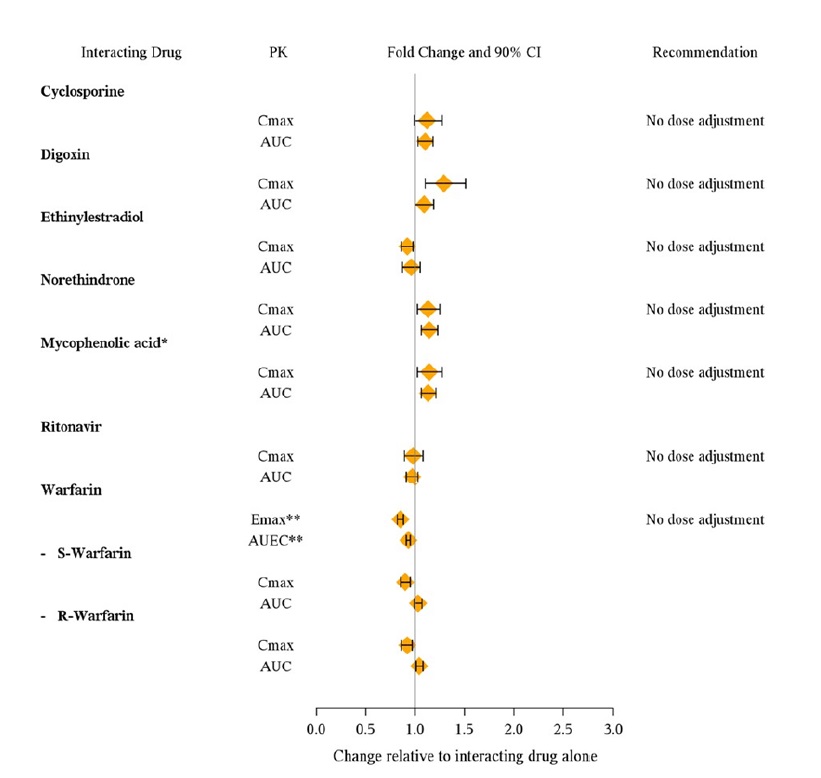
The effects of other drugs on ambrisentan pharmacokinetics and the effects of ambrisentan on the exposure to other drugs are shown in Figure 2 and Figure 3, respectively.
Figure 2 Effects of Other Drugs on Ambrisentan Pharmacokinetics
* Omeprazole: based on population pharmacokinetic analysis in PAH patients
** Rifampin: AUC and Cmax were measured at steady-state. On Day 3 of coadministration a transient 2-fold increase in AUC was noted that was no longer evident by Day 7. Day 7 results are presented.
Figure 3 Effects of Ambrisentan on Other Drugs
* Active metabolite of mycophenolate mofetil
** GMR (95% CI) for INR
Submaximal Exercise Ability
Results of the 6-minute walk distance at 12 weeks for the ARIES-1 and ARIES-2 studies are shown in Table 3 and Figure 4.
Table 3 Changes from Baseline in 6-Minute Walk Distance (meters) (ARIES-1 and ARIES-2) | ARIES-1 | ARIES-2 |
|---|
Placebo
(N=67) | 5 mg
(N=67) | 10 mg
(N=67) | Placebo
(N=65) | 2.5 mg
(N=64) | 5 mg
(N=63) |
|---|
Mean ± standard deviation
a p-values are Wilcoxon rank sum test comparisons of ambrisentan tablets to placebo at Week 12 stratified by idiopathic or heritable PAH and non-idiopathic, non-heritable PAH patients |
| Baseline | 342 ± 73 | 340 ± 77 | 342 ± 78 | 343 ± 86 | 347 ± 84 | 355 ± 84 |
| Mean change from baseline | -8 ± 79 | 23 ± 83 | 44 ± 63 | -10 ± 94 | 22 ± 83 | 49 ± 75 |
| Placebo-adjusted mean change from baseline | – | 31 | 51 | – | 32 | 59 |
| Placebo-adjusted median change from baseline | – | 27 | 39 | – | 30 | 45 |
| p-valuea | – | 0.008 | <0.001 | – | 0.022 | <0.001 |
Figure 4 Mean Change in 6-Minute Walk Distance (ARIES-1 and ARIES-2)
Mean change from baseline in 6-minute walk distance in the placebo and ambrisentan groups. Values are expressed as mean ± standard error of the mean.
In both studies, treatment with ambrisentan tablets resulted in a significant improvement in 6-minute walk distance for each dose of ambrisentan tablets and the improvements increased with dose. An increase in 6-minute walk distance was observed after 4 weeks of treatment with ambrisentan tablets, with a dose-response observed after 12 weeks of treatment. Improvements in walk distance with ambrisentan were smaller for elderly patients (age ≥65) than younger patients and for patients with secondary PAH than for patients with idiopathic or heritable PAH. The results of such subgroup analyses must be interpreted cautiously.
Clinical Worsening
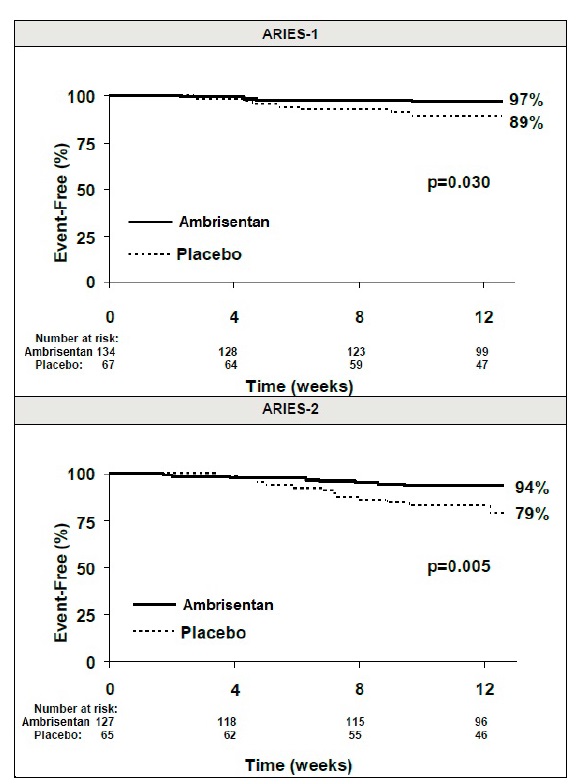
Time to clinical worsening of PAH was defined as the first occurrence of death, lung transplantation, hospitalization for PAH, atrial septostomy, study withdrawal due to the addition of other PAH therapeutic agents, or study withdrawal due to early escape. Early escape was defined as meeting two or more of the following criteria: a 20% decrease in the 6-minute walk distance; an increase in WHO functional class; worsening right ventricular failure; rapidly progressing cardiogenic, hepatic, or renal failure; or refractory systolic hypotension. The clinical worsening events during the 12-week treatment period of the ambrisentan clinical trials are shown in Table 4 and Figure 5.
Table 4 Time to Clinical Worsening (ARIES-1 and ARIES-2) | ARIES-1 | ARIES-2 |
|---|
Placebo
(N=67) | Ambrisentan tablets
(N=134) | Placebo
(N=65) | Ambrisentan tablets
(N=127) |
|---|
Intention-to-treat population.
Note: Patients may have had more than one reason for clinical worsening.
Nominal p-values |
| Clinical worsening, no. (%) | 7 (10%) | 4 (3%) | 13 (22%) | 8 (6%) |
| Hazard ratio | – | 0.28 | – | 0.30 |
| p-value, Log-rank test | – | 0.030 | – | 0.005 |
There was a significant delay in the time to clinical worsening for patients receiving ambrisentan compared to placebo. Results in subgroups such as the elderly were also favorable.
Figure 5 Time to Clinical Worsening (ARIES-1 and ARIES-2)
Time from randomization to clinical worsening with Kaplan-Meier estimates of the proportions of patients without events in ARIES-1 and ARIES-2.
p-values shown are the log-rank comparisons of ambrisentan to placebo stratified by idiopathic or heritable PAH and non-idiopathic, non-heritable PAH patients.
Embryo-fetal Toxicity
Instruct patients on the risk of fetal harm when ambrisentan tablets are used in pregnancy [see Warnings and Precautions (5.1) and Use in Specific Populations (8.1)]. Female patients must enroll in the Ambrisentan REMS. Instruct females of reproductive potential to immediately contact their physician if they suspect they may be pregnant.
Ambrisentan Risk Evaluation and Mitigation Strategy (REMS)
For female patients, ambrisentan tablets are only available through a restricted program called the Ambrisentan REMS [see Contraindications (4.1), Warnings and Precautions (5.2)]. Male patients are not enrolled in the Ambrisentan REMS.
Inform female patients (and their guardians, if applicable) of the following notable requirements:
- All female patients must sign an enrollment form.
- Female patients of reproductive potential must comply with the pregnancy testing and contraception requirements [see Use in Specific Populations (8.3)].
- Females of reproductive potential must be counseled on the use of emergency contraception in the event of unprotected sex or known or suspected contraceptive failure.
- Pre-pubertal females must report any changes in their reproductive status immediately to their prescriber.
Ambrisentan tablets are available only from certified pharmacies participating in the program. Therefore, provide patients with the telephone number and website for information on how to obtain the product.
Hepatic Effects
Advise patients of the symptoms of potential liver injury and instruct them to report any of these symptoms to their physician.
Hematological Change
Advise patients of the importance of hemoglobin testing.
Other Risks Associated with ambrisentan tablets
Instruct patients that the risks associated with ambrisentan tablets also include the following:
- Decreases in sperm count
- Fluid overload
Administration
Advise patients not to split, crush, or chew tablets.
APOTEX INC.
AMBRISENTAN TABLETS
5 mg and 10 mg
| Manufactured by: | Manufactured for: |
Apotex Inc.
Toronto, Ontario
Canada M9L 1T9 | Apotex Corp.
Weston, Florida
USA 33326 |
Revised: November 2020
Rev. 8