- Study RA-II (NCT00856544) was a 12-month trial in which 792 patients with moderate to severe active RA who had an inadequate response to a nonbiologic DMARD received XELJANZ 5 mg or 10 mg twice daily or placebo added to background DMARD treatment (excluding potent immunosuppressive treatments such as azathioprine or cyclosporine). At the Month 3 visit, nonresponding patients were switched in a blinded fashion to a second predetermined treatment of XELJANZ 5 mg or 10 mg twice daily. At the end of Month 6, all patients treated with placebo were switched to their second predetermined XELJANZ treatment in a blinded fashion. The primary endpoints were the proportion of patients who achieved an ACR20 response at Month 6, changes in HAQ-DI at Month 3, and rates of DAS28-4(ESR) less than 2.6 at Month 6.
- Study RA-III (NCT00853385) was a 12-month trial in 717 patients with moderate to severe active RA who had an inadequate response to methotrexate (MTX). Patients received XELJANZ 5 mg or 10 mg orally twice daily, adalimumab 40 mg subcutaneously every other week, or placebo added to background MTX. Patients treated with placebo were switched as in Study RA-II. The primary endpoints were the proportion of patients who achieved an ACR20 response at Month 6, HAQ-DI at Month 3, and DAS28-4(ESR) less than 2.6 at Month 6.
- Study RA-IV (NCT00847613) was a 2-year trial with a planned analysis at 1 year in which 797 patients with moderate to severe active RA who had an inadequate response to MTX received XELJANZ 5 mg or 10 mg twice daily or placebo added to background MTX. Patients treated with placebo were switched as in Study RA-II. The primary endpoints were the proportion of patients who achieved an ACR20 response at Month 6, mean change from baseline in van der Heijde-modified total Sharp Score (mTSS) at Month 6, HAQ-DI at Month 3, and DAS28-4(ESR) less than 2.6 at Month 6.
- Study RA-V (NCT00960440) was a 6-month trial in which 399 patients with moderate to severe active RA who had an inadequate response to at least one approved TNF blocking biological product received XELJANZ 5 mg or 10 mg twice daily or placebo added to background MTX. At the Month 3 visit, all patients randomized to placebo treatment were switched in a blinded fashion to a second predetermined treatment of XELJANZ 5 or 10 mg twice daily. The primary endpoints at Month 3 were the proportion of patients who achieved an ACR20 response, HAQ-DI, and DAS28-4(ESR) less than 2.6.
- Study RA-VI (NCT01039688) was a 2-year monotherapy trial with a planned analysis at 1 year in which 952 MTX-naïve patients with moderate to severe active RA received XELJANZ 5 or 10 mg twice daily or MTX dose-titrated over 8 weeks to 20 mg weekly. The primary endpoints were mean change from baseline in van der Heijde-modified Total Sharp Score (mTSS) at Month 6 and the proportion of patients who achieved an ACR70 response at Month 6.
Although other dosages have been studied, the recommended dosage of XELJANZ is 5 mg twice daily. XELJANZ 10 mg twice daily is not recommended for the treatment of RA [see Dosage and Administration (2.3)].
Clinical Response
The percentages of XELJANZ-treated patients who achieved ACR20, ACR50, and ACR70 responses in Studies RA-I, IV, and V are shown in Table 10. Similar results were observed with Studies RA-II and III. In trials RA-I through V, patients treated with 5 mg twice daily XELJANZ had higher ACR20, ACR50, and ACR70 response rates versus patients treated with placebo, with or without background DMARD treatment, at Month 3 and Month 6. Higher ACR20 response rates were observed within 2 weeks compared to placebo. In the 12-month trials, ACR response rates in XELJANZ-treated patients were consistent at 6 and 12 months.
Table 10: Proportion of Adults with Moderate to Severe Active RA with an ACR Response at Months 3 and 6 in Studies RA-I, IV, and V
| | Monotherapy in Nonbiologic or Biologic DMARD Inadequate Respondersc | MTX Inadequate Respondersd | TNF Blocker Inadequate Responderse |
| | Study RA-I | Study RA-IV | Study RA-V |
| Na | Placebo + background DMARD
122 | XELJANZ 5 mg Twice Daily+ background DMARD
243 | Placebo + background MTX
160 | XELJANZ 5 mg Twice Daily + background MTX
321 | Placebo + background MTX
132 | XELJANZ 5 mg Twice Daily + background MTX
133 |
| ACR20 Month 3 Month 6 | 26%
NAb | 59%
69% | 27%
25% | 55%
50% | 24%
NA | 41%
51% |
| ACR50 Month 3 Month 6 | 12%
NA | 31%
42% | 8%
9% | 29%
32% | 8%
NA | 26%
37% |
| ACR70 Month 3 Month 6 | 6%
NA | 15%
22% | 3%
1% | 11%
14% | 2%
NA | 14%
16% |
a N is number of randomized and treated patients.
b NA (not applicable), as data for placebo treatment is not available beyond 3 months in Studies RA-I and RA-V due to placebo advancement.
c Inadequate response to at least one DMARD (biologic or nonbiologic) due to lack of efficacy or toxicity.
d Inadequate response to MTX defined as the presence of sufficient residual disease activity to meet the entry criteria.
e Inadequate response to a least one TNF blocker due to lack of efficacy and/or intolerance.
In Study RA-IV, a greater proportion of patients treated with XELJANZ 5 mg twice daily plus MTX achieved a low level of disease activity as measured by a DAS28-4(ESR) less than 2.6 at 6 months compared to those treated with MTX alone (Table 11).
Table 11: Proportion and Numbers of Adults with Moderate to Severe Active RA with DAS28-4(ESR) Less Than 2.6 with Number of Residual Active Joints at Month 6 in Study RA-IV
| | Study RA-IV |
| DAS28-4(ESR) Less Than 2.6 | Placebo + MTX
160 | XELJANZ 5 mg
Twice Daily + MTX
321 |
| Proportion of responders at Month 6 (n) | 1% (2) | 6% (19) |
| Of responders, proportion with 0 active joints (n) | 50% (1) | 42% (8) |
| Of responders, proportion with 1 active joint (n) | 0 | 5% (1) |
| Of responders, proportion with 2 active joints (n) | 0 | 32% (6) |
| Of responders, proportion with 3 or more active joints (n) | 50% (1) | 21% (4) |
The results of the components of the ACR response criteria for Study RA-IV are shown in Table 12. Similar results were observed for XELJANZ in Studies RA-I, II, III, V, and VI.
Table 12: Components of ACR Response in Adults with Moderate to Severe Active RA at Baseline and Month 3 in Study RA-IV
| | Study RA-IV |
| | Placebo + MTX
N=160 | XELJANZ 5 mg
Twice Daily + MTX
N=321 |
| Component (mean)a | Baseline | Month 3a | Baseline | Month 3a |
| Number of tender joints | 23 | 18 | 24 | 13 |
| (0 to 68) | (13) | (14) | (14) | (14) |
Number of swollen joints
(0 to 66) | 14
(9) | 10
(9) | 14
(8) | 6
(8) |
| Painb | 55 | 47 | 58 | 34 |
| | (24) | (24) | (23) | (23) |
| Patient global assessmentb | 54 | 47 | 58 | 35 |
| (23) | (24) | (24) | (23) |
| Disability index (HAQ-DI)c | 1.32 | 1.19 | 1.41 | 0.99 |
| (0.67) | (0.68) | (0.68) | (0.65) |
| Physician global assessmentb | 56 | 43 | 59 | 30 |
| (18) | (22) | (16) | (19) |
| CRP (mg/L) | 13.7 | 14.6 | 15.3 | 7.1 |
| (14.9) | (18.7) | (19.0) | (19.1) |
a Data shown is mean (Standard Deviation) at Month 3.
b Visual analog scale: 0 = best, 100 = worst.
c Health Assessment Questionnaire Disability Index: 0 = best, 3 = worst; 20 questions; categories: dressing and grooming, arising, eating, walking, hygiene, reach, grip, and activities.
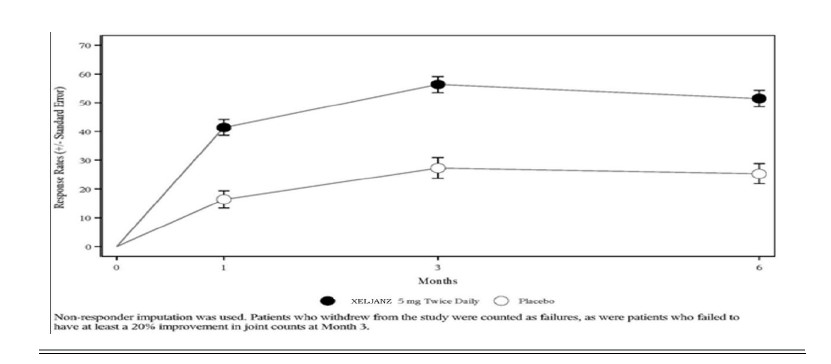
The percent of ACR20 responders by visit for Study RA-IV is shown in Figure 4. Similar responses were observed for XELJANZ in Studies RA-I, II, III, V, and VI.
Figure 4: Percentage of ACR20 Responders by Visit Through Month 6 in Study RA-IV
Radiographic Response
Two studies were conducted to evaluate the effect of XELJANZ on structural joint damage. In Study RA-IV and Study RA-VI, progression of structural joint damage was assessed radiographically and expressed as change from baseline in mTSS and its components, the erosion score and joint space narrowing score, at Months 6 and 12. The proportion of patients with no radiographic progression (mTSS change less than or equal to 0) was also assessed.
In Study RA-IV, XELJANZ 5 mg twice daily reduced the mean progression of structural damage (not statistically significant) as shown in Table 13. Analyses of erosion and joint space narrowing scores were consistent with the overall results.
In the placebo plus MTX group, 74% of patients experienced no radiographic progression at Month 6 compared to 84% of patients treated with XELJANZ plus MTX 5 mg twice daily.
In Study RA-VI, XELJANZ monotherapy inhibited the progression of structural damage compared to MTX at Months 6 and 12 as shown in Table 13. Analyses of erosion and joint space narrowing scores were consistent with the overall results.
In the MTX group, 55% of patients experienced no radiographic progression at Month 6 compared to 73% of patients treated with XELJANZ 5 mg twice daily.
Table 13: Radiographic Changes in Adults with Moderate to Severe Active RA at Months 6 and 12 in Studies RA-IV and VI
| | Study RA-IV |
| | Placebo
N=139
Mean (SD)a | XELJANZ 5 mg Twice
Daily N=277
Mean (SD) a | XELJANZ 5 mg Twice Daily
Mean Difference from Placebob (CI) |
mTSSc
Baseline
Month 6 | 33 (42)
0.5 (2.0) | 31 (48)
0.1 (1.7) | -
-0.3 (-0.7, 0.0)
|
| | Study RA-VI |
| | MTX
N=166
Mean (SD)a | XELJANZ 5 mg Twice Daily
N=346
Mean (SD) a | XELJANZ 5 mg Twice
Daily Mean Difference from MTXb (CI) |
mTSSc
Baseline
Month 6
Month 12 | 17 (29)
0.8 (2.7)
1.3 (3.7) | 20 (40)
0.2 (2.3)
0.4 (3.0) | -
-0.7 (-1.0, -0.3)
-0.9 (-1.4, -0.4) |
a SD = Standard Deviation
b Difference between least squares means XELJANZ minus placebo or MTX (95% CI = 95% confidence interval)
cMonth 6 and Month 12 data are mean change from baseline.
Physical Function Response
Improvement in physical functioning was measured by the HAQ-DI. Patients who received XELJANZ 5 mg twice daily demonstrated greater improvement from baseline in physical functioning compared to patients who received placebo at Month 3.
The mean (95% CI) difference from placebo in HAQ-DI improvement from baseline at Month 3 in Study RA-III was -0.22 (-0.35, -0.10) in patients who received 5 mg XELJANZ twice daily.
Similar results were obtained in Studies RA-I, II, IV and V. In the 12-month trials, HAQ-DI results in XELJANZ-treated patients were consistent at 6 and 12 months.
Other Health-Related Outcomes
General health status was assessed by the Short Form health survey (SF-36). In Studies RA-I, IV, and V, patients who received XELJANZ 5 mg twice daily demonstrated greater improvement from baseline compared to placebo in physical component summary (PCS), mental component summary (MCS) scores and in all 8 domains of the SF-36 at Month 3.
Clinical Response
At Month 3, patients treated with XELJANZ 5 mg twice daily had higher (p≤0.05) response rates versus placebo for ACR20, ACR50, and ACR70 in Study PsA-I and for ACR20 and ACR50 in Study PsA-II; ACR70 response rates were also higher for XELJANZ 5 mg twice daily versus placebo in Study PsA-II, although the differences versus placebo were not statistically significant (p>0.05) (Tables 14 and 15).
Table 14: Proportion of Adults with Active PsA with an ACR Response at Month 3 in Study PsA-I* [Nonbiologic DMARD Inadequate Responders (TNF Blocker-Naïve)]**
| Treatment Group | Placebo | XELJANZ 5 mg
Twice Daily + Background Nonbiologic DMARD |
| Na | 105 | 107 |
| | Response Rate | Response Rate | Difference (%) 95% CI from Placebo |
Month 3
ACR20
ACR50
ACR70 | 33%
10%
5% | 50%
28%
17% | 17.1 (4.1, 30.2)
18.5 (8.3, 28.7)
12.1 (3.9, 20.2) |
Patients with missing data were treated as non-responders.
* Patients received one concomitant nonbiologic DMARD.
** XELJANZ and tofacitinib extended-release tablets are not approved for use in TNF blocker-naïve patients [see Indications and Usage (1.2)].
aN is number of randomized and treated patients.
Table 15: Proportion of Adults with Active PsA with an ACR Response at Month 3 in Study PsA-II* (TNF Blocker Inadequate Responders)
| Treatment Group | Placebo | XELJANZ 5 mg Twice Daily |
| Na | 131 | 131 |
| | Response Rate | Response Rate | Difference (%) 95% CI from
Placebo |
Month 3
ACR20
ACR50
ACR70 | 24%
15%
10% | 50%
30%
17% | 26.0 (14.7, 37.2)
15.3 (5.4, 25.2)
6.9 (-1.3, 15.1) |
Patients with missing data were treated as non-responders.
* Patients received one concomitant nonbiologic DMARD.
a N is number of randomized and treated patients.
Improvements from baseline in the ACR response criteria components for both studies are shown in Table 16.
Table 16: Components of ACR Response in Adults with Active PsA at Baseline and Month 3 in Studies PsA-I and PsA-II
| | Nonbiologic DMARD Inadequate Responders (TNF Blocker-Naïve) | TNF Blocker Inadequate Responders |
| Study PsA-I*,** | Study PsA-II* |
| Treatment Group | Placebo | XELJANZ 5 mg
Twice Daily | Placebo | XELJANZ 5 mg
Twice Daily |
| N at Baseline | 105 | 107 | 131 | 131 |
| ACR Componenta | | | | |
Number of tender/painful joints
(0 to 68) Baseline
Month 3 | 20.6
14.6 | 20.5
12.2 | 19.8
15.1 | 20.5
11.5 |
Number of swollen joints
(0 to 66) Baseline
Month 3 | 11.5
7.1 | 12.9
6.3 | 10.5
7.7 | 12.1
4.8 |
Patient assessment of arthritis painb
Baseline
Month 3 | 53.2
44.7 | 55.7
34.7 | 54.9
48.0 | 56.4
36.1 |
Patient global assessment of arthritisb
Baseline
Month 3 | 53.9
44.4 | 54.7
35.5 | 55.8
49.2 | 57.4
36.9 |
HAQ-DIc
Baseline
Month 3 |
1.11
0.95 |
1.16
0.81 |
1.25
1.09 |
1.26
0.88 |
Physician’s Global Assessment of Arthritisb
Baseline
Month 3 | 53.8
35.4 | 54.6
29.5 | 53.7
36.4 | 53.5
27.0 |
CRP (mg/L)
Baseline
Month 3 | 10.4
8.6 | 10.5
4.0 | 12.1
11.4 | 13.8
7.7 |
*Patients received one concomitant nonbiologic DMARD.
* * XELJANZ and tofacitinib extended-release tablets are not approved for use in TNF blocker-naïve patients [see Indications and Usage (1.2)].
a Data shown are mean value at baseline and at Month 3.
b Visual analog scale (VAS): 0 = best, 100 = worst.
c HAQ-DI = Health Assessment Questionnaire – Disability Index: 0 = best, 3 = worst; 20 questions; categories: dressing and grooming, arising, eating, walking, hygiene, reach, grip, and activities.
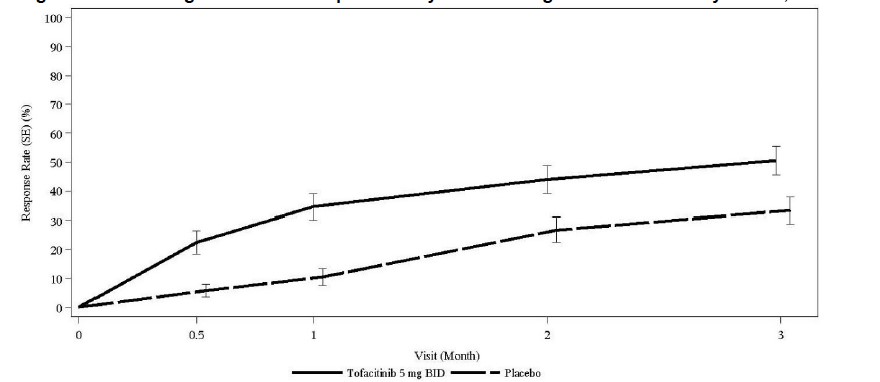
The percentage of ACR20 responders by visit for Study PsA-I is shown in Figure 5. Similar responses were observed in Study PsA-II. In both studies, improvement in ACR20 response on XELJANZ was observed at the first visit after baseline (Week 2).
Figure 5: Percentage of ACR20 Responders by Visit Through Month 3 in Study PsA-I*, **
BID=twice daily; SE=standard error.
Patients with missing data were treated as non-responders.
*Subjects received one concomitant nonbiologic DMARD.
** XELJANZ and tofacitinib extended-release tablets are not approved for use in TNF blocker-naïve patients [see Indications and Usage (1.2)].
In patients with active PsA evidence of benefit in enthesitis and dactylitis was observed with XELJANZ treatment.
Physical Function
Improvement in physical functioning was measured by the HAQ-DI. Patients receiving XELJANZ 5 mg twice daily demonstrated significantly greater improvement (p ≤0.05) from baseline in physical functioning compared to placebo at Month 3 (Table 17).
Table 17: Change from Baseline in HAQ-DI in Adults with Active PsA at Month 3 Studies PsA-I and PsA-II
| | Least Squares Mean Change from Baseline In HAQ-DI at Month 3 |
Nonbiologic DMARD Inadequate
Respondersb
(TNF Blocker-Naïve) | TNF Blocker Inadequate Respondersc |
| Study PsA-I*,** | Study PsA-II* |
| Treatment Group | Placebo | XELJANZ 5 mg
Twice Daily | Placebo | XELJANZ 5 mg
Twice Daily |
| Na | 104 | 107 | 131 | 129 |
| LSM Change from Baseline | -0.18 | -0.35 | -0.14 | -0.39 |
Difference from
Placebo (95% CI) | - | -0.17
(-0.29, -0.05) | - | -0.25
(-0.38, -0.13) |
*Patients received one concomitant nonbiologic DMARD.
** XELJANZ and tofacitinib extended-release tablets are not approved for use in TNF blocker-naïve patients [see Indications and Usage (1.2)].
a N is the total number of patients in the statistical analysis.
b Inadequate response to at least one nonbiologic DMARD due to lack of efficacy and/or intolerability.
c Inadequate response to at least one TNF blocker due to lack of efficacy and/or intolerability.
In Study PsA-I, the HAQ-DI responder rate (response defined as having improvement from baseline of ≥0.35) at Month 3 was 53% in patients receiving XELJANZ 5 mg twice daily and 31% in patients receiving placebo. Similar responses were observed in Study PsA-II.
Other Health-Related Outcomes
General health status was assessed by the Short Form health survey (SF-36). In Studies PsA-I and PsA-II, patients receiving XELJANZ 5 mg twice daily had greater improvement from baseline compared to placebo in Physical Component Summary (PCS) score, but not in Mental Component Summary (MCS) score at Month 3. Patients receiving XELJANZ 5 mg twice daily reported consistently greater improvement relative to placebo in the domains of Physical Functioning, Bodily Pain, Vitality, and Social Functioning, but not in Role-Physical, General Health, Role-Emotional, or Mental Health.
Radiographic Response
Treatment effect on inhibition of radiographic progression in PsA could not be established from the results of Study PsA-I.
Trial Design
Study AS-I was a randomized, double-blind, placebo-controlled, 48-week clinical trial in 269 adult patients who had an inadequate response (inadequate clinical response or intolerance) to at least 2 NSAIDs. Although Study AS-I included some patients who are TNF blocker-naïve, XELJANZ and tofacitinib extended-release tablets are not approved for use in TNF blocker-naïve patients [see Indications and Usage (1.3)]. Patients were randomized and treated with XELJANZ 5 mg twice daily or placebo for 16 weeks of blinded treatment and then all received treatment of XELJANZ 5 mg twice daily for additional 32 weeks. The primary endpoint was to evaluate the proportion of patients who achieved an ASAS20 response at Week 16.
Approximately 7% and 21% of patients used concomitant methotrexate or sulfasalazine, respectively from baseline to Week 16. Twenty-two percent of patients had an inadequate response to 1 or 2 TNF blockers.
Clinical Response
Patients treated with XELJANZ 5 mg twice daily achieved greater improvements in ASAS20 and ASAS40 responses compared to patients treated with placebo at Week 16 (Table 18). Consistent results were observed in the subgroup of patients who had an inadequate response to TNF blockers for both the ASAS20 (primary endpoint) and ASAS40 (secondary endpoint) at Week 16 (Table 18).
Table 18: ASAS20 and ASAS40 Responses in Adults with Active AS at Week 16 in Study AS-I
| | Placebo | XELJANZ 5 mg Twice Daily | Difference from Placebo (95% CI) |
| All patients (N) | N=136 | N=133 | |
| ASAS20 response*, % | 29 | 56 | 27 (16, 38)** |
| ASAS40 response*, % | 13 | 41 | 28 (18, 38)** |
| TNFi-IR patients (N) | N=30 | N=29 | |
| ASAS20 response, % | 17 | 41 | 25 (2, 47) |
| ASAS40 response, % | 7 | 28 | 21 (2, 39) |
* type I error-controlled.
** p-value <0.0001.
Abbreviations: CI = confidence interval; TNFi-IR = tumor necrosis factor inhibitor inadequate response.
The improvements in the components of the ASAS response and other measures of disease activity were greater in the XELJANZ 5 mg twice daily group compared to the placebo group as shown in Table 19.
Table 19: ASAS Components and Other Measures of Disease Activity in Adults with Active AS at Week 16 in Study AS-I
| | Placebo
(N=136) | XELJANZ 5 mg Twice Daily
(N=133) |
| | Baseline (mean) | Week 16 (LSM change from Baseline)g | Baseline (mean) | Week 16 (LSM change from Baseline)g | Difference from Placebo (95% CI)g |
| ASAS Components | | | | | |
| - Patient Global Assessment of Disease Activity (0 to 10)a,* | 7.0 | -1.0 | 6.9 | -2.5 | -1.5
(-2.00, -0.97)** |
| - Total spinal pain (0 to 10)a,* | 6.9 | -1.1 | 6.9 | -2.6 | -1.5
(-2.00, -1.03)** |
| - BASFI (0 to 10)b,* | 5.9 | -0.8 | 5.8 | -2.0 | -1.2
(-1.64, -0.79)** |
| - Inflammation (0 to 10)c,* | 6.8 | -1.1 | 6.6 | -2.8 | -1.7
(-2.13, -1.18)** |
| BASDAI Scored | 6.5 | -1.2 | 6.4 | -2.6 | -1.4
(-1.86, -0.98)** |
| BASMIe,* | 4.4 | -0.1 | 4.5 | -0.6 | -0.5
(-0.66, -0.36)** |
| hsCRPf,* (mg/dL) | 1.8 | -0.1 | 1.6 | -1.1 | -0.9
(-1.17, -0.69)** |
* type I error-controlled.
** p < 0.0001.
a Measured on a numerical rating scale with 0 = not active or no pain, 10 = very active or most severe pain.
b Bath Ankylosing Spondylitis Functional Index measured on a numerical rating scale with 0 = easy and 10 = impossible.
c Inflammation is the mean of two patient-reported stiffness self-assessments in BASDAI.
d BASDAI total score.
e Bath Ankylosing Spondylitis Metrology Index.
f High sensitivity C-reactive protein.
g Estimates are generated based on a mixed model for repeated measures using both on-treatment and off-treatment data.
LSM = least squares mean.
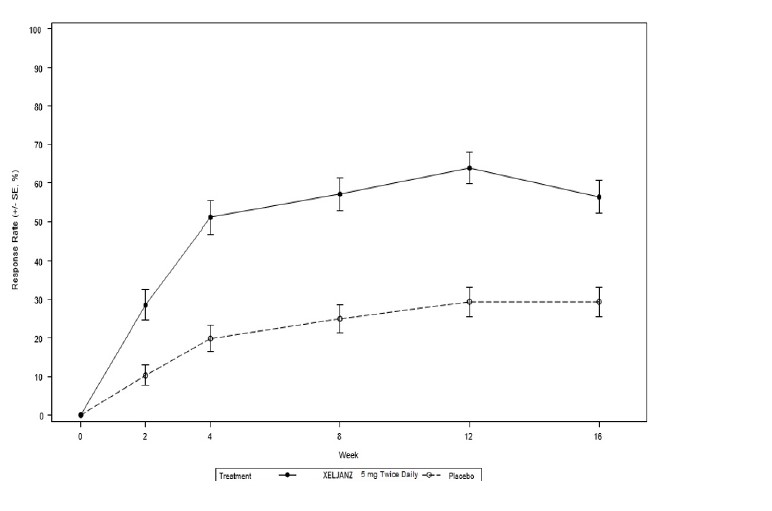
The percentage of patients with active AS who achieved ASAS20 response by visit is shown in Figure 6.
Figure 6: Percentage of ASAS20 Responders Over Time Up to Week 16 in Patients with Active AS in Study AS-I
SE=standard error.
Patients with missing data were treated as non-responders.
Other Health-Related Outcomes
Patients treated with XELJANZ 5 mg twice daily achieved greater improvements from baseline in Ankylosing Spondylitis Quality of Life (ASQoL) (-4.0 vs -2.0) compared to patients treated with placebo at Week 16.
Serious Infections
Inform patients that tofacitinib extended-release tablets may lower the ability of their immune system to fight infections. Advise patients not to start taking tofacitinib extended-release tablets if they have an active infection. Instruct patients to contact their healthcare provider immediately during treatment if symptoms suggesting infection appear to ensure rapid evaluation and appropriate treatment [see Warnings and Precautions (5.1)].
Advise patients that the risk of herpes zoster, some cases of which can be serious, is increased in patients treated with tofacitinib extended-release tablets [see Warnings and Precautions (5.1)].
Malignancies and Lymphoproliferative Disorders
Inform patients that tofacitinib extended-release tablets may increase their risk of certain cancers, and that lymphoma and other cancers have been observed in patients taking XELJANZ. Instruct patients to inform their healthcare provider if they have ever had any type of cancer [see Warnings and Precautions (5.3)].
Major Adverse Cardiovascular Events
Inform patients that tofacitinib extended-release tablets may increase their risk of major adverse cardiovascular events (MACE) defined as myocardial infarction, stroke, and cardiovascular death. Instruct all patients, especially current or past smokers or patients with other cardiovascular risk factors, to be alert for the development of signs and symptoms of cardiovascular events [see Warnings and Precautions (5.4)].
Thrombosis
Advise patients to stop taking tofacitinib extended-release tablets and to call their healthcare provider right away if they experience any symptoms of thrombosis (sudden shortness of breath, chest pain worsened with breathing, swelling of leg or arm, leg pain or tenderness, red or discolored skin in the affected leg or arm) [see Warnings and Precautions (5.5)].
Hypersensitivity
Advise patients to stop taking tofacitinib extended-release tablets and to call their healthcare provider right away if they experience any symptoms of allergic reactions while taking tofacitinib extended-release tablets [see Warnings and Precautions (5.7)].
Important Information on Laboratory Abnormalities
Inform patients that tofacitinib extended-release tablets may affect certain lab test results, and that blood tests are required before and during tofacitinib extended-release tablets treatment [see Warnings and Precautions (5.8)].
Pregnancy
Advise pregnant females and females of reproductive potential of the potential risk to a fetus. Advise females to inform their prescriber of a known or suspected pregnancy [see Use in Specific Populations (8.1)].
Lactation
Advise women not to breastfeed during treatment with tofacitinib extended-release tablets and for at least 36 hours after the last dose of tofacitinib extended-release tablets [see Use in Specific Populations (8.2)].
Infertility
Advise females of reproductive potential that tofacitinib extended-release tablets may impair fertility [see Use in Specific Populations (8.3), Nonclinical Toxicology (13.1)]. It is not known if this effect is reversible.