a. Myocardial infarction
An increased risk of myocardial infarction has been attributed to oral-contraceptive use. This risk is primarily in smokers or women with other underlying risk factors for coronary-artery disease such as hypertension, hypercholesterolemia, morbid obesity, and diabetes. The relative risk of heart attack for current oral-contraceptive users has been estimated to be two to six. The risk is very low under the age of 30.
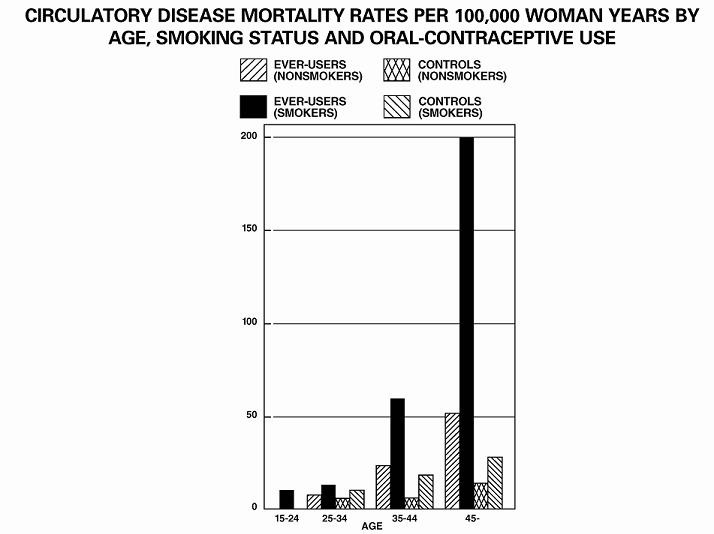
Smoking in combination with oral-contraceptive use has been shown to contribute substantially to the incidence of myocardial infarction in women in their mid-thirties or older with smoking accounting for the majority of excess cases. Mortality rates associated with circulatory disease have been shown to increase substantially in smokers over the age of 35 and nonsmokers over the age of 40 (FIGURE II) among women who use oral-contraceptives.
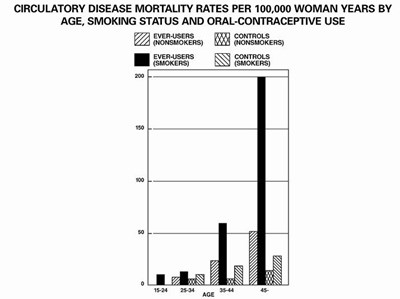
Levonorgestrel-ethinyl-estradiol-fig2 (Levonorgestrel Ethinyl Estradiol Fig2)
FIGURE II: (Adapted from P.M. Layde and V. Beral, Lancet, 1:541–546, 1981.)
Oral-contraceptives may compound the effects of well-known risk factors, such as hypertension, diabetes, hyperlipidemias, age, and obesity. In particular, some progestogens are known to decrease HDL cholesterol and cause glucose intolerance, while estrogens may create a state of hyperinsulinism.
Oral-contraceptives have been shown to increase blood pressure among users (see section 10 in
WARNINGS). Similar effects on risk factors have been associated with an increased risk of heart disease. Oral-contraceptives must be used with caution in women with cardiovascular disease risk factors.
b. Venous thrombosis and thromboembolism:
An increased risk of venous thromboembolic and thrombotic disease associated with the use of oral-contraceptives is well established. Case control studies have found the relative risk of users compared to non-users to be 3 for the first episode of superficial venous thrombosis, 4 to 11 for deep-vein thrombosis or pulmonary embolism, and 1.5 to 6 for women with predisposing conditions for venous thromboembolic disease. Cohort studies have shown the relative risk to be somewhat lower, about 3 for new cases and about 4.5 for new cases requiring hospitalization. The approximate incidence of deep-vein thrombosis and pulmonary embolism in users of low dose (< 50 mcg ethinyl estradiol) combination oral-contraceptives is up to 4 per 10,000 woman-years compared to 0.5 to 3 per 10,000 woman-years for non-users. However, the incidence is less than that associated with pregnancy (6 per 10,000 woman-years). The excess risk is highest during the first year a woman ever uses a combined oral-contraceptive. Venous thromboembolism may be fatal. The risk of thromboembolic disease due to oral-contraceptives is not related to length of use and gradually disappears after pill use is stopped.
A two- to four-fold increase in relative risk of postoperative thromboembolic complications has been reported with the use of oral-contraceptives. The relative risk of venous thrombosis in women who have predisposing conditions is twice that of women without such medical conditions. If feasible, oral-contraceptives should be discontinued at least four weeks prior to and for two weeks after elective surgery of a type associated with an increase in risk of thromboembolism and during and following prolonged immobilization. Since the immediate postpartum period is also associated with an increased risk of thromboembolism, oral-contraceptives should be started no earlier than four weeks after delivery in women who elect not to breast-feed or after a midtrimester pregnancy termination.
c. Cerebrovascular diseases
Oral-contraceptives have been shown to increase both the relative and attributable risks of cerebrovascular events (thrombotic and hemorrhagic strokes), although, in general, the risk is greatest among older (> 35 years), hypertensive women who also smoke. Hypertension was found to be a risk factor for both users and nonusers, for both types of strokes, while smoking interacted to increase the risk for hemorrhagic strokes.
In a large study, the relative risk of thrombotic strokes has been shown to range from 3 for normotensive users to 14 for users with severe hypertension. The relative risk of hemorrhagic stroke is reported to be 1.2 for nonsmokers who used oral-contraceptives, 2.6 for smokers who did not use oral-contraceptives, 7.6 for smokers who used oral-contraceptives, 1.8 for normotensive users and 25.7 for users with severe hypertension.
The attributable risk is also greater in older women. Oral-contraceptives also increase the risk for stroke in women with other underlying risk factors such as certain inherited or acquired thrombophilias. Women with migraine (particularly migraine/headaches with focal neurological symptoms, see
CONTRAINDICATIONS) who take combination oral-contraceptives may be at an increased risk of stroke.
d. Dose-related risk of vascular disease from oral-contraceptives:
A positive association has been observed between the amount of estrogen and progestogen in oral-contraceptives and the risk of vascular disease. A decline in serum high-density lipoproteins (HDL) has been reported with many progestational agents. A decline in serum high-density lipoproteins has been associated with an increased incidence of ischemic heart disease. Because estrogens increase HDL cholesterol, the net effect of an oral-contraceptive depends on a balance achieved between doses of estrogen and progestogen and the nature and absolute amount of progestogen used in the contraceptive. The amount of both hormones should be considered in the choice of an oral-contraceptive.
Minimizing exposure to estrogen and progestogen is in keeping with good principles of therapeutics. For any particular estrogen/progestogen combination, the dosage regimen prescribed should be one which contains the least amount of estrogen and progestogen that is compatible with a low failure rate and the needs of the individual patient. New acceptors of oral-contraceptive agents should be started on preparations containing the lowest estrogen content which is judged appropriate for the individual patient.
e. Persistence of risk of vascular disease:
There are two studies which have shown persistence of risk of vascular disease for ever-users of oral-contraceptives. In a study in the United States, the risk of developing myocardial infarction after discontinuing oral-contraceptives persists for at least 9 years for women 40 to 49 years who had used oral-contraceptives for five or more years, but this increased risk was not demonstrated in other age groups.
In another study in Great Britain, the risk of developing cerebrovascular disease persisted for at least 6 years after discontinuation of oral-contraceptives, although excess risk was very small. However, both studies were performed with oral-contraceptive formulations containing 50 mcg or higher of estrogens.
3. Malignant Neoplasms
Breast Cancer
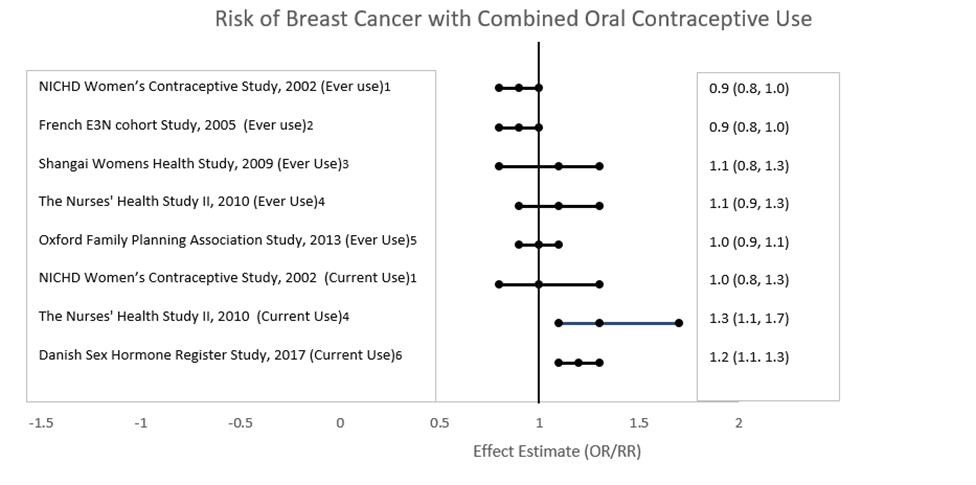
Levonorgestrel and Ethinyl Estradiol Tablets is contraindicated in women who currently have or have had breast cancer because breast cancer may be hormonally sensitive [see Contraindications]. Epidemiology studies have not found a consistent association between use of combined oral contraceptives (COCs) and breast cancer risk. Studies do not show an association between ever (current or past) use of COCs and risk of breast cancer. However, some studies report a small increase in the risk of breast cancer among current or recent users (<6 months since last use) and current users with longer duration of COC use [see Postmarketing Experience].
Cervical Cancer
Some studies have found an increase in the incidence of cancer of the cervix in women who use oral contraceptives. However, this finding may be related to factors other than the use of oral contraceptives. There is insufficient evidence to rule out the possibility that the pill may cause such cancers.
In spite of many studies of the relationship between oral contraceptive use and breast and cervical cancers, a cause-and-effect relationship has not been established.
4. Hepatic Neoplasia
Benign hepatic adenomas are associated with oral-contraceptive use, although the incidence of these benign tumors is rare in the United States. Indirect calculations have estimated the attributable risk to be in the range of 3.3 cases/100,000 for users, a risk that increases after four or more years of use. Rupture of rare, benign, hepatic adenomas may cause death through intra abdominal hemorrhage.
Studies from Britain have shown an increased risk of developing hepatocellular carcinoma in long-term (> 8 years) oral-contraceptive users. However, these cancers are extremely rare in the U.S. and the attributable risk (the excess incidence) of liver cancers in oral-contraceptive users approaches less than one per million users.
5. Risk of Liver Enzyme Elevations with Concomitant Hepatitis C Treatment
During clinical trials with the Hepatitis C combination drug regimen that contains ombitasvir/paritaprevir/ritonavir, with or without dasabuvir, ALT elevations greater than 5 times the upper limit of normal (ULN), including some cases greater than 20 times the ULN, were significantly more frequent in women using ethinyl estradiol-containing medications such as COCs. Discontinue levonorgestrel and ethinyl estradiol tablets prior to starting therapy with the combination drug regimen ombitasvir/paritaprevir/ritonavir, with or without dasabuvir (see
CONTRAINDICATIONS). Levonorgestrel and ethinyl estradiol tablets can be restarted approximately 2 weeks following completion of treatment with the combination drug regimen.
6. Ocular Lesions
There have been clinical case reports of retinal thrombosis associated with the use of oral-contraceptives that may lead to partial or complete loss of vision. Oral-contraceptives should be discontinued if there is unexplained partial or complete loss of vision; onset of proptosis or diplopia; papilledema; or retinal vascular lesions. Appropriate diagnostic and therapeutic measures should be undertaken immediately.
8. Gallbladder Disease
Combination oral-contraceptives may worsen existing gallbladder disease and may accelerate the development of this disease in previously asymptomatic women. Earlier studies have reported an increased lifetime relative risk of gallbladder surgery in users of oral-contraceptives and estrogens. More recent studies, however, have shown that the relative risk of developing gallbladder disease among oral-contraceptive users may be minimal. The recent findings of minimal risk may be related to the use of oral-contraceptive formulations containing lower hormonal doses of estrogens and progestogens.
9. Carbohydrate and Lipid Metabolic Effects
Oral-contraceptives have been shown to cause glucose intolerance in a significant percentage of users. Oral-contraceptives containing greater than 75 mcg of estrogens cause hyperinsulinism, while lower doses of estrogen cause less glucose intolerance. Progestogens increase insulin secretion and create insulin resistance, this effect varying with different progestational agents. However, in the nondiabetic woman, oral-contraceptives appear to have no effect on fasting blood glucose. Because of these demonstrated effects, prediabetic and diabetic women should be carefully observed while taking oral-contraceptives.
A small proportion of women will have persistent hypertriglyceridemia while on the pill. As discussed earlier (see
WARNINGS,
1a.and
1d.;
PRECAUTIONS,
3.), changes in serum triglycerides and lipoprotein levels have been reported in oral-contraceptive users.
10. Elevated Blood Pressure
An increase in blood pressure has been reported in women taking oral-contraceptives and this increase is more likely in older oral-contraceptive users and with continued use. Data from the Royal College of General Practitioners and subsequent randomized trials have shown that the incidence of hypertension increases with increasing quantities of progestogens.
Women with a history of hypertension or hypertension-related diseases, or renal disease should be encouraged to use another method of contraception. If women with hypertension elect to use oral-contraceptives, they should be monitored closely and if significant elevation of blood pressure occurs, oral-contraceptives should be discontinued (See
CONTRAINDICATIONSsection). For most women, elevated blood pressure will return to normal after stopping oral-contraceptives, and there is no difference in the occurrence of hypertension among ever- and never-users.
12. Bleeding Irregularities
Breakthrough bleeding and spotting are sometimes encountered in patients on oral-contraceptives, especially during the first three months of use. The type and dose of progestogen may be important. If bleeding persists or recurs, nonhormonal causes should be considered and adequate diagnostic measures taken to rule out malignancy or pregnancy in the event of breakthrough bleeding, as in the case of any abnormal vaginal bleeding. If pathology has been excluded, time or a change to another formulation may solve the problem. In the event of amenorrhea, pregnancy should be ruled out.
Some women may encounter post-pill amenorrhea or oligomenorrhea (possibly with anovulation), especially when such a condition was preexistent.
13. Ectopic Pregnancy
Ectopic as well as intrauterine pregnancy may occur in contraceptive failures.
2. Physical Examination and Follow-Up
A periodic personal and family medical history and complete physical examination are appropriate for all women, including women using oral-contraceptives. The physical examination, however, may be deferred until after initiation of oral-contraceptives if requested by the woman and judged appropriate by the clinician. The physical examination should include special reference to blood pressure, breasts, abdomen, and pelvic organs, including cervical cytology, and relevant laboratory tests. In case of undiagnosed, persistent, or recurrent abnormal vaginal bleeding, appropriate diagnostic measures should be conducted to rule out malignancy. Women with a strong family history of breast cancer or who have breast nodules should be monitored with particular care.
3. Lipid Disorders
Women who are being treated for hyperlipidemias should be followed closely if they elect to use oral-contraceptives. Some progestogens may elevate LDL levels and may render the control of hyperlipidemias more difficult..(See
WARNINGS ,
1a.,
1d.,
and
9.)
A small proportion of women will have adverse lipid changes while taking oral-contraceptives. Nonhormonal contraception should be considered in women with uncontrolled dyslipidemias. Persistent hypertriglyceridemia may occur in a small population of combination oral-contraceptive users. Elevations of plasma triglycerides may lead to pancreatitis and other complications.
4. Liver Function
If jaundice develops in any woman receiving such drugs, the medication should be discontinued. Steroid hormones may be poorly metabolized in patients with impaired liver function.
5. Fluid Retention
Oral-contraceptives may cause some degree of fluid retention. They should be prescribed with caution, and only with careful monitoring, in patients with conditions which might be aggravated by fluid retention.
6. Emotional Disorders
Patients becoming significantly depressed while taking oral-contraceptives should stop the medication and use an alternate method of contraception in an attempt to determine whether the symptom is drug related. Women with a history of depression should be carefully observed and the drug discontinued if depression recurs to a serious degree.
7. Contact Lenses
Contact-lens wearers who develop visual changes or changes in lens tolerance should be assessed by an ophthalmologist.
HOW TO TAKE LEVONORGESTREL AND ETHINYL ESTRADIOL TABLETS
IMPORTANT POINTS TO REMEMBER
BEFOREYOU START TAKING LEVONORGESTREL AND ETHINYL ESTRADIOL TABLETS:
1. BE SURE TO READ THESE DIRECTIONS:
Before you start taking levonorgestrel and ethinyl estradiol tablets.
And
Anytime you are not sure what to do.
2. THE RIGHT WAY TO TAKE THE PILL IS TO TAKE ONE PILL EVERY DAY AT THE SAME TIME.
If you miss pills you could get pregnant. This includes starting the pack late.The more pills you miss, the more likely you are to get pregnant. See “WHAT TO DO IF YOU MISS PILLS” below.
3. MANY WOMEN HAVE SPOTTING OR LIGHT BLEEDING, OR MAY FEEL SICK TO THEIR STOMACH DURING THE FIRST 1 to 3 PACKS OF PILLS.
If you feel sick to your stomach, do not stop taking levonorgestrel and ethinyl estradiol tablets. The problem will usually go away. If it doesn't go away, check with your health-care provider.
4. MISSING PILLS CAN ALSO CAUSE SPOTTING OR LIGHT BLEEDING, even when you make up these missed pills.
On the days you take 2 pills to make up for missed pills, you could also feel a little sick to your stomach.
5. IF YOU HAVE VOMITING (within 4 hours after you take your pill), you should follow the instructions for WHAT TO DO IF YOU MISS PILLS. IF YOU HAVE DIARRHEA or IF YOU TAKE SOME MEDICINES, including some antibiotics, your pills may not work as well. Use a back-up nonhormonal method (such as condoms or spermicide) until you check with your health-care provider.
6. IF YOU HAVE TROUBLE REMEMBERING TO TAKE THE PILL, talk to your health-care provider about how to make pill-taking easier or about using another method of birth control.
7. IF YOU HAVE ANY QUESTIONS OR ARE UNSURE ABOUT THE INFORMATION IN THIS LEAFLET, call your health-care provider.
BEFOREYOU START TAKING LEVONORGESTREL AND ETHINYL ESTRADIOL TABLETS
1. DECIDE WHAT TIME OF DAY YOU WANT TO TAKE YOUR PILL. It is important to take it at about the same time every day.
2. LOOK AT YOUR PILL PACK
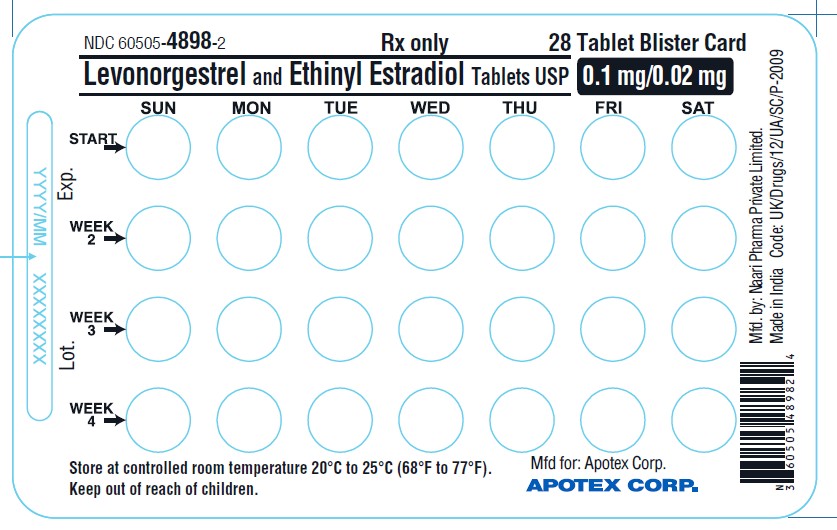
The pill pack has 21 “active” white pills (with hormones) to take for 3 weeks, followed by 1 week of reminder peach pills (without hormones).
3. FIND:
1. where on the pack to start taking pills, and
2. in what order to take the pills (follow the arrow).
4. BE SURE YOU HAVE READY AT ALL TIMES:
ANOTHER KIND OF BIRTH CONTROL (such as condoms or spermicide) to use as a back-up in case you miss pills.
AN EXTRA, FULL PILL PACK.
WHEN TO START THE
FIRSTPACK OF PILLS
You have a choice of which day to start taking your first pack of pills.
Decide with your health-care provider which is the best day for you. Pick a time of day which will be easy to remember.
DAY 1 START:
1. Pick the day label strip that starts with the first day of your period. Place this day label strip over the area that has the days of the week (starting with Sunday) pre-printed on the tablet dispenser.
Note: if the first day of your period is a Sunday, you can skip step #1.
2. Take the first "active" white pill of the first pack during the
first 24 hours of your period.
3. You will not need to use a back-up nonhormonal method of birth control, since you are starting the pill at the beginning of your period.
SUNDAY START:
1. Take the first “active” white pill of the first pack on the
Sunday after your period starts, even if you are still bleeding. If your period begins on Sunday, start the pack that same day.
2. Use
a nonhormonal method of birth control (such as condoms or spermicide)as a backup method if you have sex anytime from the Sunday you start your first pack until the next Sunday (7 days).
WHAT TO DO DURING THE MONTH
1. Take one pill at the same time every day until the pack is empty.
Do not skip pills even if you are spotting or bleeding between monthly periods or feel sick to your stomach (nausea).
Do not skip pills even if you do not have sex very often.
2. When you finish a pack:
Start the next pack on the day after your last “reminder” pill. Do not wait any days between packs.
IF YOU SWITCH FROM ANOTHER BRAND OF COMBINATION PILLS
If your previous brand had 21 pills:Wait 7 days to start taking levonorgestrel and ethinyl estradiol tablets. You will probably have your period during that week. Be sure that no more than 7 days pass between the 21-day pack and taking the first white levonorgestrel and ethinyl estradiol tablets pill (“active” with hormone).
If your previous brand had 28 pills:Start taking the first white levonorgestrel and ethinyl estradiol tablets pill (“active” with hormone) on the day after your last reminder pill. Do not wait any days between packs.
WHAT TO DO IF YOU MISS PILLS
Levonorgestrel and ethinyl estradiol tablets may not be as effective if you miss white “active” pills, and particularly if you miss the first few or the last few white “active” pills in a pack.
If you
MISS 1white “active” pill:
1. Take it as soon as you remember. Take the next pill at your regular time. This means you may take 2 pills in 1 day.
2. You COULD BECOME PREGNANT if you have sex in the
7 days after you restart your pills. You MUST use a nonhormonal birth-control method (such as condoms or spermicide) as a back-up for those 7 days.
If you
MISS 2white “active” pills in a row in
WEEK 1 OR WEEK 2of your pack:
1. Take 2 pills on the day you remember and 2 pills the next day.
2. Then take 1 pill a day until you finish the pack.
3. You COULD BECOME PREGNANT if you have sex in the
7 days after you restart your pills. You MUST use a nonhormonal birth-control method (such as condoms or spermicide) as a back-up for those 7 days.
If you
MISS 2white “active” pills in a row in
THE 3rd WEEK:
1.
If you are a Day 1 Starter:
THROW OUT the rest of the pill pack and start a new pack that same day.
If you are a Sunday Starter:
Keep taking 1 pill every day until Sunday.
On Sunday, THROW OUT the rest of the pack and start a new pack of pills that same day.
2. You may not have your period this month but this is expected. However, if you miss your period 2 months in a row, call your health-care provider because you might be pregnant.
3. You COULD BECOME PREGNANT if you have sex in the
7 daysafter you restart your pills. You MUST use a nonhormonal birth-control method (such as condoms or spermicide) as a back-up for those 7 days.
If you
MISS 3 OR MOREwhite “active” pills in a row (during the first 3 weeks):
1.
If you are a Day 1 Starter:
THROW OUT the rest of the pill pack and start a new pack that same day.
If you are a Sunday Starter:
Keep taking 1 pill every day until Sunday.
On Sunday, THROW OUT the rest of the pack and start a new pack of pills that same day.
2. You may not have your period this month but this is expected.
However, if you miss your period 2 months in a row, call your health-care provider because you might be pregnant.
3. You COULD BECOME PREGNANT if you have sex in the
7 daysafter you restart your pills.
You MUST use a nonhormonal birthcontrol method (such as condoms or spermicide) as a back-up for those 7 days.
If you forget any of the 7 peach “reminder” pills in Week 4:
THROW AWAY the pills you missed.
Keep taking 1 pill each day until the pack is empty.
You do not need a back-up nonhormonal birth-control method if you start your next pack on time.
FINALLY, IF YOU ARE STILL NOT SURE WHAT TO DO ABOUTTHE PILLS YOU HAVE MISSED
Use a BACK-UP NONHORMONAL BIRTH-CONTROL METHOD anytime you have sex.
KEEP TAKING ONE PILL EACH DAY until you can reach your health-care provider.
BIRTH CONTROL AFTER STOPPING THE PILL
If you do not wish to become pregnant after stopping the pill, speak to your health-care provider about another method of birth control.
Manufactured For:
Apotex Corp.
Weston, Florida 33326
UK/Drugs/12/UA/SC/P-2009
Made in India
Revised 11/2025
Levonorgestrel and Ethinyl Estradiol Tablets
INTRODUCTION
Any woman who considers using oral-contraceptives (the “birth-control pill” or “the pill”) should understand the benefits and risks of using this form of birth control. This leaflet will give you much of the information you will need to make this decision and will also help you determine if you are at risk of developing any of the serious side effects of the pill. It will tell you how to use the pill properly so that it will be as effective as possible. However, this leaflet is not a replacement for a careful discussion between you and your health-care provider. You should discuss the information provided in this leaflet with him or her, both when you first start taking the pill and during your revisits. You should also follow your health-care provider's advice with regard to regular check-ups while you are on the pill.
EFFECTIVENESS OF ORAL-CONTRACEPTIVES
Oral-contraceptives or “birth-control pills” or “the pill” are used to prevent pregnancy and are more effective than most other nonsurgical methods of birth control. When they are taken correctly, without missing any pills, the chance of becoming pregnant is approximately 1% per year (1 pregnancy per 100 women per year of use). Typical failure rates are approximately 5% per year (5 pregnancies per 100 women per year of use) when women who miss pills are included. The chance of becoming pregnant increases with each missed pill during each 28-day cycle of use.
In comparison, average failure rates for other methods of birth control during the first year of use are as follows:
|
IUD:0.1-2% | Female condom alone: 21% |
Depo-Provera
®(injectable progestogen):0.3%
| Cervical cap |
Norplant
®System (levonorgestrel implants): 0.05%
| Never given birth: 20% |
Diaphragm with spermicides: 20% | Given birth: 40% |
Spermicides alone: 26% | Periodic abstinence: 25% |
Male condom alone: 14% | No methods: 85% |
ESTIMATED RISK OF DEATH FROM A BIRTH-CONTROL METHOD OR PREGNANCY
All methods of birth control and pregnancy are associated with a risk of developing certain diseases which may lead to disability or death. An estimate of the number of deaths associated with different methods of birth control and pregnancy has been calculated and is shown in the following table.
ANNUAL NUMBER OF BIRTH-RELATED OR METHOD-RELATED DEATHS ASSOCIATED WITH CONTROL OF FERTILITY PER 100,000 NONSTERILE WOMEN, BY FERTILITY-CONTROL METHOD AND ACCORDING TO AGE| Method of control and outcome | 15 to 19 | 20 to 24 | 25 to 29 | 30 to 34 | 35 to 39 | 40 to 44 |
| No fertility-control methods
Deaths are birth related | 7.0 | 7.4 | 9.1 | 14.8 | 25.7 | 28.2 |
Oral-contraceptives
non-smoker
Deaths are method related | 0.3 | 0.5 | 0.9 | 1.9 | 13.8 | 31.6 |
Oral-contraceptives
smoker
| 2.2 | 3.4 | 6.6 | 13.5 | 51.1 | 117.2 |
| IUD
| 0.8 | 0.8 | 1.0 | 1.0 | 1.4 | 1.4 |
| Condom
| 1.1 | 1.6 | 0.7 | 0.2 | 0.3 | 0.4 |
| Diaphragm/spermicide
| 1.9 | 1.2 | 1.2 | 1.3 | 2.2 | 2.8 |
| Periodic abstinence
| 2.5 | 1.6 | 1.6 | 1.7 | 2.9 | 3.6 |
In the above table, the risk of death from any birth-control method is less than the risk of childbirth, except for oral-contraceptive users over the age of 35 who smoke and pill users over the age of 40 even if they do not smoke. It can be seen in the table that for women aged 15 to 39, the risk of death was highest with pregnancy (7 to 26 deaths per 100,000 women, depending on age). Among pill users who do not smoke, the risk of death was always lower than that associated with pregnancy for any age group, except for those women over the age of 40, when the risk increases to 32 deaths per 100,000 women, compared to 28 associated with pregnancy at that age. However, for pill users who smoke and are over the age of 35, the estimated number of deaths exceeds those for other methods of birth control. If a woman is over the age of 40 and smokes, her estimated risk of death is four times higher (117/100,000 women) than the estimated risk associated with pregnancy (28/100,000 women) in that age group.
The suggestion that women over 40 who do not smoke should not take oral-contraceptives is based on information from older high-dose pills. An Advisory Committee of the FDA discussed this issue in 1989 and recommended that the benefits of oral-contraceptive use by healthy, nonsmoking women over 40 years of age may outweigh the possible risks. Older women, as all women, who take oral-contraceptives, should take an oral-contraceptive which contains the least amount of estrogen and progestogen that is compatible with the individual patient needs.
WARNING SIGNALS
If any of these adverse effects occur while you are taking oral-contraceptives, call your healthcare provider immediately:
• Sharp chest pain, coughing of blood, or sudden shortness of breath (indicating a possible clot in the lung)
• Pain in the calf (indicating a possible clot in the leg)
• Crushing chest pain or heaviness in the chest (indicating a possible heart attack)
• Sudden severe headache or vomiting, dizziness or fainting, disturbances of vision or speech, weakness, or numbness in an arm or leg (indicating a possible stroke)
• Sudden partial or complete loss of vision (indicating a possible clot in the eye)
• Breast lumps (indicating possible breast cancer or fibrocystic disease of the breast; ask your health-care provider to show you how to examine your breasts)
• Severe pain or tenderness in the stomach area (indicating a possibly ruptured liver tumor).
• Difficulty in sleeping, weakness, lack of energy, fatigue, or change in mood (possibly indicating severe depression)
• Jaundice or a yellowing of the skin or eyeballs, accompanied frequently by fever, fatigue, loss of appetite, dark-colored urine, or light-colored bowel movements (indicating possible liver problems)
SIDE EFFECTS OF ORAL-CONTRACEPTIVES
1.
Unscheduled or breakthrough vaginal bleeding or spotting
Unscheduled vaginal bleeding or spotting may occur while you are taking the pills. Unscheduled bleeding may vary from slight staining between menstrual periods to breakthrough bleeding which is a flow much like a regular period. Unscheduled bleeding occurs most often during the first few months of oral-contraceptive use, but may also occur after you have been taking the pill for some time. Such bleeding may be temporary and usually does not indicate any serious problems. It is important to continue taking your pills on schedule. If the bleeding occurs in more than one cycle or lasts for more than a few days, talk to your health-care provider.
2.
Contact lenses
If you wear contact lenses and notice a change in vision or an inability to wear your lenses, contact your health-care provider.
3.
Fluid retention
Oral-contraceptives may cause edema (fluid retention) with swelling of the fingers or ankles and may raise your blood pressure. If you experience fluid retention, contact your health-care provider.
4.
Melasma
A spotty darkening of the skin is possible, particularly of the face.
5.
Other side effects
Other side effects may include nausea, breast tenderness, change in appetite, headache, nervousness, depression, dizziness, loss of scalp hair, rash, vaginal infections, inflammation of the pancreas, and allergic reactions.
If any of these side effects bother you, call your health-care provider.
HOW TO TAKE LEVONORGESTREL AND ETHINYL ESTRADIOL TABLETS
IMPORTANT POINTS TO REMEMBER
BEFOREYOU START TAKING LEVONORGESTREL AND ETHINYL ESTRADIOL TABLETS
1. BE SURE TO READ THESE DIRECTIONS:
Before you start taking levonorgestrel and ethinyl estradiol tablets.
And
Anytime you are not sure what to do.
2. THE RIGHT WAY TO TAKE THE PILL IS TO TAKE ONE PILL EVERY DAY AT THE SAME TIME.
If you miss pills you could get pregnant. This includes starting the pack late. The more pills you miss, the more likely you are to get pregnant. See “WHAT TO DO IF YOU MISS PILLS” below.
3. MANY WOMEN HAVE SPOTTING OR LIGHT BLEEDING, OR MAY FEEL SICK TO THEIR STOMACH DURING THE FIRST 1 to 3 PACKS OF PILLS.
If you feel sick to your stomach, do not stop taking levonorgestrel and ethinyl estradiol tablets. The problem will usually go away. If it doesn't go away, check with your health-care provider.
4. MISSING PILLS CAN ALSO CAUSE SPOTTING OR LIGHT BLEEDING, even when you make up these missed pills.
On the days you take 2 pills to make up for missed pills, you could also feel a little sick to your stomach.
5. IF YOU HAVE VOMITING (within 4 hours after you take your pill), you should follow the instructions for WHAT TO DO IF YOU MISS PILLS. IF YOU HAVE DIARRHEA or IF YOU TAKE SOME MEDICINES, including some antibiotics, your pills may not work as well. Use a back-up nonhormonal method (such as condoms or spermicide) until you check with your health-care provider.
6. IF YOU HAVE TROUBLE REMEMBERING TO TAKE THE PILL, talk to your health-care provider about how to make pill-taking easier or about using another method of birth control.
7. IF YOU HAVE ANY QUESTIONS OR ARE UNSURE ABOUT THE INFORMATION IN THIS LEAFLET, contact your health-care provider.
BEFOREYOU START TAKING LEVONORGESTREL AND ETHINYL ESTRADIOL TABLETS
1. DECIDE WHAT TIME OF DAY YOU WANT TO TAKE YOUR PILL. It is important to take it at about the same time every day.
2. LOOK AT YOUR PILL PACK
The pill pack has 21 “active” white pills (with hormones) to take for 3 weeks, followed by 1 week of reminder peach pills (without hormones).
3. FIND:
1 where on the pack to start taking pills, and
2 in what order to take the pills (follow the arrows).
4. BE SURE YOU HAVE READY AT ALL TIMES:
ANOTHER KIND OF BIRTH CONTROL (such as condoms or spermicide) to use as a back-up in case you miss pills.
AN EXTRA, FULL PILL PACK.
WHEN TO START THE
FIRSTPACK OF PILLS
You have a choice of which day to start taking your first pack of pills.
Decide with your health-care provider which is the best day for you. Pick a time of day which will be easy to remember.
DAY 1 START:
1. Pick the day label strip that starts with the first day of your period. Place this day label strip over the area that has the days of the week (starting with Sunday) pre-printed on the tablet dispenser.
Note: if the first day of your period is a Sunday, you can skip step #1.
2. Take the first “active” white pill of the first pack during the
first 24 hours of your period.
3. You will not need to use a back-up nonhormonal method of birth control, since you are starting the pill at the beginning of your period.
SUNDAY START:
1. Take the first “active” white pill of the first pack on the
Sunday after your period starts, even if you are still bleeding. If your period begins on Sunday,start the pack that same day.
2. Use a nonhormonal method of birth control (such as condoms or spermicide) as a back-up method if you have sex anytime from the Sunday you start your first pack until the next Sunday (7 days).
WHAT TO DO DURING THE MONTH
1. Take one pill at the same time every day until the pack is empty.
Do not skip pills even if you are spotting or bleeding between monthly periods or feel sick to your stomach (nausea).
Do not skip pills even if you do not have sex very often.
2. When you finish a pack:
Start the next pack on the day after your last “reminder” pill. Do not wait any days between packs.
IF YOU SWITCH FROM ANOTHER BRAND OF COMBINATION PILLS:
If your previous brand had 21 pills:Wait 7 days to start taking levonorgestrel and ethinyl estradiol tablets. You will probably have your period during that week. Be sure that no more than 7 days pass between the 21-day pack and taking the first white levonorgestrel and ethinyl estradiol tablets pill (“active” with hormone).
If your previous brand had 28 pills:Start taking the first white levonorgestrel and ethinyl estradiol tablets pill (“active” with hormone) on the day after your last reminder pill. Do not wait any days between packs.
WHAT TO DO IF YOU MISS PILLS
Levonorgestrel and ethinyl estradiol tablets may not be as effective if you miss white “active” pills, and particularly if you miss the first few or the last few white “active” pills in a pack.
If you
MISS 1white “active” pill:
1. Take it as soon as you remember. Take the next pill at your regular time. This means you may take 2 pills in 1 day. This means you may take 2 pills in 1 day.
2. You COULD BECOME PREGNANT if you have sex in the
7 daysafter you restart your pills. You MUST use a nonhormonal birth-control method (such as condoms or spermicide) as a back-up for those 7 days.
If you
MISS 2white “active” pills in a row in
WEEK 1 OR WEEK 2of your pack:
1. Take 2 pills on the day you remember and 2 pills the next day.
2. Then take 1 pill a day until you finish the pack.
3. You COULD BECOME PREGNANT if you have sex in the
7 daysafter you restart your pills. You MUST use a nonhormonal birth-control method (such as condoms or spermicide) as a back-up for those 7 days.
If you
MISS 2white “active” pills in a row in
THE 3rd WEEK:
1.
If you are a Day 1 Starter:
THROW OUT the rest of the pill pack and start a new pack that same day.
If you are a Sunday Starter:
Keep taking 1 pill every day until Sunday.
On Sunday, THROW OUT the rest of the pack and start a new pack of pills that same day.
2. You may not have your period this month but this is expected.
However, if you miss your period 2 months in a row, call your health-care provider because you might be pregnant.
3. You COULD BECOME PREGNANT if you have sex in the
7 daysafter you restart your pills. You MUST use a nonhormonal birth-control method (such as condoms, or spermicide) as a back-up for those 7 days.
If you
MISS 3 OR MOREwhite “active” pills in a row (during the first 3 weeks):
1.
If you are a Day 1 Starter:
THROW OUT the rest of the pill pack and start a new pack that same day.
If you are a Sunday Starter:
Keep taking 1 pill every day until Sunday.
On Sunday, THROW OUT the rest of the pack and start a new pack of pills that same day.
2. You may not have your period this month but this is expected.
However, if you miss your period 2 months in a row, call your health-care provider because you might be pregnant.
3. You COULD BECOME PREGNANT if you have sex in the
7 daysafter you restart your pills.
You MUST use a nonhormonal birth-control method (such as condoms, or spermicide) as a back-up for those 7 days.
If you forget any of the 7 peach “reminder” pills in Week 4:
THROW AWAY the pills you missed.
Keep taking 1 pill each day until the pack is empty
You do not need a back-up nonhormonal birth-control method if you start your next pack on time.
FINALLY, IF YOU ARE STILL NOT SURE WHAT TO DO ABOUT THE PILLS YOU HAVE MISSED
Use a BACK-UP NONHORMONAL BIRTH-CONTROL METHOD anytime you have sex.
KEEP TAKING ONE PILL EACH DAY until you can reach your health-care provider.
PREGNANCY DUE TO PILL FAILURE
The incidence of pill failure resulting in pregnancy is approximately 1 per year (1 pregnancy per 100 women per year of use) if taken every day as directed, but the more typical failure rate is approximately 5% per year (5 pregnancies per 100 women per year of use) including women who do not always take the pill exactly as directed without missing any pills. If you do become pregnant, the risk to the fetus is minimal, but you should stop taking your pills and discuss the pregnancy with your health-care provider.
PREGNANCY AFTER STOPPING THE PILL
There may be some delay in becoming pregnant after you stop using oral-contraceptives, especially if you had irregular menstrual cycles before you used oral-contraceptives. It may be advisable to postpone conception until you begin menstruating regularly once you have stopped taking the pill and desire pregnancy.
There does not appear to be any increase in birth defects in newborn babies when pregnancy occurs soon after stopping the pill.
BIRTH CONTROL AFTER STOPPING THE PILL
If you do not wish to become pregnant after stopping the pill, you should use another method of birth control immediately after stopping levonorgestrel and ethinyl estradiol tablets. Speak to your health-care provider about another method of birth control
OVERDOSAGE
Overdosage may cause nausea, vomiting, breast tenderness, dizziness, abdominal pain and fatigue/drowsiness. Withdrawal bleeding may occur in females. In case of overdosage, contact your health-care provider or pharmacist.
OTHER INFORMATION
Your health-care provider will take a medical and family history before prescribing oral-contraceptives and will examine you. The physical examination may be delayed to another time if you request it and your health-care provider believes that it is appropriate to postpone it. You should be reexamined at least once a year. Be sure to inform your health-care provider if there is a family history of any of the conditions listed previously in this leaflet. Be sure to keep all appointments with your health-care provider, because this is a time to determine if there are early signs of side effects of oral-contraceptive use.
Do not use the drug for any condition other than the one for which it was prescribed. This drug has been prescribed specifically for you; do not give it to others who may want birth-control pills.
HEALTH BENEFITS FROM ORAL-CONTRACEPTIVES
In addition to preventing pregnancy, use of oral-contraceptives may provide certain benefits.
They are:
• Menstrual cycles may become more regular
• Blood flow during menstruation may be lighter, and less iron may be lost. Therefore, anemia due to iron deficiency is less likely to occur
• Pain or other symptoms during menstruation may be encountered less frequently
• Ovarian cysts may occur less frequently
• Ectopic (tubal) pregnancy may occur less frequently
• Noncancerous cysts or lumps in the breast may occur less frequently
• Acute pelvic inflammatory disease may occur less frequently
• Oral-contraceptive use may provide some protection against developing two forms of cancer: cancer of the ovaries and cancer of the lining of the uterus
If you want more information about birth-control pills, ask your health-care provider or pharmacist. They have a more technical leaflet called the Professional Labeling which you may wish to read.
Manufactured For:
Apotex Corp.
Weston, Florida 33326
UK/Drugs/12/UA/SC/P-2009
Made in India
Revised 11/2025