Quarterly Intravenous Injection –
In a 1-year, double-blind, multicenter study comparing ibandronate sodium injection administered intravenously as 3 mg every 3 months to ibandronate sodium tablets 2.5 mg (ibandronate) daily oral tablet in women with postmenopausal osteoporosis, the overall safety and tolerability profiles of the two dosing regimens were similar. The incidence of serious adverse reactions was 8.0% in the ibandronate sodium tablets 2.5 mg (ibandronate) daily group and 7.5% in the ibandronate sodium injection 3 mg once every 3 months group. The percentage of patients who withdrew from treatment due to adverse reactions was approximately 6.7% in the ibandronate sodium tablets 2.5 mg (ibandronate) daily group and 8.5% in the ibandronate sodium injection 3 mg every 3 months group. Table 1 lists the adverse reactions reported in greater than 2% of patients.
Table 1 Adverse Reactions With an Incidence of at Least 2% in Patients Treated with Ibandronate sodium Injection (3 mg once every 3 months) or Ibandronate sodium Tablets 2.5 mg (ibandronate) Daily Oral Tablet | Body System/Adverse Reaction | Ibandronate sodium Tablets
2.5 mg (ibandronate) Daily (Oral)
%
(n=465) | Ibandronate sodium
3 mg every 3 months (Intravenous)
%
(n=469) |
|---|
| Infections and Infestations | | |
| Influenza | 8 | 5 |
| Nasopharyngitis | 6 | 3 |
| Cystitis | 3 | 2 |
| Gastroenteritis | 3 | 2 |
| Urinary Tract Infection | 3 | 3 |
| Bronchitis | 3 | 2 |
| Upper Respiratory Tract Infection | 3 | 1 |
| Gastrointestinal Disorders | | |
| Abdominal Pain Combination of abdominal pain and abdominal pain upper | 6 | 5 |
| Dyspepsia | 4 | 4 |
| Nausea | 4 | 2 |
| Constipation | 4 | 3 |
| Diarrhea | 2 | 3 |
| Gastritis | 2 | 2 |
| Musculoskeletal and Connective Tissue Disorders | | |
| Arthralgia | 9 | 10 |
| Back Pain | 8 | 7 |
| Localized Osteoarthritis | 2 | 2 |
| Pain in Extremity | 2 | 3 |
| Myalgia | 1 | 3 |
| Nervous System Disorders | | |
| Dizziness | 3 | 2 |
| Headache | 3 | 4 |
| Psychiatric Disorders | | |
| Insomnia | 3 | 1 |
| Depression | 2 | 1 |
| General Disorders and Administration Site Conditions | | |
| Influenza-like Illness Combination of influenza-like illness and acute phase reaction | 1 | 5 |
| Fatigue | 1 | 3 |
| Skin and Subcutaneous Tissue Disorders | | |
| Rash Combination of rash, rash pruritic, rash macular, dermatitis, dermatitis allergic, exanthema, erythema, rash papular, rash generalized, dermatitis medicamentosa, rash erythematous | 3 | 2 |
Acute Phase Reaction-like Events
Symptoms consistent with acute phase reaction (APR) have been reported with intravenous bisphosphonate use. The overall incidence of patients with APR-like events was higher in the intravenous treatment group (4% in the ibandronate sodium tablets 2.5 mg (ibandronate) daily oral tablet group vs. 10% in the ibandronate sodium injection 3 mg once every 3 months group). These incidence rates are based upon reporting of any of 33 potential APR-like symptoms within 3 days of an intravenous dose and lasting 7 days or less. In most cases, no specific treatment was required and the symptoms subsided within 24 to 48 hours.
Injection Site Reactions
Local reactions at the injection site, such as redness or swelling, were observed at a higher incidence in patients treated with ibandronate sodium injection 3 mg every 3 months (1.7%; 8/469) than in patients treated with placebo injections (0.2%; 1/465). In most cases, the reaction was of mild to moderate severity.
Daily Oral Tablet -
The safety of ibandronate sodium tablets 2.5 mg (ibandronate) once daily in the treatment and prevention of postmenopausal osteoporosis was assessed in 3577 patients aged 41 to 82 years. The duration of the trials was 2 to 3 years, with 1134 patients exposed to placebo and 1140 exposed to ibandronate sodium tablets 2.5 mg (ibandronate). Patients with pre-existing gastrointestinal disease and concomitant use of non-steroidal anti-inflammatory drugs, proton pump inhibitors and H2 antagonists were included in these clinical trials. All patients received 500 mg calcium plus 400 international units vitamin D supplementation daily.
The incidence of all-cause mortality was 1% in the placebo group and 1.2% in the ibandronate sodium tablets 2.5 mg (ibandronate) daily group. The incidence of serious adverse reactions was 20% in the placebo group and 23% in the ibandronate sodium tablets 2.5 mg (ibandronate) daily oral tablet group. The percentage of patients who withdrew from treatment due to adverse reactions was approximately 17% in both the placebo group and the ibandronate sodium tablets 2.5 mg (ibandronate) daily oral tablet group. Table 2 lists adverse reactions from the Treatment and Prevention Studies reported in greater than or equal to 2% of patients and in more patients treated with ibandronate sodium tablets 2.5 mg (ibandronate) daily oral tablet than patients treated with placebo.
Table 2 Adverse Reactions Occurring at an Incidence greater than or equal to 2% and in More Patients Treated with Ibandronate sodium Tablets 2.5 mg (ibandronate) Daily Oral Tablet than in Patients Treated with Placebo in the Osteoporosis Treatment and Prevention Studies| Body System | Placebo
%
(n=1134) | Ibandronate sodium Tablets 2.5 mg (ibandronate) daily
%
(n=1140) |
|---|
| Body as a Whole | | |
| Back Pain | 12 | 14 |
| Pain in Extremity | 6 | 8 |
| Asthenia | 2 | 4 |
| Allergic Reaction | 2 | 3 |
| Digestive System | | |
| Dyspepsia | 10 | 12 |
| Diarrhea | 5 | 7 |
| Tooth Disorder | 2 | 4 |
| Vomiting | 2 | 3 |
| Gastritis | 2 | 2 |
| Musculoskeletal System | | |
| Myalgia | 5 | 6 |
| Joint Disorder | 3 | 4 |
| Arthritis | 3 | 3 |
| Nervous System | | |
| Headache | 6 | 7 |
| Dizziness | 3 | 4 |
| Vertigo | 3 | 3 |
| Respiratory System | | |
| Upper Respiratory Infection | 33 | 34 |
| Bronchitis | 7 | 10 |
| Pneumonia | 4 | 6 |
| Pharyngitis | 2 | 3 |
| Urogenital System | | |
| Urinary Tract Infection | 4 | 6 |
Gastrointestinal Adverse Reactions
The incidence of selected gastrointestinal adverse reactions in the placebo and ibandronate sodium tablets 2.5 mg (ibandronate) daily groups were: dyspepsia (10% vs. 12%), diarrhea (5% vs. 7%), and abdominal pain (5% vs. 6%).
Musculoskeletal Adverse Reactions
The incidence of selected musculoskeletal adverse reactions in the placebo and ibandronate sodium tablets 2.5 mg (ibandronate) daily groups were: back pain (12% vs. 14%), arthralgia (14% vs. 14%) and myalgia (5% vs. 6%).
Distribution
Area under the serum ibandronate concentrations versus time curve increases in a dose proportional manner after administration of 2 mg to 6 mg by intravenous injection.
After administration, ibandronate either rapidly binds to bone or is excreted into urine. In humans, the apparent terminal volume of distribution is at least 90 L, and the amount of dose removed from the circulation into the bone is estimated to be 40% to 50% of the circulating dose. In one study, in vitro protein binding in human serum was approximately 86% over an ibandronate concentration range of 20 to 2,000 ng/mL (approximate range of maximum serum ibandronate concentrations upon intravenous bolus administration).
Metabolism
There is no evidence that ibandronate is metabolized in humans. Ibandronate does not inhibit human P450 1A2, 2A6, 2C9, 2C19, 2D6, 2E1, and 3A4 isozymes in vitro.
Ibandronate does not undergo hepatic metabolism and does not inhibit the hepatic cytochrome P450 system. Ibandronate is eliminated by renal excretion. Based on a rat study, the ibandronate secretory pathway does not appear to include known acidic or basic transport systems involved in the excretion of other drugs.
Elimination
The portion of ibandronate that is not removed from the circulation via bone absorption is eliminated unchanged by the kidney (approximately 50% to 60% of the administered intravenous dose).
The plasma elimination of ibandronate is multiphasic. Its renal clearance and distribution into bone accounts for a rapid and early decline in plasma concentrations, reaching 10% of Cmax within 3 or 8 hours after intravenous or oral administration, respectively. This is followed by a slower clearance phase as ibandronate redistributes back into the blood from bone. The observed apparent terminal half-life for ibandronate is generally dependent on the dose studied and on assay sensitivity. The observed apparent terminal half-life for intravenous 2 and 4 mg ibandronate after 2 hours of infusion ranges from 4.6 to 15.3 hours and 5 to 25.5 hours, respectively.
Following intravenous administration, total clearance of ibandronate is low, with average values in the range 84 to 160 mL/min. Renal clearance (about 60 mL/min in healthy postmenopausal women) accounts for 50% to 60% of total clearance and is related to creatinine clearance. The difference between the apparent total and renal clearances likely reflects bone uptake of the drug.
Pharmacokinetics in Specific Populations
Pediatrics
The pharmacokinetics of ibandronate have not been studied in patients less than 18 years of age.
Gender
The pharmacokinetics of ibandronate are similar in both men and women.
Geriatric
Since ibandronate is not known to be metabolized, the only difference in ibandronate elimination for geriatric patients versus younger patients is expected to relate to progressive age-related changes in renal function [see Use in Specific Populations (8.5)].
Race
Pharmacokinetic differences due to race have not been studied.
Renal Impairment
Renal clearance of ibandronate in patients with various degrees of renal impairment is linearly related to creatinine clearance (CLcr).
Following a single dose of 0.5 mg ibandronate by intravenous administration, patients with creatinine clearance 40 to 70 mL/min had 55% higher exposure (AUC∞) than the exposure observed in patients with creatinine clearance higher than 90 mL/min. Patients with severe renal impairment (creatinine clearance below 30 mL/min) had more than a two-fold increase in exposure compared to the exposure for patients with creatinine clearance equal to or higher than 80 mL/min [see Dosage and Administration (2.6) and Use in Specific Populations (8.6)].
Hepatic Impairment
No studies have been performed to assess the pharmacokinetics of ibandronate in patients with hepatic impairment since ibandronate is not metabolized in the human liver.
Drug Interaction
Melphalan/Prednisolone
A pharmacokinetic interaction study in multiple myeloma patients demonstrated that intravenous melphalan (10 mg/m2) and oral prednisolone (60 mg/m2) did not interact with 6 mg ibandronate upon intravenous coadministration. Ibandronate did not interact with melphalan or prednisolone.
Tamoxifen
A pharmacokinetic interaction study in healthy postmenopausal women demonstrated that there was no interaction between oral 30 mg tamoxifen and intravenous 2 mg ibandronate.
Quarterly Intravenous Injection
The effectiveness and safety of ibandronate sodium injection 3 mg once every 3 months were demonstrated in a randomized, double-blind, multinational, noninferiority study in 1358 women with postmenopausal osteoporosis (L2 to L4 lumbar spine BMD, T-score below -2.5 SD at baseline). The control group received ibandronate sodium tablets 2.5 mg (ibandronate) daily oral tablets. The primary efficacy parameter was the relative change from baseline to 1 year of treatment in lumbar spine BMD, which was compared between the intravenous injection and the daily oral treatment groups. All patients received 400 international units vitamin D and 500 mg calcium supplementation per day.
Effect on BMD
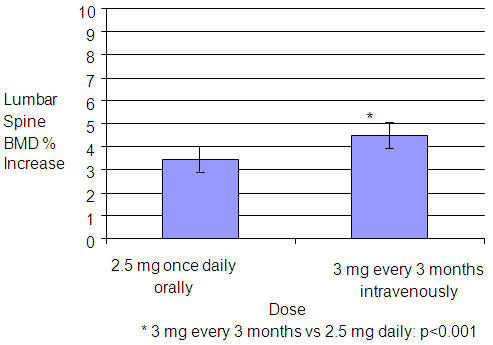
In the intent-to-treat (ITT) efficacy analysis, the least-squares mean increase at 1 year in lumbar spine BMD in patients (n=429) treated with ibandronate sodium injection 3 mg once every 3 months (4.5%) was statistically superior to that in patients (n=434) treated with daily oral tablets (3.5%). The mean difference between groups was 1.1% (95% confidence interval: 0.5%, 1.6%; p<0.001; see Figure 1). The mean increase from baseline in total hip BMD at 1 year was 2.1% in the ibandronate sodium injection 3 mg once every 3 months group and 1.5% in the ibandronate sodium tablets 2.5 mg (ibandronate) daily oral tablet group. Consistently higher BMD increases at the femoral neck and trochanter were also observed following ibandronate sodium injection 3 mg once every 3 months compared to ibandronate sodium tablets 2.5 mg (ibandronate) daily oral tablet.
Figure 1 Mean Percent Change (95% Confidence Interval) from Baseline in Lumbar Spine BMD at One Year in Patients Treated with Ibandronate sodium Tablets 2.5 mg (ibandronate) Daily Oral Tablet or Ibandronate sodium Injection 3 mg Once Every 3 Months
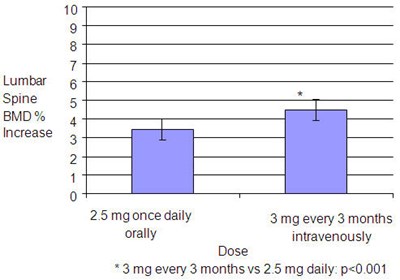
Figure 1 (Ibandronate 01)
Bone Histology
The histological analysis of bone biopsies after 22 months of treatment with 3 mg intravenous ibandronate every 3 months (n=30) or 23 months of treatment with 2 mg intravenous ibandronate every 2 months (n=27) in women with postmenopausal osteoporosis showed bone of normal quality and no indication of a mineralization defect.
Daily Oral Tablets
The effectiveness and safety of ibandronate sodium tablets 2.5 mg (ibandronate) daily oral tablets were demonstrated in a randomized, double-blind, placebo-controlled, multinational study (Treatment Study) of 2946 women aged 55 to 80 years, who were on average 21 years postmenopause, who had a lumbar spine BMD 2 to 5 SD below the premenopausal mean (T-score) in at least one vertebra [L1 to L4], and who had one to four prevalent vertebral fractures. Ibandronate sodium was evaluated at oral doses of 2.5 mg daily and 20 mg intermittently. The main outcome measure was the occurrence of new radiographically diagnosed, vertebral fractures after 3 years of treatment. The diagnosis of an incident vertebral fracture was based on both qualitative diagnosis by the radiologist and quantitative morphometric criterion. The morphometric criterion required the dual occurrence of two events: a relative height ratio or relative height reduction in a vertebral body of at least 20%, together with at least a 4 mm absolute decrease in height. All women received 400 international units vitamin D and 500 mg calcium supplementation per day.
Effect on Vertebral Fracture
Ibandronate sodium tablets 2.5 mg (ibandronate) daily oral tablet significantly reduced the incidence of new vertebral fractures compared to placebo. Over the course of the 3-year study, the risk for new vertebral fracture was 9.6% in the placebo-treated women and 4.7% in the women treated with ibandronate sodium tablets 2.5 mg (ibandronate) daily oral tablet (p<0.001) (see Table 3).
Table 3 Effect of Ibandronate sodium Tablets 2.5 mg (ibandronate) Daily Oral Tablet on the Incidence of Vertebral Fracture in the 3-Year Osteoporosis Treatment Study*
| | Proportion of Patients with Fracture (%) |
Placebo
n=975 | Ibandronate sodium Tablets 2.5 mg (ibandronate) Daily
n=977 | Absolute Risk Reduction (%)
95% CI | Relative Risk Reduction (%)
95% CI |
New Vertebral Fracture
0-3 Year | 9.6
| 4.7
| 4.9
(2.3, 7.4) | 52**
(29, 68) |
New and WorseningVertebral Fracture***
0-3 Year | 10.4
| 5.1
| 5.3
(2.6, 7.9) | 52
(30, 67) |
Clinical (Symptomatic) Vertebral Fracture
0-3 Year | 5.3
| 2.8
| 2.5
(0.6, 4.5) | 49
(14, 69) |
*The endpoint value is the value at the study's last time point, 3 years, for all patients who had a fracture identified at that time; otherwise, the last postbaseline value prior to the study's last time point is used.
**p=0.0003 vs. placebo
***"Worsening vertebral fracture" defined as a new fracture in a vertebral body with a prevalent fracture
Effect on Nonvertebral Fractures
Ibandronate sodium tablets 2.5 mg (ibandronate) daily did not reduce the incidence of nonvertebral fractures (secondary efficacy measure). There was a similar number of nonvertebral osteoporotic fractures at 3 years reported in women treated with ibandronate sodium tablets 2.5 mg (ibandronate) daily oral tablet [9.1%, (95% CI: 7.1%, 11.1%)] and placebo [8.2%, (95% CI: 6.3%, 10.2%)]. The two treatment groups were also similar with regard to the number of fractures reported at the individual non-vertebral sites: pelvis, femur, wrist, forearm, rib, and hip.
Effect on BMD
Ibandronate sodium tablets 2.5 mg (ibandronate) daily oral tablet significantly increased BMD at the lumbar spine and hip relative to treatment with placebo. In the 3-year osteoporosis treatment study, ibandronate sodium tablets 2.5 mg (ibandronate) daily oral tablet produced increases in lumbar spine BMD that were progressive over 3 years of treatment and were statistically significant relative to placebo at 6 months and at all later time points. Lumbar spine BMD increased by 6.4% after 3 years of treatment with ibandronate sodium tablets 2.5 mg (ibandronate) daily oral tablet compared with 1.4% in the placebo group (p<0.0001). Table 4 displays the significant increases in BMD seen at the lumbar spine, total hip, femoral neck, and trochanter compared to placebo.
Table 4 Mean Percent Change in BMD from Baseline to Endpoint in Patients Treated with Ibandronate sodium Tablets 2.5 mg (ibandronate) Daily Oral Tablet or Placebo in the 3-Year Osteoporosis Treatment StudyThe endpoint value is the value at the study's last time point, 3 years, for all patients who had BMD measured at that time; otherwise the last postbaseline value prior to the study's last time point is used.
| Placebo | Ibandronate sodium Tablets 2.5 mg (ibandronate) |
|---|
| Lumbar Spine | 1.4
(n=693) | 6.4
(n=712) |
| Total Hip | -0.7
(n=638) | 3.1
(n=654) |
| Femoral neck | -0.7
(n=683) | 2.6
(n=699) |
| Trochanter | 0.2
(n=683) | 5.3
(n=699) |
Bone Histology
The effects of ibandronate sodium tablets 2.5 mg (ibandronate) daily oral tablet on bone histology were evaluated in iliac crest biopsies from 16 women after 22 months of treatment and 20 women after 34 months of treatment. The histological analysis of bone biopsies showed bone of normal quality and no indication of osteomalacia or a mineralization defect.
| Manufactured by | Manufactured for |
| Gland Pharma Limited, | Apotex Corp. |
| India | Weston, Florida |
| M.L.No.103/AP/RR/97/F/R | 33326 |
January 2017, Rev. 01
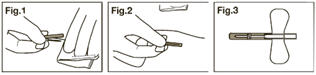
TERUMO® Surshield™ Safety Winged Infusion Set –
Instructions for Use: IV Administration
Aseptic technique, proper skin preparation and continued protection of the site are essential. Observe Universal Precautions on all patients.
Caution: Keep hands behind the needle at all times during use and disposal.
Instructions for Device Assembly