Multiple Vitamins (pediatric) Pharmacy Bulk Package Kit
FDA Label NDC 60505-6171

Full FDA labeling including Indications, Dosage, Usage, and Precautions

Structured Product Label

The following Structured Product Label (SPL) was submitted to the FDA by Apotex Corp for the product Multiple Vitamins (pediatric) Pharmacy Bulk Package (NDC 60505-6171). This document serves as the official prescribing information, containing essential scientific data and clinical materials required for healthcare providers and patients.

This specific version of the label includes detailed information regarding 1 indications and usage, 2.1 important dosage and administration instructions, 2.2 dosage information, 2.3 preparation and administration instructions, 2.4 monitoring vitamin blood levels, 2.5 drug incompatibilities, 3 dosage forms and strengths, 4 contraindications, and other regulatory disclosures. Use the navigation below to review specific sections of the FDA submission.

1 Indications And Usage

Multiple vitamins injection (pediatric) is a combination of vitamins indicated for the prevention of vitamin deficiency in pediatric patients up to 11 years of age receiving parenteral nutrition.

The physician should not await the development of clinical signs of vitamin deficiency before initiating vitamin therapy.

2.1 Important Dosage And Administration Instructions

Multiple vitamins injection (pediatric) is a combination product that contains the following vitamins: ascorbic acid, vitamin A, vitamin D, thiamine, riboflavin, pyridoxine, niacinamide, dexpanthenol, vitamin E, vitamin K1, folic acid, biotin, and vitamin B12.

Multiple vitamins injection (pediatric) is supplied as a pharmacy bulk package for intravenous use intended for administration by intravenous infusion after dilution:

  • Multiple vitamins injection (pediatric) Pharmacy Bulk Package consists of two pharmacy bulk vials which must be mixed prior to use. The mixed solution will provide multiple daily doses which must be diluted prior to intravenous administration. Pharmacy bulk package of multiple vitamins injection (pediatric) is intended for dispensing of single doses to multiple patients in a pharmacy admixture program and is restricted to the preparation of admixtures for infusion. [see Dosage and Administration (2.2 and 2.3)].

2.2 Dosage Information

The recommended daily dosage volume is based on the patient's actual weight: less than 1 kg, 1 kg to less than 3 kg, and 3 kg or greater.

Patients with multiple vitamin deficiencies or with increased vitamin requirements may need multiple daily dosages as indicated or additional doses of individual vitamins. Supplemental vitamin A may be required for low-birth weight infants.

Additional daily dosages of Vitamin E in infants are not recommended [see Warnings and Precautions (5.8)].

Multiple vitamins injection (pediatric) Pharmacy Bulk Package (see Table 2):

The recommended daily dosage volume of combined content of vials 1 and 2 (1.5 mL, 3.25 mL or 5 mL) is based on the patient’s weight and then added directly to the specific volume of an intravenous fluid [see Dosage and Administration (2.3)].

Table 2: Recommended Weight-Based Dosage of Multiple Vitamins Injection (Pediatric) Pharmacy Bulk Package

Less than 1 kg

1 kg to less than 3 kg

3 kg or greater

Daily Dosage Volume (combined contents of Vial 1 and Vial 2)

1.5 mL

3.25 mL

5 mL

Ascorbic acid (Vitamin C)

24 mg

52 mg

80 mg

Vitamin A (as palmitate)

690 IU (equals 0.2 mg)

1,495 IU (equals 0.5 mg)

2,300 IU (equals 0.7 mg)

Vitamin D3 (cholecalciferol)

120 IU (equals 3 mcg)

260 IU (equals 7 mcg)

400 IU (equals 10 mcg)

Thiamine (Vitamin B1) (as the hydrochloride)

0.4 mg

0.8 mg

1.2 mg

Riboflavin (Vitamin B2) (as riboflavin 5-phosphate sodium)

0.4 mg

0.9 mg

1.4 mg

Pyridoxine HCl (Vitamin B6)

0.3 mg

0.7 mg

1 mg

Niacinamide

5.1 mg

11.1 mg

17 mg

Dexpanthenol (as d-pantothenyl alcohol)

1.5 mg

3.3 mg

5 mg

Vitamin E (dl-α-tocopheryl acetate)

2.1 IU (equals 2 mg)

4.6 IU (equals 5 mg)

7 IU (equals 7 mg)

Vitamin K1

0.1 mg

0.1 mg

0.2 mg

Folic acid

42 mcg

91 mcg

140 mcg

Biotin

6 mcg

13 mcg

20 mcg

Vitamin B12 (cyanocobalamin)

0.3 mcg

0.7 mcg

1 mcg

2.3 Preparation And Administration Instructions

Do not administer multiple vitamins injection (pediatric) as a direct, undiluted intravenous injection as it may cause dizziness, faintness, and possible tissue irritation.

Multiple vitamins injection (pediatric) Pharmacy Bulk Package:

  • Use only in a suitable work area such as a laminar flow hood (or an equivalent clean air compounding area).
  • Transfer the contents of Vial 2 (10 mL of solution) into the contents of Vial 1 (40 mL of solution). The mixed solution (50 mL) will provide thirty-three 1.5 mL single doses, fifteen 3.25 mL single doses or ten 5 mL single doses.
  • Each bulk vial closure shall be penetrated only one time with a suitable sterile transfer device or dispensing set that allows measured dispensing of the contents.
  • Once the closure system has been penetrated, complete dispensing from the pharmacy bulk vial should be completed within 4 hours. The mixed solution may be refrigerated and stored for up to 4 hours.
  • Discard unused portion.
  • Visually inspect for particulate matter and discoloration prior to administration.
  • Add one dose directly to at least 100 mL of intravenous dextrose or saline solution for each patient.
  • After multiple vitamins injection (pediatric) is diluted in an intravenous infusion, refrigerate the resulting solution unless it is to be used immediately, and use the solution within 24 hours after dilution.
  • Minimize exposure to light because some of the vitamins in multiple vitamins injection (pediatric), particularly A, D and riboflavin, are light sensitive.

2.4 Monitoring Vitamin Blood Levels

Blood vitamin concentrations should be monitored to ensure maintenance of adequate levels, particularly in patients receiving parenteral multivitamins as the only source of vitamins for long periods of time.

2.5 Drug Incompatibilities

  • Multiple vitamins injection (pediatric) is not physically compatible with moderately alkaline solutions such as a sodium bicarbonate solution and other alkaline drugs such as acetazolamide sodium, aminophylline, ampicillin sodium, tetracycline HCl and chlorothiazide sodium.
  • Folic acid is unstable in the presence of calcium salts such as calcium gluconate.
  • Vitamin A and thiamine in multiple vitamins injection (pediatric) may react with bisulfite solutions such as sodium bisulfite or vitamin K bisulfite.
  • Do not add multiple vitamins injection (pediatric) directly to intravenous fat emulsions.
  • Consult appropriate references for additional listings of physical and chemical compatibility of solutions and drugs with the vitamin infusion when needed. If incompatibilities are identified, avoid admixture or Y-site administration with vitamin solutions.

3 Dosage Forms And Strengths

Multiple vitamins injection (pediatric) Pharmacy Bulk Package is an injection consisting of two vials labeled Vial 1 (40 mL Fill in 50 mL Vial) and Vial 2 (10 mL). The mixed solution (50 mL) will provide thirty-three 1.5 mL single doses, fifteen 3.25 mL single doses or ten 5 mL single doses. For the vitamin strengths [see Dosage and Administration (2.2) and Description (11)].

Vial 1 (Pharmacy Bulk Package) is supplied as clear, yellow to orange colored solution in amber glass vial, closed with a rubber stopper, aluminum flip-off seal of a blue color matte top.  

Vial 2 (Pharmacy Bulk Package) is supplied as clear, off white to pale yellow colored solution in amber glass vial, closed with a rubber stopper, aluminum flip-off seal of a pink color matte top.

4 Contraindications

Multiple vitamins injection (pediatric) is contraindicated in patients who have:

  • An existing hypervitaminosis, or
  • A history of hypersensitivity to any vitamins or excipients contained in this formulation.

5.1 Aluminum Toxicity

Multiple vitamins injection (pediatric) contains aluminum that may be toxic. Aluminum may reach toxic levels with prolonged parenteral administration in pediatric patients with renal impairment. Premature neonates are particularly at risk because their kidneys are immature, and they require large amounts of calcium and phosphate solution, which contain aluminum.

Research indicates that patients with impaired kidney function, including premature neonates who receive parenteral levels of aluminum at greater than 4 to 5 mcg/kg/day accumulate aluminum at levels associated with central nervous system and bone toxicity. Tissue loading may occur at even lower rates of administration. To prevent aluminum toxicity periodically monitor aluminum levels with prolonged parenteral administration of multiple vitamins injection (pediatric).

5.2 Allergic Reactions To Thiamine

Allergic reactions such as urticaria, shortness of breath, wheezing and angioedema have been reported following intravenous administration of thiamine, which is found in multiple vitamins injection (pediatric). There have been rare reports of anaphylaxis following intravenous doses of thiamine. No fatal anaphylaxis associated with multiple vitamins injection (pediatric) has been reported.

5.3 Hypervitaminosis A

Hypervitaminosis A, manifested by nausea, vomiting, headache, dizziness, blurred vision has been reported in patients with renal failure receiving 1.5 mg/day retinol and in patients with liver disease. Therefore, supplementation of renal failure patients and patients with liver disease with vitamin A, an ingredient found in multiple vitamins injection (pediatric), should be undertaken with caution [see Use in Specific Populations (8.6 and 8.7)]. Blood levels of Vitamin A should be monitored periodically.

5.4 Decreased Anticoagulant Effect Of Warfarin

Multiple vitamins injection (pediatric) contains Vitamin K which may decrease the anticoagulant action of warfarin. In patients who are on warfarin anticoagulant therapy receiving multiple vitamins injection (pediatric) monitor blood levels of prothrombin/INR to determine if dose of warfarin needs to be adjusted.

5.5 Interference With Diagnosis Of Megaloblastic Anemia

Multiple vitamins injection (pediatric) contains folic acid and cyanocobalamin which can mask serum deficiencies of folic acid and cyanocobalamin in patients with megaloblastic anemia. Avoid the use of multiple vitamins injection (pediatric) in patients with suspected or diagnosed megaloblastic anemia prior to blood sampling for the detection of the folic acid and cyanocobalamin deficiencies.

5.6 Potential To Develop Vitamin Deficiencies Or Excesses

In patients receiving parenteral multivitamins such as with multiple vitamins injection (pediatric), blood vitamin concentrations should be periodically monitored to determine if vitamin deficiencies or excesses are developing. Multiple vitamins injection (pediatric) may not correct long-standing specific vitamin deficiencies. The administration of additional doses of specific vitamins may be required [see Dosage and Administration (2.2)].

5.7 Interference With Urine Glucose Testing

Multiple vitamins injection (pediatric) contains vitamin C which is also known as ascorbic acid. Ascorbic acid in the urine may cause false negative urine glucose results.

5.8 Vitamin E Overdose In Infants Receiving Additional Vitamin E

Additional vitamin E supplementations of patients receiving multiple vitamins injection (pediatric) may result in elevated blood concentrations of vitamin E and potential vitamin E toxicity in infants. Avoid additional oral or parental doses of vitamin E in infants. Daily dose of multiple vitamins injection (pediatric) contains adequate concentrations of vitamin E required to achieve normal blood levels of vitamin E.

5.9 Risk Of Low Vitamin A Levels

Lower vitamin A concentrations may occur after administration of multiple vitamins injection (pediatric) due to the adherence of Vitamin A to plastic. Monitor blood vitamin A concentrations periodically. Additional administration of therapeutic doses of vitamin A may be required, especially in low-birth weight infants.

5.10 Risk Of E-Ferol Syndrome In Low-Birth Weight Infants

E-Ferol syndrome manifested by thrombocytopenia, renal dysfunction, hepatomegaly, cholestasis, ascites, hypotension and metabolic acidosis has been reported in low-birth weight infants following administration of polysorbates which are found in multiple vitamins injection (pediatric). No E-Ferol syndrome associated with multiple vitamins injection (pediatric) has been reported.

6 Adverse Reactions

The following adverse reactions are discussed in greater detail in other sections of the labeling.

  • Allergic reactions to thiamine [see Warnings and Precautions (5.2)].
  • Hypervitaminosis A [see Warnings and Precautions (5.3)]
  • The following adverse reactions have been identified during postapproval use of multiple vitamins injection (pediatric). Because these reactions are reported voluntarily from a population of uncertain size, it is not always possible to reliably estimate their frequency or establish a causal relationship to drug exposure.

    •  Dermatologic: rash, erythema, pruritis
    •  CNS: headache, dizziness, agitation, anxiety
    •  Ophthalmic: diplopia

7 Drug Interactions

A number of interactions between vitamins and drugs have been reported. The following are examples of these types of interactions.

7.1 Drug Interactions Affecting Co-Administered Drugs

Warfarin: Vitamin K, a component of multiple vitamins injection (pediatric), antagonizes the anticoagulant action of warfarin. In patients who are co-administered warfarin and multiple vitamins injection (pediatric), blood levels of prothrombin/INR should be monitored to determine if dose of warfarin needs to be adjusted [see Warnings and Precautions (5.4)].

Antibiotics: Thiamine, riboflavin, pyridoxine, niacinamide, and ascorbic acid decrease antibiotic activities of erythromycin, kanamycin, streptomycin, doxycycline, and lincomycin.

Bleomycin: Ascorbic acid and riboflavin inactivate bleomycin in vitro, thus the activity of bleomycin may be reduced.

Levodopa: Pyridoxine may increase the metabolism of levodopa (decrease blood levels of levodopa) and decrease its efficacy.

Phenytoin: Folic acid may increase phenytoin metabolism and lower the serum concentration of phenytoin resulting in increased seizure activity.

Methotrexate: Folic acid may decrease a patient’s response to methotrexate therapy.
7.2 Drug Interactions Affecting Vitamin Levels

Hydralazine, Isoniazid: Concomitant administration of hydralazine or isoniazid may increase pyridoxine requirements.

Phenytoin: Phenytoin may decrease serum folic acid concentrations.

8.1 Pregnancy

Risk Summary

Administration of the approved recommended dose of multiple vitamins injection (pediatric) in parental nutrition is not expected to cause major birth defects, miscarriage, or adverse maternal or fetal outcomes. Pregnant patients should follow the U.S. Recommended Daily Allowances for pregnancy because their vitamin requirements may exceed those of nonpregnant patients. Deficiency of essential vitamins may result in adverse pregnancy outcomes (see Clinical Considerations). Animal reproduction studies have not been conducted with multiple vitamins injection (pediatric).

The estimated background risk of major birth defects and miscarriage for the indicated population is unknown. All pregnancies have a background risk of birth defect, loss, or other adverse outcomes. In the U.S. general population, the estimated background risk of major birth defects and miscarriage in clinically recognized pregnancies is 2 to 4% and 15 to 20%, respectively.  

Clinical Considerations

Disease-associated Maternal and/or Embryo-Fetal Risk  

Deficiency of essential vitamins has been associated with adverse pregnancy and fetal outcomes, such as maternal folic acid deficiency and an increased risk of neural tube defects. Therefore, parenteral nutrition with multiple vitamins injection should be considered if a pregnant patient’s nutritional requirements cannot be fulfilled by oral or enteral intake.

8.2 Lactation

Risk Summary

Multiple vitamins present in multiple vitamins injection (pediatric) are also present in human milk. Administration of the approved recommended dose of multiple vitamins injection (pediatric) in parental nutrition is not expected to cause harm to a breastfed infant. There is no information on the effects of multiple vitamins injection (pediatric) on milk production. Lactating patients should follow the U.S. Recommended Daily Allowances for their condition, because their vitamin requirements may exceed those of nonlactating patients. The developmental and health benefits of breastfeeding should be considered along with the mother’s clinical need for multiple vitamins injection (pediatric) and any potential adverse effects on the breastfed child from multiple vitamins injection (pediatric) or from the underlying maternal condition.

8.4 Pediatric Use

Multiple vitamins injection (pediatric) is approved for the prevention of vitamin deficiency in pediatric patients up to 11 years old receiving parenteral nutrition. Multiple vitamins injection (pediatric) has not been studied in pediatric patients older than 11 years.

Multiple vitamins injection (pediatric) contains aluminum that may be toxic for premature neonates. Aluminum levels should be monitored periodically during administration of multiple vitamins injection (pediatric) to premature neonates [see Warnings and Precautions (5.1)].

Additional vitamin E supplementations of infants receiving multiple vitamins injection (pediatric) may result in elevated blood concentrations of vitamin E and potential vitamin E toxicity [see Warnings and Precautions (5.8)].

E-Ferol syndrome has been reported in low-birth weight infants following administration of polysorbates which are found in multiple vitamins injection (pediatric). No E-Ferol syndrome associated with multiple vitamins injection (pediatric) has been reported [see Warnings and Precautions (5.10)].

8.6 Renal Impairment

Multiple vitamins injection (pediatric) has not been studied in patients with renal impairment. Monitor renal function, calcium, phosphorus and vitamin A levels in patients with renal impairment [see Warnings and Precautions (5.1 and 5.3)].

8.7 Hepatic Impairment

Multiple vitamins injection (pediatric) has not been studied in patients with liver impairment. Monitor vitamin A levels in patients with liver disease [see Warnings and Precautions (5.3)].

10 Overdosage

Signs and symptoms of acute or chronic overdosage may be those of individual multiple vitamins injection (pediatric) component toxicity. There is no clinical experience with multiple vitamins injection (pediatric) overdosage.

11 Description

Multiple vitamins injection (pediatric) is a sterile product consisting of two vials provided as a pharmacy bulk package for intravenous use intended for administration by intravenous infusion after dilution:

Multiple vitamins injection (pediatric) supplied as pharmacy bulk package consists of:

  • (a)Vial 1 (40 mL Fill in 50 mL Vial); and
  • (b)Vial 2 (10 mL).
  • The mixed solution will provide many single doses [see Dosage and Administration (2.2)].

    Each 4 mL of Vial 1 contains 10 vitamins and each 1 mL of Vial 2 contains 3 vitamins (see Table 3).

    Table 3: Ingredients In Multiple Vitamins Injection (Pediatric) Formulation

    Vial 1
    Active Ingredient Quantity per 4 mL
    Ascorbic acid (Vitamin C) 80 mg
    Vitamin A* (as palmitate) 2,300 IU (equals 0.7 mg)
    Vitamin D3* (cholecalciferol) 400 IU (equals 10 mcg)
    Thiamine (Vitamin B1) (as the hydrochloride) 1.2 mg
    Riboflavin (Vitamin B2) (as riboflavin 5-phosphate sodium) 1.4 mg
    Pyridoxine HCl (Vitamin B6) 1 mg
    Niacinamide 17 mg
    Dexpanthenol (as d-pantothenyl alcohol) 5 mg
    Vitamin E* (dl-α-tocopheryl acetate) 7 IU (equals 7 mg)
    Vitamin K1 * 0.2 mg

    *Polysorbate 80 is used to water solubilize the oil-soluble vitamins A, D, E, and K.  

    Inactive ingredients in 4 mL of Vial 1: 50 mg polysorbate 80, sodium hydroxide and/or hydrochloric acid for pH adjustment, and water for injection.  

    Vial 2
    Active Ingredient Quantity per 1 mL
    Folic acid 140 mcg
    Biotin 20 mcg
    Vitamin B12 (cyanocobalamin) 1 mcg

    Inactive ingredients in 1 mL of Vial 2: 75 mg mannitol, citric acid and/or sodium citrate for pH adjustment and water for injection.  

    Multiple vitamins injection (pediatric) makes available a combination of oil-soluble and water-soluble vitamins in an aqueous solution, formulated for incorporation into intravenous solutions. The liposoluble vitamins A, D, E, and K have been solubilized in an aqueous medium with polysorbate 80, permitting intravenous administration of these vitamins.

    Multiple vitamins injection (pediatric) contains no more than 170 mcg/L of aluminum (combined Vials 1 and 2).

13.1 Carcinogenesis, Mutagenesis, Impairment Of Fertility

Carcinogenicity, mutagenicity, and fertility studies have not been performed with multiple vitamins injection (pediatric).

16 How Supplied/Storage And Handling

How Supplied

Multiple vitamins injection (pediatric) is supplied as follows:

Vial 1 (Pharmacy Bulk Package) is supplied as clear, yellow to orange colored solution in amber glass vial, closed with a rubber stopper, aluminum flip-off seal of a blue color matte top.  

Vial 2 (Pharmacy Bulk Package) is supplied as clear, off white to pale yellow colored solution in amber glass vial closed with a rubber stopper, aluminum flip-off seal of a pink color matte top.

Multiple vitamins injection (pediatric) Pharmacy Bulk Package:

Carton contains total two vials NDA 60505-6171-0
One vial 1 (40 mL Fill in 50 mL) NDC 60505-6295-1
One vial 2 (10 mL) NDC 60505-6296-2

Mixed contents of Vial 2 with Vial 1 provide thirty-three 1.5 mL single doses, fifteen 3.25 mL single doses or 10 single 5 mL doses [see Dosage and Administration (2.2 and 2.3)].

Storage and Handling:

Minimize exposure of multiple vitamins injection (pediatric) to light because vitamins A, D and riboflavin are light sensitive.

Store under refrigeration 2°C to 8°C (36°F to 46°F).

17 Patient Counseling Information

Instruct caregiver(s) and patients (if age appropriate):

  • To watch for signs of allergic reactions such as urticaria, shortness of breath, wheezing and angioedema since hypersensitivity reactions may occur to any of the vitamins or excipients contained in multiple vitamins injection (pediatric).
  • To watch for and immediately report nausea, vomiting, headache, dizziness, blurred vision, especially if patients have renal impairment, as these may be signs of hypervitaminosis A.
  • To report other adverse reactions that patients may experience such as rash, erythema, pruritus, headache, dizziness, agitation, anxiety, and diplopia.
  • Patients on warfarin anticoagulant therapy will be monitored periodically with blood prothrombin/ INR levels to determine if the dose of warfarin needs to be adjusted.
  • About the significance of periodic monitoring of blood vitamin concentrations to determine if vitamin deficiencies or excesses are developing and the need to monitor renal function, calcium, phosphorus, aluminum and vitamin A levels in patients with renal impairment.
  • That multiple vitamins injection (pediatric) should be avoided in patients with suspected or diagnosed megaloblastic anemia prior to blood sampling for the detection of the folic acid and cyanocobalamin deficiencies.
  • That vitamin C (ascorbic acid) contained in multiple vitamins injection (pediatric) may cause false negative urine glucose results.
  • Manufactured by:Manufactured for:
    Gland Pharma LimitedApotex Corp.
    Hyderabad, Telangana – 500 043, IndiaWeston, Florida
    ML No. 103/AP/RR/97/F/R33326

    Revised: January 2026

    Rev. 4

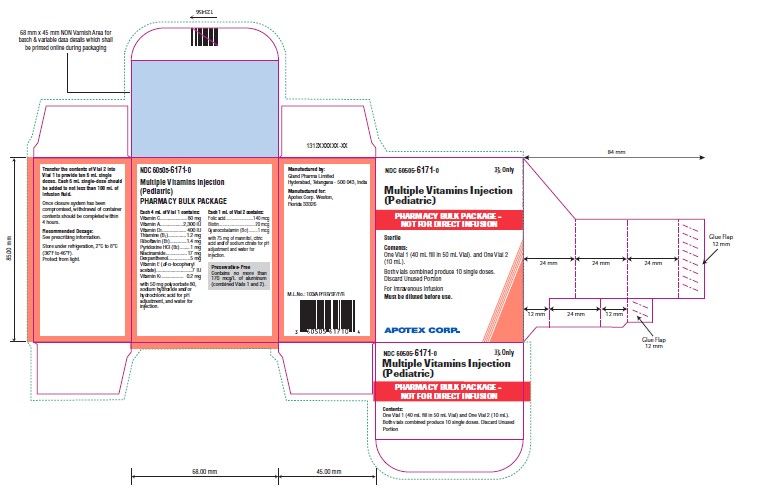
Carton

MultipleVitaminsInjection

(Pediatric)
NDC 60505-6171 0

PHARMACY BULK PACKAGE

NOT FOR DIRECT INFUSION

For intravenous infusion after dilution only.

STERILE

Contents: Vial 1 (40 mL fill in 50 mL) and

Vial 2 (10 mL).

Both vials combined produce 10 single doses.

Store under refrigeration, 2°C to 8°C (36°F to 46°F)

APOTEX CORP.

Rx only

Carton.jpg (Carton)

Carton.jpg (Carton)


* Please review the disclaimer below.