Azilsartan medoxomil
Use of drugs that act on the renin-angiotensin system during the second and third trimesters of pregnancy reduces fetal renal function and increases fetal and neonatal morbidity and death. Resulting oligohydramnios can be associated with fetal lung hypoplasia and skeletal deformations. Potential neonatal adverse effects include skull hypoplasia, anuria, hypotension, renal failure, and death. When pregnancy is detected, discontinue Edarbyclor as soon as possible [see Use in Specific Populations (8.1)].
Chlorthalidone
Thiazides cross the placental barrier and appear in cord blood. Adverse reactions include fetal or neonatal jaundice and thrombocytopenia.
Edarbyclor
Monitor for worsening renal function in patients with renal impairment. Consider withholding or discontinuing Edarbyclor if progressive renal impairment becomes evident.
Azilsartan medoxomil
As a consequence of inhibiting the renin-angiotensin system, changes in renal function may be anticipated in susceptible individuals treated with Edarbyclor. In patients whose renal function may depend on the activity of the renin-angiotensin system (e.g., patients with severe congestive heart failure, renal artery stenosis, or volume depletion), treatment with angiotensin-converting enzyme inhibitors and angiotensin receptor blockers has been associated with oliguria or progressive azotemia and rarely with acute renal failure and death. Similar results may be anticipated in patients treated with Edarbyclor [see Drug Interactions (7), Use in Specific Populations (8.6) and Clinical Pharmacology (12.3)].
In studies of ACE inhibitors in patients with unilateral or bilateral renal artery stenosis, increases in serum creatinine or blood urea nitrogen have been reported. There has been no long-term use of azilsartan medoxomil in patients with unilateral or bilateral renal artery stenosis, but similar results are expected.
Chlorthalidone
In patients with renal disease, chlorthalidone may precipitate azotemia. If progressive renal impairment becomes evident, as indicated by increased blood urea nitrogen, consider withholding or discontinuing diuretic therapy.
Chlorthalidone
Hyperuricemia may occur or frank gout may be precipitated in certain patients receiving chlorthalidone or other thiazide diuretics.
Azilsartan medoxomil
A total of 4814 patients were evaluated for safety when treated with azilsartan medoxomil at doses of 20, 40 or 80 mg in clinical trials. This includes 1704 patients treated for at least 6 months, of these, 588 were treated for at least 1 year. Generally, adverse reactions were mild, not dose related and similar regardless of age, gender and race.
Adverse reactions with a plausible relationship to treatment that have been reported with an incidence of ≥0.3% and greater than placebo in more than 3300 patients treated with azilsartan medoxomil in controlled trials are listed below:
Gastrointestinal Disorders: diarrhea, nausea
General Disorders and Administration Site Conditions: asthenia, fatigue
Musculoskeletal and Connective Tissue Disorders: muscle spasm
Nervous System Disorders: dizziness, dizziness postural
Respiratory, Thoracic and Mediastinal Disorders: cough
Chlorthalidone
The following adverse reactions have been observed in clinical trials of chlorthalidone: rash, headache, dizziness, GI upset, and elevations of uric acid and cholesterol.
Clinical Laboratory Findings with Edarbyclor
In the factorial design trial, clinically relevant changes in standard laboratory parameters were uncommon with administration of the recommended doses of Edarbyclor.
Renal parameters:
Increased blood creatinine is a known pharmacologic effect of renin-angiotensin aldosterone system (RAAS) blockers, such as ARBs and ACE inhibitors, and is related to the magnitude of blood pressure reduction. The incidence of consecutive increases of creatinine ≥50% from baseline and >ULN was 2.0% in patients treated with the recommended doses of Edarbyclor compared with 0.4% and 0.3% with azilsartan medoxomil and chlorthalidone, respectively. Elevations of creatinine were typically transient, or non-progressive and reversible, and associated with large blood pressure reductions.
Mean increases in blood urea nitrogen (BUN) were observed with Edarbyclor (5.3 mg/dL) compared with azilsartan medoxomil (1.5 mg/dL) and with chlorthalidone (2.5 mg/dL).
Edarbyclor
The pharmacokinetics of azilsartan medoxomil and chlorthalidone are not altered when the drugs are co-administered.
No drug interaction studies have been conducted with other drugs and Edarbyclor, although studies have been conducted with azilsartan medoxomil and chlorthalidone.
Azilsartan medoxomil
No clinically significant drug interactions have been observed in studies of azilsartan medoxomil or azilsartan given with amlodipine, antacids, chlorthalidone, digoxin, fluconazole, glyburide, ketoconazole, metformin, pioglitazone, and warfarin. Therefore, azilsartan medoxomil may be used concomitantly with these medications.
Non-Steroidal Anti-Inflammatory Agents including Selective Cyclooxygenase-2 Inhibitors (COX-2 Inhibitors)
In patients who are elderly, volume-depleted (including those on diuretic therapy), or who have compromised renal function, co-administration of NSAIDs, including selective COX-2 inhibitors, with angiotensin II receptor antagonists, including azilsartan, may result in deterioration of renal function, including possible acute renal failure. These effects are usually reversible. Monitor renal function periodically in patients receiving Edarbyclor and NSAID therapy.
The antihypertensive effect of Edarbyclor may be attenuated by NSAIDs, including selective COX-2 inhibitors.
Dual Blockade of the Renin-Angiotensin System (RAS)
Dual blockade of the RAS with angiotensin receptor blockers, ACE inhibitors, or aliskiren is associated with increased risks of hypotension, hyperkalemia, and changes in renal function (including acute renal failure) compared to monotherapy. Most patients receiving the combination of two RAS inhibitors do not obtain any additional benefit compared to monotherapy. In general, avoid combined use of RAS inhibitors. Closely monitor blood pressure, renal function and electrolytes in patients on Edarbyclor and other agents that affect the RAS.
Do not coadminister aliskiren with Edarbyclor in patients with diabetes. Avoid use of aliskiren with Edarbyclor in patients with renal impairment (GFR <60 mL/min).
Chlorthalidone
Lithium renal clearance is reduced by diuretics, such as chlorthalidone, increasing the risk of lithium toxicity. Consider monitoring lithium levels when using Edarbyclor.
Lithium
Increases in serum lithium concentrations and lithium toxicity have been reported during concomitant administration of lithium with angiotensin II receptor agonists. Monitor serum lithium levels during concomitant use.
Neonates with a history of in utero exposure to Edarbyclor:
If oliguria or hypotension occurs, support blood pressure and renal function. Exchange transfusions or dialysis may be required.
Edarbyclor
No dose adjustment with Edarbyclor is necessary in elderly patients. Of the total patients in clinical studies with Edarbyclor, 24% were elderly (65 years of age or older); 5.7% were 75 years and older. No overall differences in safety or effectiveness were observed between elderly patients and younger patients, but greater sensitivity of some older individuals cannot be ruled out [see Clinical Pharmacology (12.3)].
Edarbyclor
Safety and effectiveness of Edarbyclor in patients with severe renal impairment (eGFR <30 mL/min/1.73 m2) have not been established. No dose adjustment is required in patients with mild (eGFR 60-90 mL/min/1.73 m2) or moderate (eGFR 30-60 mL/min/1.73 m2) renal impairment.
Chlorthalidone
Chlorthalidone may precipitate azotemia.
Azilsartan medoxomil
No dose adjustment is necessary for subjects with mild or moderate hepatic impairment. Azilsartan medoxomil has not been studied in patients with severe hepatic impairment [see Clinical Pharmacology (12.3)].
Chlorthalidone
Minor alterations of fluid and electrolyte balance may precipitate hepatic coma in patients with impaired hepatic function or progressive liver disease.
Azilsartan medoxomil
Limited data are available related to overdosage in humans. During controlled clinical trials in healthy subjects, once daily doses up to 320 mg of azilsartan medoxomil were administered for 7 days and were well tolerated. In the event of an overdose, supportive therapy should be instituted as dictated by the patient's clinical status. Azilsartan is not dialyzable.
Chlorthalidone
Symptoms of acute overdosage include nausea, weakness, dizziness, and disturbances of electrolyte balance. The oral LD50 of the drug in the mouse and the rat is more than 25,000 mg/kg body weight. The minimum lethal dose (MLD) in humans has not been established. There is no specific antidote, but gastric lavage is recommended, followed by supportive treatment. Where necessary, this may include intravenous dextrose-saline with potassium, administered with caution.
Azilsartan medoxomil
Angiotensin II is formed from angiotensin I in a reaction catalyzed by angiotensin-converting enzymes (ACE, kinase II). Angiotensin II is the principle pressor agent of the renin-angiotensin system, with effects that include vasoconstriction, stimulation of synthesis and release of aldosterone, cardiac stimulation, and renal reabsorption of sodium. Azilsartan medoxomil is an orally administered prodrug that is rapidly converted by esterases during absorption to the active moiety, azilsartan. Azilsartan blocks the vasoconstrictor and aldosterone-secreting effects of angiotensin II by selectively blocking the binding of angiotensin II to the AT1 receptor in many tissues, such as vascular smooth muscle and the adrenal gland. Its action is, therefore, independent of the pathway for angiotensin II synthesis.
An AT2 receptor is also found in many tissues, but this receptor is not known to be associated with cardiovascular homeostasis. Azilsartan has more than a 10,000-fold greater affinity for the AT1 receptor than for the AT2 receptor.
Blockade of the renin-angiotensin system with ACE inhibitors, which inhibit the biosynthesis of angiotensin II from angiotensin I, is widely used in the treatment of hypertension. ACE inhibitors also inhibit the degradation of bradykinin, a reaction catalyzed by ACE. Because azilsartan does not inhibit ACE (kinase II), it should not affect bradykinin levels. Whether this difference has clinical relevance is not yet known. Azilsartan does not bind to or block other receptors or ion channels known to be important in cardiovascular regulation.
Blockade of the angiotensin II receptor inhibits the negative regulatory feedback of angiotensin II on renin secretion, but the resulting increased plasma renin activity and angiotensin II circulating levels do not overcome the effect of azilsartan on blood pressure.
Chlorthalidone
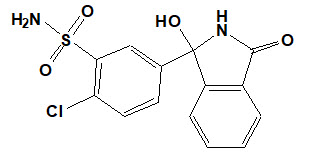
Chlorthalidone produces diuresis with increased excretion of sodium and chloride. The site of action appears to be the distal renal tubule (early convoluted part), inhibiting NaCl reabsorption (by antagonizing the Na+-Cl-cotransporter) and promoting Ca++ reabsorption (by an unknown mechanism). The enhanced delivery of Na+ and water to the cortical collecting tubule and/or the increased flow rate leads to increased secretion and elimination of K+ and H+. The diuretic effects of chlorthalildone lead to decreased extracellular fluid volume, plasma volume, cardiac output, total exchangeable sodium, glomerular filtration rate, and renal plasma flow. Although the mechanism of action of chlorthalidone and related drugs is not wholly clear, sodium and water depletion appear to provide a basis for its antihypertensive effect.
Edarbyclor
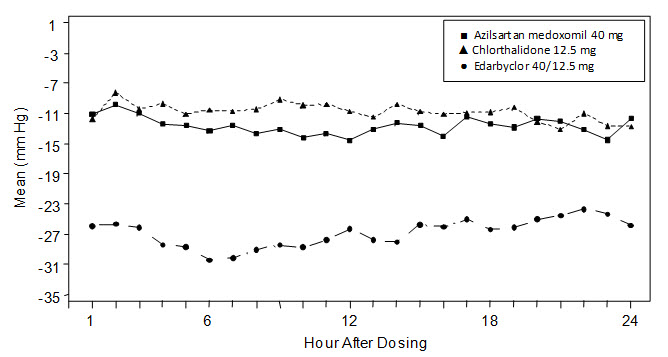
Edarbyclor tablets have been shown to be effective in lowering blood pressure. Both azilsartan medoxomil and chlorthalidone lower blood pressure by reducing peripheral resistance but through complementary mechanisms.
Azilsartan medoxomil
Azilsartan inhibits the pressor effects of an angiotensin II infusion in a dose-related manner. An azilsartan single dose equivalent to 32 mg azilsartan medoxomil inhibited the maximal pressor effect by approximately 90% at peak, and approximately 60% at 24 hours. Plasma angiotensin I and II concentrations and plasma renin activity increased while plasma aldosterone concentrations decreased after single and repeated administration of azilsartan medoxomil to healthy subjects; no clinically significant effects on serum potassium or sodium were observed.
Chlorthalidone
The diuretic effect of chlorthalidone occurs in approximately 2.6 hours and continues for up to 72 hours.
Edarbyclor
Following oral administration of Edarbyclor, peak plasma concentrations of azilsartan and chlorthalidone are reached at 3 and 1 hours, respectively. The rate (Cmax and Tmax) and extent (AUC) of absorption of azilsartan are similar when it is administered alone or with chlorthalidone. The extent (AUC) of absorption of chlorthalidone is similar when it is administered alone or with azilsartan medoxomil; however, the Cmax of chlorthalidone from Edarbyclor was 45-47% higher.
There is no clinically significant effect of food on the bioavailability of azilsartan or chlorthalidone following administration of Edarbyclor.
Azilsartan medoxomil
Absorption: Azilsartan medoxomil is an orally administered prodrug that is rapidly converted by esterases during absorption to the active moiety, azilsartan. Azilsartan medoxomil is not detected in plasma after oral administration. Dose proportionality in exposure was established for azilsartan in the azilsartan medoxomil dose range of 20 mg to 320 mg after single or multiple dosing.
The estimated absolute bioavailability of azilsartan following administration of azilsartan medoxomil is approximately 60%. After oral administration of azilsartan medoxomil, peak plasma concentrations (Cmax) of azilsartan are reached within 1.5 to 3 hours. Food does not affect the bioavailability of azilsartan.
Distribution
Azilsartan medoxomil: The volume of distribution of azilsartan is approximately 16L. Azilsartan is highly bound to human plasma proteins (>99%), mainly serum albumin. Protein binding is constant at azilsartan plasma concentrations well above the range achieved with recommended doses.
In rats, minimal azilsartan-associated radioactivity crossed the blood-brain barrier. Azilsartan passed across the placental barrier in pregnant rats and was distributed to the fetus.
Chlorthalidone: In whole blood, chlorthalidone is predominantly bound to erythrocyte carbonic anhydrase. In the plasma, approximately 75% of chlorthalidone is bound to plasma proteins, 58% of the drug being bound to albumin. Chlorthalidone crosses the placental barrier and passes into breast milk. When mothers were treated before and after birth with 50 mg chlorthalidone daily, chlorthalidone levels in fetal whole blood were around 15% of those found in maternal blood. Chlorthalidone concentrations in amniotic fluid and breast milk are approximately 4% of those found in maternal blood.
Metabolism and Elimination
Azilsartan medoxomil: Azilsartan medoxomil, when administered alone or in combination with chlorthalidone is eliminated from plasma with an elimination half-life of 11-13 hours. Azilsartan is metabolized to two primary metabolites. The major metabolite in plasma is formed by O-dealkylation, referred to as metabolite M-II, and the minor metabolite is formed by decarboxylation, referred to as metabolite M-I. Systemic exposures to the major and minor metabolites in humans were approximately 50% and less than 1% of azilsartan, respectively. M-I and M-II do not contribute to the pharmacologic activity of azilsartan medoxomil. The major enzyme responsible for azilsartan metabolism is CYP2C9.
Following an oral dose of 14C-labeled azilsartan medoxomil, approximately 55% of radioactivity was recovered in feces and approximately 42% in urine, with 15% of the dose excreted in urine as azilsartan. The elimination half-life of azilsartan is approximately 11 hours and renal clearance is approximately 2.3 mL/min. Steady-state levels of azilsartan are achieved within 5 days and no accumulation in plasma occurs with repeated once-daily dosing.
Chlorthalidone: Chlorthalidone when administered alone or in combination with azilsartan medoxomil is eliminated from plasma with an elimination half-life of 42-45 hours. The elimination half-life is unaltered following repeat dosing. The majority of an absorbed quantity of chlorthalidone is excreted by the kidneys with a mean renal clearance of 46-70 mL/min. By contrast, metabolism and excretion via the liver and bile play a minor role in the elimination of the substance. Approximately 60%-70% of chlorthalidone is excreted in the urine and feces within 120 hours, mainly in unchanged form.
Special Populations
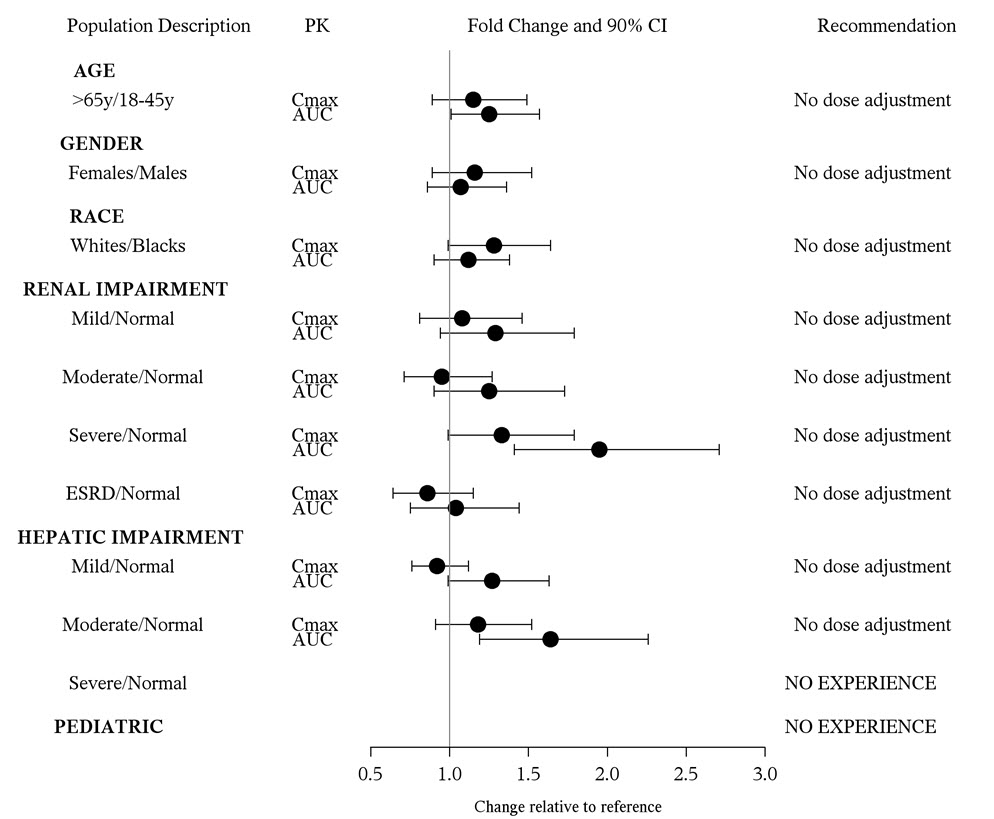
Azilsartan medoxomil: The effect of demographic and functional factors on the pharmacokinetics of azilsartan was studied in single and multiple dose studies. Pharmacokinetic measures indicating the magnitude of the effect on azilsartan are presented in Figure 2 as change relative to reference (test/reference).
Figure 2. Impact of intrinsic factors on the pharmacokinetics of azilsartan |
Azilsartan medoxomil
Carcinogenesis: Azilsartan medoxomil was not carcinogenic when assessed in 26-week transgenic (Tg.rasH2) mouse and 2-year rat studies. The highest doses tested (450 mg azilsartan medoxomil/kg/day in the mouse and 600 mg azilsartan medoxomil/kg/day in the rat) produced exposures to azilsartan that are 12 (mice) and 27 (rats) times the average exposure to azilsartan in humans given the maximum recommended human dose (MRHD, 80 mg azilsartan medoxomil/day). M-II was not carcinogenic when assessed in 26-week Tg.rasH2 mouse and 2-year rat studies. The highest doses tested (approximately 8000 mg M-II/kg/day (males) and 11,000 mg M-II/kg/day (females) in the mouse and 1000 mg M-II/kg/day (males) and up to 3000 mg M-II/kg/day (females) in the rat) produced exposures that are, on average, about 30 (mice) and 7 (rats) times the average exposure to M-II in humans at the MRHD.
Mutagenesis: Chlorthalidone demonstrated no potential for mutagenic effects at non-cytotoxic concentrations and is considered not to pose a mutagenic risk to humans.
Azilsartan medoxomil, azilsartan, and M-II were positive for structural aberrations in the Chinese Hamster Lung Cytogenic Assay. In this assay, structural chromosomal aberrations were observed with the prodrug, azilsartan medoxomil, without metabolic activation. The active moiety, azilsartan, was also positive in this assay both with and without metabolic activation. The major human metabolite, M-II was also positive in this assay during a 24-hr assay without metabolic activation.
Azilsartan medoxomil, azilsartan, and M-II were devoid of genotoxic potential in the Ames reverse mutation assay with Salmonella typhimurium and Escherichia coli, the in vitro Chinese Hamster Ovary Cell forward mutation assay, the in vitro mouse lymphoma (tk) gene mutation test, the ex vivo unscheduled DNA synthesis test, and the in vivo mouse and/or rat bone marrow micronucleus assay.
Impairment of Fertility: Chlorthalidone at a dosage of 100 mg/kg had no effect on fertility in rats. There was no effect of azilsartan medoxomil on the fertility of male or female rats at oral doses of up to 1000 mg azilsartan medoxomil/kg/day [6000 mg/m2 (approximately 122 times the MRHD of 80 mg azilsartan medoxomil/60 kg on a mg/m2 basis)]. Fertility of rats also was unaffected at doses of up to 3000 mg M-II/kg/day.
Edarbyclor
Repeat dose toxicity
The safety profiles of azilsartan medoxomil and chlorthalidone monotherapy have been individually established. To characterize the toxicological profile for Edarbyclor, a 13-week repeat-dose toxicity study was conducted in rats. The results of this study indicated that the combined administration of azilsartan medoxomil, M-II, and chlorthalidone resulted in increased exposures to chlorthalidone. Pharmacologically-mediated toxicity, including suppression of body weight gain and decreased food consumption in male rats, and increases in blood urea nitrogen in both sexes, was enhanced by coadministration of azilsartan medoxomil, M-II, and chlorthalidone. With the exception of these findings, there were no toxicologically synergistic effects in this study.
In an embryo-fetal developmental study in rats, there was no teratogenicity or increase in fetal mortality in the litters of dams receiving azilsartan medoxomil, M-II and chlorthalidone concomitantly at maternally toxic doses.
Azilsartan medoxomil
Reproductive Toxicology: In peri- and postnatal rat development studies, adverse effects on pup viability, delayed incisor eruption and dilatation of the renal pelvis along with hydronephrosis were seen when azilsartan medoxomil was administered to pregnant and nursing rats at 1.2 times the MRHD on a mg/m2 basis. Reproductive toxicity studies indicated that azilsartan medoxomil was not teratogenic when administered at oral doses up to 1000 mg azilsartan medoxomil/kg/day to pregnant rats (122 times the MRHD on a mg/m2 basis) or up to 50 mg azilsartan medoxomil/kg/day to pregnant rabbits (12 times the MRHD on a mg/m2 basis). M-II also was not teratogenic in rats or rabbits at doses up to 3000 mg M-II/kg/day. Azilsartan crossed the placenta and was found in the fetuses of pregnant rats and was excreted into the milk of lactating rats.
Chlorthalidone
Reproductive toxicology: Reproduction studies have been performed in the rat and the rabbit at doses up to 420 times the human dose and have revealed no evidence of harm to the fetus. Thiazides cross the placental barrier and appear in cord blood.
Pharmacology: Biochemical studies in animals have suggested reasons for the prolonged effect of chlorthalidone. Absorption from the gastrointestinal tract is slow because of its low solubility. After passage to the liver, some of the drug enters the general circulation, while some is excreted in the bile, to be reabsorbed later. In the general circulation, it is distributed widely to the tissue, but is taken up in highest concentrations by the kidneys, where amounts have been found 72 hours after ingestion, long after it has disappeared from other tissues. The drug is excreted unchanged in the urine.
Cardiovascular Outcomes
There are no trials of Edarbyclor demonstrating reductions in cardiovascular risk in patients with hypertension; however, trials with chlorthalidone and at least one drug pharmacologically similar to azilsartan medoxomil have demonstrated such benefits.
Pregnancy
Tell female patients of childbearing potential about the consequences of exposure to Edarbyclor during pregnancy. Discuss treatment options with women planning to become pregnant. Tell patients to report pregnancies to their physicians as soon as possible.
Symptomatic Hypotension
Advise patients to report light-headedness. Advise patients, if syncope occurs, to have someone call the doctor or seek medical attention, and to discontinue Edarbyclor.
Inform patients that dehydration from excessive perspiration, vomiting, or diarrhea may lead to an excessive fall in blood pressure. Inform patients to consult with their healthcare provider if these symptoms occur.
Renal Impairment
Inform patients with renal impairment that they should receive periodic blood tests to monitor their renal function while taking Edarbyclor.
Gout
Have patients report gout symptoms.
Manufactured by:
Takeda
Osaka, Japan
Manufactured for:
arbor
PHARMACEUTICALS, LLC
Atlanta, GA 30328
Revised: October 2016
Edarbyclor is a trademark of Takeda Pharmaceutical Company Limited registered with the U.S. Patent and Trademark Office and used under license by Arbor Pharmaceuticals, LLC.
©2016 Arbor Pharmaceuticals, LLC
EC-PI-04