Absorption
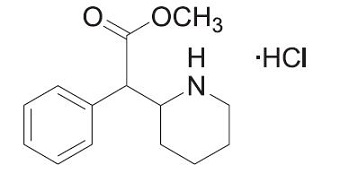
Methylphenidate is readily absorbed. Following oral administration of methylphenidate hydrochloride extended-release tablets, plasma methylphenidate concentrations increase rapidly, reaching an initial maximum at about 1 hour, followed by gradual ascending concentrations over the next 5 to 9 hours, after which a gradual decrease begins. Mean times to reach peak plasma concentrations across all doses of methylphenidate hydrochloride extended-release tablets occurred between 6 and 10 hours.
Methylphenidate hydrochloride extended-release tablets once daily minimizes the fluctuations between peak and trough concentrations associated with immediate-release methylphenidate three times daily (see Figure 1). The relative bioavailability of methylphenidate hydrochloride extended-release tablets once daily and methylphenidate three times daily in adults is comparable.
Figure 1. Mean methylphenidate plasma concentrations in 36 adults, following a single dose of methylphenidate hydrochloride extended-release tablets 18 mg once daily and immediate-release methylphenidate 5 mg three times daily administered every 4 hours.
The mean single-dose pharmacokinetic parameters in 36 healthy adults following the administration of methylphenidate hydrochloride extended-release tablets 18 mg once daily and methylphenidate 5 mg three times daily are summarized in Table 6.
Table 6. Pharmacokinetic Parameters (Mean ± SD) After Single Dose in Healthy AdultsParameters | Methylphenidate hydrochloride extended release tablets
(18 mg once daily)
(n=36)
| Methylphenidate
(5 mg three times daily)
(n=35)
|
C
max (ng/mL)
| 3.7 ± 1.0 | 4.2 ± 1.0 |
T
max (h)
| 6.8 ± 1.8 | 6.5 ± 1.8 |
AUC
inf (ng•h/mL)
| 41.8 ± 13.9 | 38.0 ± 11.0 |
t
½ (h)
| 3.5 ± 0.4 | 3.0 ± 0.5 |
The pharmacokinetics of methylphenidate hydrochloride extended-release tablets were evaluated in healthy adults following single- and multiple-dose administration (steady state) of doses up to 144 mg/day. The mean half-life was about 3.6 hours. No differences in the pharmacokinetics of methylphenidate hydrochloride extended-release tablets were noted following single and repeated once-daily dosing, indicating no significant drug accumulation. The AUC and t
1/2 following repeated once-daily dosing are similar to those following the first dose of methylphenidate hydrochloride extended-release tablets in a dose range of 18 to 144 mg.
Dose Proportionality
Following administration of methylphenidate hydrochloride extended-release tablets in single doses of 18, 36, and 54 mg/day to healthy adults, C
max and AUC
(0-inf) of d-methylphenidate were proportional to dose, whereas l-methylphenidate C
max and AUC
(0-inf) increased disproportionately with respect to dose. Following administration of methylphenidate hydrochloride extended-release tablets, plasma concentrations of the l-isomer were approximately 1/40 the plasma concentrations of the d-isomer.
In healthy adults, single and multiple dosing of once-daily methylphenidate hydrochloride extended-release tablets doses from 54 to 144 mg/day resulted in linear and dose-proportional increases in C
max and AUC
inf for total methylphenidate (MPH) and its major metabolite, α-phenyl-piperidine acetic acid (PPAA). There was no time dependency in the pharmacokinetics of methylphenidate. The ratio of metabolite (PPAA) to parent drug (MPH) was constant across doses from 54 to 144 mg/day, both after single dose and upon multiple dosing.
In a multiple-dose study in adolescent ADHD patients aged 13 to 16 administered their prescribed dose (18 to 72 mg/day) of methylphenidate hydrochloride extended-release tablets, mean C
max and AUC
TAU of d- and total methylphenidate increased proportionally with respect to dose.
Distribution
Plasma methylphenidate concentrations in adults and adolescents decline biexponentially following oral administration. The half-life of methylphenidate in adults and adolescents following oral administration of methylphenidate hydrochloride extended-release tablets was approximately 3.5 hours.
Metabolism and Excretion
In humans, methylphenidate is metabolized primarily by de-esterification to PPAA, which has little or no pharmacologic activity. In adults the metabolism of methylphenidate hydrochloride extended-release tablets once daily as evaluated by metabolism to PPAA is similar to that of methylphenidate three times daily. The metabolism of single and repeated once-daily doses of methylphenidate hydrochloride extended-release tablets is similar.
After oral dosing of radiolabeled methylphenidate in humans, about 90% of the radioactivity was recovered in urine. The main urinary metabolite was PPAA, accounting for approximately 80% of the dose.
Food Effects
In patients, there were no differences in either the pharmacokinetics or the pharmacodynamic performance of methylphenidate hydrochloride extended-release tablets when administered after a high-fat breakfast. There is no evidence of dose dumping in the presence or absence of food.
Alcohol Effect
An
in vitro study was conducted to explore the effect of alcohol on the release characteristics of methylphenidate from the methylphenidate hydrochloride extended-release tablets 18 mg tablet dosage form. At an alcohol concentration up to 40% there was no increased release of methylphenidate in the first hour. The results with the 18 mg tablet strength are considered representative of the other available tablet strengths.
Special Populations
Gender
In healthy adults, the mean dose-adjusted AUC
(0-inf) values for methylphenidate hydrochloride extended-release tablets were 36.7 ng·h/mL in men and 37.1 ng·h/mL in women, with no differences noted between the two groups.
Race
In adults receiving methylphenidate hydrochloride extended-release tablets, dose-adjusted AUC
(0-inf) was consistent across ethnic groups; however, the sample size may have been insufficient to detect ethnic variations in pharmacokinetics.
Age
Increase in age resulted in increased apparent oral clearance (CL/F) (58% increase in adolescents compared to children). Some of these differences could be explained by body‑ weight differences among these populations. This suggests that subjects with higher body weight may have lower exposures of total methylphenidate at similar doses.
The pharmacokinetics of methylphenidate hydrochloride extended-release tablets have not been studied in children less than 6 years of age.
Renal Insufficiency
There is no experience with the use of methylphenidate hydrochloride extended-release tablets in patients with renal insufficiency. After oral administration of radiolabeled methylphenidate in humans, methylphenidate was extensively metabolized and approximately 80% of the radioactivity was excreted in the urine in the form of PPAA. Since renal clearance is not an important route of methylphenidate clearance, renal insufficiency is expected to have little effect on the pharmacokinetics of methylphenidate hydrochloride extended-release tablets.
Hepatic Insufficiency
There is no experience with the use of methylphenidate hydrochloride extended-release tablets in patients with hepatic insufficiency.