Rivastigmine Tartrate Capsule
Product Images NDC 60687-777

View Photos of Packaging, Regulatory Labels, and Product Appearance

Product Visual Gallery

This gallery contains 12 technical images submitted to the FDA as part of the official labeling for Rivastigmine Tartrate (NDC 60687-777). Unlike standard consumer photos, these assets often include clinical data figures, molecular chemical structures, and official manufacturer packaging layouts.

As provided by American Health Packaging, these visuals offer a comprehensive scientific overview of the product's physical and chemical identity, aiding pharmacists and researchers in product verification and study.

FDA Label Image

1.5 mg Rivastigmine Tartrate Capsule Blister (1.5 mg Rivastigmine Tartrate Capsule Blister.jpg)
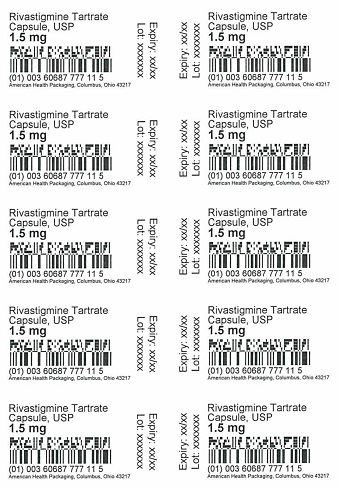
1.5 mg Rivastigmine Tartrate Capsule Blister (1.5 mg Rivastigmine Tartrate Capsule Blister.jpg)
Label for Rivastigmine Tartrate Capsule, USP 1.5 mg by American Health Packaging. The label includes the product name, dosage strength, barcode, NDC 60687-777, and space for lot number and expiration date. The label is repeated multiple times on the sheet and features the manufacturer's location in Columbus, Ohio.*
FDA Label Image

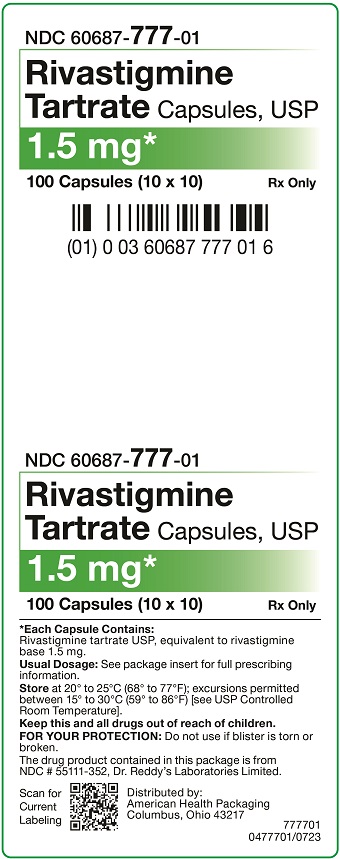
1.5 mg Rivastigmine Tartrate Capsules Carton (1.5 mg Rivastigmine Tartrate Capsules Carton.jpg)

1.5 mg Rivastigmine Tartrate Capsules Carton (1.5 mg Rivastigmine Tartrate Capsules Carton.jpg)
Rivastigmine Tartrate Capsules, USP, 1.5 mg strength. The label indicates a package size of 100 capsules (10 x 10), labeled for prescription use only (Rx Only). The label includes storage instructions and alerts about product integrity and child safety. Distributed by American Health Packaging, Columbus, Ohio.*
FDA Label Image

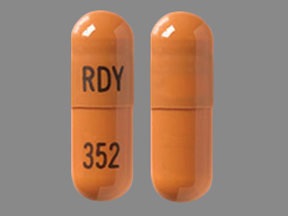
Ahp77701

Ahp77701
Orange Rivastigmine Tartrate capsule imprinted with "RDY 352" shown from two angles. The capsule is an oral dosage form for human prescription use, labeled by American Health Packaging, corresponding to the 1.5 mg strength.*
FDA Label Image

Figure 1: Time-course Of The Change From Baseline In Adas-cog Score For Patients Completing 26 Weeks Of Treatment In Study 1 (Figure1)

Figure 1: Time-course Of The Change From Baseline In Adas-cog Score For Patients Completing 26 Weeks Of Treatment In Study 1 (Figure1)
A line graph showing mean change from baseline in ADAS-cog rating over 26 weeks of treatment. The X-axis represents weeks during treatment, while the Y-axis shows mean change with positive values indicating clinical improvement and negative values indicating clinical decline. Three lines represent different groups: 6-12 mg, 1-4 mg, and placebo, with the placebo group showing the greatest clinical decline over time.*
FDA Label Image

Figure 2: Cumulative Percentage Of Patients Completing 26 Weeks Of Double-blind Treatment With Specified Changes From Baseline Adas-cog Scores. The Percentages Of Randomized Patients Who Completed The (Figure2)

Figure 2: Cumulative Percentage Of Patients Completing 26 Weeks Of Double-blind Treatment With Specified Changes From Baseline Adas-cog Scores. The Percentages Of Randomized Patients Who Completed The (Figure2)
A cumulative percentage plot showing change from baseline in ADAS-cog scores for three groups: placebo, 1-4 mg/day, and 6-12 mg/day. The x-axis represents change from baseline, and the y-axis represents the cumulative percentage of patients. An inset table compares change in ADAS-cog scores for the treatment groups and placebo at points corresponding to 7, 4, and 0 points change.*
FDA Label Image

Figure 3: Frequency Distribution Of Cibic-plus Scores At Week 26 In Study 1 (Figure3)

Figure 3: Frequency Distribution Of Cibic-plus Scores At Week 26 In Study 1 (Figure3)
A bar chart showing the distribution of patient outcomes based on the CIBIC-Plus rating, comparing placebo, 1-4 mg, and 6-12 mg dose groups. The x-axis represents patient improvement or worsening levels, while the y-axis shows the percentage of patients in each category.*
FDA Label Image

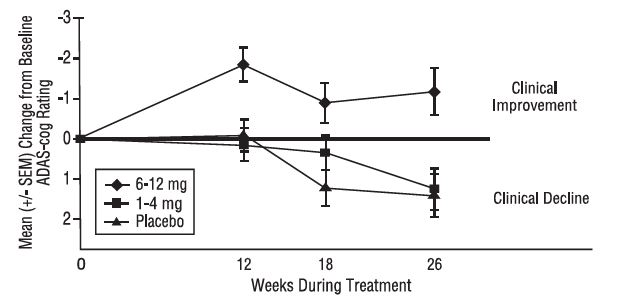
Figure 4: Time-course Of The Change From Baseline In Adas-cog Score For Patients Completing 26 Weeks Of Treatment (Figure4)

Figure 4: Time-course Of The Change From Baseline In Adas-cog Score For Patients Completing 26 Weeks Of Treatment (Figure4)
A line graph showing mean change in ADAS-cog rating from baseline over 26 weeks of treatment for three groups: 6-12 mg, 1-4 mg, and placebo. The y-axis represents clinical improvement or decline, and the x-axis shows weeks during treatment, with error bars indicating SEM variability.*
FDA Label Image

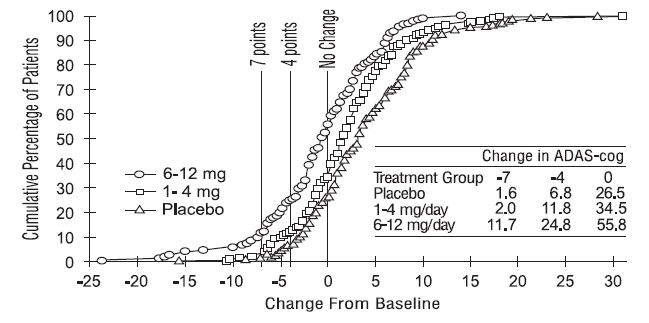
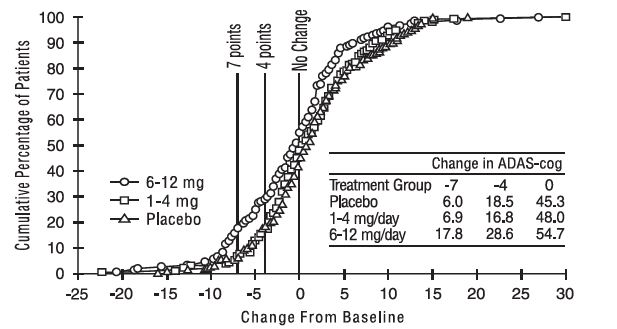
Figure 5: Cumulative Percentage Of Patients Completing 26 Weeks Of Double-blind Treatment With Specified Changes From Baseline Adas-cog Scores. The Percentages Of Randomized Patients Who Completed The (Figure5)

Figure 5: Cumulative Percentage Of Patients Completing 26 Weeks Of Double-blind Treatment With Specified Changes From Baseline Adas-cog Scores. The Percentages Of Randomized Patients Who Completed The (Figure5)
A cumulative percentage graph showing change from baseline on the x-axis and cumulative percentage of patients on the y-axis, comparing placebo, 1-4 mg/day, and 6-12 mg/day treatment groups. The graph illustrates patient responses in change scores with lines for 7 points, 4 points, and no change. An inset table presents numerical changes in ADAS-cog scores for each group.*
FDA Label Image

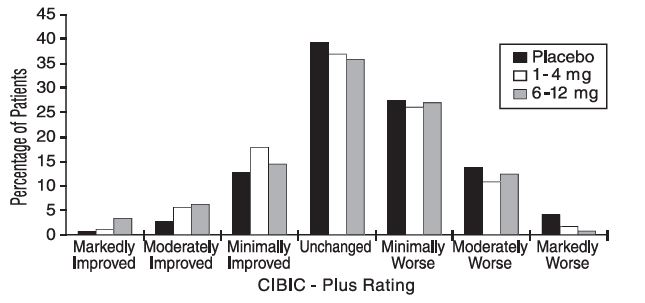
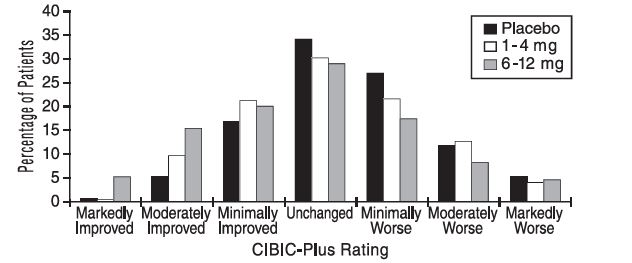
Figure 6: Frequency Distribution Of Cibic-plus Scores At Week 26 In Study 2 (Figure6)

Figure 6: Frequency Distribution Of Cibic-plus Scores At Week 26 In Study 2 (Figure6)
A bar chart showing the percentage of patients across different CIBIC-Plus Rating categories (from Markedly Improved to Markedly Worse). It compares three groups: Placebo, 1-4 mg, and 6-12 mg, with bars representing patient percentages for each group within each category.*
FDA Label Image

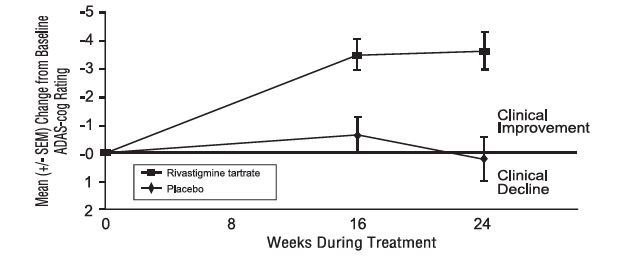
Figure 7: Time Course Of The Change From Baseline In Adas-cog Score For Patients Completing 24 Weeks Of Treatment In Study 4 (Figure7)

Figure 7: Time Course Of The Change From Baseline In Adas-cog Score For Patients Completing 24 Weeks Of Treatment In Study 4 (Figure7)
A line graph depicting mean change from baseline ADAS-cog rating over 24 weeks of treatment comparing Rivastigmine Tartrate and placebo. The y-axis ranges from clinical improvement to clinical decline, showing Rivastigmine Tartrate improving cognitive scores at weeks 16 and 24, whereas placebo remains stable near baseline.*
FDA Label Image

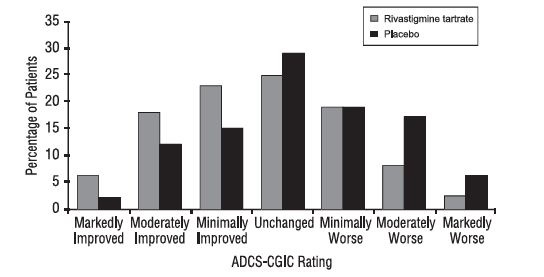
Figure 8: Distribution Of Adcs-cgic Scores For Patients Completing 24 Weeks Of Treatment In Study 4 (Figure8)

Figure 8: Distribution Of Adcs-cgic Scores For Patients Completing 24 Weeks Of Treatment In Study 4 (Figure8)
A bar chart comparing the percentage of patients across different ADCS-CGIC rating categories between Rivastigmine Tartrate and placebo groups. Categories include Markedly Improved, Moderately Improved, Minimally Improved, Unchanged, Minimally Worse, Moderately Worse, and Markedly Worse, with percentages shown on the vertical axis.*
FDA Label Image

Structural Formula (Structure 01)

Structural Formula (Structure 01)
Chemical structure of Rivastigmine Tartrate shown as a molecular diagram with labeled atoms and bonds, including the tartrate component represented as C4H6O6.*

* About these descriptions: Image descriptions on this page are generated by automated AI analysis of the product label images from the manufacturer's FDA label submission (SPL). They are provided for reference only and may contain errors or omissions. Always rely on the printed label itself and the official FDA labeling, and consult a pharmacist or healthcare professional with any questions about this product.