Sacubitril And Valsartan Tablet, Film Coated
Product Images NDC 60687-955

View Photos of Packaging, Regulatory Labels, and Product Appearance

Product Visual Gallery

This gallery contains 15 technical images submitted to the FDA as part of the official labeling for Sacubitril And Valsartan (NDC 60687-955). Unlike standard consumer photos, these assets often include clinical data figures, molecular chemical structures, and official manufacturer packaging layouts.

As provided by American Health Packaging, these visuals offer a comprehensive scientific overview of the product's physical and chemical identity, aiding pharmacists and researchers in product verification and study.

FDA Label Image

24 mg 26 mg Sacubitril Valsartan Tablet Blister.jpg (24 mg 26 mg Sacubitril Valsartan Tablet Blister)
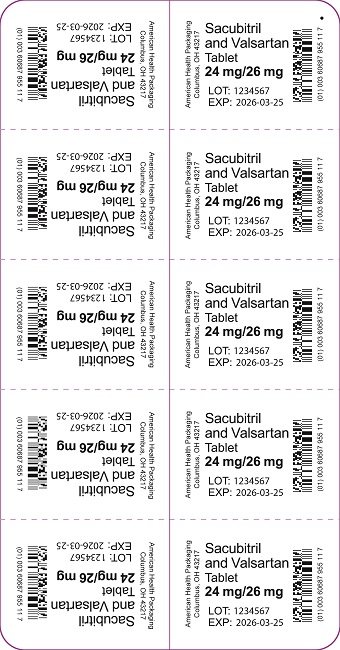
24 mg 26 mg Sacubitril Valsartan Tablet Blister.jpg (24 mg 26 mg Sacubitril Valsartan Tablet Blister)
Sacubitril and Valsartan 24 mg/26 mg film-coated oral tablets label from American Health Packaging. The label includes the product name, strength, dosage form, lot number 1234567, expiration date 2026-03-25, and barcodes. The design shows multiple repeated labels arranged in a grid.*
FDA Label Image

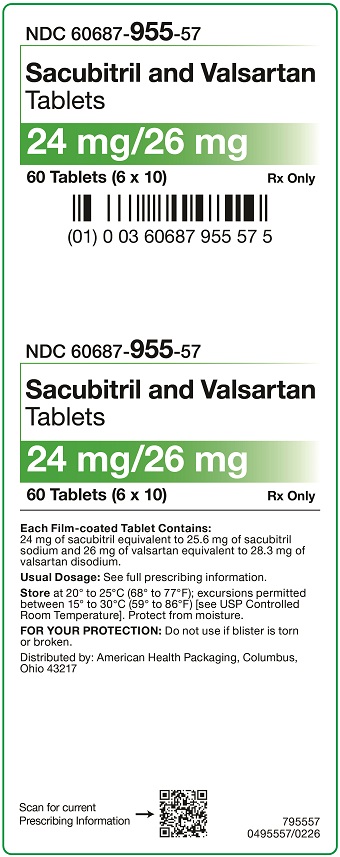
24 mg 26 mg Sacubitril Valsartan Tablets Carton.jpg (24 mg 26 mg Sacubitril Valsartan Tablets Carton)

24 mg 26 mg Sacubitril Valsartan Tablets Carton.jpg (24 mg 26 mg Sacubitril Valsartan Tablets Carton)
Label for Sacubitril and Valsartan tablets, film-coated, strength 24 mg/26 mg. The label shows a package containing 60 tablets (6 blister packs of 10). It includes NDC number 60687-955-57 and notes the product is prescription only. The label also provides storage instructions, dosage form details, manufacturer as American Health Packaging, Columbus, Ohio, and a QR code for prescribing information.*
FDA Label Image

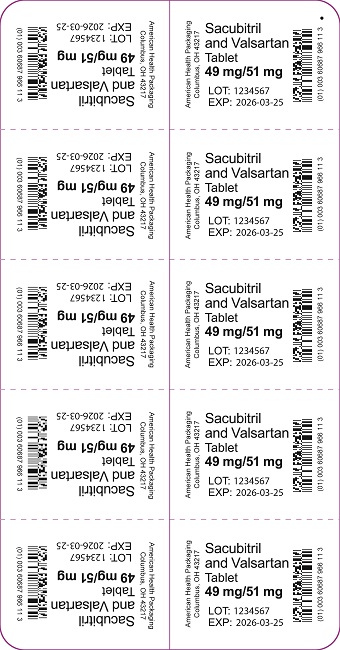
49 mg 51 mg Sacubitril Valsartan Tablet Blister.jpg (49 mg 51 mg Sacubitril Valsartan Tablet Blister)

49 mg 51 mg Sacubitril Valsartan Tablet Blister.jpg (49 mg 51 mg Sacubitril Valsartan Tablet Blister)
Sacubitril and Valsartan 49 mg/51 mg film-coated tablet labels by American Health Packaging. The label shows the product name, dosage strength, dosage form, lot number 1234567, and expiration date 2026-03-25. Multiple identical labels are arranged on a sheet with barcode and regulatory information.*
FDA Label Image

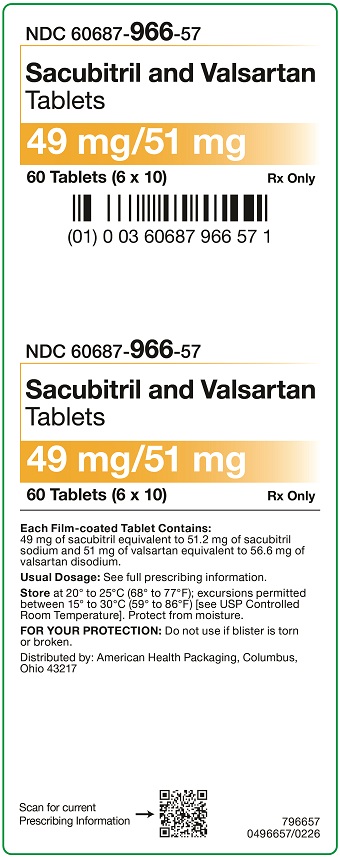
49 mg 51 mg Sacubitril Valsartan Tablets Carton.jpg (49 mg 51 mg Sacubitril Valsartan Tablets Carton)

49 mg 51 mg Sacubitril Valsartan Tablets Carton.jpg (49 mg 51 mg Sacubitril Valsartan Tablets Carton)
Label for Sacubitril and Valsartan tablets, film coated, strength 49 mg/51 mg. The package contains 60 tablets (6 strips of 10). Distributed by American Health Packaging, Columbus, Ohio. The label includes storage instructions, dosage form details, barcode, NDC 60687-966-57, and a QR code for prescribing information.*
FDA Label Image

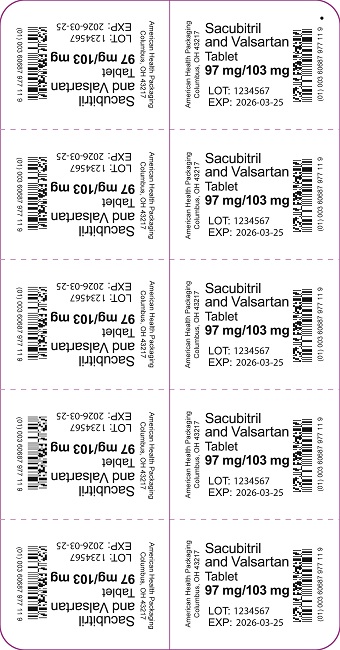
97 mg 103 mg Sacubitril Valsartan Tablet Blister.jpg (97 mg 103 mg Sacubitril Valsartan Tablet Blister)

97 mg 103 mg Sacubitril Valsartan Tablet Blister.jpg (97 mg 103 mg Sacubitril Valsartan Tablet Blister)
Sacubitril and Valsartan 97 mg/103 mg film-coated tablets in a blister pack. The label shows the proprietary name, strength, dosage form, lot number, expiration date, and the labeler American Health Packaging, Columbus, OH. The pack contains multiple tablets arranged in two columns.*
FDA Label Image

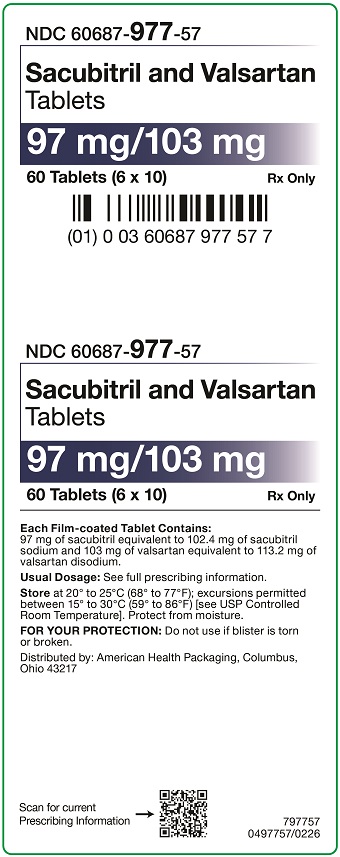
97 mg 103 mg Sacubitril Valsartan Tablets Carton.jpg (97 mg 103 mg Sacubitril Valsartan Tablets Carton)

97 mg 103 mg Sacubitril Valsartan Tablets Carton.jpg (97 mg 103 mg Sacubitril Valsartan Tablets Carton)
Label for Sacubitril and Valsartan tablets, film-coated, at 97 mg/103 mg strength. The label shows a package containing 60 tablets (6 blister packs of 10 tablets). It is labeled for prescription use only and distributed by American Health Packaging, Columbus, Ohio. Dosage and storage instructions are included, along with a barcode and a QR code for current prescribing information.*
FDA Label Image

Figure 1 (Figure0001)

Figure 1 (Figure0001)
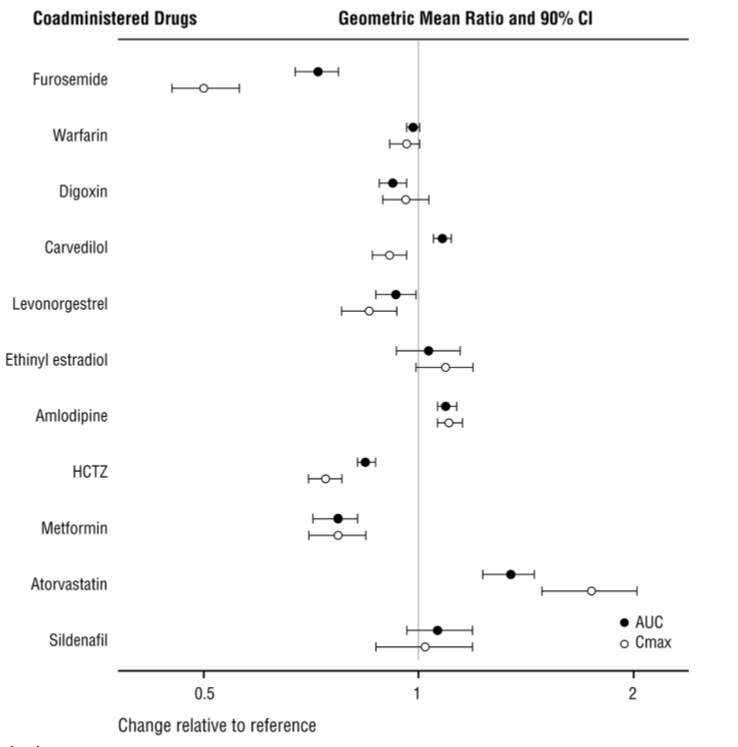
A chart showing the geometric mean ratio and 90% confidence interval for various coadministered drugs relative to a reference. The drugs listed include Furosemide, Warfarin, Digoxin, Carvedilol, Levonorgestrel, Ethinyl estradiol, Amlodipine, HCTZ, Metformin, Atorvastatin, and Sildenafil. Data points depict changes in AUC and Cmax values for each drug.*
FDA Label Image

Image Description (Figure0003)

Image Description (Figure0003)
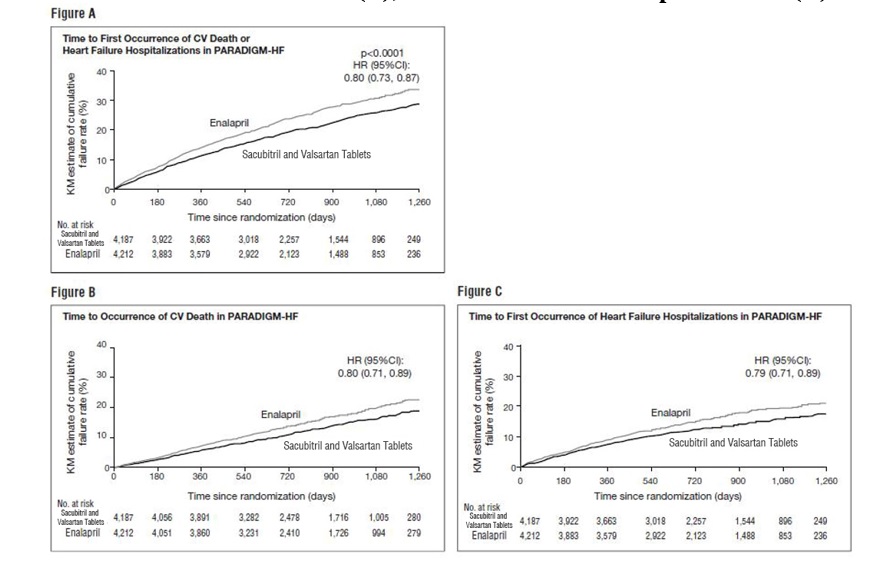
Three Kaplan-Meier curve graphs depict time-to-event data in the PARADIGM-HF study comparing Sacubitril and Valsartan Tablets with Enalapril. Figure A shows time to first occurrence of cardiovascular death or heart failure hospitalizations. Figure B shows time to cardiovascular death. Figure C shows time to first heart failure hospitalization. Each graph includes cumulative failure rates over time, risk numbers, hazard ratios, and confidence intervals.*
FDA Label Image

Image Description (Figure0004)

Image Description (Figure0004)
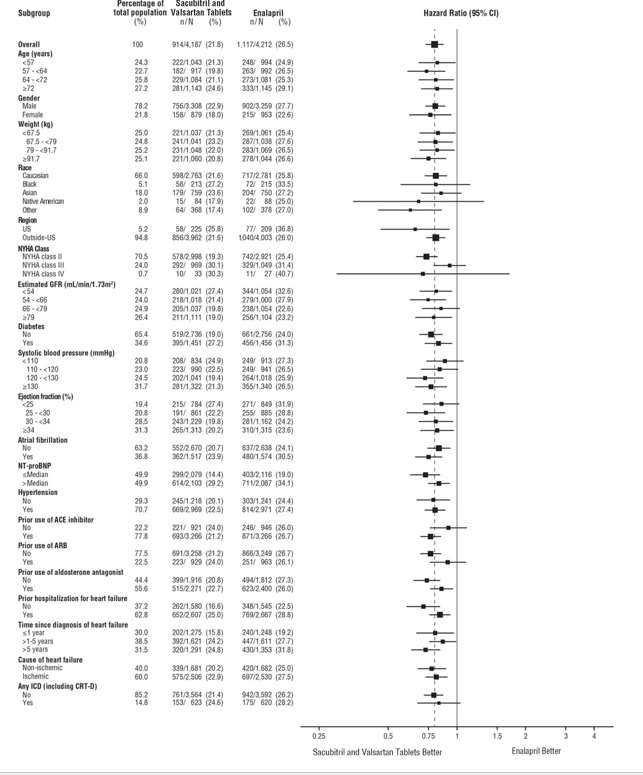
A forest plot comparing the hazard ratios of Sacubitril and Valsartan tablets versus Enalapril across various patient subgroups. The chart displays subgroups based on age, gender, weight, race, region, NYHA class, kidney function (eGFR), diabetes status, systolic blood pressure, ejection fraction, atrial fibrillation, NT-proBNP levels, hypertension, prior use of ACE inhibitors or ARBs, prior heart failure hospitalizations, time since heart failure diagnosis, cause of heart failure, and presence of ICD devices. Each subgroup is represented with hazard ratios and 95% confidence intervals.*
FDA Label Image

Image Description (Figure0005)

Image Description (Figure0005)
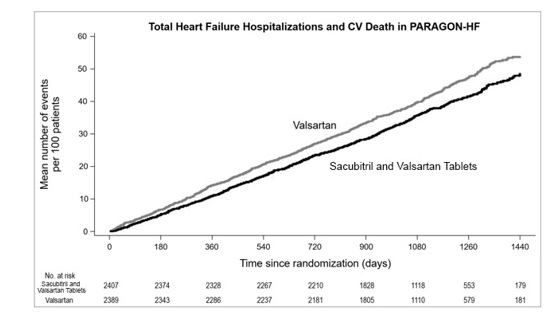
A line graph depicting total heart failure hospitalizations and cardiovascular death over time in the PARAGON-HF study. The x-axis represents time since randomization in days, ranging from 0 to 1440 days. The y-axis shows the mean number of events per 100 patients, from 0 to 60. Two lines compare Sacubitril and Valsartan Tablets (lower line) and Valsartan alone (upper line), with the Sacubitril and Valsartan group showing fewer mean events over time. Below the graph is a table indicating the number of patients at risk in each group at various time points.*
FDA Label Image

Image Description (Figure0006)

Image Description (Figure0006)
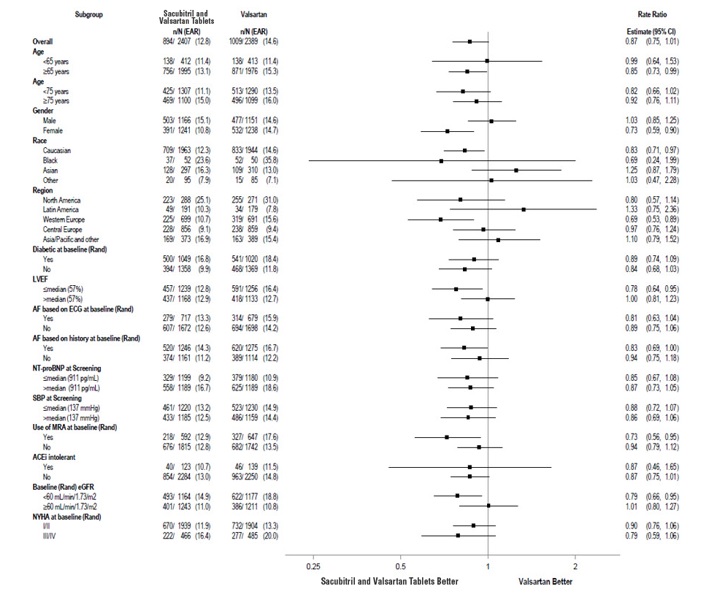
A forest plot comparing the efficacy of Sacubitril and Valsartan tablets versus Valsartan, presented across various subgroups including age, gender, race, region, and medical baseline characteristics. The plot shows rate ratios with 95% confidence intervals displayed as horizontal lines with markers against a central vertical line indicating equivalence of treatment effects.*
FDA Label Image

Image Description (Figure0007)

Image Description (Figure0007)
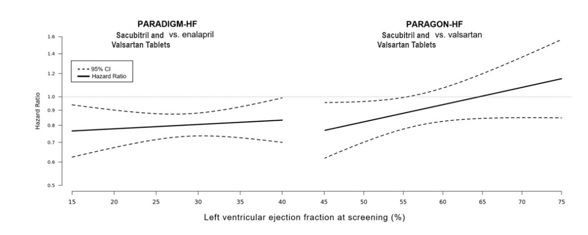
A line graph comparing hazard ratios for sacubitril versus enalapril and sacubitril versus valsartan across left ventricular ejection fraction percentages in PARADIGM-HF and PARAGON-HF studies. The graph includes solid hazard ratio lines and dashed 95% confidence interval curves.*
FDA Label Image

Figure 2 (Figure02)

Figure 2 (Figure02)
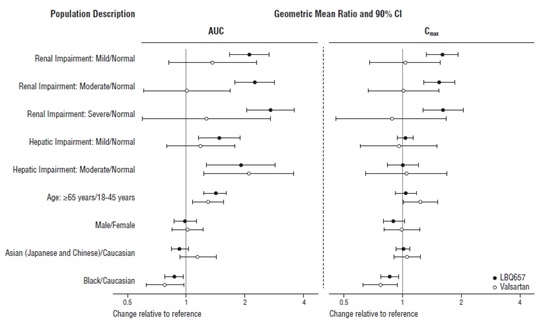
A chart presenting the geometric mean ratio and 90% confidence interval for AUC and Cmax comparing various population groups, including renal and hepatic impairment levels, age groups, gender, and races, showing changes relative to a reference for LBQ657 and Valsartan.*
FDA Label Image

Sacubitril Sodium (Image 01)

Sacubitril Sodium (Image 01)
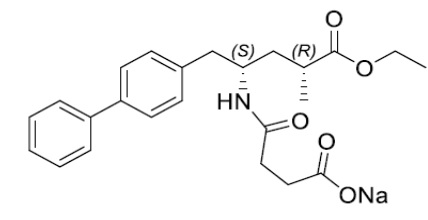
Chemical structure diagram of Sacubitril and Valsartan, showing the molecular arrangement with labeled stereochemistry (S and R configurations) and key functional groups including aromatic rings, an amide, and a carboxylate group.*
FDA Label Image

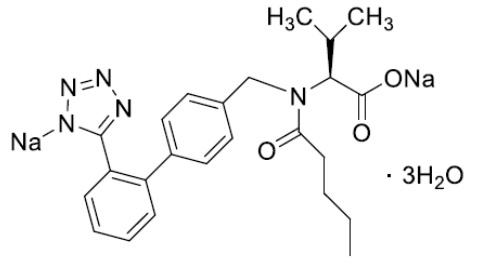
Valsartan Disodium (Structure0002)

Valsartan Disodium (Structure0002)
Chemical structure of sacubitril and valsartan showing the detailed molecular arrangement including sodium and water of hydration components as indicated.*

* About these descriptions: Image descriptions on this page are generated by automated AI analysis of the product label images from the manufacturer's FDA label submission (SPL). They are provided for reference only and may contain errors or omissions. Always rely on the printed label itself and the official FDA labeling, and consult a pharmacist or healthcare professional with any questions about this product.