Anastrozole
Product Images NDC 60763-376

View Photos of Packaging, Regulatory Labels, and Product Appearance

Product Visual Gallery

This gallery contains 8 technical images submitted to the FDA as part of the official labeling for Anastrozole (NDC 60763-376). Unlike standard consumer photos, these assets often include clinical data figures, molecular chemical structures, and official manufacturer packaging layouts.

As provided by Stason Pharmaceuticals, Inc, these visuals offer a comprehensive scientific overview of the product's physical and chemical identity, aiding pharmacists and researchers in product verification and study.

FDA Label Image

Container-label-1mg (Container Label 1mg)

Container-label-1mg (Container Label 1mg)
Label for Anastrozole Tablets 1 mg by Stason Pharmaceuticals, Inc. The label indicates a package of 30 tablets with instructions to dispense in the original container. Storage instructions specify controlled room temperature 20° to 25°C (68° to 77°F). The label includes a warning to keep out of reach of children and notes usual dosage should follow prescribing information.*
FDA Label Image

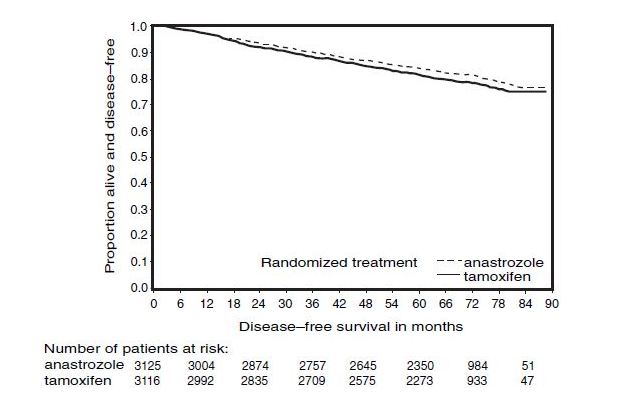
Figure-1 (Figure 1)

Figure-1 (Figure 1)
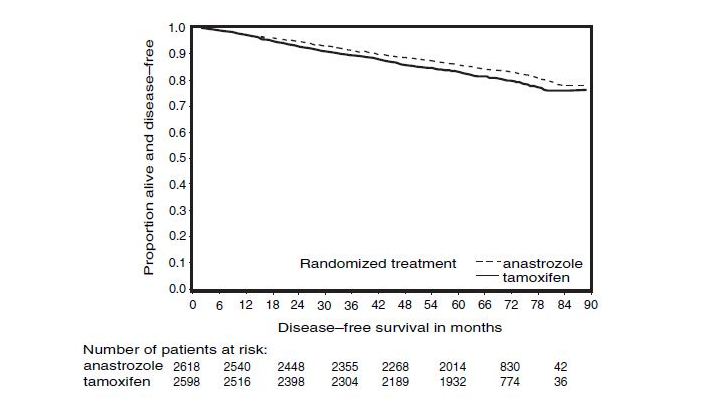
A survival curve graph comparing disease-free survival over months between patients treated with anastrozole and tamoxifen. The y-axis shows the proportion of patients alive and disease-free, ranging from 0.0 to 1.0. The x-axis indicates disease-free survival time in months. Two curves represent treatments: a dashed line for anastrozole and a solid line for tamoxifen. Patient risk numbers at various time points are listed below the graph for each treatment group.*
FDA Label Image

Figure-2 (Figure 2)

Figure-2 (Figure 2)
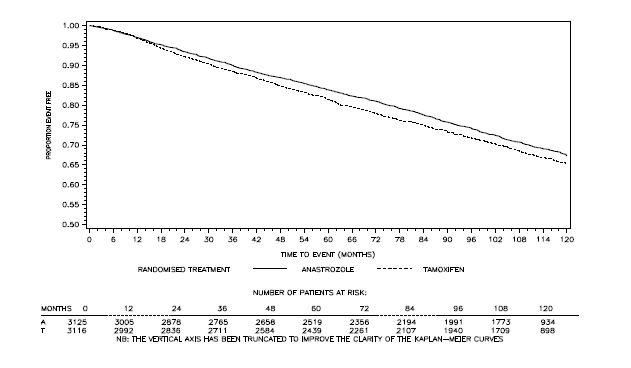
A survival curve chart comparing disease-free survival proportion over time in months for patients treated with anastrozole versus tamoxifen. The graph plots proportion alive and disease-free on the vertical axis against months on the horizontal axis. Below the graph is a table showing the number of patients at risk at various time points for each treatment group.*
FDA Label Image

Figure-3 (Figure 3)

Figure-3 (Figure 3)
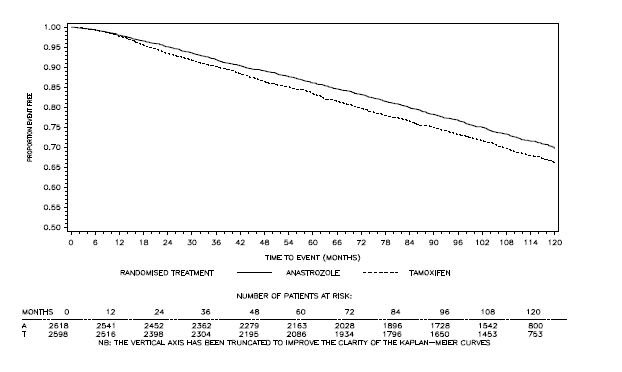
A Kaplan-Meier survival curve chart comparing randomized treatment groups Anastrozole and Tamoxifen over time to event measured in months, with a proportion of patients event-free on the vertical axis. The chart includes a table showing the number of patients at risk at various monthly intervals up to 120 months.*
FDA Label Image

Figure-4 (Figure 4)

Figure-4 (Figure 4)
A Kaplan-Meier survival curve graph showing time to event in months for two randomized treatment groups: Anastrozole (dashed line) and Tamoxifen (solid line). The vertical axis represents the proportion event-free, truncated at 0.50 to 1.00. The horizontal axis shows time from 0 to 120 months. A table below the graph lists numbers of patients at risk for both groups at various time points throughout the study.*
FDA Label Image

Figure-5 (Figure 5)

Figure-5 (Figure 5)
A line graph showing time to progression in months on the x-axis and proportion not progressing on the y-axis. It compares three treatments: randomized treatment, Anastrozole, and Tamoxifen, with respective survival curves and patient counts at various time points.*
FDA Label Image

Figure-6 (Figure 6)

Figure-6 (Figure 6)
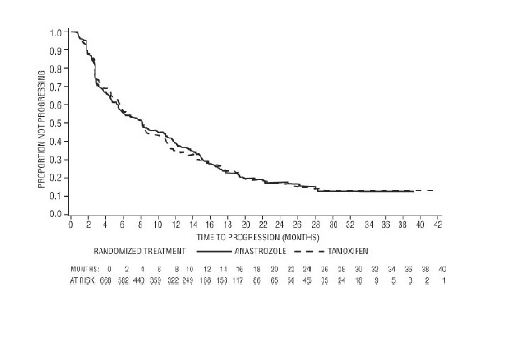
A Kaplan-Meier survival curve graph comparing the percentage of patients not progressing over time in months between two treatment groups: Anastrozole and Tamoxifen. The x-axis represents time to progression in months, and the y-axis shows the proportion of patients without disease progression. A table below the graph lists the number of patients at risk at various time points for each treatment group.*
FDA Label Image

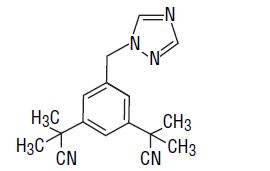
Anastrozol Chemical Structure (Structure)

Anastrozol Chemical Structure (Structure)
Chemical structure of anastrozole, showing its molecular arrangement with nitrogen-containing rings and aromatic components.*

* About these descriptions: Image descriptions on this page are generated by automated AI analysis of the product label images from the manufacturer's FDA label submission (SPL). They are provided for reference only and may contain errors or omissions. Always rely on the printed label itself and the official FDA labeling, and consult a pharmacist or healthcare professional with any questions about this product.