Consult the Absorbable Gelatin Sponge, USP labeling for complete information for use prior to utilizing the following thrombin saturated sponge procedure.
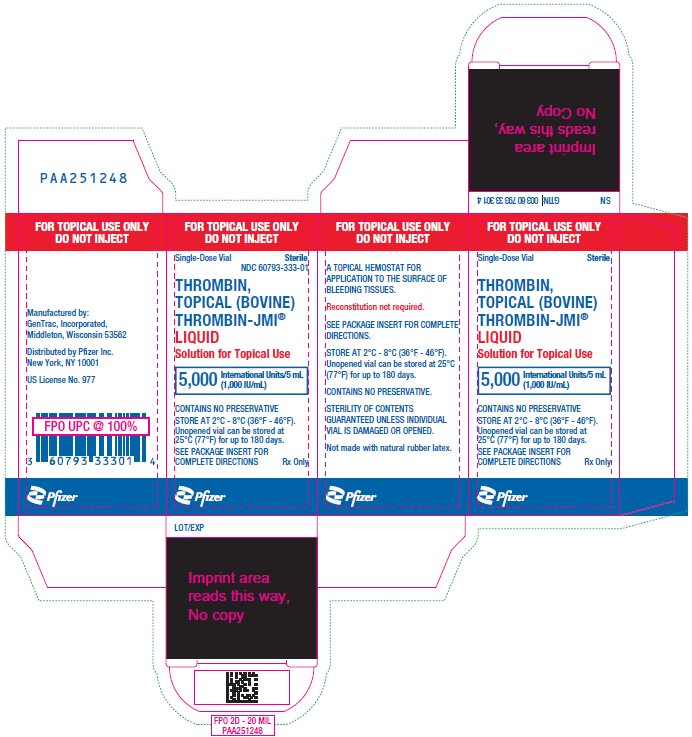
- 1.THROMBIN-JMI LIQUID does not require reconstitution.
- 2.Immerse sponge strips of the desired size in THROMBIN-JMI LIQUID. Knead the sponge strips vigorously with moistened, gloved fingers to remove trapped air, thereby facilitating saturation of the sponge.
- 3.Apply saturated sponge to bleeding area. Hold in place with a pledget of cotton or a small gauze sponge until hemostasis occurs.
Study 1
In a randomized, double-blinded, controlled trial that compared recombinant human thrombin to THROMBIN-JMI, 206 patients received THROMBIN-JMI and 205 patients received recombinant human thrombin as adjuncts to hemostasis in liver resection, spine, peripheral arterial bypass, and dialysis access surgeries.2 Four hundred one (401) patients completed the trial. The reported adverse reactions in both treatment groups were: cardiac events (18%), hypersensitivity (17%), other infections (15%), bleeding (11%), postoperative wound infection (10%), and thromboembolic events (5%). Among 200 patients who were evaluated for the presence of antibodies to THROMBIN-JMI, 10 patients (5%) were positive at baseline and 43 (21.5%) after treatment. The seroconversion rate in THROMBIN-JMI group was 18.4%.
Study 2
In a multicenter, prospective, randomized, double-blinded, controlled trial that compared plasma-derived human thrombin to THROMBIN-JMI, 152 patients received THROMBIN-JMI and 153 patients received human thrombin applied topically to the target bleeding site with a gelatin sponge.3 Serious adverse reactions (pyrexia and post-procedural hematoma) were reported in two patients receiving THROMBIN-JMI. In this study, 16 out of 126 (12.7%) patients who received THROMBIN-JMI demonstrated seroconversion for at least one of the four antibodies assayed. The four separate ELISA assays used to detect development of antibodies and the corresponding antibody development rates included: 1) Anti-bovine thrombin 10/126 (7.94%), 2) Anti-bovine factor V/Va 12/126 (9.52%), 3) Anti-human thrombin 3/126 (2.38%) and 4) Anti-human factor V/Va 0/126 (0%).
Study 3
The effect of repeat exposure was evaluated in a multi-center, prospective, randomized, double-blinded, controlled trial on 72 patients with diabetic foot ulcers, using a gel prepared with THROMBIN-JMI and autologous platelet rich plasma that was applied weekly for 12 weeks.4 Forty (40) patients were treated with the gel at fourteen (14) sites. Safety parameters were evaluated during the 12 weeks of treatment and the three-month follow-up period. No serious adverse reactions related to the gel treatment were reported.
Study 4
In a prospective, randomized, phase 2, non-inferiority study, topical human thrombin was compared with THROMBIN-JMI during vascular, hepatic, soft tissue, and spinal open surgery procedures.5 A total of 205 patients were randomized in a 2:1 ratio to receive human thrombin (n=137) or THROMBIN-JMI (n=68). The most common treatment-emergent adverse reactions (experienced by >5% patients within a treatment group) were procedural pain, nausea, constipation, pruritus, muscle spasms, insomnia, pyrexia, and vomiting. Two patients in the THROMBIN-JMI group (3.2% of treated patients) showed low-level titers of antibodies to bovine factor V.
Thrombin Concentration Study
In a blinded pre-clinical study conducted on a liver lesion model in swine, an inverse dose related response was observed between the visual bleeding scores and the thrombin
THROMBIN-JMI (Thrombin, Topical (Bovine) U.S.P.) was used for all thrombin concentrations tested in this study.
concentration within the absorbable gelatin powder delivery system (GEL-FLOW™ NT) syringe, a device containing 550 mg of absorbable gelatin powder (GELFOAM® Powder).1 Bleeding was assigned scores according to a visual scale, with scores of 0 (no bleeding), 0.5 (ooze), 1 (very slight), 2 (slight), 3 (moderate), and 4 (severe). Scores of 1 and less were considered clinically acceptable. The 770 IU/mL thrombin concentration provided statistically significant lower bleeding scores than either 375 IU/mL or 250 IU/mL thrombin concentrationsPer the THROMBIN-JMI prescribing information, for routine use THROMBIN-JMI is reconstituted with sterile isotonic saline at a recommended concentration of 1,000 to 2,000 IU per mL.
(Table 1). The results of this study showed that higher concentrations of thrombin within the GEL-FLOW™ NT syringe resulted in improved hemostasis as measured by lower bleeding scores.Table 1: Comparison of Effect on Hemostasis of Varying Thrombin Concentrations in GEL-FLOW™ NT as Measured by Bleeding Scores in Swine Liver Lesion Model using Repeated Measures Logistic Regression| Parameter | 250 IU/mL
Mean (Standard Error) | 375 IU/mL
Mean (Standard Error) | 770 IU/mL
Mean (Standard Error) |
|---|
3 Minute Bleeding Score | 1.8 (0.2) | 1.6 (0.2) | 0.7 (0.2) Significantly different from both 250 and 375 IU/mL at <0.001 significance level. Tukey adjusted p-values for multiple comparisons. |
6 Minute Bleeding Score | 1.7 (0.2) | 1.5 (0.2) | 0.6 (0.2) |
9 Minute Bleeding Score | 1.5 (0.2) | 1.2 (0.2) | 0.5 (0.2) |
12 Minute Bleeding Score | 1.4 (0.2) | 1.0 (0.2) Significantly different from 250 IU/mL at the 0.05 significance level. Tukey adjusted p-value for multiple comparisons. | 0.4 (0.2) |
Observational Study
A total of 554 subjects were enrolled, in a multicenter, open-label, observational study (MOSAIC) conducted to assess the effect of possible exposure to THROMBIN-JMI on activated partial thromboplastin time (aPTT) at 48 hours post-surgery in subjects with likelihood of prior exposure to THROMBIN-JMI within the past 4 years.6 Of the 554 subjects, 550 had undergone surgery and completed the study. A total of 384 subjects undergoing vascular surgeries, neurosurgeries and orthopedic surgeries were exposed to THROMBIN-JMI (5,000 to 20,000 IU).
In this study, the impact of exposure to THROMBIN-JMI in 78 subjects who were positive for anti-bovine thrombin (aBT) antibodies prior to surgery was compared with 140 subjects who did not have any aBT antibodies and were not exposed to THROMBIN-JMI. The study did not meet the pre-specified primary endpoint, a mean change from baseline in aPTT at 48 hours post-surgery. The study was not powered to detect coagulopathy related to an immune response after bovine thrombin use.
A post hoc analysis was performed in which subjects who underwent surgery were re-assigned to one of four exploratory cohorts based on the presence or absence of pre-surgery anti-bovine factor V/anti-bovine factor V active (aBV/Va) antibodies and whether or not they were administered THROMBIN-JMI during the study surgery. Non-inferiority (based on aPTT) was observed in these exploratory cohorts at all-time points of 48 hours, 4 weeks, and 8 weeks post-surgery.
For the primary study cohort (THROMBIN-JMI use in subjects with baseline positive aBT or positive aBV/Va), there was a higher incidence of seroconversion from anti human thrombin (aHT) negative at baseline to post-surgery positive compared to the primary reference cohort (no THROMBIN-JMI use in subjects with baseline negative aBT or negative aBV/Va). This difference was not present at 48 hours after surgery but was evident at 4 weeks and 8 weeks post-surgery. A similar immunological response with aBT and aBV/Va antibodies was observed following THROMBIN-JMI administration.
Secondary immune responses in patients treated with THROMBIN-JMI were evidenced by the generation of anti-bovine and anti-human thrombin and factor V/Va antibodies, consistent with known immunogenicity of topical bovine thrombin.
LAB-1634-3.0