Thrombin-jmi Liquid
FDA Label NDC 60793-333

Full FDA labeling including Indications, Dosage, Usage, and Precautions

Structured Product Label

The following Structured Product Label (SPL) was submitted to the FDA by Pfizer Laboratories Div Pfizer Inc for the product Thrombin-jmi (NDC 60793-333). This document serves as the official prescribing information, containing essential scientific data and clinical materials required for healthcare providers and patients.

This specific version of the label includes detailed information regarding warning: severe bleeding and thrombosis complications, 1 indications and usage, 2 dosage and administration, other, 3 dosage forms and strengths, 4 contraindications, 5.1 hypersensitivity reactions, 5.2 thrombosis, and other regulatory disclosures. Use the navigation below to review specific sections of the FDA submission.

Warning: Severe Bleeding And Thrombosis Complications

  • THROMBIN-JMI® LIQUID can cause fatal severe bleeding or thrombosis. Thrombosis may result from the development of antibodies against bovine thrombin. Bleeding may result from the development of antibodies against factor V. These may cross-react with human factor V and lead to its deficiency. (5.2, 5.3)
  • Do not re-expose patients to THROMBIN-JMI LIQUID if there are known or suspected antibodies to bovine thrombin and/or factor V. (4, 5.3)
  • Monitor patients for abnormal coagulation laboratory values, bleeding, or thrombosis. (5.3)

1 Indications And Usage

THROMBIN-JMI LIQUID is a topical bovine thrombin indicated to aid hemostasis whenever oozing blood and minor bleeding from capillaries and small venules is accessible and control of bleeding by standard surgical techniques (such as suture, ligature, or cautery) is ineffective or impractical.

In various types of surgeries, solutions of THROMBIN-JMI LIQUID may be used in conjunction with an Absorbable Gelatin Sponge, USP for hemostasis.

2 Dosage And Administration

For topical use on the surface of bleeding tissue only. Do not inject.

THROMBIN-JMI LIQUID is a ready to use presentation that does not require reconstitution prior to use. THROMBIN-JMI LIQUID is an equivalent presentation to the reconstituted THROMBIN-JMI.

To use THROMBIN-JMI LIQUID remove the flip-off plastic cap from the vial to expose the rubber stopper. Using a sterile needle and syringe, withdraw the thrombin solution from the vial. Alternatively, remove the rubber stopper (by removing the metal ferrule) to transfer THROMBIN-JMI LIQUID into a sterile container using aseptic technique.

Other

Topical application of THROMBIN-JMI LIQUID

  • 1.The recipient surface should be sponged (not wiped) free of blood before THROMBIN-JMI LIQUID is applied.
  • 2.A spray may be used or the surface may be flooded using a sterile syringe and small gauge needle. The most effective hemostasis results occur when the THROMBIN-JMI LIQUID mixes freely with the blood as soon as it reaches the surface.
  • 3.Sponging of the treated surfaces should be avoided to assure that the clot remains securely in place.
  • Use in conjunction with Absorbable Gelatin Sponge

    Consult the Absorbable Gelatin Sponge, USP labeling for complete information for use prior to utilizing the following thrombin saturated sponge procedure.

    • 1.THROMBIN-JMI LIQUID does not require reconstitution.
    • 2.Immerse sponge strips of the desired size in THROMBIN-JMI LIQUID. Knead the sponge strips vigorously with moistened, gloved fingers to remove trapped air, thereby facilitating saturation of the sponge.
    • 3.Apply saturated sponge to bleeding area. Hold in place with a pledget of cotton or a small gauze sponge until hemostasis occurs.
    • Study 1

      In a randomized, double-blinded, controlled trial that compared recombinant human thrombin to THROMBIN-JMI, 206 patients received THROMBIN-JMI and 205 patients received recombinant human thrombin as adjuncts to hemostasis in liver resection, spine, peripheral arterial bypass, and dialysis access surgeries.2 Four hundred one (401) patients completed the trial. The reported adverse reactions in both treatment groups were: cardiac events (18%), hypersensitivity (17%), other infections (15%), bleeding (11%), postoperative wound infection (10%), and thromboembolic events (5%). Among 200 patients who were evaluated for the presence of antibodies to THROMBIN-JMI, 10 patients (5%) were positive at baseline and 43 (21.5%) after treatment. The seroconversion rate in THROMBIN-JMI group was 18.4%.

      Study 2

      In a multicenter, prospective, randomized, double-blinded, controlled trial that compared plasma-derived human thrombin to THROMBIN-JMI, 152 patients received THROMBIN-JMI and 153 patients received human thrombin applied topically to the target bleeding site with a gelatin sponge.3 Serious adverse reactions (pyrexia and post-procedural hematoma) were reported in two patients receiving THROMBIN-JMI. In this study, 16 out of 126 (12.7%) patients who received THROMBIN-JMI demonstrated seroconversion for at least one of the four antibodies assayed. The four separate ELISA assays used to detect development of antibodies and the corresponding antibody development rates included: 1) Anti-bovine thrombin 10/126 (7.94%), 2) Anti-bovine factor V/Va 12/126 (9.52%), 3) Anti-human thrombin 3/126 (2.38%) and 4) Anti-human factor V/Va 0/126 (0%).

      Study 3

      The effect of repeat exposure was evaluated in a multi-center, prospective, randomized, double-blinded, controlled trial on 72 patients with diabetic foot ulcers, using a gel prepared with THROMBIN-JMI and autologous platelet rich plasma that was applied weekly for 12 weeks.4 Forty (40) patients were treated with the gel at fourteen (14) sites. Safety parameters were evaluated during the 12 weeks of treatment and the three-month follow-up period. No serious adverse reactions related to the gel treatment were reported.

      Study 4

      In a prospective, randomized, phase 2, non-inferiority study, topical human thrombin was compared with THROMBIN-JMI during vascular, hepatic, soft tissue, and spinal open surgery procedures.5 A total of 205 patients were randomized in a 2:1 ratio to receive human thrombin (n=137) or THROMBIN-JMI (n=68). The most common treatment-emergent adverse reactions (experienced by >5% patients within a treatment group) were procedural pain, nausea, constipation, pruritus, muscle spasms, insomnia, pyrexia, and vomiting. Two patients in the THROMBIN-JMI group (3.2% of treated patients) showed low-level titers of antibodies to bovine factor V.

      Thrombin Concentration Study

      In a blinded pre-clinical study conducted on a liver lesion model in swine, an inverse dose related response was observed between the visual bleeding scores and the thrombin

      THROMBIN-JMI (Thrombin, Topical (Bovine) U.S.P.) was used for all thrombin concentrations tested in this study.

      concentration within the absorbable gelatin powder delivery system (GEL-FLOW NT) syringe, a device containing 550 mg of absorbable gelatin powder (GELFOAM® Powder).1 Bleeding was assigned scores according to a visual scale, with scores of 0 (no bleeding), 0.5 (ooze), 1 (very slight), 2 (slight), 3 (moderate), and 4 (severe). Scores of 1 and less were considered clinically acceptable. The 770 IU/mL thrombin concentration provided statistically significant lower bleeding scores than either 375 IU/mL or 250 IU/mL thrombin concentrations

      Per the THROMBIN-JMI prescribing information, for routine use THROMBIN-JMI is reconstituted with sterile isotonic saline at a recommended concentration of 1,000 to 2,000 IU per mL.

      (Table 1). The results of this study showed that higher concentrations of thrombin within the GEL-FLOW NT syringe resulted in improved hemostasis as measured by lower bleeding scores.

      Table 1: Comparison of Effect on Hemostasis of Varying Thrombin Concentrations in GEL-FLOW NT as Measured by Bleeding Scores in Swine Liver Lesion Model using Repeated Measures Logistic Regression
      Parameter250 IU/mL
      Mean (Standard Error)
      375 IU/mL
      Mean (Standard Error)
      770 IU/mL
      Mean (Standard Error)

      3 Minute Bleeding Score

      1.8 (0.2)

      1.6 (0.2)

      0.7 (0.2)

      Significantly different from both 250 and 375 IU/mL at <0.001 significance level. Tukey adjusted p-values for multiple comparisons.

      6 Minute Bleeding Score

      1.7 (0.2)

      1.5 (0.2)

      0.6 (0.2)

      9 Minute Bleeding Score

      1.5 (0.2)

      1.2 (0.2)

      0.5 (0.2)

      12 Minute Bleeding Score

      1.4 (0.2)

      1.0 (0.2)

      Significantly different from 250 IU/mL at the 0.05 significance level. Tukey adjusted p-value for multiple comparisons.

      0.4 (0.2)

      Observational Study

      A total of 554 subjects were enrolled, in a multicenter, open-label, observational study (MOSAIC) conducted to assess the effect of possible exposure to THROMBIN-JMI on activated partial thromboplastin time (aPTT) at 48 hours post-surgery in subjects with likelihood of prior exposure to THROMBIN-JMI within the past 4 years.6 Of the 554 subjects, 550 had undergone surgery and completed the study. A total of 384 subjects undergoing vascular surgeries, neurosurgeries and orthopedic surgeries were exposed to THROMBIN-JMI (5,000 to 20,000 IU).

      In this study, the impact of exposure to THROMBIN-JMI in 78 subjects who were positive for anti-bovine thrombin (aBT) antibodies prior to surgery was compared with 140 subjects who did not have any aBT antibodies and were not exposed to THROMBIN-JMI. The study did not meet the pre-specified primary endpoint, a mean change from baseline in aPTT at 48 hours post-surgery. The study was not powered to detect coagulopathy related to an immune response after bovine thrombin use.

      A post hoc analysis was performed in which subjects who underwent surgery were re-assigned to one of four exploratory cohorts based on the presence or absence of pre-surgery anti-bovine factor V/anti-bovine factor V active (aBV/Va) antibodies and whether or not they were administered THROMBIN-JMI during the study surgery. Non-inferiority (based on aPTT) was observed in these exploratory cohorts at all-time points of 48 hours, 4 weeks, and 8 weeks post-surgery.

      For the primary study cohort (THROMBIN-JMI use in subjects with baseline positive aBT or positive aBV/Va), there was a higher incidence of seroconversion from anti human thrombin (aHT) negative at baseline to post-surgery positive compared to the primary reference cohort (no THROMBIN-JMI use in subjects with baseline negative aBT or negative aBV/Va). This difference was not present at 48 hours after surgery but was evident at 4 weeks and 8 weeks post-surgery. A similar immunological response with aBT and aBV/Va antibodies was observed following THROMBIN-JMI administration.

      Secondary immune responses in patients treated with THROMBIN-JMI were evidenced by the generation of anti-bovine and anti-human thrombin and factor V/Va antibodies, consistent with known immunogenicity of topical bovine thrombin.

      LAB-1634-3.0
3 Dosage Forms And Strengths

THROMBIN-JMI LIQUID [Thrombin, Topical (Bovine)], Solution for topical use is supplied in the following packages:

Vial: 5,000 IU/5 mL (1,000 IU/mL)

Vial: 20,000 IU/20 mL (1,000 IU/mL)

4 Contraindications

  • Do not inject directly into the circulatory system. Because of its action in the clotting mechanism, THROMBIN-JMI LIQUID can cause extensive intravascular clotting or death.
  • Do not re-expose patients to THROMBIN-JMI LIQUID if there are known or suspected antibodies to bovine thrombin and/or factor V.
  • Do not administer to patients with a history of hypersensitivity to THROMBIN-JMI or THROMBIN-JMI LIQUID, its components and/or to material of bovine origin.
  • Do not use for treatment of severe or brisk arterial bleeding.

5.1 Hypersensitivity Reactions

  • Allergic reactions, including anaphylactic/anaphylactoid reactions, have been reported following administration of THROMBIN-JMI LIQUID.
  • Institute intensive supportive measures and treat individual symptoms. Secure the airway and establish adequate respiratory exchange.

5.2 Thrombosis

THROMBIN-JMI LIQUID causes thrombosis if it enters the circulatory system due to its action in the clotting system.

Apply topically. DO NOT INJECT.

5.3 Immunogenicity

Inhibitory antibodies may develop in patients and interfere with hemostasis. Do not re-expose patients to THROMBIN-JMI LIQUID if there are known or suspected antibodies to bovine thrombin and/or factor V, due to the potential for these antibodies to interfere with hemostasis. Monitor patients for abnormal coagulation laboratory values, bleeding, or thrombosis.

Bleeding

Bleeding may result from the development of antibodies against factor V. These antibodies may cross-react with human factor V and lead to human factor V deficiency.

Thrombosis

Thrombosis may result from the development of antibodies against bovine thrombin.

6 Adverse Reactions

The most common adverse reactions (incidence greater than or equal to 2%) following administration of THROMBIN-JMI were: hypersensitivity, bleeding, anemia, post-operative wound infection, thromboembolic events, hypotension, pyrexia, tachycardia and thrombocytopenia.

6.1 Clinical Trials Experience

Because clinical trials are conducted under widely varying conditions, adverse reaction rates observed in the clinical trials of a drug cannot be directly compared to rates in the clinical trials of another drug and may not reflect the rates observed in practice.

The safety assessment of THROMBIN-JMI LIQUID is based primarily on the review of post marketing publications summarizing four (4) randomized controlled clinical trials in which THROMBIN-JMI was used as a comparator2–5, and one (1) observational study6 [see Clinical Studies (14)].

6.2 Postmarketing Experience

The following serious adverse reactions have been identified during post approval use of THROMBIN-JMI: anaphylactic reactions, prolonged prothrombin time, prolonged activated partial thromboplastin time, disseminated intravascular coagulation, factor V deficiency, post-procedural hematoma, swelling and Staphylococcal wound infection. Because these reactions are reported voluntarily from a population of uncertain size, it is not always possible to reliably estimate their frequency or establish a causal relationship to drug exposure.

8.1 Pregnancy

Risk Summary

Animal reproduction studies have not been conducted with THROMBIN-JMI LIQUID. It is also not known whether THROMBIN-JMI LIQUID can cause fetal harm when administered to a pregnant woman. THROMBIN-JMI LIQUID should be given to a pregnant woman only if clearly needed.

The estimated background risk of major birth defects and miscarriage for the indicated population is unknown. All pregnancies have a risk of birth defect, loss, or other adverse outcomes. In the U.S. general population, the estimated background risk of major birth defects and miscarriage in clinically recognized pregnancies is 2% to 4% and 15% to 20%, respectively.

8.2 Lactation

It is not known whether this drug is excreted in human milk. The developmental and health benefits of breastfeeding should be considered along with the mother's clinical need for THROMBIN-JMI LIQUID and any potential adverse effects on the breastfed infant from THROMBIN-JMI LIQUID or from the underlying maternal condition.

8.4 Pediatric Use

Safety and effectiveness in children have not been established.

8.5 Geriatric Use

Clinical studies of THROMBIN-JMI did not include sufficient numbers of subjects aged 65 and over to determine whether they respond differently from younger subjects. Other reported clinical experience has not identified differences in responses between the elderly and younger patients. In general, dose selection for an elderly patient should be cautious, usually starting at the low end of the dosing range, reflecting the greater frequency of decreased hepatic, renal, or cardiac function, and of concomitant disease or other drug therapy.

11 Description

THROMBIN-JMI LIQUID is a single-dose sterile product supplied as a clear solution suitable for topical use. THROMBIN-JMI LIQUID contains thrombin, glycerin, PEG-300, sodium chloride, sodium acetate trihydrate, sodium hydroxide, hydrochloric acid, and water. The drug product contains no preservative and is for single use only.

THROMBIN-JMI LIQUID undergoes multistep chromatographic purification and ultrafiltration. The manufacturing process for THROMBIN‑JMI LIQUID has been further improved by the addition of viral filtration and impurity reduction processes. Analytical studies demonstrate the capability of the current manufacturing process to remove significant amounts of extraneous proteins, and result in a reduction of factor Va light chain content to levels below the limit of detection of semi-quantitative Western Blot assay (<92 ng/mL, when reconstituted as directed). The clinical relevance of these findings is unknown.

12.1 Mechanism Of Action

THROMBIN-JMI LIQUID requires no intermediate physiological agent for its action. It activates platelets and catalyzes the conversion of fibrinogen to fibrin, which are essential steps for clot formation. Failure to clot blood occurs in the case where the primary clotting defect is the absence of fibrinogen itself. The speed with which thrombin clots blood is dependent upon the concentration of both thrombin and fibrinogen.

13.1 Carcinogenesis, Mutagenesis, Impairment Of Fertility

No studies have been undertaken examining carcinogenicity, genetic toxicity or fertility.

15 References

  • 1.Morse DC, Silva E, Bartrom J, et al: Improved bleeding scores using Gelfoam Powder with incremental concentrations of bovine thrombin in a swine liver lesion model. J Throm Thrombolysis. 2016;42(3):352–359.
  • 2.Chapman WC, Singla N, Genyk Y, et al: A Phase 3, Randomized, Double-Blind Comparative Study of the Efficacy and Safety of Topical Recombinant Human Thrombin and Bovine Thrombin in Surgical Hemostasis. J Am Coll Surg. 2007;205:256–265.
  • 3.Doria C, Fischer CP, Wood CG, et al: Phase 3, randomized, double-blind study of plasma-derived human thrombin versus bovine thrombin in achieving hemostasis in patients undergoing surgery. Curr Med Res Opin. 2008;24(3):785–794.
  • 4.Driver VR, Hanft J, Fylling CP, et al: A Prospective, Randomized, Controlled Trial of Autologous Platelet-Rich Plasma Gel for the Treatment of Diabetic Foot Ulcers. Ostomy/Wound Management. 2006;52(6):68–87.
  • 5.Minkowitz H, Navarro-Puerto J, Lakshman S, et al: Prospective, Randomized, Phase II, Non-Inferiority Study to Evaluate the Safety and Efficacy of Topical Thrombin (Human) Grifols as Adjunct to Hemostasis During Vascular, Hepatic, Soft Tissue, and Spinal Open Surgery. J Am Coll Surg. 2019;229(5):497–507.
  • 6.Paterson CA, Pixton GC, Proskin HM, et al: Immune responses associated with perioperative exposure and reexposure to topical bovine thrombin do not impair hemostasis. Clin Appl Thromb Hemost. 2011;17(6):620–632.

16 How Supplied/Storage And Handling

Not made with natural rubber latex.

THROMBIN-JMI® LIQUID is supplied in the following packages:

  •  NDC 60793-333-01
    Carton containing one 5,000 IU/5 mL vial

    NDC 60793-020-01
    Carton containing one 20,000 IU/20 mL vial

Storage And Handling

Store Thrombin-JMI LIQUID at 2°C - 8°C (36°F - 46°F). Unopened vial can be stored at 25°C (77°F) for up to 180 days.

17 Patient Counseling Information

Because THROMBIN-JMI LIQUID may cause the formation of clots in blood vessels if it enters the bloodstream, advise patients to consult their physician if they experience leg tenderness or swelling, chest pain, shortness of breath, or difficulty speaking or swallowing.

Manufactured by: GenTrac, Incorporated,
Middleton, Wisconsin 53562

Pfizer Logo (Thrombin 00)

Pfizer Logo (Thrombin 00)

US License No. 977

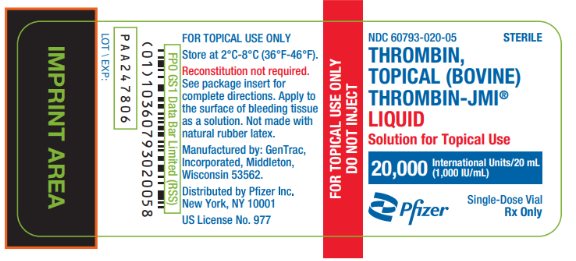
Principal Display Panel – 20 Ml Vial Label

NDC 60793-020-05
STERILE

THROMBIN,
TOPICAL (BOVINE)
THROMBIN-JMI®
LIQUID
Solution for Topical Use
20,000 International Units/20 mL
(1,000 IU/mL)

Pfizer

Single-Dose Vial
Rx Only

Principal Display Panel – 20 mL Vial Label (Thrombin 03)

Principal Display Panel – 20 mL Vial Label (Thrombin 03)

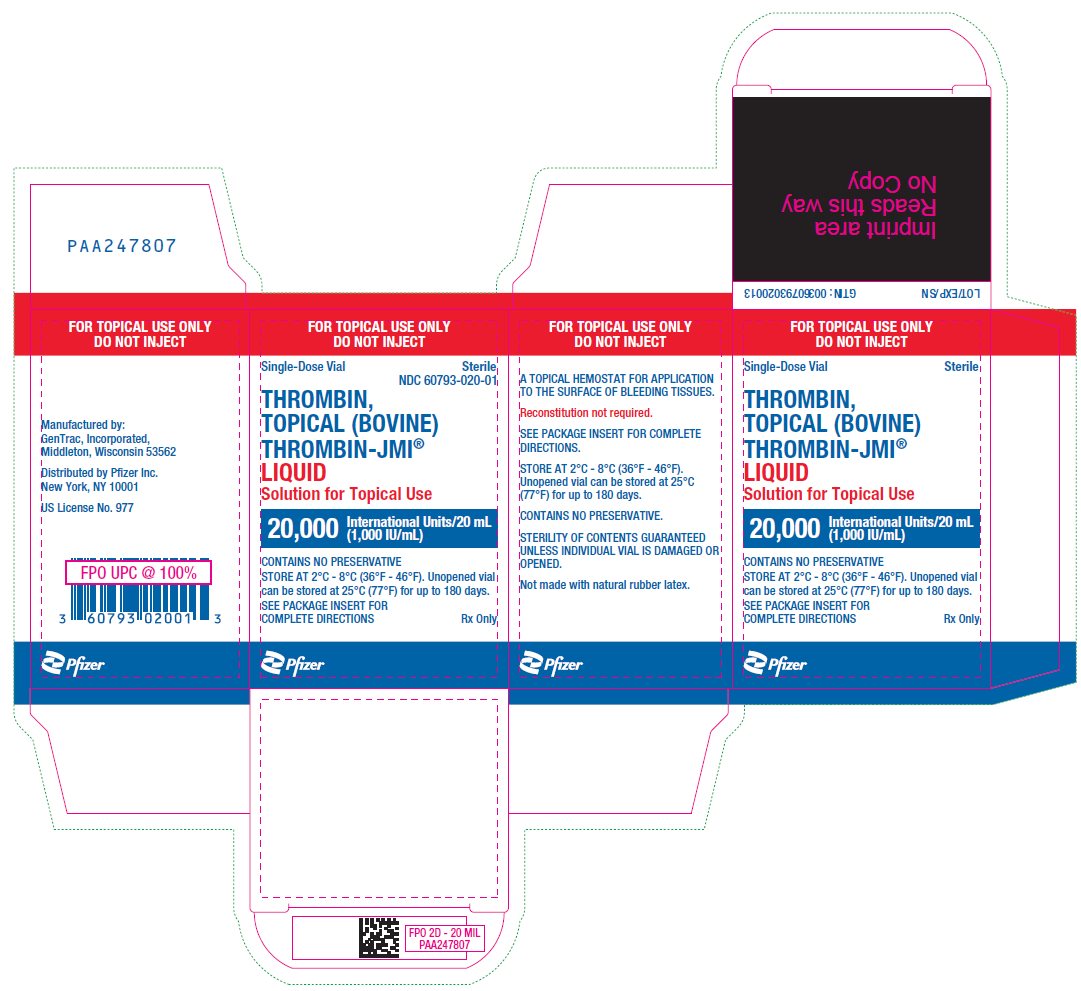
Principal Display Panel - 20 Ml Vial Carton

Single-Dose Vial
Sterile
NDC 60793-020-01

THROMBIN,
TOPICAL (BOVINE)
THROMBIN-JMI®
LIQUID
Solution for Topical Use
20,000 International Units/20 mL
(1,000 IU/mL)

CONTAINS NO PRESERVATIVE
STORE AT 2°C - 8°C (36°F - 46°F) Unopened vial
can be stored at 25°C (77°F) for up to 180 days.
SEE PACKAGE INSERT FOR
COMPLETE DIRECTIONS

Rx Only

Pfizer

Principal Display Panel (20 mL Vial Carton)

Principal Display Panel (20 mL Vial Carton)

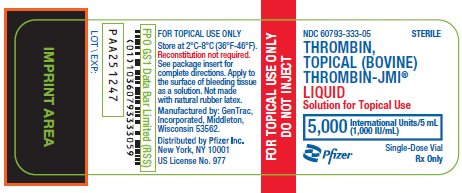
Principal Display Panel – 5 Ml Vial Label

NDC 60793-333-05
STERILE

THROMBIN,
TOPICAL (BOVINE)
THROMBIN-JMI®
LIQUID
Solution for Topical Use
5,000 International Units/5 mL
(1,000 IU/mL)

Pfizer

Single-Dose Vial
Rx Only

Principal Display Panel – 5 mL Vial Label (Thrombin 01)

Principal Display Panel – 5 mL Vial Label (Thrombin 01)

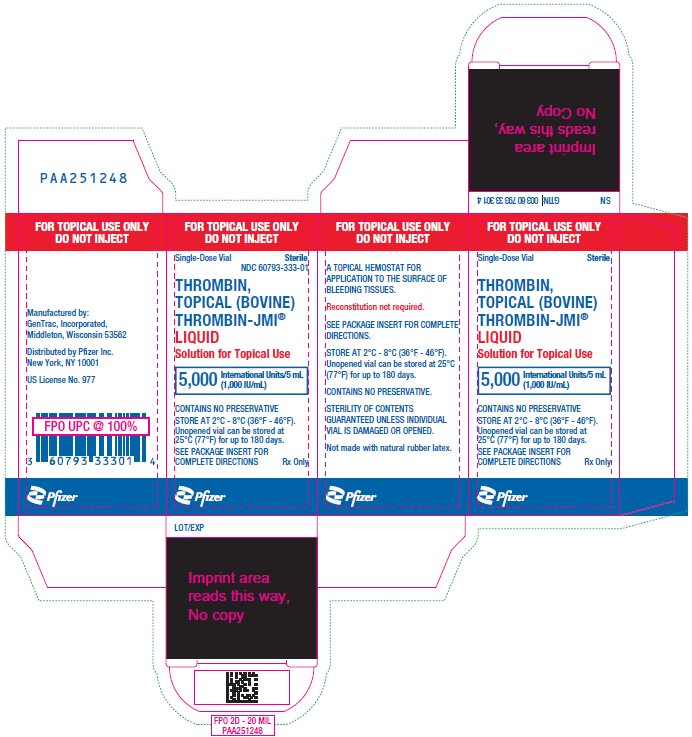
Principal Display Panel - 5 Ml Vial Carton

Single-Dose Vial
Sterile
NDC 60793-333-01

THROMBIN,
TOPICAL (BOVINE)
THROMBIN-JMI®
LIQUID
Solution for Topical Use
5,000 International Units/5 mL
(1,000 IU/mL)

CONTAINS NO PRESERVATIVE
STORE AT 2°C - 8°C (36°F - 46°F).
Unopened vial can be stored at
25°C (77°F) for up to 180 days.
SEE PACKAGE INSERT FOR
COMPLETE DIRECTIONS

Rx Only

Pfizer

Principal Display Panel (5 mL Vial Carton)

Principal Display Panel (5 mL Vial Carton)

* Please review the disclaimer below.