Two randomized, multi-center, double-blind, placebo-controlled trials (Trials 1 and 2) of identical design were conducted to evaluate KYBELLA for use to improve the appearance of moderate to severe convexity or fullness associated with submental fat. The trials enrolled healthy adults (ages 19 to 65, BMI ≤ 40 kg/m2) with moderate or severe convexity or fullness associated with submental fat (i.e., grade 2 or 3 on 5-point grading scales, where 0 = none and 4 = extreme), as judged by both clinician and subject ratings. Subjects received up to 6 treatments with KYBELLA (N=514, combined trials) or placebo (N=508, combined trials) at no less than 1 month intervals. Use of ice/cold packs, topical and/or injectable local anesthesia was allowed during the clinical trials. Injection volume was 0.2 mL (2 mg) per injection site, spaced 1 cm apart into the submental fat tissue, which is also expressed in dose per area as 2 mg/cm2. For each treatment session a maximum of 100 mg (10 mL) was permitted over the entire treatment area. Subjects were administered an average of 64 mg (6.4 mL) at the first treatment session, and subjects who received all six treatments were administered an average of 44 mg (4.4 mL) at the sixth treatment session. In these trials, 59% of subjects received all six treatments.
Baseline Demographics and Important Disease Characteristics
In these trials, the mean age was 49 years and the mean BMI was 29 kg/m2. Most of the subjects were women (85%) and White (87%) and African American (8%). At baseline, 51% of the subjects had a clinician-rated submental fat severity rating of moderate submental fat rating (graded as 2 on a 0 to 4 scale) and 49% had a severe submental fat rating (graded as 3 on a 0 to 4 scale) and without excessive skin laxity.
Key Endpoints
The co-primary efficacy assessments in these trials were based on at least 2-grade and at least 1-grade improvements in submental convexity or fullness on the composite of clinician-reported and patient-reported ratings of submental fat 12 weeks after final treatment. Additionally, changes in submental fat volume were evaluated in a subset of subjects (N=449, combined trials) using magnetic resonance imaging (MRI). Visual and emotional impacts of submental fat (happy, bothered, self-conscious, embarrassed, looking older or overweight) were also evaluated using a 6-question survey, with each question rated from 0 (not at all) to 10 (extremely/very much).
Efficacy Results
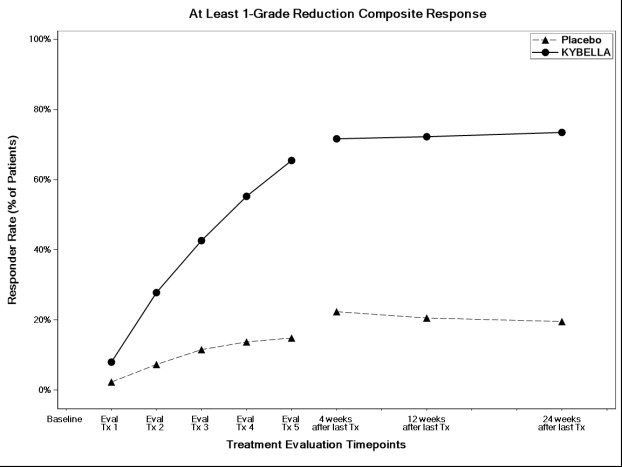
In Trials 1 and 2, reductions in submental fat volume were observed more frequently in the KYBELLA group compared to the placebo group as measured by the composite clinician and patient ratings (Table 2). The composite response rates by visit are presented in Figure 4.
Table 2. ≥ 2-Grade and ≥ 1-Grade Composite Clinician Response and Composite Patient Response 12 Weeks After Final Treatment in Adult Patients with Moderate to Severe Convexity or Fullness Associated with Submental Fat | Trial 1 | Trial 2 |
| Endpoint | KYBELLA
(N=256) | Placebo
(N=250) | KYBELLA
(N=258) | Placebo
(N=258) |
| 2-Grade Composite Response a | 13.4% | <0.1% | 18.6% | 3.0% |
| 1-Grade Composite Response b | 70.0% | 18.6% | 66.5% | 22.2% |
a At least 2 grade reduction on both the clinician-reported and patient-reported ratings of submental fat
b At least 1 grade reduction on both the clinician-reported and patient-reported ratings of submental fat
Figure 4. Subjects with ≥ 2-Grade on Both the Clinician-Reporting Ratings and the Patient Response in Adult Patients with Moderate to Severe Convexity or Fullness Associated with Submental Fat
Subjects were followed up 4, 12 and 24 weeks after the last¬ treatment. Forty-one percent of subjects received fewer than 6 treatments and entered the post-treatment period earlier than Week 24.
Figure 5. Subjects with ≥ 1-Grade on Both the Composite Clinician Response and the Composite Patient Response in Adult Patients with Moderate to Severe Convexity or Fullness Associated with Submental Fat
Subjects were followed up 4, 12 and 24 weeks after the last treatment. Forty-one percent of subjects received fewer than 6 treatments and entered the post-treatment period earlier than Week 24.
A greater proportion of KYBELLA-treated subjects had at least a 10% reduction in submental fat volume (evaluated by MRI) as compared to placebo-treated subjects (43% vs 5%, respectively).
The overall patient-reported satisfaction and self-perceived visual attributes showed greater improvement in the KYBELLA group than in the placebo group.