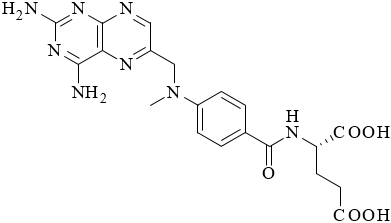
Avoid the intrathecal use of Methotrexate Injection that contains the preservative benzyl alcohol because of the risk of serious neurotoxicity [see Warnings and Precautions (5.3)].
Products containing folic acid or its derivatives may decrease the clinical effectiveness of methotrexate. Avoid use of products containing folic acid or folinic acid unless clinically indicated [see Drug Interactions (7.1)].
Folate deficiency may increase methotrexate adverse reactions. Administer folic acid or folinic acid to patients with rheumatoid arthritis, pJIA, and psoriasis [see Dosage and Administration (2.10, 2.11, 2.12)].
The approximate incidences of methotrexate-attributed (i.e., placebo rate subtracted) adverse reactions in 12- to 18-week double-blind studies in patients (n=128) with RA treated with low-dose oral (7.5 mg per week to 15 mg per week) pulse methotrexate are listed below. Most patients were on concomitant NSAIDs and some received corticosteroids. Hepatic histology was not examined in these short-term studies.
Two other controlled trials of patients (n=680) with RA on 7.5 mg per week to 15 mg per week oral doses showed the following adverse reactions:
The approximate incidences of adverse reactions reported in patients 2 to 18 years of age with pJIA treated with oral, weekly doses of methotrexate (5 mg/m2 per week to 20 mg/m2 per week or 0.1 mg/kg per week to 0.65 mg/kg per week) were as follows (most patients were receiving concomitant NSAIDs, and some received corticosteroids): elevated liver function tests, 14%; gastrointestinal reactions (e.g., nausea, vomiting, diarrhea), 11%; stomatitis, 2%; leukopenia, 2%; headache, 1.2%; alopecia, 0.5%; dizziness, 0.2%; rash, 0.2%.
In two published series of adult psoriasis patients (n=204, 248) treated with methotrexate doses up to 25 mg per week for up to 4 years, adverse reaction rates were similar to those in patients with RA, except for alopecia, photosensitivity, and "burning of skin lesions" (each 3% to 10%). Painful plaque erosions have been reported.
Coadministration of methotrexate with the following products may increase methotrexate plasma concentrations, which may increase the risk of methotrexate severe adverse reactions.
Increased organ specific adverse reactions may also occur when methotrexate is coadministered with hepatotoxic or nephrotoxic products. If coadministration cannot be avoided, monitor closely for methotrexate adverse reactions when coadministered with:
- Penicillin or sulfonamide antibiotics
- Highly protein-bound drugs (e.g., oral anticoagulants, phenytoin, salicylates, sulfonamides, sulfonylureas, and tetracyclines)
- Proton pump inhibitors
- Probenecid
- Antifolate drugs (e.g., dapsone, pemetrexed, pyrimethamine and sulfonamides)
- Aspirin and other nonsteroidal anti-inflammatory drugs
Unexpectedly severe and fatal gastrointestinal toxicity can occur with concomitant administration of methotrexate (primarily at high-dose) and nonsteroidal anti-inflammatory drugs (NSAIDs) - Mercaptopurine
- Hepatotoxic products
- Weak acids (e.g., salicylates)
- Nephrotoxic products
Nitrous Oxide
Coadministration of methotrexate with nitrous oxide anesthesia potentiates the effect of methotrexate on folate-dependent metabolic pathways, which may increase the risk of severe methotrexate adverse reactions. Avoid nitrous oxide anesthesia in patients receiving methotrexate. Consider alternative therapies in patients who have received prior nitrous oxide anesthesia.
Folic Acid
Coadministration of methotrexate with folic acid or its derivatives decreases the clinical effectiveness of methotrexate in patients with neoplastic diseases. Methotrexate competes with reduced folates for active transport across cell membranes. Instruct patients to take folic or folinic acid only as directed by their healthcare provider [see Warnings and Precautions (5.12)].
Theophylline
Coadministration of methotrexate with theophylline increases theophylline plasma concentrations which may increase the risk of theophylline adverse reactions. Monitor theophylline levels and adjust the theophylline dosage in accordance with approved product labeling.
Risk Summary
Methotrexate Injection is contraindicated in pregnant women with non-neoplastic diseases. Based on published reports and its mechanism of action, methotrexate can cause embryo-fetal toxicity and fetal death when administered to a pregnant woman [see Data and Clinical Pharmacology (12.1)]. There are no animal data that meet current standards for nonclinical developmental toxicity studies. Advise pregnant women with neoplastic diseases of the potential risk to a fetus. The preservative benzyl alcohol can cross the placenta; when possible, use the preservative-free formulation when Methotrexate Injection is needed during pregnancy to treat a neoplastic disease [see Warnings and Precautions (5.3) and Use in Specific Populations (8.4)].
In the U.S. general population, the estimated background risk of major birth defects and miscarriage in clinically recognized pregnancies is 2–4% and 15–20%, respectively.
Data
Human Data
Published data from case reports, literature reviews, and observational studies report that methotrexate exposure during pregnancy is associated with an increased risk of embryo-fetal toxicity and fetal death. Methotrexate exposure during the first trimester of pregnancy is associated with an increased incidence of spontaneous abortions and multiple adverse developmental outcomes, including skull anomalies, facial dysmorphism, CNS abnormalities, limb abnormalities, and sometimes cardiac anomalies and intellectual impairment. Adverse outcomes associated with exposure during second and third trimesters of pregnancy include intrauterine growth restriction and functional abnormalities. Because methotrexate is widely distributed and persists in the body for a prolonged period, there is a potential risk to the fetus from preconception methotrexate exposure.
A prospective multicenter study evaluated pregnancy outcomes in women taking methotrexate less than or equal to 30 mg/week after conception. The rate of spontaneous abortion/miscarriage in pregnant women exposed to methotrexate was 42.5% (95% confidence interval [95% CI] 29.2–58.7), which was higher than in unexposed patients with autoimmune disease (22.5%, 95% CI 16.8–29.7) and unexposed patients with non-autoimmune disease (17.3%, 95% CI 13–22.8). Of the live births, the rate of major birth defects in pregnant women exposed to methotrexate after conception was higher than in unexposed patients with autoimmune disease (adjusted odds ratio (OR) 1.8 [95% CI 0.6–5.7]) and unexposed patients with non-autoimmune disease (adjusted OR 3.1 [95% CI 1.03–9.5]) (2.9%). Major birth defects associated with pregnancies exposed to methotrexate after conception were not always consistent with methotrexate-associated adverse developmental outcomes.
Risk Summary
Limited published literature reports the presence of methotrexate in human milk in low amounts, with the highest breast milk to plasma concentration ration reported to be 0.08:1. No information is available on the effects of methotrexate on a breastfed infant or on milk production. Because of the potential for serious adverse reactions from methotrexate in breastfed infants, advise women not to breastfeed during treatment with Methotrexate Injection and for 1 week after the final dose.
Pregnancy Testing
Verify the pregnancy status of females of reproductive potential prior to initiating Methotrexate Injection [see Contraindications (4) and Use in Specific Populations (8.1)].
Contraception
Females
Advise females of reproductive potential to use effective contraception during and for 6 months after the final dose of Methotrexate Injection therapy.
Males
Methotrexate can cause chromosomal damage to sperm cells. Advise males with female partners of reproductive potential to use effective contraception during and for 3 months after the final dose of Methotrexate Injection therapy.
Infertility
Females
Based on published reports of female infertility after therapy with methotrexate, advise females of reproductive potential that Methotrexate Injection can cause impairment of fertility and menstrual dysfunction during and after cessation of therapy. It is not known if the infertility may be reversed in all affected females.
Males
Based on published reports of male infertility after therapy with methotrexate, advise males that Methotrexate Injection can cause oligospermia or infertility during and after cessation of therapy. It is not known if the infertility may be reversed in all affected males.
Risks of Serious Adverse Reactions due to Benzyl Alcohol-Preservative
Due to the risk of serious adverse reactions and fatal gasping syndrome following administration of intravenous solutions containing the preservative benzyl alcohol in neonates, use only preservative-free Methotrexate Injection in neonates and low-birth weight infants. The "gasping syndrome" is characterized by CNS depression, metabolic acidosis, and gasping respirations.
Serious adverse reactions including fatal reactions and the "gasping syndrome" occurred in premature neonates and low-birth weight infants in the neonatal intensive care unit who received drugs containing benzyl alcohol as a preservative. In these cases, benzyl alcohol dosages of 99 to 234 mg/kg/day produced high levels of benzyl alcohol and its metabolites in the blood and urine (blood levels of benzyl alcohol were 0.61 to 1.378 mmol/L). Additional adverse reactions include gradual neurological deterioration, seizures, intracranial hemorrhage, hematological abnormalities, skin breakdown, hepatic and renal failure, hypotension, bradycardia, and cardiovascular collapse. Preterm, low-birth weight infants may be more likely to develop these reactions because they may be less able to metabolize benzyl alcohol.
When prescribing in infants (non-neonate, non-low-birth weight), if a preservative-free formulation of Methotrexate Injection is not available and use of a benzyl alcohol-containing formulation is necessary, consider the combined daily metabolic load of benzyl alcohol from all sources including Methotrexate Injection (Methotrexate Injection contains 9.4 mg of benzyl alcohol/per mL) and other drugs containing benzyl alcohol. The minimum amount of benzyl alcohol at which serious adverse reactions may occur is not known.
Do not administer methotrexate formulations containing benzyl alcohol intrathecally due to the risk of severe neurotoxicity [see Warnings and Precautions (5.3)].
Leukemia/Lymphoma
Serious neurotoxicity, frequently manifested as generalized or focal seizures, has been reported with unexpectedly increased frequency among pediatric patients with acute lymphoblastic leukemia who were treated with intermediate-dose intravenous methotrexate (1 g/m2) [see Warnings and Precautions (5.8)].
Manifestations
Overdosage, including fatal overdosage, has occurred with methotrexate [see Warnings and Precautions (5.19)].
Manifestations of overdosage include adverse reactions reported at pharmacologic doses, particularly hematologic and gastrointestinal reactions (e.g., leukopenia, thrombocytopenia, anemia, pancytopenia, myelosuppression, mucositis, stomatitis, oral ulceration, nausea, vomiting, gastrointestinal ulceration, or gastrointestinal bleeding). In some cases, no symptoms were reported; however, sepsis or septic shock, renal failure, and aplastic anemia were also reported.
Manifestations of intrathecal overdosage include CNS symptoms (e.g., headache, nausea and vomiting, seizure or convulsion, and acute toxic encephalopathy). In some cases, no symptoms were reported; however, cerebellar herniation associated with increased intracranial pressure and acute toxic encephalopathy have also been reported.
Management
Leucovorin and levoleucovorin are indicated to diminish the toxicity and counteract the effect of inadvertently administered overdosages of methotrexate. Administer leucovorin or levoleucovorin as soon as possible after overdosage (refer to the leucovorin or levoleucovorin prescribing information). Monitor serum methotrexate concentrations closely to guide leucovorin or levoleucovorin therapy. Monitor serum creatinine concentrations closely because high serum methotrexate concentrations may cause renal damage leading to acute renal failure.
Glucarpidase is indicated for the treatment of toxic methotrexate concentrations in patients with delayed methotrexate clearance due to impaired renal function (refer to the glucarpidase prescribing information). If glucarpidase is used, do not administer leucovorin within 2 hours before or after a dose of glucarpidase because leucovorin is a substrate for glucarpidase.
Hydration and urinary alkalinization may be necessary to prevent the precipitation of methotrexate and/or its metabolites in the renal tubules. Neither hemodialysis nor peritoneal dialysis has been shown to improve methotrexate elimination. However, effective clearance of methotrexate has been reported with acute, intermittent hemodialysis using a high-flux dialyzer.
Distribution
After intravenous administration, the initial volume of distribution is approximately 0.18 L/kg (18% of body weight) and steady-state volume of distribution is approximately 0.4 L/to 0.8 L/kg (40% to 80% of body weight).
Methotrexate competes with reduced folates for active transport across cell membranes by means of a single carrier-mediated active transport process. At serum concentrations greater than 100 micromolar, passive diffusion becomes a major pathway by which effective intracellular concentrations can be achieved.
Methotrexate in serum is approximately 50% protein bound.
Methotrexate may be displaced from plasma albumin by various compounds, including sulfonamides, salicylates, tetracyclines, chloramphenicol, and phenytoin.
Methotrexate does not penetrate the blood-cerebrospinal fluid barrier in therapeutic amounts when given intravenously, intramuscularly, or subcutaneously.
Elimination
The terminal half-life reported for methotrexate is approximately 3 to 10 hours for patients receiving treatment for psoriasis, or rheumatoid arthritis or low-dose antineoplastic therapy (less than 30 mg/m2).
Following intravenous administration of high-dose methotrexate, the terminal half-life is 8 hours to 15 hours.
Metabolism
Methotrexate undergoes hepatic and intracellular metabolism to polyglutamated forms that can be converted back to methotrexate by hydrolase enzymes. These polyglutamates act as inhibitors of dihydrofolate reductase and thymidylate synthetase. Small amounts of methotrexate polyglutamates may remain in tissues for extended periods. The retention and prolonged drug action of these active metabolites vary among different cells, tissues, and tumors. Methotrexate undergoes minor metabolism to 7-hydroxymethotrexate, and accumulation may become significant following high dosages. The aqueous solubility of 7-hydroxymethotrexate is 3- to 5-fold lower than the solubility of methotrexate.
Excretion
Renal excretion is the primary route of elimination and is dependent upon dosage and route of administration. With intravenous administration, 80% to 90% of the administered dose is excreted unchanged in the urine within 24 hours. There is limited biliary excretion amounting to 10% or less of the administered dose. Enterohepatic recirculation of methotrexate has been proposed.
Renal excretion occurs by glomerular filtration and active tubular secretion. Nonlinear elimination due to saturation of renal tubular reabsorption has been observed in psoriatic patients at doses between 7.5 mg and 30 mg.
Specific Populations
Pediatric Patients
In pediatric patients receiving methotrexate for acute lymphoblastic leukemia (6.3 mg/m2 to 30 mg/m2), or for JIA (3.75 mg/m2 to 26.2 mg/m2), the terminal half-life has been reported to range from 0.7 to 5.8 hours or from 0.9 to 2.3 hours, respectively [see Use in Specific Populations (8.4)].
Patients with Renal impairment
The elimination half-life of methotrexate increases with the severity of renal impairment, with high inter-individual variability [see Use in Specific Populations (8.6)].
How Supplied
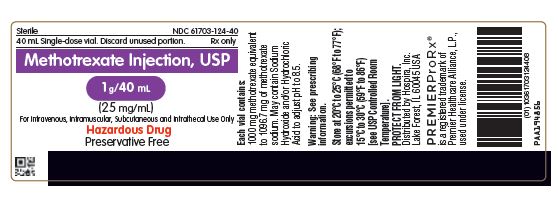
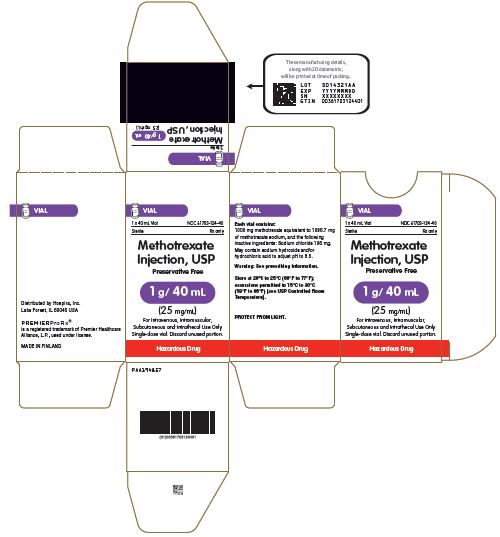
Methotrexate Injection is a clear, yellow, sterile solution available as preservative-free (single-dose vials) as follows:
| Strength/Fill volume | NDC number | Pack style |
|---|
Preservative-free |
1 g/40 mL (25 mg/mL) | 61703-124-40 | Carton containing one (1) single-dose vial |
| Carton contents | NDC |
|---|
Preservative-free Methotrexate Injection, 1 single-dose vial |
1 g/40 mL (25 mg/mL) | 61703-124-40 |
Also supplied in the following manufacturer supplied dosage form for Methotrexate Injection
- Methotrexate Injection, With Preservative, 5 multiple-dose vials (50 mg/2 mL (25 mg/mL)
Embryo-Fetal Toxicity
- Advise females of reproductive potential of the potential risk to a fetus and to inform their healthcare provider of a known or suspected pregnancy [see Contraindications (4), Warnings and Precautions (5.1), and Use in Specific Populations (8.1)].
- Advise females of reproductive potential to use effective contraception during methotrexate therapy and for 6 months after the final dose [see Use in Specific Populations (8.3)].
- Advise males of reproductive potential to use effective contraception during methotrexate therapy and for 3 months after the final dose [see Use in Specific Populations (8.3)].
Hypersensitivity Reactions
Advise patients of the potential risk of hypersensitivity and that Methotrexate Injection is contraindicated in patients with a history of severe hypersensitivity to methotrexate. Advise patients to seek immediate medical attention if signs or symptoms of a hypersensitivity reaction occur [see Warnings and Precautions (5.2)].
Myelosuppression and Serious Infections
Advise patient to contact their healthcare provider immediately for new onset fever, symptoms of infection, easy bruising or persistent bleeding [see Warnings and Precautions (5.4, 5.5)].
Renal Toxicity
Advise patients that methotrexate can cause renal toxicity. Advise patients to immediately contact their healthcare provider for signs or symptoms of renal toxicity, such as marked increases or decreases in urinary output [see Warnings and Precautions (5.6)].
Hepatotoxicity
Advise patients to report signs or symptoms of hepatic toxicity and avoidance of alcohol during methotrexate treatment [see Warnings and Precautions (5.7)].
Neurotoxicity
Advise patient to contact their healthcare provider immediately if they develop new neurological symptoms [see Warnings and Precautions (5.8)].
Gastrointestinal Toxicity
Advise patients to contact their healthcare provider if they develop diarrhea, vomiting, or stomatitis. Advise patients to immediately contact their healthcare provider for high fever, rigors, persistent or severe abdominal pain, severe constipation, hematemesis, or melena [see Warnings and Precautions (5.9)].
Pulmonary Toxicity
Advise patients to contact their healthcare provider for symptoms of cough, fever, and dyspnea [see Warnings and Precautions (5.10)].
Dermatologic Toxicity
Advise patients that Methotrexate Injection can cause serious skin rash and to immediately contact their healthcare provider for new or worsening skin rash. Advise patients to avoid excessive sun exposure and to use sun protection measures [see Warnings and Precautions (5.11)].
Secondary Malignancies
Advise patients on the risk of second primary malignancies during treatment with Methotrexate Injection [see Warnings and Precautions (5.13)].
Lactation
Advise women not to breastfeed during treatment with methotrexate and for 1 week after the final dose [see Use in Specific Populations (8.2)].
Infertility
Advise females and males of reproductive potential that methotrexate may cause impairment of fertility [see Use in Specific Populations (8.3)].
Drug Interactions
- Advise patients and caregivers to inform their healthcare provider of all concomitant medications, including prescription medicines, over-the-counter drugs, vitamins, and herbal products [see Drug Interactions (7)].
- Instruct patients being treated for neoplastic indication to not take products containing folic acid or folinic acid unless directed to do so by their healthcare provider [see Warnings and Precautions (5.12)].
Distributed by Hospira, Inc.
Lake Forest, IL 60045 USA
PREMIERProRx® is a registered trademark of Premier Healthcare Alliance, L.P., used under license.
LAB-1529 1.0