1 Indications And Usage
PASATRU is indicated to reduce formation of new heterotopic ossification (HO) lesions and clinician-assessed flare-ups in adults with fibrodysplasia ossificans progressiva (FOP).
The following Structured Product Label (SPL) was submitted to the FDA by Regeneron Pharmaceuticals, Inc. for the product Pasatru (NDC 61755-012). This document serves as the official prescribing information, containing essential scientific data and clinical materials required for healthcare providers and patients.
This specific version of the label includes detailed information regarding 1 indications and usage, 2.1 pregnancy testing prior to treatment with pasatru, 2.2 recommended dosage, 2.3 preparation and administration instructions, 3 dosage forms and strengths, 4 contraindications, 5.1 embryo-fetal toxicity, 5.2 skin and soft tissue infections, and other regulatory disclosures. Use the navigation below to review specific sections of the FDA submission.
PASATRU is indicated to reduce formation of new heterotopic ossification (HO) lesions and clinician-assessed flare-ups in adults with fibrodysplasia ossificans progressiva (FOP).
Verify that females of reproductive potential are not pregnant prior to initiating PASATRU [see Contraindications (4), Warnings and Precautions (5.1), Use in Specific Populations (8.1, 8.3)].
The recommended starting dosage of PASATRU is 10 mg/kg administered as an intravenous infusion over 60 minutes once every 4 weeks. The dosage of PASATRU may be decreased to 3 mg/kg administered as an intravenous infusion over 60 minutes once every 4 weeks if 10 mg/kg is not tolerated.
If a dose of PASATRU is missed, administer the dose as soon as possible. Thereafter, PASATRU should be scheduled once every 4 weeks from the date of the last dose.
Preparation
Storage of Infusion Solution
Administration
Injection: 300 mg/5 mL (60 mg/mL) clear to slightly opalescent, colorless to pale yellow solution in a single-dose vial.
PASATRU is contraindicated during pregnancy. PASATRU can cause fetal harm when administered to a pregnant woman [see Warnings and Precautions (5.1) and Use in Specific Populations (8.1, 8.3)].
PASATRU is contraindicated during pregnancy. Based on its mechanism of action and findings from animal reproduction studies, PASATRU can cause fetal harm when administered to a pregnant woman [see Use in Specific Populations (8.1) and Clinical Pharmacology (12.1)]. Intravenous administration of garetosmab-grts to pregnant cynomolgus monkeys resulted in embryo-fetal toxicity, infant mortality, and post-natal malformations at exposures equivalent to or higher than those in patients at the recommended human doses of PASATRU 10 mg/kg or 3 mg/kg every 4 weeks, respectively.
For females of reproductive potential, verify that the patient is not pregnant prior to initiating treatment. Advise females of reproductive potential to use effective contraception during treatment with PASATRU and for 6 months after the last dose. Advise the patient to discontinue PASATRU immediately if pregnancy occurs during treatment and to contact their healthcare provider [see Use in Specific Populations (8.1, 8.3)].
Skin and soft tissue infections requiring treatment and/or hospitalization, including abscesses and cellulitis [see Adverse Reactions (6.1)], have occurred in patients receiving PASATRU in clinical trials.
Advise patients to report signs or symptoms of skin infection, including erythema, pain, swelling, or fever, and to seek medical attention if these occur.
Spontaneous epistaxis, including serious cases requiring medical intervention, has been reported in patients receiving PASATRU. In clinical trials in the FOP population, one serious case of spontaneous epistaxis occurred that required hospitalization for nasal packing and application of a clotting agent.
Advise patients to seek medical attention if they experience epistaxis that is severe, prolonged (e.g., lasting more than 20 minutes) and does not resolve with standard first-aid measures.
The following clinically significant adverse reactions are described elsewhere in the labeling:
Because clinical trials are conducted under widely varying conditions, adverse reaction rates observed in the clinical trials of a drug cannot be directly compared to rates in the clinical trials of another drug and may not reflect the rates observed in practice.
The safety of PASATRU was evaluated in a randomized, double-blind, parallel-group, multicenter, placebo-controlled trial that enrolled a total of 63 adults with FOP. Patients received placebo or PASATRU 10 mg/kg or 3 mg/kg every 4 weeks in the 56-week double-blind treatment period then continued their originally assigned treatment in a double-blind extension phase [see Clinical Studies (14)].
Table 1 summarizes the adverse reactions occurring in ≥10% of patients treated with PASATRU (10 mg/kg or 3 mg/kg) every 4 weeks and more frequently than placebo through Week 56.
| Adverse Reaction | Placebo | PASATRU 10 mg/kg every 4 weeks | PASATRU 3 mg/kg every 4 weeks |
|---|---|---|---|
| N=21 n (%) | N=23 n (%) | N=19 n (%) | |
| Abscess Abscess includes abscess, abscess limb, subcutaneous abscess, and tooth abscess. | 2 (10%) | 8 (35%) | 2 (11%) |
| Acne | 2 (10%) | 7 (30%) | 3 (16%) |
| Increased hair growth Increased hair growth includes hirsutism, hypertrichosis, hair growth abnormal, and hair disorder. | 0 | 6 (26%) | 8 (42%) |
| Madarosis | 4 (19%) | 6 (26%) | 3 (16%) |
| Oral ulcers Oral ulcers includes aphthous ulcer, lip ulceration, mouth ulceration, oral mucosal blistering, and stomatitis. | 1 (5%) | 6 (26%) | 1 (5%) |
| Epistaxis | 5 (24%) | 4 (17%) | 10 (53%) |
| Folliculitis | 2 (10%) | 2 (9%) | 3 (16%) |
| Paronychia | 0 | 1 (4%) | 2 (11%) |
| Rash | 0 | 1 (4%) | 5 (26%) |
Clinically Significant Adverse Reactions Occurring in <10% of Adults with FOP
Cellulitis was reported in 1 (4%) patient receiving PASATRU 10 mg/kg every 4 weeks and in none of the patients receiving PASATRU 3 mg/kg every 4 weeks or placebo.
Risk Summary
PASATRU is contraindicated for use during pregnancy. Based on its mechanism of action and data from animal reproduction studies, PASATRU can cause fetal harm when administered to a pregnant woman [see Clinical Pharmacology (12.1)]. There are no available data on PASATRU during pregnancy to evaluate for a drug associated risk of major birth defects, miscarriage, or other adverse maternal or fetal outcomes. Although there are no data on PASATRU exposure during pregnancy, monoclonal antibodies can be actively transported across the placenta. Inhibition of activin A signaling by PASATRU during pregnancy may adversely affect embryogenesis and fetal organogenesis, including development of the reproductive system (see Clinical Considerations).
In an enhanced pre- and post-natal developmental (ePPND) toxicity study, intravenous administration of garetosmab-grts to pregnant cynomolgus monkeys resulted in developmental toxicity, including post-natal malformations, neurobehavioral deficits, and infant mortality at exposures equivalent to or higher than those in patients at the recommended human doses of PASATRU 10 mg/kg or 3 mg/kg every 4 weeks, respectively (see Data). If pregnancy occurs during treatment with PASATRU, discontinue treatment immediately, and advise the patient to contact their healthcare provider.
The background risk of major birth defects and miscarriage for the indicated population is unknown. All pregnancies have a background risk of birth defect, loss, or other adverse outcomes. In the U.S. general population, the estimated background risk of major birth defects and miscarriage in clinically recognized pregnancies is 2 to 4% and 15 to 20%, respectively.
Clinical Considerations
Fetal/Neonatal Adverse Reactions
Transport of endogenous IgG antibodies across the placenta increases as pregnancy progresses, and peaks during the third trimester. Therefore, it is expected that PASATRU may be present in infants exposed in utero. The potential clinical impact of PASATRU exposure in infants exposed in utero should be considered.
Data
Animal Data
In an ePPND toxicity study, pregnant cynomolgus monkeys were administered intravenous doses of garetosmab-grts 5 mg/kg or 50 mg/kg once weekly beginning from gestation day 20 through delivery, with no evidence of maternal toxicity at either dose level. An increased incidence of post-natal malformations, including neurological deficiencies and testes malformations, were observed in offspring at 5 mg/kg/week (approximately equivalent to or 4 times the recommended human doses of PASATRU 10 mg/kg or 3 mg/kg every 4 weeks, respectively, based on area under the concentration curve [AUC]). Increased incidences of stillbirth, premature delivery, post-natal malformations including generalized alopecia, and infant mortality were observed in offspring of pregnant monkeys receiving treatment with garetosmab-grts at 50 mg/kg/week (approximately 9 times or 31 times the recommended human doses of PASATRU 10 mg/kg or 3 mg/kg every 4 weeks, respectively, based on AUC).
Risk Summary
There are no data on the presence of PASATRU in human or animal milk, the effects on the breastfed infant, or the effects on milk production. Maternal IgG is known to be present in human milk. The effects of local gastrointestinal exposure and limited systemic exposure in the breastfed infant to PASATRU are unknown. Because of the potential for serious adverse reactions of PASATRU absorption in the breastfed infant, including skin and soft tissue infections, and the potential for effects on male reproductive organ development based on the mechanism of action, advise patients that breastfeeding is not recommended during treatment with PASATRU and for 6 months after the last dose.
Based on animal data and mechanism of action, PASATRU can cause fetal harm when administered to pregnant women [see Use in Specific Populations (8.1) and Clinical Pharmacology (12.1)].
Pregnancy Testing
Verify that the patient is not pregnant prior to initiating PASATRU [see Dosage and Administration (2.1)].
Contraception
Females
Advise females of reproductive potential to use effective contraception during treatment with PASATRU and for 6 months after the last dose of PASATRU.
Infertility
Males
Based on findings from animal studies, PASATRU may impair male fertility [see Nonclinical Toxicology (13.1)].
The safety and effectiveness of PASATRU have not been established in pediatric patients.
Clinical studies of PASATRU did not include sufficient numbers of patients 65 years of age and older to determine whether they respond differently from younger adult patients.
Garetosmab-grts is an activin signaling inhibitor. Garetosmab-grts is a human IgG4 monoclonal antibody produced by recombinant DNA technology in Chinese hamster ovary cell suspension culture. Garetosmab-grts has an approximate molecular weight of 146 kDa.
PASATRU (garetosmab-grts) injection is a sterile, preservative-free solution for intravenous use. The solution is clear to slightly opalescent, colorless to pale yellow with a pH of 6.3.
Each PASATRU 300 mg/5 mL vial contains 300 mg of garetosmab-grts. Each mL contains 60 mg of garetosmab-grts, arginine hydrochloride (14.7 mg), histidine (1 mg), L-histidine hydrochloride monohydrate (0.7 mg), polysorbate 20 (0.5 mg), sucrose (50 mg), and Water for Injection, USP.
FOP is caused by gain-of-function mutations in the intracellular domain of activin receptor type 1 (ACVR1, also known as ALK2), a bone morphogenetic protein (BMP) type I receptor that is expressed in many tissues, including skeletal muscle and cartilage. In patients with FOP, mutant ACVR1 is activated by activin A resulting in heterotopic ossification. Garetosmab-grts is a human IgG4 monoclonal antibody that specifically binds to and inhibits signaling by activin A to block the activation of FOP-mutant ACVR1 and reduce the formation and progression of new heterotopic bone lesions.
No pharmacodynamic studies have been conducted with garetosmab-grts.
Following multiple doses of garetosmab-grts 10 mg/kg or 3 mg/kg administered intravenously every 4 weeks in patients with FOP, the steady-state exposures were approximately dose proportional. The mean (SD) trough concentrations at steady-state following intravenous administration of garetosmab-grts 10 mg/kg or 3 mg/kg every 4 weeks were 99 (34) mg/L or 27 (10) mg/L, respectively, in patients with FOP. Steady-state concentrations were attained by approximately 12 weeks with an accumulation ratio of approximately 1.7-fold.
Distribution
The estimated mean (SD) volume of distribution is 5.1 (1.2) L.
Elimination
Garetosmab-grts is eliminated by parallel linear and non-linear pathways. At higher concentrations, the elimination is predominantly through the linear, non-saturable proteolytic pathway, while at lower concentrations, non-linear, target-mediated clearance predominates.
After the last dose of garetosmab-grts 10 mg/kg or 3 mg/kg administered intravenously every 4 weeks in patients with FOP, the median time to a non-detectable concentration was approximately 24 weeks or 17 weeks, respectively, based on population pharmacokinetic analysis.
Metabolism
Garetosmab-grts is expected to be degraded into small peptides and amino acids via catabolic pathways in the same manner as endogenous IgG.
Specific Populations
No clinically meaningful differences in the exposure of garetosmab-grts were observed in adults based on age (18 to 70 years), sex, body weight (32 to 128 kg), race (White 86%, Asian 10%, Black 1%), mild to moderate renal impairment (creatinine clearance 30 to 89 mL/min, estimated by Cockcroft-Gault equation), or mild to moderate hepatic impairment (total bilirubin > 1.5 to ≤ 3 times upper limit of normal [ULN] and any aspartate aminotransferase [AST]) following 10 mg/kg and 3 mg/kg administered once every 4 weeks.
The effect of severe renal impairment or kidney failure (creatinine clearance < 30 mL/min) and severe hepatic impairment (total bilirubin > 3 times ULN and any AST) on garetosmab-grts pharmacokinetics is unknown.
Since garetosmab-grts is a monoclonal antibody that is not eliminated via renal pathways and is degraded by widely distributed proteolytic enzymes rather than restricted to hepatic tissue, changes in renal or hepatic function are not expected to impact the pharmacokinetics of garetosmab-grts.
Drug Interaction Studies
No drug-drug interaction studies have been conducted with garetosmab-grts.
The observed incidence of anti-drug antibodies is highly dependent on the sensitivity and specificity of the assay. Differences in assay methods preclude meaningful comparisons of the incidence of anti-drug antibodies in the studies described below with the incidence of anti-drug antibodies in other studies, including those of PASATRU or of other garetosmab products.
Among patients with FOP who received PASATRU 10 mg/kg or 3 mg/kg every 4 weeks in clinical trials for up to 76 weeks, 1.3% (1/76) developed anti-garetosmab-grts antibodies.
There are insufficient data to assess whether there are clinically significant effects of anti-drug antibodies on the pharmacokinetics, safety, or effectiveness of PASATRU.
Carcinogenicity studies have not been conducted with garetosmab-grts. The mutagenic potential of garetosmab-grts has not been evaluated; however, monoclonal antibodies are not expected to alter DNA or chromosomes.
Dedicated fertility studies have not been conducted with garetosmab-grts. Reproductive organs and fertility-related parameters were assessed in sexually mature cynomolgus monkeys in a 26-week study in which garetosmab-grts was administered intravenously once weekly at doses up to 50 mg/kg (approximately 14 times or 49 times the recommended human doses of PASATRU 10 mg/kg or 3 mg/kg every 4 weeks, respectively, based on AUC). Minimal to moderate seminiferous tubule degeneration was observed in male monkeys, which was reversible after a treatment-free recovery period. Changes in sperm concentration, sperm motility, or testosterone levels were not observed.
In 5-week toxicology studies in male rats, intravenous administration of garetosmab-grts resulted in adverse effects including inflammation, granulomas, and epithelial degeneration in the male reproductive tract (testes, epididymis, and efferent ducts) associated with decreases in sperm motility at exposures less than the recommended human doses of PASATRU 10 mg/kg or 3 mg/kg every 4 weeks.
The efficacy of PASATRU was evaluated in Study 1 (NCT05394116), a randomized, double-blind, parallel-group, multicenter, placebo-controlled trial in 63 adults with FOP confirmed by an ACVR1 FOP-causing mutation.
Patients were randomized to receive PASATRU 10 mg/kg (N=23), PASATRU 3 mg/kg (N=19), or placebo (N=21), intravenously every 4 weeks for 56 weeks using an infusion pump. Upon completion of the first 56 weeks, 61 patients continued to receive their original assigned study treatment in a double-blind extension phase.
The median age of patients was 25 (range: 18 to 42) years; 60% of patients were female; 67% of patients were White, 30% were Asian, 19% were Hispanic or Latino, and 2% were Black or African American. Ninety-five percent (95%) of patients had the R206H genetic mutation. The mean Cumulative Analog Joint Involvement Scale (CAJIS) score (range: 0 to 30) at baseline was 13 (range: 0 to 19).
The primary efficacy endpoint was the number of new HO lesions at Week 56 assessed by low-dose, whole-body computed tomography (WBCT) imaging, with the treatment effect evaluated using the estimated rate ratio for the number of new HO lesions. The key secondary endpoints included the number of clinician-assessed flare-ups through Week 56, the proportion of patients with new HO lesions at Week 56; and the total volume of new HO lesions at Week 56.
Statistically significant reductions in the number of new HO lesions at Week 56 were observed in patients receiving PASATRU 10 mg/kg every 4 weeks or 3 mg/kg every 4 weeks compared to placebo (90% reduction or 94% reduction for PASATRU 10 mg/kg or 3 mg/kg, respectively, compared to placebo). There were a total of 19 new HO lesions observed in 5/21 (24%) patients receiving placebo compared to 2 total lesions in 2/23 (9%) patients or 1 lesion in 1/19 (5%) patients treated with PASATRU 10 mg/kg or 3 mg/kg every 4 weeks, respectively, at Week 56 (see Table 2).
The number of clinician-assessed flare-ups through Week 56 was 9, 53, and 66 for PASATRU 10 mg/kg, 3 mg/kg, and placebo, respectively. The rate ratio (95% CI) compared to placebo was 0.12 (0.03, 0.42) for PASATRU 10 mg/kg, and 0.85 (0.26, 2.73) for PASATRU 3 mg/kg. Changes in the proportion of patients with patient-reported flare-ups through Week 56 were not significantly different between placebo and PASATRU treatment groups.
The mean new HO volume at Week 56 was 10.5 cm3 in patients receiving placebo compared to 0.02 cm3 (mean difference vs. placebo: -10.4 cm3 [95% CI: -27.5, -0.3]) in patients receiving PASATRU 10 mg/kg every 4 weeks and 0.01 cm3 (mean difference vs. placebo: -10.4 cm3 [95% CI: -27.5, -0.3]) in patients receiving PASATRU 3 mg/kg every 4 weeks. These findings were not statistically significant based on the pre-specified Wilcoxon rank-sum test.
| Placebo | PASATRU 10 mg/kg every 4 weeks | PASATRU 3 mg/kg every 4 weeks | |
|---|---|---|---|
| (N = 21) | (N = 23) | (N = 19) | |
| Number of new HO lesions at Week 56, total Total number is defined as the sum of the number of new HO lesions observed in each treatment group at Week 56. (rateRate is defined as the mean number of new HO lesions per patient at Week 56. ) | 19 (0.90) | 2 (0.09) | 1 (0.05) |
| Rate Ratio vs. Placebo | - | 0.10 Statistically significant (multiplicity-adjusted p-value <0.05). | 0.06 |
| (95% CI) | (0.01, 0.76) | (0, 0.73) | |
| % Reduction vs. Placebo | 90% | 94% |
How Supplied
PASATRU (garetosmab-grts) injection is a clear to slightly opalescent, colorless to pale yellow solution. It is supplied in a carton containing one single-dose vial of:
Storage and Handling
Store the unopened vial in a refrigerator at 2°C to 8°C (36°F to 46°F) in the original carton to protect from light.
Do not freeze. Do not shake.
Advise the patient to read the FDA-approved patient labeling (Medication Guide).
Embryo-Fetal Toxicity
PASATRU can cause fetal harm and is contraindicated during pregnancy. Advise patients to immediately stop PASATRU and contact their healthcare provider if pregnancy occurs during treatment [see Contraindications (4), Warnings and Precautions (5.1), and Use in Specific Populations (8.1)].
Advise females of reproductive potential to use effective contraception during treatment with PASATRU and for 6 months after the last dose [see Use in Specific Populations (8.3)].
Skin and Soft Tissue Infections
Advise patients that PASATRU may cause abscesses and cellulitis and to report signs or symptoms of infection, such as erythema, pain, swelling, or fever, to their healthcare provider [see Warnings and Precautions (5.2)].
Epistaxis
Advise patients to seek medical attention if they experience epistaxis that is severe, prolonged (e.g., lasting more than 20 minutes) and does not resolve with standard first-aid measures [see Warnings and Precautions (5.3)].
Lactation
Advise patients not to breastfeed during treatment with PASATRU and for 6 months after the last dose [see Use in Specific Populations (8.2)].
Manufactured by:
Regeneron Pharmaceuticals, Inc.
777 Old Saw Mill River Road
Tarrytown, NY 10591-6707
U.S. License Number 1760
PASATRU is a trademark of Regeneron Pharmaceuticals Inc.
© 2026 Regeneron Pharmaceuticals, Inc.
All rights reserved.
| MEDICATION GUIDE PASATRU™ (PA-SAH-TROO) (garetosmab-grts) injection, for intravenous use | |||||
|---|---|---|---|---|---|
| This Medication Guide has been approved by the U.S. Food and Drug Administration. | Issued: August 2026 | ||||
| What is the most important information I should know about PASATRU? PASATRU can cause serious side effects, including:
| |||||
| |||||
|
| ||||
| |||||
| What is PASATRU? PASATRU is a prescription medicine used to reduce the formation of new abnormal bone growth outside of the skeleton (heterotopic ossification) and flare-ups in adults with fibrodysplasia ossificans progressiva (FOP). It is not known if PASATRU is safe and effective in children. | |||||
| Who should not receive PASATRU? Do not receive PASATRU if you:
| |||||
Before you receive PASATRU, tell your healthcare provider about all your medical conditions, including if you:
| |||||
How will I receive PASATRU?
| |||||
| What are the possible side effects of PASATRU? PASATRU may cause serious side effects, including: | |||||
| The most common side effects of PASATRU include: | |||||
|
| ||||
| These are not all of the possible side effects of PASATRU. Call your doctor for medical advice about side effects. You may report side effects to FDA at 1-800-FDA-1088. | |||||
| General information about the safe and effective use of PASATRU. Medicines are sometimes prescribed for purposes other than those listed in a Medication Guide. You can ask your healthcare provider or pharmacist for information about PASATRU that is written for health professionals. | |||||
| What are the ingredients in PASATRU? Active ingredient: garetosmab-grts Inactive ingredients: arginine hydrochloride, histidine, L-histidine hydrochloride monohydrate, polysorbate 20, sucrose, and Water for Injection, USP. | |||||
| Manufactured by: Regeneron Pharmaceuticals, Inc., Tarrytown, NY 10591 U.S. License No. 1760 For more information about PASATRU, go to www.PASATRU.com or call 1-877-372-7287. PASATRU is a trademark of Regeneron Pharmaceuticals, Inc. © 2026 Regeneron Pharmaceuticals, Inc. All rights reserved. | |||||
NDC 61755-012-01
Rx only
PASATRU™
(garetosmab-grts)
Injection
300 mg/5 mL (60 mg/mL)
For Intravenous Infusion after Dilution
ATTENTION: Dispense the enclosed Medication Guide
to each patient.
One 5 mL
Single-Dose Vial.
Discard unused portion.
REGENERON
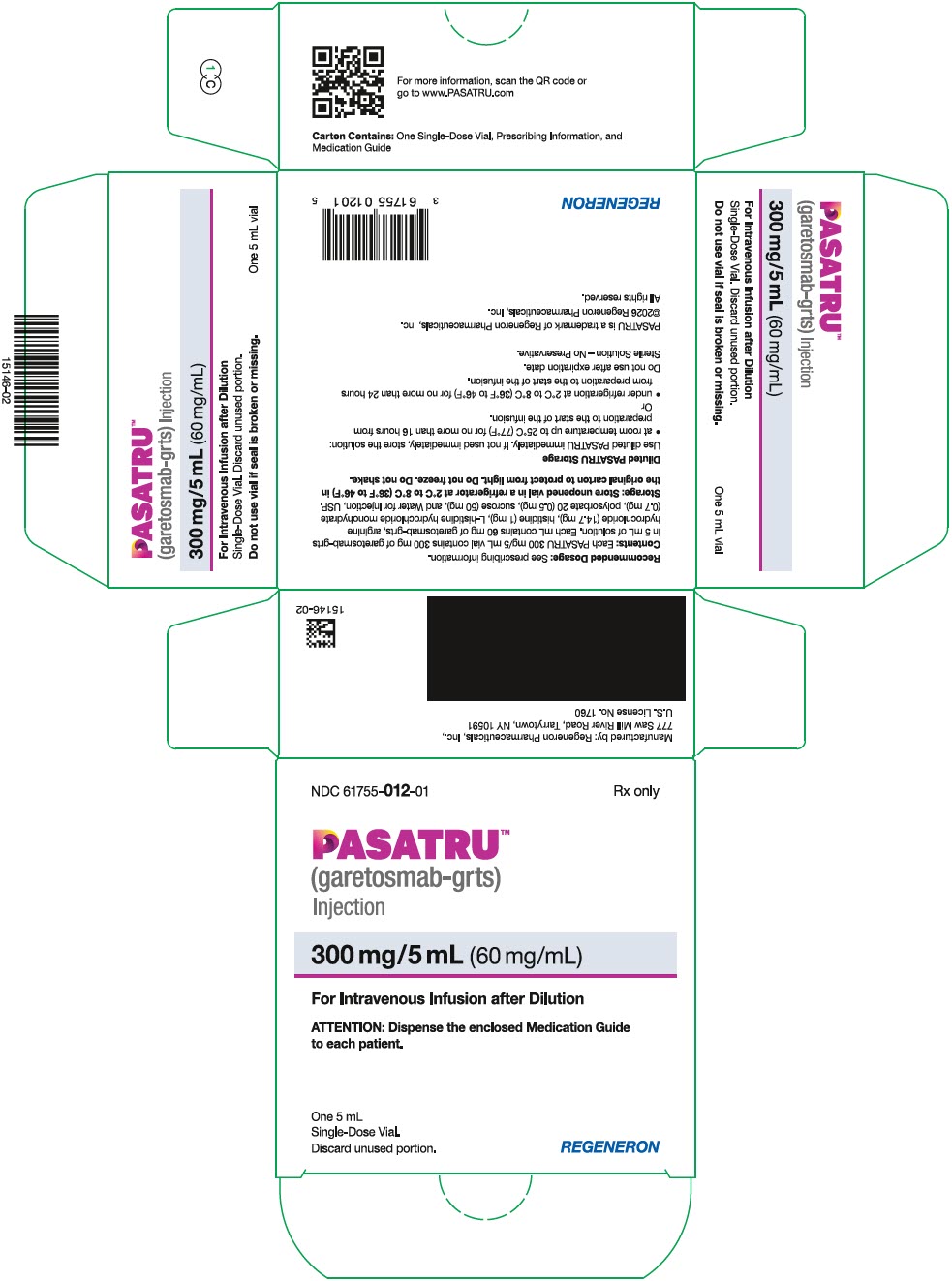
Principal Display Panel (Pasatru 01)
* Please review the disclaimer below.
