- Inject VEOPOZ into the abdomen, thigh, or upper arm. Rotate sites. Do not inject VEOPOZ into moles, scars, or areas where the skin is tender, bruised, red, hard, or not intact. When administering more than one injection, administer consecutively, each at different injection sites.
- Observe the patient for 30 minutes following completion of the first subcutaneous injection [see Warnings and Precautions (5.3)].
Storage of Subcutaneous Injection
Administer the subcutaneous injection within 4 hours of preparation.
Vital Signs:
Four patients reported elevated systolic and/or diastolic blood pressure readings above the normal range for age at multiple study visits.
Risk Summary
Although there are no data on VEOPOZ use in pregnant women to inform a drug-associated risk of major birth defects, miscarriage, or adverse maternal or fetal outcomes, monoclonal antibodies can be actively transported across the placenta.
In an animal reproduction study in monkeys, pozelimab-bbfg did not adversely affect embryofetal or postnatal development when administered from pregnancy confirmation through parturition at doses that produced exposure up to 3.3 to 3.8 times the predicted clinical exposures (on an AUC basis; see Data).
The estimated background risk of major birth defects and miscarriage for the indicated population is unknown. All pregnancies have a background risk of birth defect, loss, or other outcome. In the U.S. general population, the estimated background risk of major birth defects and miscarriage in clinically recognized pregnancies is 2 to 4% and 15 to 20%, respectively.
Data
Animal Data
In an enhanced pre- and postnatal development study, pregnant female monkeys were subcutaneously administered pozelimab-bbfg at doses of 5 or 50 mg/kg once weekly from confirmation of pregnancy (gestation day 20) through parturition (approximately gestation day 160). No adverse effects were observed on maintenance of pregnancy, pregnancy outcome, or on the development of offspring through postnatal day 90 at doses up to 3.3-3.8 times the predicted clinical exposures.
Risk Summary
There are no data on the presence of pozelimab-bbfg in either human or animal milk, the effects on the breastfed infant, or the effects on milk production. Endogenous maternal IgG and monoclonal antibodies are transferred into human milk. The effects of local gastrointestinal exposure and the extent of systemic exposure in the breastfed infant to pozelimab are unknown. The development and health benefits of breastfeeding should be considered along with the mother's clinical need for VEOPOZ and any potential adverse effects on the breastfed infant from VEOPOZ or from the underlying maternal condition.
Absorption
In healthy subjects, following subcutaneous injection of 600 mg, the bioavailability of pozelimab-bbfg is estimated as 51%. The median (range) time to reach peak concentration was 7 (3 to 7) days following a single subcutaneous injection of 300 mg or 600 mg in healthy subjects.
Distribution
In healthy adult subjects with a mean body weight of 70 kg, the mean (SD) volume of distribution following a single intravenous dose of 30 mg/kg was 3.3 (0.4) L. The mean (SD) apparent volume of distribution following a single subcutaneous injection of 300 mg and 600 mg was 6.0 (0.9) L and 8.6 (2.7) L, respectively.
Elimination
Pozelimab-bbfg is expected to be degraded into small peptides and amino acids via catabolic pathways in the same manner as endogenous IgG. Pozelimab-bbfg elimination is mediated via linear and non-linear pathways. At higher concentrations, pozelimab-bbfg elimination is primarily through the linear non-saturable proteolytic pathway, whereas at lower concentrations, the non-linear, saturable C5 target-mediated elimination predominates.
In healthy adult subjects, the median (range) terminal half-life of total pozelimab in serum was 13.5 (10.0, 17.2) days following a single 30 mg/kg dose administered as an intravenous infusion. The median (range) terminal half-life was 14.1 (8.6, 17.3) days following a single 600 mg subcutaneous injection.
In patients with CD55-deficient PLE, steady-state total pozelimab concentrations were reached at approximately 20 weeks following subcutaneous injection once weekly.
Specific Populations
Body Weight
Body weight was a significant covariate on the pharmacokinetics of pozelimab-bbfg.
Renal and Hepatic Impairment
Pozelimab-bbfg, a monoclonal antibody, is not likely to undergo renal or hepatic excretion.
Drug Interaction Studies
Drug interaction studies have not been conducted. Intravenous Immunoglobulin (IVIg) may interfere with the endosomal neonatal Fc receptor (FcRn) recycling mechanism of monoclonal antibodies such as pozelimab-bbfg, which may decrease serum pozelimab concentrations [see Drug Interactions (7.1)].
Carcinogenesis and Mutagenesis
Carcinogenicity studies have not been conducted with pozelimab-bbfg. The mutagenic potential of pozelimab-bbfg has not been evaluated; however, monoclonal antibodies are not expected to alter DNA or chromosomes.
Impairment of Fertility
Fertility studies have not been conducted with pozelimab-bbfg. In a 6-month toxicity study in sexually-mature male and female monkeys, pozelimab-bbfg had no adverse effects on histological or functional markers of reproductive function (e.g., estrous cyclicity, testicular volume, ejaculate amount, total sperm count per ejaculate, sperm motility and morphology, and histology of reproductive organs) at doses up to 100 mg/kg/week (11.9 to 13.9-fold the predicted exposures at the recommended clinical doses, on an AUC basis).
Serum Albumin Concentrations
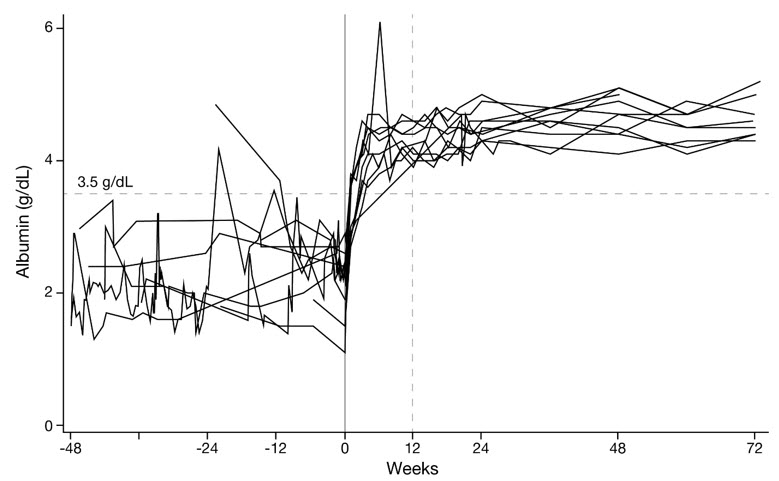
The median time for serum albumin to reach at least 3.5 g/dL was 15.5 days (N=10; 95% CI: 8 to 28). All 10 patients achieved normalization by Week 12 and maintained serum albumin concentrations within the normal range through at least 72 weeks of treatment (Figure 1).
Figure 1: Serum Albumin Concentrations from 48 Weeks Pre-Treatment Through 72 Weeks on VEOPOZ in Ten Patients with CD-55 Deficient PLE
Albumin Transfusions
Five of the 10 patients received a total of 60 transfusions in the 48 weeks prior to treatment. In the 48 weeks after starting treatment, one patient received one albumin transfusion.
Hospitalizations
Nine of the 10 patients were hospitalized for a total of 268 days in the 48 weeks prior to treatment. In the 48 weeks after starting treatment, two patients were hospitalized for a total of 7 days.
Additional Efficacy Results
Serum IgG concentrations reached normal values for age in all patients within the first 12 weeks of treatment; improvement was maintained through at least 72 weeks of treatment.
Meningococcal Infection
- Advise patients of the risk of meningococcal, and other bacterial infections.
- Inform patients of the need to complete or update meningococcal vaccination for both MenACWY and MenB at least 2 weeks prior to receiving the first dose of VEOPOZ and to be revaccinated according to current ACIP recommendations for meningococcal vaccines while on VEOPOZ therapy.
- Inform patients that vaccination may not prevent meningococcal infection.
- Inform patients of the signs and symptoms of meningococcal infection and advise patients to seek immediate medical attention if any signs or symptoms of infection occur [see Warnings and Precautions (5.1)].
Other Bacterial Infections, Including Gonococcal Infection
- Inform patients of the increased risk of other bacterial infections, particularly those due to encapsulated bacteria.
- Inform patients of the need to receive vaccinations according to the ACIP recommendations.
- Advise patients to report any new signs and symptoms of infection.
- Counsel patients about gonorrhea prevention and advise patients at risk (e.g., sexually active) to seek regular testing [see Warnings and Precautions (5.2)].
Systemic Hypersensitivity Reactions
Advise patients to notify the healthcare provider and seek immediate medical attention if they experience any symptoms of systemic hypersensitivity reactions [see Warnings and Precautions (5.3)].
Manufactured by:
Regeneron Pharmaceuticals, Inc.
777 Old Saw Mill River Road
Tarrytown, NY 10591-6707
U.S. License No. 1760
Marketed by:
Regeneron Pharmaceuticals, Inc. (Tarrytown, NY 10591)
©2023 Regeneron Pharmaceuticals, Inc.
All rights reserved.