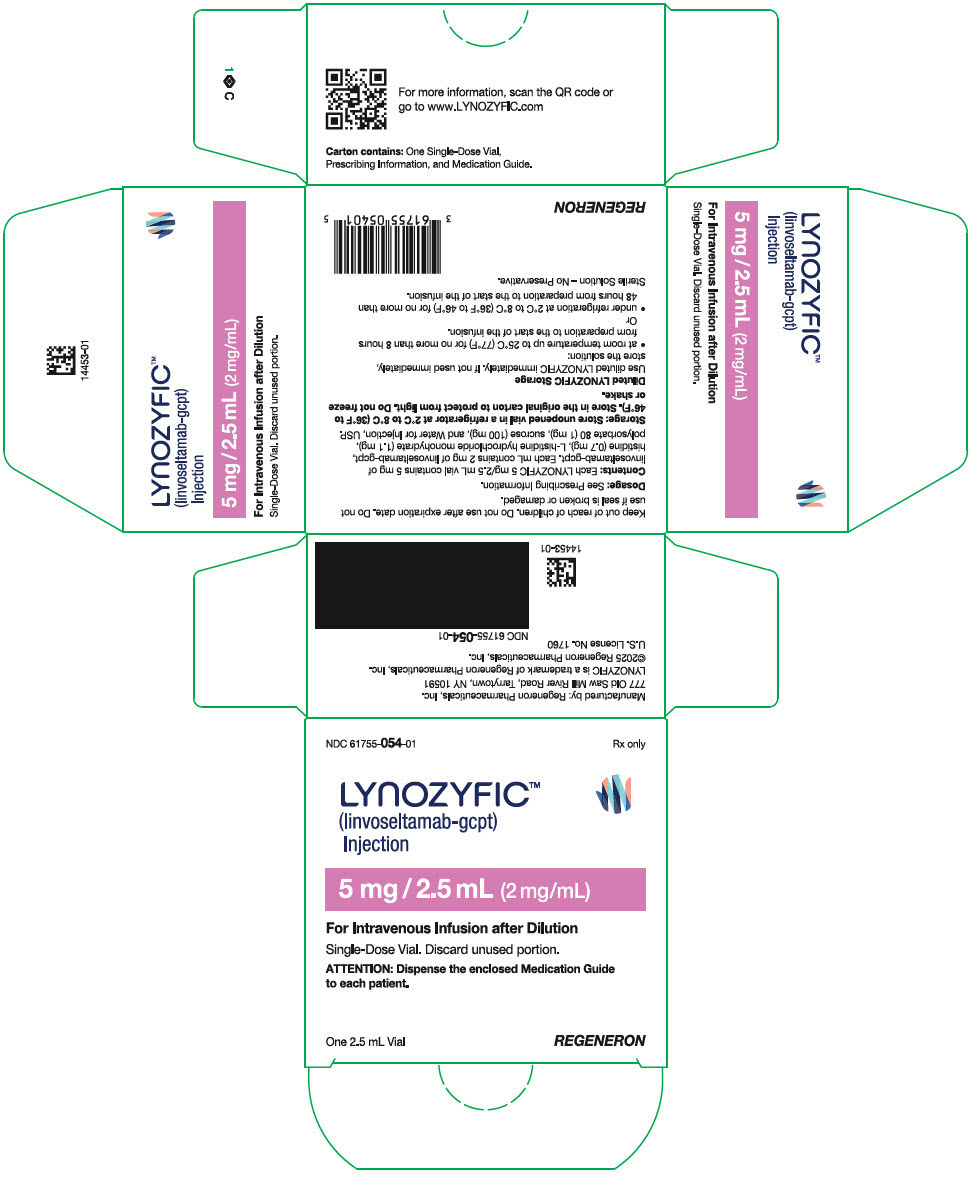
Do not freeze.
Do not shake.
- Administer as an intravenous infusion only.
- Refer to Dosage and Administration (2.2) for infusion rates.
- Connect the prepared intravenous infusion bag containing the final LYNOZYFIC solution to intravenous tubing constructed of PVC, polyethylene (PE)-lined PVC, or polyurethane (PU).
- Use of a 0.2-micron to 5-micron polyethersulfone (PES) filter is required.
- Prime with LYNOZYFIC to the end of the intravenous tubing.
- Do not mix LYNOZYFIC with other drugs or concurrently administer other drugs through the same intravenous line.
- Upon completion of LYNOZYFIC infusion, flush the infusion line with an adequate volume of sterile 0.9% Sodium Chloride Injection to ensure that the entire contents of the infusion bag are administered.
- Total infusion time should include flushing of the infusion line.
Infusion Related Reactions
Infusion-related reactions (IRR) may be clinically indistinguishable from manifestations of CRS. In the patients who were treated with the recommended step-up dosing regimen and pretreatment medications [see Dosage and Administration (2.2) and Dosage and Administration (2.3)], the rate of IRR was 9% [11/117 including Grade 2 IRR (4.3%) and Grade 3 IRR (1.7%)]. For IRR, interrupt or slow the rate of infusion or permanently discontinue LYNOZYFIC based on severity of reaction [see Dosage and Administration (2.5)].
LYNOZYFIC is available only through a restricted program under a REMS [see Warnings and Precautions (5.3)].
Relapsed or Refractory Multiple Myeloma
The safety of LYNOZYFIC was evaluated in LINKER-MM1 [see Clinical Studies (14)]. Patients (n=117) received LYNOZYFIC as step-up doses of 5 mg on Day 1 and 25 mg on Day 8, and the first treatment dose of 200 mg on Day 15. Patients then received 200 mg intravenously once weekly from Week 4 to Week 13, followed by 200 mg every 2 weeks from Week 14. In the Phase 2 portion of the study, patients who achieved and maintained VGPR or better at or after Week 24 and received at least 17 doses of 200 mg were able to receive every 4-week dosing. The median duration of treatment was 47 weeks (range 1, 151); 55% of patients were exposed for 9 months or longer and 36% were exposed for 1 year or longer.
The median age of patients who received LYNOZYFIC was 70 years (range: 37 to 91 years); 55% were male; 71% were White, 17% were Black or African American, and 9% were Asian.
Serious adverse reactions occurred in 74% of patients who received LYNOZYFIC. Serious adverse reactions that occurred in >5% of patients included cytokine release syndrome (27%), pneumonia (13%), COVID-19 (7%), and acute kidney injury (5%). Fatal adverse reactions occurred in 7% of patients, and included sepsis (3.4%), chronic kidney disease (0.9%), pneumonia (0.9%), tumor lysis syndrome (0.9%), and encephalopathy (0.9%).
Permanent discontinuation of LYNOZYFIC due to adverse reactions occurred in 16% of patients. Adverse reactions leading to discontinuation that occurred in at least 2 patients included sepsis, pneumonia, and encephalopathy.
Dosage interruptions or delays of LYNOZYFIC due to adverse reactions occurred in 74% of patients. Adverse reactions which required a dosage interruption or delay in >10% of patients included neutropenia (29%), upper respiratory tract infection (18%), pneumonia (15%), and COVID-19 infection (11%).
The most common adverse reactions (≥20%) were musculoskeletal pain, cytokine release syndrome, cough, upper respiratory tract infection, diarrhea, fatigue, pneumonia, nausea, headache, and dyspnea. The most common Grade 3 to 4 laboratory abnormalities (≥30%) were decreased lymphocyte count, decreased neutrophil count, decreased hemoglobin, and decreased white blood cell count.
Table 7 summarizes the adverse reactions in LINKER-MM1.
Table 7: Adverse Reactions (≥10%) in Patients with Relapsed or Refractory Multiple Myeloma Who Received LYNOZYFIC in LINKER-MM1| Adverse Reaction | LYNOZYFIC
(N=117) |
|---|
All Grades
(%) | Grade 3 or 4
(%) |
|---|
| Musculoskeletal and connective tissue disorders |
| Musculoskeletal pain Includes other related terms. | 53 | 3.4 Only Grade 3 adverse reactions occurred. |
| Immune system disorders |
| Cytokine release syndrome | 46 | 0.9 |
| Hypogammaglobulinemia | 13 | 0.9 |
| Respiratory, thoracic and mediastinal disorders |
| Cough | 39 | 0 |
| Dyspnea | 21 | 0.9 |
| Nasal congestion | 16 | 0 |
| Infections and infestations |
| Upper respiratory tract infection | 35 | 6 |
| Pneumonia Pneumonia includes atypical pneumonia, COVID-19 pneumonia, PJP, pneumonia, pneumonia cytomegaloviral, pneumonia fungal, pneumonia influenzal, and pneumonia viral. ,Includes fatal outcome. | 28 | 21 |
| COVID-19 | 17 | 5 |
| Urinary tract infections | 16 | 8 |
| Sepsis | 10 | 6 |
| Gastrointestinal disorders |
| Diarrhea | 35 | 1.7 |
| Nausea | 23 | 0 |
| Vomiting | 19 | 0 |
| Constipation | 17 | 0 |
| General disorders and administration site conditions |
| Fatigue | 34 | 0 |
| Edema | 19 | 0.9 |
| Pyrexia | 17 | 0 |
| Nervous system disorders |
| Headache | 22 | 0.9 |
| Encephalopathy, Encephalopathy includes agitation, amnesia, cognitive disorder, confusional state, delirium, depressed level of consciousness, encephalopathy (including hyperammonemic and toxic encephalopathy), irritability, lethargy, memory impairment, mental status changes, somnolence, and excludes ICANS. | 18 | 3.4 |
| Sensory Neuropathy | 13 | 0.9 |
| Metabolism and nutrition disorders |
| Decreased appetite | 15 | 0.9 |
| Skin and subcutaneous tissue disorders |
| Rash Rash includes dermatitis acneiform, dermatitis contact, drug eruption, erythema, rash, rash erythematous, rash maculo-papular, rash pruritic, and stasis dermatitis. | 15 | 1.7 |
| Psychiatric disorders |
| Insomnia | 13 | 0 |
| Vascular disorders |
| Hypertension | 10 | 4.3 |
Clinically significant adverse reactions that occurred in <10% of patients treated with LYNOZYFIC included IRR, motor dysfunction, febrile neutropenia, ICANS, CMV infection, and PML.
Table 8 summarizes the laboratory abnormalities in LINKER-MM1.
Table 8: Select Laboratory Abnormalities (≥5% for Grade 3 or 4) That Worsened from Baseline in Patients with Multiple Myeloma Treated with LYNOZYFIC in LINKER-MM1| Laboratory Abnormality | LYNOZYFIC
(N=117)The denominator used to calculate the rate varied from 106 to 117 based on the number of patients with a baseline value and at least one post-treatment value. |
|---|
| All Grades
(%) | Grades 3 or 4
(%) |
|---|
| Hematology |
| Lymphocyte count decreased | 97 | 92 |
| Hemoglobin decreased | 72 | 42 |
| Platelet count decreased | 64 | 19 |
| White blood cell count decreased | 63 | 31 |
| Neutrophil count decreased | 62 | 47 |
| Chemistry |
| Aspartate aminotransferase increased | 61 | 10 |
| Phosphorus decreased | 55 | 24 |
| Creatinine increased | 47 | 7 |
| Alanine aminotransferase increased | 46 | 6 |
Certain CYP substrates
Monitor for toxicity unless otherwise recommended in the Prescribing Information of certain CYP substrates where minimal changes in the concentration may lead to serious adverse reactions when used concomitantly with LYNOZYFIC.
Linvoseltamab-gcpt causes the release of cytokines [see Clinical Pharmacology (12.2)] that may suppress cytochrome P450 (CYP) enzyme activity. Concomitant use with LYNOZYFIC increases CYP substrate exposure which may increase the risk of adverse reactions related to these substrates. Increased CYP substrate exposure is more likely to occur from initiation of the LYNOZYFIC step-up dosing schedule up to 14 days after the first 200 mg dose, and during and after CRS [see Warnings and Precautions (5.1)].
Risk Summary
Based on the mechanism of action, LYNOZYFIC may cause fetal harm when administered to a pregnant woman [see Clinical Pharmacology (12.1)]. There are no available data on the use of LYNOZYFIC in pregnant women to evaluate for a drug associated risk. No animal reproductive or developmental toxicity studies have been conducted with LYNOZYFIC.
Linvoseltamab-gcpt causes T-cell activation and cytokine release; immune activation may compromise pregnancy maintenance. In addition, based on the finding of B-cell depletion in non-pregnant animals, linvoseltamab-gcpt can cause B-cell lymphocytopenia in infants exposed to linvoseltamab-gcpt in-utero. Human immunoglobulin (IgG) is known to cross the placenta after the first trimester of pregnancy; therefore, linvoseltamab-gcpt has the potential to be transmitted from the mother to the developing fetus. Advise women of the potential risk to the fetus.
LYNOZYFIC is associated with hypogammaglobulinemia, therefore, assessment of immunoglobulin levels in newborns of mothers treated with LYNOZYFIC should be considered.
In the U.S. general population, the estimated background risk of major birth defects and miscarriage in clinically recognized pregnancies is 2% to 4% and 15% to 20%, respectively.
Risk Summary
There are no data on the presence of linvoseltamab-gcpt in human milk, the effects on the breastfed child, or the effects on milk production. Maternal IgG is known to be present in human milk.
Because of the potential for serious adverse reactions in a breastfed child, advise women not to breastfeed during treatment with LYNOZYFIC and for 3 months after the last dose.
Pregnancy Testing
Verify the pregnancy status of females of reproductive potential prior to initiating treatment with LYNOZYFIC.
Contraception
Females
Advise females of reproductive potential to use effective contraception during treatment and for 3 months after the last dose of LYNOZYFIC.
Effect on Circulating Cytokines
Transient elevation of circulating cytokines (IL-2, IL-6, and IFN-γ) was primarily observed during the step-up dose regimen and the first full 200 mg dose. The highest elevation of cytokines was generally observed 4 hours after each infusion and generally returned to baseline prior to the next dose. Limited cytokine release was observed following subsequent doses.
Distribution
Linvoseltamab-gcpt volume of distribution (Vd) is 7.05 L (33.6%).
Elimination
Linvoseltamab-gcpt clearance is 0.68 L/day (52.2%) at baseline and 0.43 L/day (83.8%) at steady state.
Linvoseltamab-gcpt clearance decreases over time because its elimination is mediated by two parallel processes: a linear, non-saturable catabolic process and a nonlinear, saturable target-mediated pathway. Patients who discontinue linvoseltamab-gcpt are expected to have a 97% reduction from Cmax at a median (5th to 95th percentile) time of 77.7 (18 to 154) days after last dose.
Metabolism
Linvoseltamab-gcpt is expected to be metabolized into small peptides by catabolic pathways.
Specific Populations
No clinically significant differences in the pharmacokinetics of linvoseltamab-gcpt were observed based on age (37 to 91 years), weight (44 to 172 kg), sex, race (White, Asian, or Black), ethnicity (Hispanic/Latino or not Hispanic/Latino), mild to moderate renal impairment (creatinine clearance [CrCL] 30 to 89 mL/min, by Cockcroft-Gault [C-G] equation), or mild hepatic impairment (total bilirubin less than or equal to upper limit of normal [ULN] with AST greater than ULN or total bilirubin greater than 1 to 1.5 times ULN with any AST).
The effect of severe renal impairment (CrCL 15 to 29 mL/min), end-stage renal disease (CrCL less than 15 mL/min), and moderate to severe hepatic impairment (total bilirubin greater than 1.5 times ULN with any AST) on the pharmacokinetics of linvoseltamab-gcpt is unknown.
Cytokine Release Syndrome (CRS)
Advise patients that they should be hospitalized for 24 hours after administration of the first and second step-up doses of LYNOZYFIC [see Dosage and Administration (2.2)]. Inform patients of the risk of CRS, and discuss the signs and symptoms associated with CRS, including fever, chills, hypoxia, tachycardia, and hypotension. Counsel patients to seek immediate medical attention should signs or symptoms of CRS occur at any time [see Warnings and Precautions (5.1)].
Neurologic Toxicity, including Immune Effector Cell-Associated Neurotoxicity Syndrome
Discuss the signs and symptoms associated with neurologic toxicity, including ICANS, including confusion, depressed level of consciousness, and lethargy. Advise patients to immediately contact their healthcare provider if they experience any signs or symptoms of neurologic toxicity. Advise patients to refrain from driving, or operating heavy or potentially dangerous machinery, for 48 hours after completion of each of the step-up doses or if they experience new onset of neurologic toxicity symptoms until the symptoms resolve [see Warnings and Precautions (5.2)].
LYNOZYFIC REMS
LYNOZYFIC is available only through a restricted program called the LYNOZYFIC REMS. Inform patients that they will be given a Patient Wallet Card that they should carry with them at all times and show to all of their healthcare providers. This card describes symptoms of CRS and neurologic toxicity, including ICANS which, if experienced, should prompt the patient to seek immediate medical attention [see Warnings and Precautions (5.3)].
Infections
Advise patients of the risk of serious infections. Instruct patients to immediately report infection-related signs or symptoms of infection (e.g., fever, chills, weakness) [see Warnings and Precautions (5.4)].
Neutropenia
Discuss the signs and symptoms associated with neutropenia and febrile neutropenia [see Warnings and Precautions (5.5)].
Hepatotoxicity
Advise patients that liver enzymes elevations may occur and that they should report symptoms that may indicate liver toxicity, including fatigue, anorexia, right upper abdominal discomfort, dark urine, or jaundice [see Warnings and Precautions (5.6)].
Embryo-Fetal Toxicity
Advise pregnant women and females of reproductive potential of the potential risk to a fetus. Advise females of reproductive potential to inform their healthcare provider if they are pregnant or become pregnant. Advise females of reproductive potential to use effective contraception during treatment with LYNOZYFIC and for 3 months after the last dose [see Warnings and Precautions (5.7), Use in Specific Populations (8.1, 8.3)].
Lactation
Advise women not to breastfeed during treatment with LYNOZYFIC and for 3 months after the last dose [see Use in Specific Populations (8.2)].
Manufactured by:
Regeneron Pharmaceuticals, Inc.
777 Old Saw Mill River Road
Tarrytown, NY 10591-6707
U.S. License No. 1760
LYNOZYFIC is a trademark of Regeneron Pharmaceuticals, Inc.
©2025 Regeneron Pharmaceuticals, Inc.
All rights reserved.