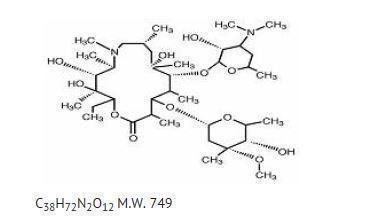
12.1 Mechanism of Action
Azithromycin is a macrolide antibacterial drug [see Microbiology (12.4)].
12.2 Pharmacodynamics
Based on animal models of infection, the antibacterial activity of azithromycin appears to correlate with the ratio of area under the concentration-time curve to minimum inhibitory concentration (AUC/MIC) for certain pathogens (S. pneumoniae and S. aureus). The principal pharmacokinetic/pharmacodynamic parameter best associated with clinical and microbiological cure has not been elucidated in clinical trials with azithromycin.
Cardiac Electrophysiology
QTc interval prolongation was studied in a randomized, placebo-controlled parallel trial in 116 healthy subjects who received either chloroquine (1000 mg) alone or in combination with oral azithromycin (500 mg, 1000 mg, and 1500 mg once daily). Coadministration of azithromycin increased the QTc interval in a dose-and concentration-dependent manner. In comparison to chloroquine alone, the maximum mean (95% upper confidence bound) increases in QTcF were 5 (10) ms, 7 (12) ms and 9 (14) ms with the coadministration of 500 mg, 1000 mg and 1500 mg azithromycin, respectively.
12.3 Pharmacokinetics
Following oral administration of a single 500 mg dose (two 250 mg tablets) to 36 fasted healthy male volunteers, the mean (SD) pharmacokinetic parameters were AUC0-72 = 4.3 (1.2) mcg·h/mL; Cmax= 0.5 (0.2) mcg/mL; Tmax = 2.2 (0.9) hours. Two azithromycin 250 mg tablets are bioequivalent to a single 500 mg tablet.
In a two-way crossover study, 12 adult healthy volunteers (6 males, 6 females) received 1500 mg of azithromycin administered in single daily doses over either 5 days (two 250 mg tablets on day 1, followed by one 250 mg tablet on days 2 to 5) or 3 days (500 mg per day for days 1 to 3). Due to limited serum samples on day 2 (3 day regimen) and days 2 to 4 (5 day regimen), the serum concentration-time profile of each subject was fit to a 3 compartment model and the AUC0-∞ for the fitted concentration profile was comparable between the 5 day and 3 day regimens.
3 Day Regimen
5 Day Regimen
Pharmacokinetic Parameter [mean (SD)]
Day 1
Day 3
Day 1
Day 5
Cmax (serum, mcg/mL)
0.44 (0.22)
0.54 (0.25)
0.43 (0.20)
0.24 (0.06)
Serum AUC0-∞ (mcg·hr/mL)
17.4 (6.2)*
14.9 (3.1)*
Serum T1/2
71.8 hr
68.9 hr
*Total AUC for the entire 3 day and 5 day regimens.
Absorption
The absolute bioavailability of azithromycin 250 mg capsules is 38%.
In a two-way crossover study in which 12 healthy subjects received a single 500 mg dose of azithromycin (two 250 mg tablets) with or without a high fat meal, food was shown to increase Cmax by 23% but had no effect on AUC.
When azithromycin oral suspension was administered with food to 28 adult healthy male subjects, Cmax increased by 56% and AUC was unchanged.
Distribution
The serum protein binding of azithromycin is variable in the concentration range approximating human exposure, decreasing from 51% at 0.02 mcg/mL to 7% at 2 mcg/mL.
The antibacterial activity of azithromycin is pH related and appears to be reduced with decreasing pH, However, the extensive distribution of drug to tissues may be relevant to clinical activity.
Azithromycin has been shown to penetrate into human tissues, including skin, lung, tonsil, and cervix. Extensive tissue distribution was confirmed by examination of additional tissues and fluids (bone, ejaculum, prostate, ovary, uterus, salpinx, stomach, liver, and gallbladder). As there are no data from adequate and well-controlled studies of azithromycin treatment of infections in these additional body sites, the clinical significance of these tissue concentration data is unknown.
Following a regimen of 500 mg on the first day and 250 mg daily for 4 days, very low concentrations were noted in cerebrospinal fluid (less than 0.01 mcg/mL) in the presence of noninflamed meninges.
Metabolism
In vitro and in vivo studies to assess the metabolism of azithromycin have not been performed.
Elimination
Plasma concentrations of azithromycin following single 500 mg oral and IV doses declined in a polyphasic pattern resulting in a mean apparent plasma clearance of 630 mL/min and terminal elimination half-life of 68 hours. The prolonged terminal half-life is thought to be due to extensive uptake and subsequent release of drug from tissues. Biliary excretion of azithromycin, predominantly as unchanged drug, is a major route of elimination. Over the course of a week, approximately 6% of the administered dose appears as unchanged drug in urine.
Specific Populations
Renal Insufficiency
Azithromycin pharmacokinetics was investigated in 42 adults (21 to 85 years of age) with varying degrees of renal impairment. Following the oral administration of a single 1 g dose of azithromycin (4 x 250 mg capsules), mean Cmax and AUC0-120 increased by 5.1% and 4.2%, respectively, in subjects with mild to moderate renal impairment (GFR 10 to 80 mL/min) compared to subjects with normal renal function (GFR > 80 mL/min). The mean Cmax and AUC0-120 increased 61% and 35%, respectively, in subjects with severe renal impairment (GFR < 10 mL/min) compared to subjects with normal renal function (GFR > 80 mL/min).
Hepatic Insufficiency
The pharmacokinetics of azithromycin in subjects with hepatic impairment has not been established.
Gender
There are no significant differences in the disposition of azithromycin between male and female subjects. No dosage adjustment is recommended based on gender.
Geriatric Patients
Pharmacokinetic parameters in older volunteers (65 to 85 years old) were similar to those in young adults (18 to 40 years old) for the 5 day therapeutic regimen. Dosage adjustment does not appear to be necessary for older patients with normal renal and hepatic function receiving treatment with this dosage regimen [see Geriatric Use (8.5)].
Pediatric Patients
In two clinical studies, azithromycin for oral suspension was dosed at 10 mg/kg on day 1, followed by 5 mg/kg on days 2 through 5 in two groups of pediatric patients (aged 1 to 5 years and 5 to 15 years, respectively). The mean pharmacokinetic parameters on day 5 were Cmax = 0.216 mcg/mL, Tmax = 1.9 hours, and AUC0-24 = 1.822 mcg·hr/mL for the 1 to 5 year-old group and were Cmax = 0.383 mcg/mL, Tmax = 2.4 hours, and AUC0-24 = 3.109 mcg·hr/mL for the 5 to 15 year-old group.
In another study, 33 pediatric patients received doses of 12 mg/kg/day (maximum daily dose 500 mg) for 5 days, of whom 31 patients were evaluated for azithromycin pharmacokinetics following a low fat breakfast. In this study, azithromycin concentrations were determined over a 24 hour period following the last daily dose. Patients weighing above 41.7 kg received the maximum adult daily dose of 500 mg. Seventeen patients (weighing 41.7 kg or less) received a total dose of 60 mg/kg. The following table shows pharmacokinetic data in the subset of pediatric patients who received a total dose of 60 mg/kg.
Pharmacokinetic Parameter [mean (SD)]
5 Day Regimen (12 mg/kg for 5 days)
N
17
Cmax (mcg/mL)
0.5 (0.4)
Tmax (hr)
2.2 (0.8)
AUC0-24(mcg⋅hr/mL)
3.9 (1.9)
Single dose pharmacokinetics of azithromycin in pediatric patients given doses of 30 mg/kg have not been studied [see Dosage and Administration (2)].
Drug interaction studies were performed with azithromycin and other drugs likely to be coadministered. The effects of coadministration of azithromycin on the pharmacokinetics of other drugs are shown in Table 1 and the effects of other drugs on the pharmacokinetics of azithromycin are shown in Table 2.
Coadministration of azithromycin at therapeutic doses had a modest effect on the pharmacokinetics of the drugs listed in Table 1. No dosage adjustment of drugs listed in Table 1 is recommended when coadministered with azithromycin.
Coadministration of azithromycin with efavirenz or fluconazole had a modest effect on the pharmacokinetics of azithromycin. Nelfinavir significantly increased the Cmax and AUC of azithromycin. No dosage adjustment of azithromycin is recommended when administered with drugs listed in Table 2[see Drug Interactions (7.3)].
Table 1. Drug Interactions: Pharmacokinetic Parameters for Coadministered Drugs in the Presence of Azithromycin
Coadministered Drug
Dose of Coadministered Drug
Dose of Azithromycin
n
Ratio (with/without azithromycin) of Coadministered Drug Pharmacokinetic Parameters (90% CI); No Effect = 1
Mean Cmax
Mean AUC
Atorvastatin
10 mg/day for 8 days
500 mg/day orally on days 6 to 8
12
0.83
(0.63 to 1.08)
1.01
(0.81 to 1.25)
Carbamazepine
200 mg/day for 2 days, then 200 mg twice a day for 18 days
500 mg/day orally for days 16 to 18
7
0.97
(0.88 to 1.06)
0.96
(0.88 to 1.06)
Cetirizine
20 mg/day for 11 days
500 mg orally on day 7, then 250 mg/day on days 8 to 11
14
1.03
(0.93 to 1.14)
1.02
(0.92 to 1.13)
Didanosine
200 mg orally twice a day for 21 days
1200 mg/day orally on days 8 to 21
6
1.44
(0.85 to 2.43)
1.14
(0.83 to 1.57)
Efavirenz
400 mg/day for 7 days
600 mg orally on day 7
14
1.04*
0.95*
Fluconazole
200 mg orally single dose
1200 mg orally single dose
18
1.04
(0.98 to 1.11)
1.01
(0.97 to 1.05)
Indinavir
800 mg three times a day for 5 days
1200 mg orally on day 5
18
0.96
(0.86 to 1.08)
0.90
(0.81 to 1)
Midazolam
15 mg orally on day 3
500 mg/day orally for 3 days
12
1.27
(0.89 to 1.81)
1.26
(1.01 to 1.56)
Nelfinavir
750 mg three times a day for 11 days
1200 mg orally on day 9
14
0.90
(0.81 to 1.01)
0.85
(0.78 to 0.93)
Sildenafil
100 mg on days 1 and 4
500 mg/day orally for 3 days
12
1.16
(0.86 to 1.57)
0.92
(0.75 to 1.12)
Theophylline
4 mg/kg IV on days 1, 11, 25
500 mg orally on day 7, 250 mg/day on days 8 to 11
10
1.19
(1.02 to 1.40)
1.02
(0.86 to 1.22)
Theophylline
300 mg orally twice a day for 15 days
500 mg orally on day 6, then 250 mg/day on days 7 to 10
8
1.09
(0.92 to 1.29)
1.08
(0.89 to 1.31)
Triazolam
0.125 mg on day 2
500 mg orally on day 1, then 250 mg/day on day 2
12
1.06*
1.02*
Trimethoprim/ Sulfamethoxazole
160 mg/800 mg/day orally for 7 days
1200 mg orally on day 7
12
0.85
(0.75 to 0.97)/
0.90
(0.78 to 1.03)
0.87
(0.80 to 0.95)/ 0.96
(0.88 to 1.03)
Zidovudine
500 mg/day orally for 21 days
600 mg/day orally for 14 days
5
1.12
(0.42 to 3.02)
0.94
(0.52 to 1.70)
Zidovudine
500 mg/day orally for 21 days
1200 mg/day orally for 14 days
4
1.31
(0.43 to 3.97)
1.30
(0.69 to 2.43)
* -90% Confidence interval not reported
Table 2. Drug Interactions: Pharmacokinetic Parameters for Azithromycin in the Presence of Coadministered Drugs [see Drug Interactions (7)].
Coadministered Drug
Dose of Coadministered Drug
Dose of Azithromycin
n
Ratio (with/without coadministered drug) of Azithromycin Pharmacokinetic Parameters (90% CI); No Effect = 1
Mean Cmax
Mean AUC
Efavirenz
400 mg/day for 7 days
600 mg orally on day 7
14
1.22
(1.04 to 1.42)
0.92*
Fluconazole
200 mg orally single dose
1200 mg orally single dose
18
0.82
(0.66 to 1.02)
1.07
(0.94 to 1.22)
Nelfinavir
750 mg three times a day for 11 days
1200 mg orally on day 9
14
2.36
(1.77 to 3.15)
2.12
(1.80 to 2.50)
* -90% Confidence interval not reported
12.4 Microbiology
Mechanism of Action
Azithromycin acts by binding to the 50S ribosomal subunit of susceptible microorganisms and interferes with bacterial protein synthesis. Nucleic acid synthesis is not affected.
Cross Resistance
Azithromycin demonstrates cross resistance with erythromycin resistant Gram positive isolates.
Azithromycin has been shown to be active against most isolates of the following bacteria, both in vitro and in clinical [see Indications and Usage (1)].
Gram-Positive Bacteria
Staphylococcus aureus Streptococcus agalactiae Streptococcus pneumoniae Streptococcus pyogenes
Gram-Negative Bacteria
Haemophilus ducreyi Haemophilus influenzae Moraxella catarrhalis Neisseria gonorrhoeae
Other Bacteria
Chlamydophila pneumoniae Chlamydia trachomatis Mycoplasma pneumoniae
The following in vitro data are available, but their clinical significance is unknown. Azithromycin exhibits in vitro minimal inhibitory concentrations (MICs) of 4 mcg/ml or less against most (≥ 90%) isolates of the following bacteria; however, the safety and effectiveness of azithromycin in treating clinical infections due to these bacteria have not been established in adequate and well-controlled trials.
Gram-Positive Bacteria
Beta-hemolytic streptococci (Groups C, F, G) Viridans group streptococci
Gram-Negative Bacteria
Bordetella pertussis Legionella pneumophila
Anaerobic Bacteria
Prevotella bivia Peptostreptococcus species
Other Bacteria
Ureaplasma urealyticum
Susceptibility Testing Methods
When available, the clinical microbiology laboratory should provide the results of in vitro susceptibility test results for antibacterial drugs used in resident hospitals to the physician as periodic reports that describe the susceptibility profile of nosocomial and community-acquired pathogens. These reports should aid the physician in selecting an antibacterial drug product for treatment.
Dilution Techniques
Quantitative methods are used to determine minimal inhibitory concentrations (MICs). These MICs provide estimates of the susceptibility of bacteria to antibacterial compounds. The MICs should be determined using a standardized test method1,2,3 (broth or agar). The MIC values should be interpreted according to criteria provided in Table 1.
Diffusion Techniques
Quantitative methods that require measurement of zone diameters can also provide reproducible estimates of the susceptibility of bacteria to antibacterial compounds. The zone size provides an estimate of the susceptibility of bacteria to antibacterial compounds. The zone size should be determined using a standardized method2,3. This procedure uses paper disk impregnated with 15 mcg azithromycin to test the susceptibility of bacteria to azithromycin. The disk diffusion interpretive criteria are provided in Table 1.
Table 1: Susceptibility Test Interpretive Criteria for Azithromycina
Pathogen
Minimum Inhibitory Concentrations (mcg/mL)
Disk Diffusion
(zone diameters in mm)
S
I
R
S
I
R
Haemophilus influenzaeb
≤ 4
--
--
≥ 12
--
--
Staphylococcus aureus
≤ 2
4
≥ 8
≥ 18
14 to 17
≤ 13
Streptococci including S. pneumoniae
≤ 0.5
1
≥ 2
≥ 18
14 to 17
≤ 13
aClarithromycin is used for susceptibility testing due to its better solubility
bInsufficient information is available to determine Intermediate or Resistant interpretive criteria
The ability to correlate MIC values and plasma drug levels is difficult as azithromycin concentrates in macrophages and tissues [see Clinical Pharmacology (12)].
A report of “Susceptible” indicates that the pathogen is likely to inhibit growth of the pathogen if the antibacterial compound reaches the concentration at the infection site necessary to inhibit growth of the pathogen. A report of “Intermediate” indicates that the result should be considered equivocal, and if the microorganism is not fully susceptible to alternative clinically feasible drugs, the test should be repeated. This category implies possible clinical applicability in body sites where the drug is physiologically concentrated. This category also provides a buffer zone that prevents small uncontrolled technical factors from causing major discrepancies in interpretation. A report of “Resistant” indicates that the antibacterial is not likely to inhibit growth of the pathogen if the antibacterial compound reaches the concentrations usually achievable at the infection site; other therapy should be selected.
Quality Control
Standardized susceptibility test procedures require the use of laboratory controls to monitor and ensure the accuracy and precision of supplies and reagents used in the assay, and the techniques of the individuals performing the test1,2,3. Standard azithromycin powder should provide the following range of MIC values provided in Table 2. For the diffusion technique using the 15 mcg azithromycin disk the criteria provided in Table 2 should be achieved.
Table 2: Acceptable Quality Control Ranges for Susceptibility Testing
Quality Control Organism
Minimum Inhibitory Concentrations
(mcg/mL)
Disk Diffusion (zone diameters in mm)
Staphylococcus aureus
ATCC* 25923
Not Applicable
21 to 26
Staphylococcus aureus
ATCC 29213
0.5 to 2
Not Applicable
Haemophilus influenza
ATCC 49247
1 to 4
13 to 21
Streptococcus pneumoniae
ATCC 49619
0.06 to 0.25
19 to 25
*ATCC = American Type Culture Collection