Doxycycline
Product Images NDC 61919-474

View Photos of Packaging, Regulatory Labels, and Product Appearance

Product Visual Gallery

This gallery contains 14 technical images submitted to the FDA as part of the official labeling for Doxycycline (NDC 61919-474). Unlike standard consumer photos, these assets often include clinical data figures, molecular chemical structures, and official manufacturer packaging layouts.

As provided by Direct Rx, these visuals offer a comprehensive scientific overview of the product's physical and chemical identity, aiding pharmacists and researchers in product verification and study.

FDA Label Image

Image Description (Label)

Image Description (Label)
The text provided contains details regarding the antibiotic medication Doxycycline, available in the form of tablets of 100 mg strength. The text further mentions the drug's generic variant - ADOXA and lists its main active ingredient as Doxycycline monohydrate. However, the text lacks clarity due to multiple errors and is difficult to understand fully.*
FDA Label Image

Image Description (Molecule)

FDA Label Image

Image Description (Table1 1)

FDA Label Image

Image Description (Table1)

Image Description (Table1)
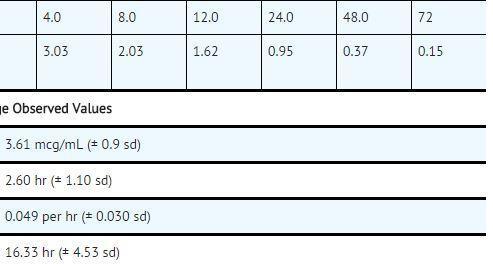
This is a data table showing different concentrations of a substance at different time points. The values are in units of meg/mL. The table also includes fields for calculating the average, maximum concentration, time of maximum concentration, elimination rate constant, and half-life. No further context or information is available.*
FDA Label Image

Image Description (Table2 1)

Image Description (Table2 1)
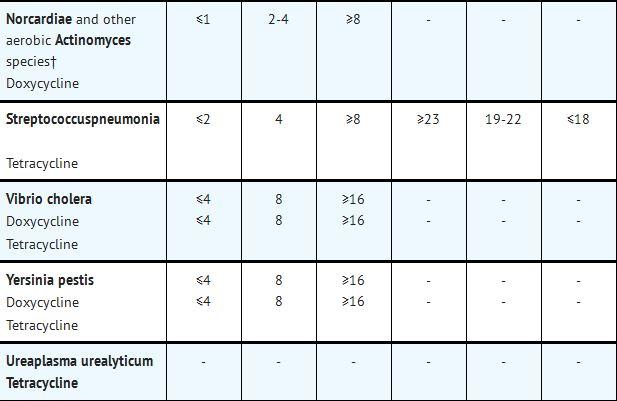
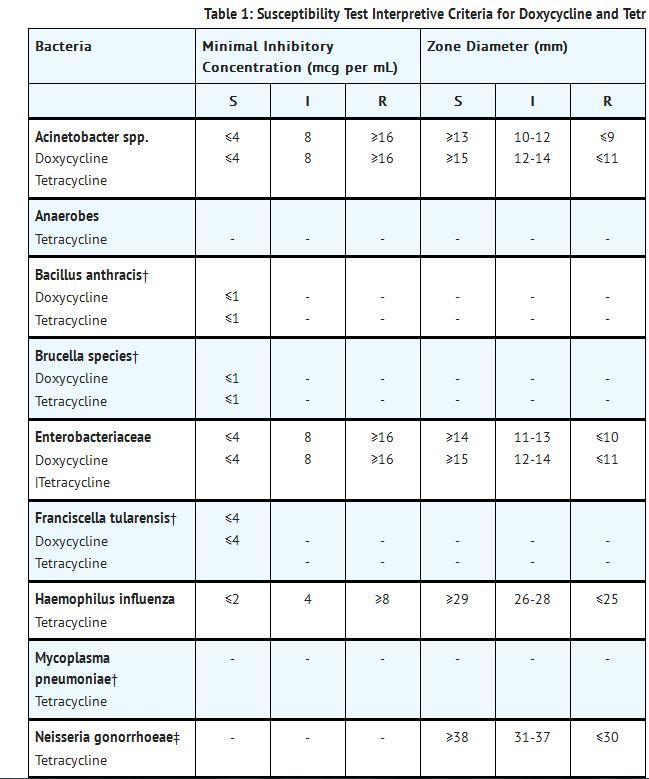
This appears to be a list of bacterial species and their susceptibility to the antibiotics doxycycline and tetracycline. The list includes Norcardiae, Actinomyces, Streptococcus pneumoniae, Vibrio cholera, Yersinia pestis, and Ureaplasma urealyticum. The effectiveness of the antibiotics varies for each species.*
FDA Label Image

Image Description (Table2 2)

FDA Label Image

Image Description (Table2 3)

FDA Label Image

Image Description (Table2)

FDA Label Image

Image Description (Table3)

Image Description (Table3)
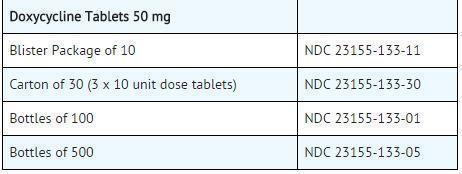
Doxycycline Tablets 50 mg available in blister packages of 10, cartons of 30 (3 x 10 unit dose tablets), bottles of 100, and bottles of 500. NDC codes provided for each package size.*
FDA Label Image

Image Description (Table4)

Image Description (Table4)
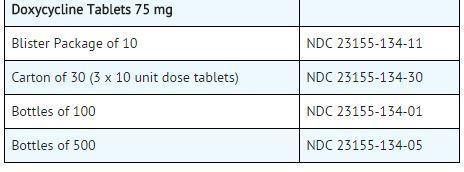
Doxycycline Tablets 75 mg are available in blister packs of 10, cartons of 30 (5 x 10 unit dose tablets), bottles of 100, and bottles of 500. The NDC codes for each packaging size are listed.*
FDA Label Image

Image Description (Table5)

Image Description (Table5)
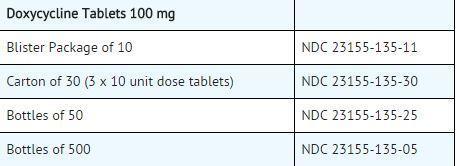
Doxycycline Tablets 100 mg are available in various packaging options including blister packages of 10, cartons of 30 (3 x 10 unit dose tablets), bottles of 50, and bottles of 500. They are identified by NDC codes 23155-135-11, 23155-135-30, 23155-135-25, and 23155-135-05.*
FDA Label Image

Image Description (Table6)

Image Description (Table6)
Doxycycline Tablets are available in various packaging including blister packages of 10, cartons of 30 (3 x 10 unit dose tablets), bottles of 30, and bottles of 500. The tablets have a strength of 150 mg each. The NDC codes for each package size are provided.*
FDA Label Image

Image Description (Table7 1)

Image Description (Table7 1)
This text appears to be a list of four bacterial strains (Bacteroides fragilis ATCC 0125-05 25285, Bacteroides thetaiotaomicron ATCC 29741, Mycoplasma pneumoniae 006-05 ATCC 29342, and Ureaplasma urealyticum ATCC 33175) and the antibiotic Tetracycline.*
FDA Label Image

Image Description (Table7)

Image Description (Table7)
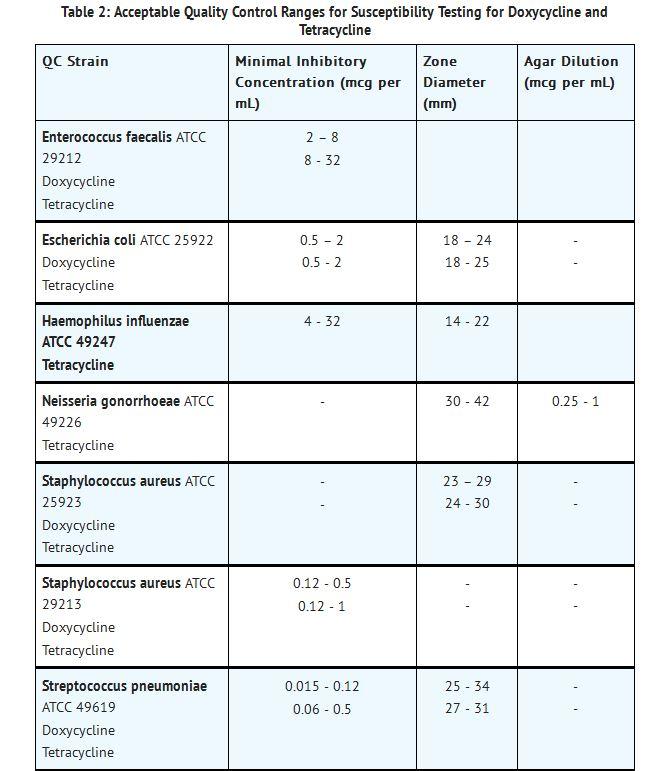
This appears to be a table outlining the acceptable quality control ranges for susceptibility testing for the antibiotics Doxycycline and Tetracycline in several strains of bacteria, such as Enterococcus faecalis ATCC, Escherichia coli ATCC, Haemophilus influenzae ATCC, Neisseria gonorrhoeae ATCC, Staphylococcus aureus ATCC, and Streptococcus pneumoniae ATCC. The table features two methods of testing, minimal inhibitory zone diameter, and agar dilution concentration, and displays the acceptable ranges for each method.*

* These product label images have been analyzed using experimental machine learning. Please verify findings with the primary label text.