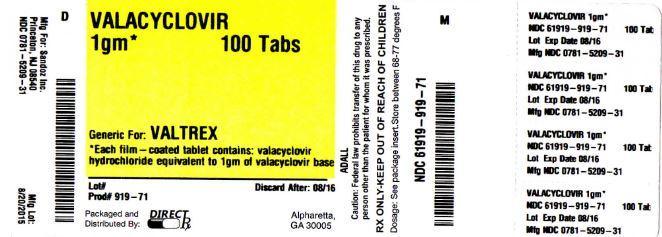
Other
These highlights do not include all the information needed to use valacyclovir tablets, USP safely and effectively. See full prescribing information for valacyclovir tablets, USP.
Valacyclovir Tablets, USP for oral use
Initial U.S. Approval: 1995
RECENT MAJOR CHANGES
Warnings and Precautions, Central Nervous System Effects (5.3) 3/2010
INDICATIONS AND USAGE
Valacyclovir tablets, USP are nucleoside analogue DNA polymerase inhibitor indicated for:
Adult Patients (1.1)
Cold Sores (Herpes Labialis)
Genital Herpes
Treatment in immunocompetent patients (initial or recurrent episode)
Suppression in immunocompetent or HIV-infected patients
Reduction of transmission
Herpes Zoster
Pediatric Patients (1.2)
Cold Sores (Herpes Labialis)
Chickenpox
Limitations of Use (1.3)
The efficacy and safety of valacyclovir tablets, USP have not been established in immunocompromised patients other than for the suppression of genital herpes in HIV-infected patients.
Valacyclovir oral suspension (25 mg/mL or 50 mg/mL) can be prepared from the 500 mg valacyclovir tablets, USP.
DOSAGE FORMS AND STRENGTHS
Tablets: 500 mg (unscored), 1 gram (partially scored) (3)
CONTRAINDICATIONS
Hypersensitivity to valacyclovir (e.g., anaphylaxis), acyclovir, or any component of the formulation. (4)
WARNINGS AND PRECAUTIONS
Thrombotic thrombocytopenic purpura/hemolytic uremic syndrome (TTP/HUS): Has occurred in patients with advanced HIV disease and in allogenic bone marrow transplant and renal transplant patients receiving 8 grams per day of valacyclovir tablets in clinical trials. Discontinue treatment if clinical symptoms and laboratory findings consistent with TTP/HUS occur. ( 5.1)
Acute renal failure: May occur in elderly patients (with or without reduced renal function), patients with underlying renal disease who receive higher than recommended doses of valacyclovir tablets for their level of renal function, patients who receive concomitant nephrotoxic drugs, or inadequately hydrated patients. Use with caution in elderly patients and reduce dosage in patients with renal impairment. ( 2.4, 5.2)
Central nervous system adverse reactions (e.g., agitation, hallucinations, confusion, and encephalopathy): May occur in both adult and pediatric patients (with or without reduced renal function) and in patients with underlying renal disease who receive higher than recommended doses of valacyclovir tablets for their level of renal function. Elderly patients are more likely to have central nervous system adverse reactions. Use with caution in elderly patients and reduce dosage in patients with renal impairment. ( 2.4, 5.3)
ADVERSE REACTIONS
The most common adverse reactions reported in at least one indication by >10% of adult patients treated with valacyclovir tablets and more commonly than in patients treated with placebo are headache, nausea, and abdominal pain. ( 6.1)
The only adverse reaction occurring in >10% of pediatric patients <18 years of age was headache. ( 6.2)
To report SUSPECTED ADVERSE REACTIONS, contact Sandoz Inc. at 1-800-525-8747 or FDA at 1-800-FDA-1088 or WWW.FDA.GOV/MEDWATCH
See 17 for PATIENT COUNSELING INFORMATION and FDA-approved patient labeling.
Revised: 2/2013
1 INDICATIONS AND USAGE
1.1 Adult Patients
1.2 Pediatric Patients
1.3 Limitations of Use
2 DOSAGE AND ADMINISTRATION
2.1 Adult Dosing Recommendations
2.2 Pediatric Dosing Recommendations
2.3 Extemporaneous Preparation of Oral Suspension
2.4 Patients With Renal Impairment
3 DOSAGE FORMS AND STRENGTHS
4 CONTRAINDICATIONS
5 WARNINGS AND PRECAUTIONS
5.1 Thrombotic Thrombocytopenic Purpura/Hemolytic Uremic Syndrome (TTP/HUS)
5.2 Acute Renal Failure
5.3 Central Nervous System Effects
6 ADVERSE REACTIONS
6.1 Clinical Trials Experience in Adult Patients
6.2 Clinical Trials Experience in Pediatric Patients
6.3 Postmarketing Experience
7 DRUG INTERACTIONS
8 USE IN SPECIFIC POPULATIONS
8.1 Pregnancy
8.3 Nursing Mothers
8.4 Pediatric Use
8.5 Geriatric Use
8.6 Renal Impairment
10 OVERDOSAGE
11 DESCRIPTION
12 CLINICAL PHARMACOLOGY
12.1 Mechanism of Action
12.3 Pharmacokinetics
12.4 Microbiology
13 NONCLINICAL TOXICOLOGY
13.1 Carcinogenesis, Mutagenesis, Impairment of Fertility
14 CLINICAL STUDIES
14.1 Cold Sores (Herpes Labialis)
14.2 Genital Herpes Infections
14.3 Herpes Zoster
14.4 Chickenpox
16 HOW SUPPLIED/STORAGE AND HANDLING
17 PATIENT COUNSELING INFORMATION
17.1 Importance of Adequate Hydration
17.2 Cold Sores (Herpes Labialis)
17.3 Genital Herpes
17.4 Herpes Zoster
17.5 Chickenpox
Sections or subsections omitted from the full prescribing information are not listed.
See FDA-Approved Patient Labeling.
17.1 Importance of Adequate Hydration
Patients should be advised to maintain adequate hydration.
17.2 Cold Sores (Herpes Labialis)
Patients should be advised to initiate treatment at the earliest symptom of a cold sore (e.g., tingling, itching, or burning). There are no data on the effectiveness of treatment initiated after the development of clinical signs of a cold sore (e.g., papule, vesicle, or ulcer). Patients should be instructed that treatment for cold sores should not exceed 1 day (2 doses) and that their doses should be taken about 12 hours apart. Patients should be informed that valacyclovir hydrochloride is not a cure for cold sores.
17.3 Genital Herpes
Patients should be informed that valacyclovir hydrochloride is not a cure for genital herpes. Because genital herpes is a sexually transmitted disease, patients should avoid contact with lesions or intercourse when lesions and/or symptoms are present to avoid infecting partners. Genital herpes is frequently transmitted in the absence of symptoms through asymptomatic viral shedding. Therefore, patients should be counseled to use safer sex practices in combination with suppressive therapy with valacyclovir hydrochloride. Sex partners of infected persons should be advised that they might be infected even if they have no symptoms. Type-specific serologic testing of asymptomatic partners of persons with genital herpes can determine whether risk for HSV-2 acquisition exists.
Valacyclovir hydrochloride has not been shown to reduce transmission of sexually transmitted infections other than HSV-2.
If medical management of a genital herpes recurrence is indicated, patients should be advised to initiate therapy at the first sign or symptom of an episode.
There are no data on the effectiveness of treatment initiated more than 72 hours after the onset of signs and symptoms of a first episode of genital herpes or more than 24 hours after the onset of signs and symptoms of a recurrent episode.
There are no data on the safety or effectiveness of chronic suppressive therapy of more than 1 year’s duration in otherwise healthy patients. There are no data on the safety or effectiveness of chronic suppressive therapy of more than 6 months’ duration in HIV-infected patients.
17.4 Herpes Zoster
There are no data on treatment initiated more than 72 hours after onset of the zoster rash. Patients should be advised to initiate treatment as soon as possible after a diagnosis of herpes zoster.
17.5 Chickenpox
Patients should be advised to initiate treatment at the earliest sign or symptom of chickenpox.
Manufactured in India by Sandoz Private Limited
for Sandoz Inc., Princeton, NJ 08540
Rev. February 2013