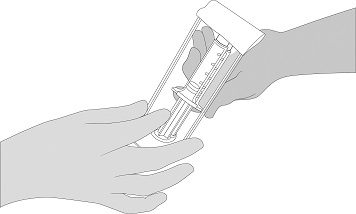
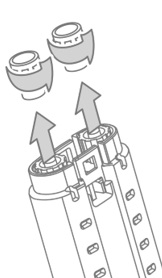
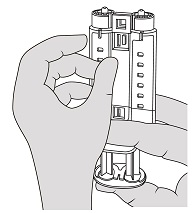
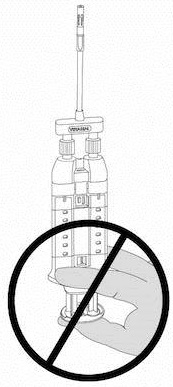
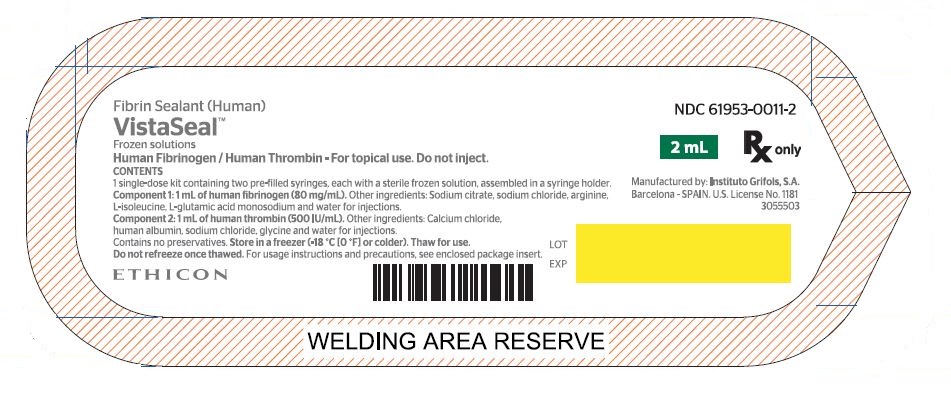
VISTASEAL is a two-component fibrin sealant consisting of human fibrinogen (component 1) and human thrombin with calcium chloride (component 2) sterile solutions filled in syringes which are assembled in a syringe holder.
VISTASEAL is supplied as frozen solutions. After thawing, the human fibrinogen and human thrombin solutions are clear or slightly opalescent and colorless or pale yellow. VISTASEAL does not contain any preservatives.
Fibrinogen
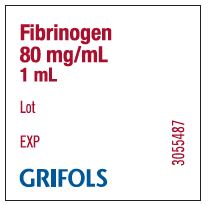
Component 1 is a sterile solution, pH 6.5 – 8.0, which contains concentrated human fibrinogen and excipients. Fibrinogen is a protein from human blood that forms a clot when combined with thrombin. The composition of the human fibrinogen solution is as follows:
Active ingredient: human fibrinogen (80 mg/mL)
Other ingredients: sodium citrate, sodium chloride, arginine, L-isoleucine, L-glutamic acid monosodium and water for injection.
Thrombin
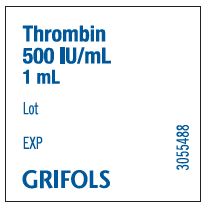
Component 2 is a sterile solution, pH 6.0 – 8.0, which contains purified human thrombin and excipients. Thrombin is a specific protease that activates clotting of the final combined product and converts fibrinogen to fibrin. The composition of the human thrombin solution is as follows:
Active ingredient: human thrombin (500 IU/mL)
Other ingredients: calcium chloride, human albumin, sodium chloride, glycine and water for injection.
The starting material for the production of both fibrinogen and thrombin components of VISTASEAL is pooled human Source Plasma obtained from FDA-licensed plasma collection centers in the United States. Cohn’s plasma fractionation method is used to obtain Fraction I, which is the starting material for the production of fibrinogen, and the prothrombin complex isolated from supernatant of Fraction I, which is the starting material for the production of thrombin. The purification process of fibrinogen includes solvent/detergent treatment, three glycine precipitation steps, and double nanofiltration using 35-nm and 20-nm filters. The purification process of thrombin includes solvent/detergent treatment, ion exchange chromatography, and double nanofiltration through 15-nm filters. After nanofiltration, the fibrinogen and thrombin solutions are formulated, sterile filtered, aseptically filled in syringes, packaged, sterilized, and frozen.
Viral safety
Individual plasma donations used in the manufacture of VISTASEAL are collected in FDA-licensed plasma donation centers in the U.S. and are tested for viral markers in compliance with the U.S. regulatory requirements. In addition, mini-pools of plasma units are tested as an in-process control for hepatitis A virus (HAV) and parvovirus B19 (B19V) using validated nucleic acid testing (NAT) methods. All the tests must be non-reactive (negative) except for B19V, for which the limit in plasma manufacturing pools does not exceed a titer of 104 IU/mL. The manufacturing plasma pool is also tested with NAT for HBV, HCV, and HIV, and all the tests must be non‑reactive (negative).
The manufacturing processes for fibrinogen and thrombin include processing steps which are designed to reduce the risk of viral transmission. Both components have two discrete steps with viral clearance capacity, namely solvent/detergent treatment (with 1.0% (v/v) Tween 80/0.30% (v/v) tri-n-butyl phosphate (TNBP) for 6.0 – 6.5 hours at 27.0 ± 1.5 °C for fibrinogen or 25 ± 1 °C for thrombin), validated to inactivate enveloped viruses, and a nanofiltration step validated to remove non-enveloped and enveloped viruses (35-nm and 20-nm filters for fibrinogen and two 15-nm filters for thrombin). Additionally, the glycine precipitation steps contribute to the overall safety of the product in the purification process of human fibrinogen. The Fraction I precipitation and ion-exchange chromatography steps contribute to the overall safety of the product in the purification process of human thrombin.
The viral clearance capacity of these virus inactivation/removal procedures has been validated in small-scale in vitro studies using relevant and model viruses with a range of physico-chemical characteristics. The results of viral clearance validation studies are summarized in Tables 7 and 8:
Table 7. Global Virus Reduction Factors (Log10) for Human Fibrinogen| Manufacturing step | Virus reduction factor (log10)* |
| Enveloped viruses | Non-enveloped viruses |
| HIV-1 | PRV | WNV | BVDV | HAV | PPV |
| S/D treatment | ≥ 5.33 | ≥ 6.80 | ≥ 5.20 | ≥ 5.60 | n.a. | n.a. |
Glycine
precipitations | n.d. | n.d. | n.d. | n.d. | 5.21 | 2.09 |
Nanofiltration 35 nm
and 20 nm | ≥ 5.57 | ≥ 6.09 | ≥ 4.51 | ≥ 4.53 | 5.22 | 4.37 |
Global virus
reduction factor
(log10) | ≥ 10.90 | ≥ 12.89 | ≥ 9.71 | ≥ 10.13 | 10.43 | 6.46 |
Table 8. Global Virus Reduction Factors (Log10) for Human Thrombin| *: Reduction factor below 1 log10 is not considered in calculating the global virus reduction; n.d.: Not done; n.a.: Not applicable; BVDV: bovine viral diarrhea virus, model for HCV; WNV: West Nile virus; PRV: pseudorabies virus, model for large enveloped DNA viruses; PPV: porcine parvovirus, model for B19V |
| Manufacturing step | Virus reduction factor (log10)* |
| Enveloped viruses | Non-enveloped viruses |
| HIV-1 | PRV | WNV | BVDV | HAV | PPV |
| Fraction I precipitation | < 1.0 | 2.13 | 2.78 | 1.34 | 1.18 | < 1.0 |
| S/D treatment | ≥ 5.52 | ≥ 5.85 | ≥ 5.94 | ≥ 5.09 | n.a. | n.a. |
| SP-Sepharose XL chromatography | n.d. | n.d. | n.d. | n.d. | 4.61 | 3.97 |
| Double nanofiltration 15 nm | ≥ 4.03 | ≥ 5.95 | ≥ 5.42 | ≥ 4.93 | 6.56 | 6.14 |
| Global virus reduction factor (log10) | ≥ 9.55 | ≥ 13.93 | ≥ 14.14 | ≥ 11.36 | 12.35 | 10.11 |