Other
Adult Patients:
TYBOST is a CYP3A inhibitor indicated to increase systemic exposure of atazanavir or darunavir (once daily dosing regimen) in combination with other antiretroviral agents in the treatment of HIV-1 infection in adults [see Dosage and Administration (2.1)].
Pediatric Patients:
TYBOST is a CYP3A inhibitor indicated to increase systemic exposure of atazanavir or darunavir (once daily dosing regimen) in combination with other antiretroviral agents in the treatment of HIV-1 infection in pediatric patients weighing at least 14 kg [see Dosage and Administration (2.2), and Drug Interactions (7.3)].
Adverse Reactions from Clinical Trials Experience in Adults
The safety of TYBOST is based on Week 144 data from a Phase 3 trial, Trial 114, in which 692 antiretroviral treatment-naïve participants with HIV-1 received:
- TYBOST coadministered with atazanavir and TDF/emtricitabine (administered as TRUVADA) (N=344) or
- ritonavir coadministered with atazanavir and TDF/emtricitabine (administered as TRUVADA) (N=348).
The most common adverse reactions (Grades 2−4) and reported in >5% of participants in the TYBOST group were jaundice (6%) and rash (5%). The proportion of participants who discontinued study treatment due to adverse events, regardless of severity, was 11% in both the TYBOST and ritonavir groups. Table 4 displays the frequency of adverse reactions (Grades 2−4) occurring in at least 2% of participants in the TYBOST group in Trial 114.
| TYBOST Coadministered with Atazanavir + TRUVADA N=344 | Ritonavir Coadministered with Atazanavir + TRUVADA N=348 | |
|---|---|---|
| Jaundice | 6% | 3% |
| Rash Rash events include dermatitis allergic, drug hypersensitivity, pruritus generalized, eosinophilic pustular folliculitis, rash, rash generalized, rash macular, rash maculo-papular, rash morbilliform, rash papular, and urticaria. | 5% | 4% |
| Ocular icterus | 4% | 2% |
| Nausea | 2% | 2% |
| Diarrhea | 2% | 1% |
| Headache | 2% | 1% |
Less Common Adverse Reactions
Selected adverse reactions of at least moderate severity (≥Grade 2) occurring in less than 2% of participants receiving TYBOST coadministered with atazanavir and TRUVADA are listed below. These events have been included because of the investigator’s assessment of potential causal relationship and were considered serious or have been reported in more than one subject treated with TYBOST and with greater frequency compared with ritonavir.
Gastrointestinal Disorders: vomiting, upper abdominal pain
General Disorders and Administration Site Conditions: fatigue
Musculoskeletal and Connective Tissue Disorders: rhabdomyolysis
Psychiatric Disorders: depression, abnormal dreams, insomnia
Renal and Urinary Disorders: nephropathy, Fanconi syndrome acquired, nephrolithiasis
Refer to the prescribing information for atazanavir or darunavir for information regarding adverse reactions with these drugs.
Laboratory Abnormalities: The frequency of laboratory abnormalities (Grades 3−4) occurring in at least 2% of participants in the TYBOST group in Trial 114 is presented in Table 5.
| TYBOST + Atazanavir + TRUVADA | Ritonavir + Atazanavir + TRUVADA | |
|---|---|---|
| Laboratory Parameter Abnormality | N=344 | N=348 |
| Total Bilirubin (>2.5 × ULN) | 73% | 66% |
| Creatine Kinase (≥10.0 × ULN) | 8% | 9% |
| Urine RBC (Hematuria) (>75 RBC/HPF) | 6% | 3% |
| ALT (>5.0 × ULN) | 6% | 3% |
| AST (>5.0 × ULN) | 4% | 3% |
| GGT (>5.0 × ULN) | 4% | 2% |
| Serum Amylase For participants with serum amylase >1.5 × upper limit of normal, lipase test was also performed. The frequency of increased lipase (Grades 3−4) occurring in the TYBOST (N=46) and ritonavir (N=35) groups was 7% and 3%, respectively. (>2.0 × ULN) | 4% | 2% |
| Urine Glucose (Glycosuria) (≥1000 mg/dL) | 3% | 3% |
| Neutrophils (<750/mm3) | 3% | 2% |
| Serum Glucose (Hyperglycemia) (>250 mg/dL) | 2% | 2% |
Increase in Serum Creatinine: TYBOST causes increases in serum creatinine and decreases in estimated creatinine clearance due to inhibition of tubular secretion of creatinine without affecting actual renal glomerular function [see Warnings and Precautions (5.1) and Clinical Pharmacology (12.2)]. In Trial 114, increases in serum creatinine and decreases in estimated creatinine clearance occurred early in treatment with TYBOST, after which they stabilized. The mean (± SD) change in estimated glomerular filtration rate (eGFR) by Cockcroft-Gault method after 144 weeks of treatment was –15.1 ± 16.5 mL/min in the TYBOST group and –8.0 ± 16.8 mL/min in the ritonavir group.
Serum Lipids: Changes from baseline in total cholesterol, HDL-cholesterol, LDL-cholesterol, and triglycerides are presented in Table 6. In both groups, mean values for serum lipids remained within the study reference range for each laboratory test. The clinical significance of these changes is unknown.
| TYBOST + Atazanavir + TRUVADA | Ritonavir + Atazanavir + TRUVADA | |||
|---|---|---|---|---|
| Baseline | Week 144 | Baseline | Week 144 | |
| mg/dL | Change from baseline The change from baseline is the mean of within-patient changes from baseline for patients with both baseline and Week 144 values. Analysis excludes participants receiving an HMG-CoA reductase inhibitor drug. | mg/dL | Change from baseline | |
| Total Cholesterol (fasted) | 163 [N=219] | +11 [N=219] | 165 [N=227] | +13 [N=227] |
| HDL-cholesterol (fasted) | 43 [N=218] | +7 [N=218] | 43 [N=228] | +6 [N=228] |
| LDL-cholesterol (fasted) | 102 [N=218] | +11 [N=218] | 104 [N=228] | +16 [N=228] |
| Triglycerides (fasted) | 130 [N=219] | +14 [N=219] | 131 [N=227] | +14 [N=227] |
Adverse Reactions from Clinical Trials Experience in Pediatric Participants
The safety of TYBOST was evaluated in an open-label clinical trial (Trial 128) of pediatric participants with HIV-1 administered TYBOST-boosted atazanavir or darunavir plus two nucleoside reverse transcriptase inhibitors; this study included 22 virologically-suppressed participants between the ages of 12 to less than 18 years (weighing ≥35 kg) administered atazanavir (N=14) or darunavir (N=7) through Week 48; 9 virologically-suppressed pediatric participants between the ages of 6 to less than 12 years weighing at least 25 kg to less than 40 kg administered darunavir (N=9) through Week 48; and 11 virologically-suppressed participants at least 2 years of age (weighing ≥14 kg to <25 kg) administered darunavir through Week 48 [see Drug Interactions (7.3), Use in Specific Populations (8.4), Clinical Studies (14.2)]. In this trial, the safety profile of TYBOST was similar to that in adults.
Pregnancy Exposure Registry
There is a pregnancy exposure registry that monitors fetal outcomes in individuals exposed to TYBOST during pregnancy. Healthcare providers are encouraged to register patients by calling the Antiretroviral Pregnancy Registry (APR) 1-800-258-4263.
Risk Summary
TYBOST coadministered with darunavir or atazanavir is not recommended during pregnancy [see Dosage and Administration (2.5)]. In a clinical trial of individuals taking cobicistat coadministered with darunavir, exposures of cobicistat and darunavir were substantially lower during the second and third trimesters of pregnancy [see Data and Clinical Pharmacology (12.3)].
TYBOST use during pregnancy has been evaluated in a limited number of individuals as reported by the APR, and available data show no significant difference in the rate of overall birth defects for cobicistat compared with the background rate for major defects of 2.7% in a U.S. reference population of the Metropolitan Atlanta Congenital Defects Program (MACDP) (see Data). The rate of miscarriage is not reported in the APR. The estimated background rate of miscarriage in clinically recognized pregnancies in the U.S. general population is 15−20%.
In animal reproduction studies in rats and rabbits, no evidence of fetal harm was observed with oral administration of cobicistat during organogenesis at doses that produced exposures up to 1.4 and 3.3 times, respectively, the maximal recommended human dose (MRHD) of 150 mg (see Data). Because TYBOST is coadministered with atazanavir or darunavir and other antiretroviral drugs, also refer to the prescribing information of each drug for information about pregnancy.
Data
Human Data
Cobicistat coadministered with darunavir as a fixed dose combination, in combination with a background regimen, was evaluated in a clinical trial of 7 pregnant individuals taking darunavir/cobicistat prior to enrollment and who were willing to remain on darunavir/cobicistat throughout the study. The study period included the second and third trimesters, and through 12 weeks postpartum. Six pregnant individuals completed the trial.
Exposure to darunavir and cobicistat as part of an antiretroviral regimen was substantially lower during the second and third trimesters of pregnancy compared with postpartum [see Clinical Pharmacology (12.3)].
One out of 6 individuals who completed the study experienced virologic failure with HIV-1 RNA >1,000 copies/mL from the third trimester visit through the postpartum period. Five individuals had sustained virologic response (HIV-1 RNA <50 copies/mL) throughout the study period. There are no clinical data on the virologic response when darunavir/cobicistat is initiated during pregnancy.
There were no new clinically relevant safety findings compared with the known safety profile of darunavir/cobicistat in adult participants with HIV-1.
The APR has received prospective reports of live births following exposure to cobicistat-containing regimens during pregnancy, including over 600 exposures in the first trimester and over 90 exposures in the second/third trimester. The prevalence of birth defects in live births was 3.5% (95% CI: 2.2% to 5.3%) and 3.2% (95% CI: 0.7% to 9.1%) following first trimester and second/third trimester exposure, respectively, to cobicistat-containing regimens. Methodological limitations of the APR include the use of MACDP as the external comparator group. The MACDP population is not disease-specific, evaluates women and infants from a limited geographic area, and does not include outcomes for births that occurred at <20 weeks gestation.
Animal Data
Cobicistat was administered orally to pregnant rats at doses of 0, 25, 50, and 125 mg/kg/day on gestation day 6 to 17. Maternal toxicity (adverse clinical signs, decreased body weight and food consumption) was noted at 125 mg/kg/day and was associated with increases in postimplantation loss and decreased fetal weights. No malformations were noted at doses up to 125 mg/kg/day. Systemic exposures (AUC) at 50 mg/kg/day in pregnant females were 1.4-fold higher than the exposures at the MRHD.
In pregnant rabbits, cobicistat was administered orally at doses of 0, 20, 50, and 100 mg/kg/day during the gestation days 7 to 20. No maternal or embryo/fetal effects were noted at the highest dose of 100 mg/kg/day. Systemic exposures (AUC) at 100 mg/kg/day were 3.3-fold higher than exposures at the MRHD.
In a pre- and postnatal developmental study, cobicistat was administered orally at doses of 0, 10, 30, and 75 mg/kg from gestation day 6 to postnatal day 20, 21, or 22. At doses of 75 mg/kg/day of cobicistat, neither maternal nor developmental toxicity was noted. Systemic exposures (AUC) at this dose were slightly lower than (0.9-fold) the MRHD.
Risk Summary
There is no information regarding the presence of cobicistat in human milk, the effects on the breastfed infant, or the effects on milk production. Cobicistat is present in rat milk (see Data).
Potential risks of breastfeeding include: (1) HIV-1 transmission to HIV-1–negative infants; (2) developing viral resistance in HIV-1–positive infants; and (3) adverse reactions in a breastfed infant similar to those seen in adults.
Animal Data
During the prenatal and postnatal development toxicology study at doses up to 75 mg/kg/day, mean cobicistat milk to plasma ratio of up to 1.9 was measured 2 hours after administration to rats on lactation Day 10.
Contraception
TYBOST interacts with certain oral contraceptives [see Drug Interactions (7.3)].
Effects on Pharmacokinetic Enhancement
The effect of TYBOST on atazanavir pharmacokinetics was evaluated in the pharmacokinetic substudy (N=48) of Trial 114 in which participants with HIV-1 received atazanavir 300 mg coadministered with TYBOST 150 mg or atazanavir 300 mg coadministered with ritonavir 100 mg, both in combination with TRUVADA. The steady-state pharmacokinetic parameters of atazanavir were comparable when coadministered with TYBOST versus ritonavir groups as shown in Table 8 [see Clinical Studies (14.1)].
| TYBOST + Atazanavir + TRUVADA Once Daily | Ritonavir + Atazanavir + TRUVADA Once Daily | |
|---|---|---|
| Atazanavir Pharmacokinetic Parameters | N=22 | N=26 |
| AUCtau (mcg∙hr/mL) | 46.13 ± 26.18 | 47.59 ± 24.38 |
| Cmax (mcg/mL) | 3.91 ± 1.94 | 4.76 ± 1.94 |
| Ctau (mcg/mL) | 0.80 ± 0.72 | 0.85 ± 0.72 |
The effect of TYBOST on darunavir was evaluated in a clinical study (Trial 115) in 31 healthy participants who received darunavir 800 mg in combination with TYBOST 150 mg or ritonavir 100 mg, all once daily, for 10 days. With the exception of Ctau, the steady-state pharmacokinetic parameters of darunavir were comparable when coadministered with TYBOST versus ritonavir as shown in Table 9, and these results were similar to those reported in previous clinical trials of darunavir 800 mg with ritonavir 100 mg once daily (refer to prescribing information for darunavir).
| TYBOST + Darunavir Once Daily | Ritonavir + Darunavir Once Daily | |
|---|---|---|
| Darunavir Pharmacokinetic Parameters | N=31 | N=31 |
| AUCtau (mcg∙hr/mL) | 81.08 ± 25.15 | 79.99 ± 27.20 |
| Cmax (mcg/mL) | 7.74 ± 1.69 | 7.46 ± 1.52 |
| C0h (mcg/mL) | 2.40 ± 1.22 | 2.48 ± 0.85 |
| Ctau (mcg/mL) | 1.33 ± 0.89 | 1.87 ± 1.56 |
Cardiac Electrophysiology
In a thorough QT/QTc study in 48 healthy participants, a single dose of cobicistat 250 mg and 400 mg (1.67 and 2.67 times the dose in TYBOST) did not affect the QT/QTc interval. Prolongation of the PR interval was noted in participants receiving cobicistat. The maximum mean (95% upper confidence bound) difference in PR from placebo after baseline-correction was 9.5 (12.1) msec for the 250 mg cobicistat dose and 20.2 (22.8) for the 400 mg cobicistat dose.
Effects on Serum Creatinine
The effect of TYBOST on serum creatinine was investigated in a trial in participants with normal renal function (eGFR ≥80 mL/min, N=12) and mild-to-moderate renal impairment (eGFR 50–79 mL/min, N=18). A statistically significant decrease in the estimated glomerular filtration rate, calculated by Cockcroft-Gault method (eGFRCG) from baseline, was observed after 7 days of treatment with cobicistat 150 mg among participants with normal renal function (−9.9 ± 13.1 mL/min) and mild-to-moderate renal impairment (−11.9 ± 7.0 mL/min). No statistically significant changes in eGFRCG were observed compared to baseline for participants with normal renal function or mild-to-moderate renal impairment 7 days after cobicistat was discontinued. The actual glomerular filtration rate, as determined by the clearance of probe drug iohexol, was not altered from baseline following treatment with TYBOST among participants with normal renal function and mild-to-moderate renal impairment, indicating that cobicistat inhibits tubular secretion of creatinine, reflected as a reduction in eGFRCG, without affecting the actual glomerular filtration rate [see Warnings and Precautions (5.1)].
Absorption
In a trial where participants were instructed to take coadministered TYBOST and darunavir with food, median cobicistat peak plasma concentrations were observed approximately 3.5 hours postdose. Steady-state cobicistat Cmax, AUCtau, and Ctau (mean ± SD) values were 0.99 ± 0.3 mcg/mL (n=60), 7.6 ± 3.7 mcg∙hr/mL (n=59), and 0.03 ± 0.1 mcg/mL (n=59), respectively.
Effect of Food on Oral Absorption
A food-effect trial was not conducted for TYBOST. In clinical trials, TYBOST was coadministered with other antiretroviral agents [see Clinical Studies (14.1)] under fed conditions, in accordance with the prescribing information for these agents. It is recommended that TYBOST coadministered with atazanavir or darunavir be administered with food [see Dosage and Administration (2.1, 2.2)].
Distribution
Cobicistat is 97–98% bound to human plasma proteins and the mean blood-to-plasma ratio was approximately 0.5.
Metabolism
Cobicistat is metabolized by CYP3A and to a minor extent by CYP2D6 enzymes and does not undergo glucuronidation.
Elimination
The terminal plasma half-life of cobicistat following administration of TYBOST is approximately 3 to 4 hours. With single dose administration of [14C] cobicistat after multiple dosing of cobicistat for 6 days, the mean percent of the administered dose excreted in feces and urine was 86.2% and 8.2%, respectively.
Specific Populations
Race and Gender
No clinically relevant differences in the pharmacokinetics of cobicistat were observed based on race or gender.
Pediatric Patients
In pediatric participants aged 12 to less than 18 years who received TYBOST 150 mg coadministered with atazanavir 300 mg (N=12), geometric mean atazanavir Cmax and AUCtau and cobicistat AUCtau values were approximately 20-30% higher than in adults and geometric mean atazanavir and cobicistat Ctau values were approximately 60% to 160% higher than in adults; the increases were not considered clinically significant. In pediatric participants aged 12 to less than 18 years who received TYBOST 150 mg coadministered with darunavir 800 mg (N=7), geometric mean darunavir Cmax and AUCtau values were similar between adults and adolescents. Geometric mean darunavir AUCtau and Ctau values were 15% and 32% lower, with geometric mean ratios of 0.85 (90% CI: 0.64, 1.13) and 0.68 (90% CI: 0.30, 1.55) in adolescent participants relative to adults, respectively. This difference was not considered clinically significant based on exposure-response relationships. Geometric mean cobicistat AUCtau, Cmax, and Ctau values were comparable in adolescents and adults (Table 10).
In pediatric participants aged 6 to less than 12 years (weighing ≥25 kg to <40 kg) who received TYBOST 150 mg coadministered with atazanavir (N=14) or darunavir (N=9), AUCtau and Cmax values were similar to those in adults, while the Ctrough was 33% higher for atazanavir and 44% higher for darunavir than in adults. In this study, exposures of cobicistat (AUCtau, Cmax, and Ctrough) in the combined groups were 88%, 52%, and 192%, respectively, higher than in adults (Table 10). However, the increases were not considered clinically significant.
In pediatric participants at least 2 years of age (weighing ≥14 kg to <25 kg) who received TYBOST 90 mg coadministered with atazanavir (N=15) or darunavir (N=11), exposures (AUCtau, Cmax, and Ctrough) were higher for atazanavir (46%, 72% and 42%, respectively) and darunavir (49%, 88%, and 66%, respectively) as compared to exposures in adults. Exposures of cobicistat (AUCtau, Cmax, and Ctrough) in the combined groups were 58%, 29%, and 126%, respectively, higher than in adults (Table 10). However, the increases were not considered clinically significant.
| Parameter Mean (CV%) | Cobicistat | Atazanavir | Darunavir | |
|---|---|---|---|---|
| Treatment Administered | TYBOST + Atazanavir | TYBOST + Darunavir | TYBOST + Atazanavir | TYBOST + Darunavir |
| CV=Coefficient of Variation | ||||
| Pediatric Participants 12 to less than 18 years of age (weighing ≥35 kg) Values are geometric means | N=12 | N=7 | N=12 | N=7 |
| AUCtau (mcg∙hr/mL) | 12.11 (44.7) | 8.33 (34.9) | 49.48 (49.1) | 77.22 (29.5) |
| Cmax (mcg/mL) | 1.28 (31.7) | 1.10 (20.0) | 4.32 (49.9) | 7.32 (21.7) |
| Ctau (mcg/mL) | 0.09 (156.2) | 0.02 (123.9) N=5; Data from two participants who had undetectable TYBOST Ctau concentrations were excluded from summary statistics. | 0.91 (96.4) | 0.68 (91.6) |
| Pediatric Participants 6 to less than 12 years of age (weighing ≥25 to < 40 kg) Values are arithmetic means | N=14 | N=9 | N=14 | N=9 |
| AUCtau (mcg∙hr/mL) | 21.03 (21.7) N=13 | 13.67 (39.8) | 47.48 (38.4) | 110.51 (30.8) |
| Cmax (mcg/mL) | 2.62 (20.5) | 1.64 (29.8) | 4.19 (38.9) | 9.10 (23.9) |
| Ctau (mcg/mL) | 0.10 (118.4) | 0.06 (109.7) | 0.92 (66.4) | 3.78 (43.2) |
| Pediatric Participants at least 2 years of age (weighing ≥14 to < 25 kg) | N=15 | N=11 | N=15 | N=11 |
| AUCtau (mcg∙hr/mL) | 15.14 (39.3) | 16.07 (46.9) | 65.51 (50.8) | 160.53 (54.0) |
| Cmax (mcg/mL) | 1.95 (37.1) | 2.08 (36.0) | 6.78 (52.0) | 15.02 (38.0) |
| Ctau (mcg/mL) | 0.06 (114.0) | 0.06 (138.6) | 0.95 (58.0) | 2.79 (92.1) |
| Adults From pooled Intensive PK analysis of trials with TYBOST + atazanavir. ,From Intensive PK analysis of Trial GS-US-299-0102 with TYBOST + darunavir. , | N=30 | N=21 | N=30 | N=21 |
| AUCtau (mcg∙hr/mL) | 9.65 (41.8) | 7.69 (43.9) | 39.96 (52.1) | 90.56 (45.3) |
| Cmax (mcg/mL) | 1.28 (35.6) | 1.04 (35.3) | 3.54 (45.8) | 8.34 (33.3) |
| Ctau (mcg/mL) | 0.04 (112.7) | 0.02 (135.1) N=18. | 0.58 (84.7) | 1.00 (108.0) |
Patients with Renal Impairment
No clinically relevant differences in cobicistat pharmacokinetics were observed between participants with severe renal impairment (estimated creatinine clearance below 30 mL/min) and healthy participants [see Use in Specific Populations (8.6)].
Patients with Hepatic Impairment
No clinically relevant differences in cobicistat pharmacokinetics were observed between participants with moderate hepatic impairment (Child-Pugh Class B) and healthy participants. The effect of severe hepatic impairment (Child-Pugh Class C) on the pharmacokinetics of cobicistat has not been studied [see Use in Specific Populations (8.7)].
Pregnancy and Postpartum
The exposure to total and unbound darunavir boosted with cobicistat after intake of darunavir/cobicistat as part of an antiretroviral regimen was substantially lower during the second and third trimesters of pregnancy compared with 6–12 weeks postpartum (see Table 11 and Figure 1).
| Pharmacokinetics of total darunavir (mean ± SD) | 2nd Trimester of pregnancy N=7 | 3rd Trimester of pregnancy N=6 | Postpartum (6–12 weeks) N=6 |
|---|---|---|---|
| Cmax, ng/mL | 4,340 ± 1,616 | 4,910 ± 970 | 7,918 ± 2,199 |
| AUC24h, ng.h/mL | 47,293 ± 19,058 | 47,991 ± 9,879 | 99,613 ± 34,862 |
| Cmin, ng/mL | 168 ± 149 | 184 ± 99 | 1,538 ± 1,344 |
| Legend: 90% CI: 90% confidence interval; GMR: geometric mean ratio (i.e. second or third trimester / postpartum). Solid vertical line: ratio of 1.0; dotted vertical lines: reference lines of 0.8 and 1.25. |
| Figure 1: Pharmacokinetic Results (Within-participant Comparison) of Total and Unbound Darunavir and Total Cobicistat After Administration of Darunavir/Cobicistat at 800/150 mg Once Daily as Part of an Antiretroviral Regimen, During the 2nd and 3rd Trimester of Pregnancy Compared to Postpartum |
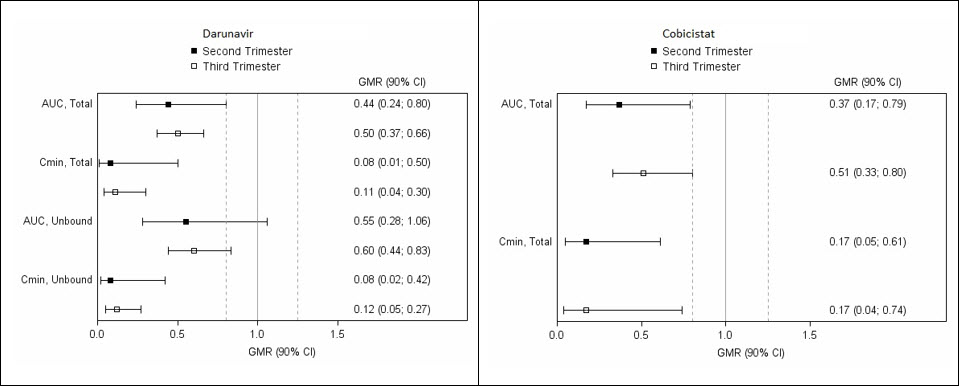 Figure 1 (Tybost 02) |
Assessment of Drug Interactions
Drug interaction trials were conducted with TYBOST (as a single entity) and desipramine, digoxin, and efavirenz. Drug interaction trials of TYBOST coadministered with atazanavir or darunavir included atorvastatin, drospirenone/ethinyl estradiol, and rosuvastatin. Drug interaction trials of TYBOST coadministered with elvitegravir included rosuvastatin and rifabutin.
The effects of cobicistat on the exposure of coadministered drugs are shown in Table 12.
| Note: The information listed below is not a comprehensive list of all the available drug interaction data for concomitant medications with cobicistat containing regimens. Please refer to the U.S. prescribing information for antiretroviral medications administered in combination with cobicistat for additional drug interaction information. | |||||
|---|---|---|---|---|---|
| Coadministered Drug | Dose of Coadministered Drug (mg) | TYBOST Dose (mg) | N | Mean Ratio of Coadministered Drug Pharmacokinetic Parameters (90% CI); No effect = 1.00 | |
| Cmax | AUC | ||||
| Atorvastatin | 10 single dose | 150 once daily | 16 | 18.85 Study conducted in the presence of 300 mg atazanavir. (13.53, 26.27) | 9.22 (7.58, 11.22) |
| 4.19 Study conducted in the presence of 800 mg darunavir. (3.67, 4.78) | 3.90 (3.52, 4.32) | ||||
| Desipramine | 50 single dose | 150 once daily | 8 | 1.24 (1.08, 1.44) | 1.65 (1.36, 2.02) |
| Digoxin | 0.5 single dose | 150 once daily | 22 | 1.41 (1.29, 1.55) | 1.08 (1.00, 1.17) |
| Drospirenone/ ethinyl estradiol | 3 drospirenone single dose | 150 once daily | 14 | 1.12 (1.05, 1.19) | 2.30 (2.00, 2.64) |
| 0.02 ethinyl estradiol single dose | 0.82 (0.76, 0.89) | 0.78 (0.73, 0.85) | |||
| 3 drospirenone single dose | 150 once daily | 15 | 1.15 (1.05, 1.26) | 1.58 (1.47, 1.71) | |
| 0.02 ethinyl estradiol single dose | 0.86 (0.77, 0.95) | 0.70 (0.63, 0.77) | |||
| Efavirenz | 600 single dose | 150 once daily | 17 | 0.87 (0.80, 0.94) | 0.93 (0.89, 0.97) |
| Rosuvastatin | 10 single dose | 150 once daily | 16 | 10.58 (8.72, 12.83) | 3.42 (2.87, 4.07) |
| 3.77 (3.29, 4.32) | 1.93 (1.70, 2.20) | ||||
Antiviral Activity
Cobicistat does not inhibit recombinant HIV-1 protease in a biochemical assay and has no detectable antiviral activity in cell culture against HIV-1, HBV, or HCV. The antiviral activity in cell culture of selected HIV-1 antiretroviral drugs was not antagonized by cobicistat.
Resistance
In an analysis of treatment-failure adult participants who received TYBOST coadministered with atazanavir and TRUVADA in Trial 114 through Week 144, evaluable genotypic data from paired baseline and treatment-failure isolates from participants who had HIV-1 RNA greater than or equal to 400 copies/mL were available for all 21 virologic failures in the TYBOST group (6%, 21/344). Among the 21 participants, 3 developed the emtricitabine resistance-associated substitution M184V. No participant developed the tenofovir resistance-associated substitution K65R or K70E, or any primary resistance substitution associated with protease inhibitors. In the ritonavir group, evaluable genotypic data were available for all 19 virologic failures (5%, 19/348). Among the 19 participants, 1 developed the emtricitabine resistance-associated substitution M184V with no tenofovir or protease inhibitor resistance-associated substitutions.
Carcinogenesis
In a long-term carcinogenicity study in mice, no drug-related increases in tumor incidence were observed at doses up to 50 and 100 mg/kg/day (males and females, respectively). Cobicistat exposures at these doses were approximately 7 (male) and 16 (females) times, respectively, the human systemic exposure at the therapeutic daily dose. In a long-term carcinogenicity study of cobicistat in rats, an increased incidence of follicular cell adenomas and/or carcinomas in the thyroid gland was observed at doses of 25 and 50 mg/kg/day in males, and at 30 mg/kg/day in females. The follicular cell findings are considered to be rat-specific, secondary to hepatic microsomal enzyme induction and thyroid hormone imbalance, and are not relevant for humans. At the highest doses tested in the rat carcinogenicity study, systemic exposures were approximately 2 times the human systemic exposure at the therapeutic daily dose.
Mutagenesis
Cobicistat was not genotoxic in the reverse mutation bacterial test (Ames test), mouse lymphoma, or rat micronucleus assays.
Impairment of Fertility
Cobicistat did not affect fertility in male or female rats at daily exposures (AUC) approximately 3-fold higher than human exposures at the recommended 150 mg daily dose.
Fertility was normal in the offspring of rats exposed daily from before birth (in utero) through sexual maturity at daily exposures (AUC) of approximately similar human exposures at the recommended 150 mg daily dose.
Drug Interaction
Inform patients that TYBOST coadministered with atazanavir or darunavir may interact with many drugs with potential serious implications and that some drugs are contraindicated with TYBOST coadministered with atazanavir or darunavir. Advise patients to report to their healthcare provider the use of any other prescription or nonprescription medication, including acid-modifying medications or herbal products, including St. John's wort [see Contraindications (4), Warnings and Precautions (5.3), and Drug Interactions (7)].
New Onset or Worsening Renal Impairment
Inform patients that renal impairment, including cases of acute renal failure and Fanconi syndrome, has been reported when TYBOST is used in combination with a TDF containing regimen [see Warnings and Precautions (5.2)].
Pregnancy
Advise patients that TYBOST is not recommended during pregnancy and to alert their healthcare provider if they get pregnant while taking TYBOST [see Use in Specific Populations (8.1)].
Inform patients that there is a pregnancy exposure registry that monitors fetal outcomes in pregnant individuals exposed to TYBOST during pregnancy [see Use in Specific Populations (8.1)].
Lactation
Inform individuals with HIV-1 infection that the potential risks of breastfeeding include: (1) HIV-1 transmission to HIV-1–negative infants, (2) developing viral resistance in HIV-1–positive infants, and (3) adverse reactions in a breastfed infant similar to those seen in adults [see Use in Specific Populations (8.2)].
Dosing Instructions
Inform patients that TYBOST must be taken at the same time as atazanavir or darunavir and with food once daily as prescribed. It is important to take TYBOST and atazanavir or darunavir together on a regular dosing schedule and to avoid missing doses. Counsel patients about the risks of developing resistance to their HIV-1 medications.
© 2025 Gilead Sciences, Inc. All rights reserved.
TYBOST, GSI, and TRUVADA are trademarks of Gilead Sciences, Inc., or its related companies. All other trademarks are the property of their respective owners.