Limitations of Use
Zydelig is not indicated and is not recommended for first-line treatment of any patient, including patients with CLL, small lymphocytic lymphoma (SLL), follicular lymphoma (FL), and other indolent non-Hodgkin lymphomas.
Zydelig is not indicated and is not recommended in combination with bendamustine and rituximab, or in combination with rituximab for the treatment of patients with FL, SLL, and other indolent non-Hodgkin lymphomas.
Summary of Clinical Trials in Chronic Lymphocytic Leukemia
The safety data reflect exposure to Zydelig from two randomized, double-blind clinical trials (Studies 312-0116 and 312-0115) in 634 patients with relapsed CLL [see Clinical Studies (14.1)] and one randomized, open-label trial in 259 patients with relapsed CLL (Study 312-0119).
Zydelig with Rituximab (Study 312-0116)
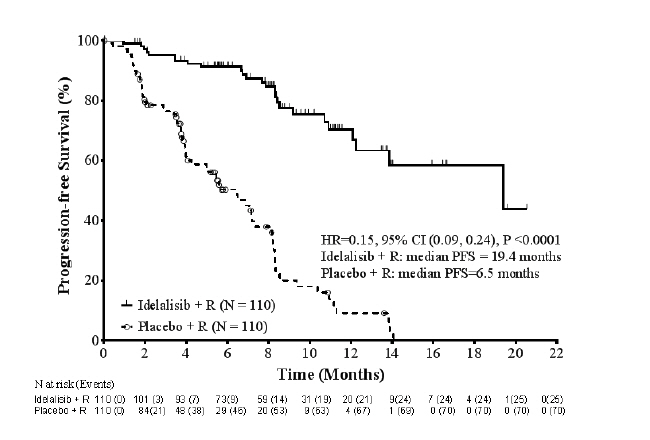
Patients with relapsed CLL received up to 8 doses of rituximab (R) with (n=110) or without Zydelig (n=108)150 mg twice daily. The median duration of exposure to Zydelig was 8 months.
Serious adverse reactions were reported in 65 (59%) patients treated with Zydelig + R The most frequent serious adverse reactions reported for patients treated with Zydelig + R were pneumonia (23%), diarrhea (10%), pyrexia (9%), sepsis (8%), and febrile neutropenia (5%).
Adverse reactions that led to discontinuation of Zydelig occurred in 19 (17%) patients. The most common adverse reactions that led to treatment discontinuations were hepatotoxicity and diarrhea/colitis.
Forty-two (38%) patients had dose interruptions and sixteen (15%) patients had dose reductions due to adverse reactions or laboratory abnormalities. The most common reasons for dose interruptions or reductions were pneumonia, diarrhea or colitis, rash, and elevated transaminases.
Table 2 and Table 3 summarize common adverse reactions and laboratory abnormalities reported for Zydelig + R and placebo + R arms.
Table 2 Adverse Reactions Reported in ≥5% of Patients with CLL and Occurred at ≥2% Higher Incidence in Patients Receiving Zydelig in Study 312-0116 | Zydelig + R
N=110 (%) | Placebo + R
N=108 (%) |
|---|
| Adverse Reaction | Any Grade | Grade ≥3 | Any Grade | Grade ≥3 |
|---|
| General disorders and administration site conditions |
| pyrexia | 44 (40) | 3 (3) | 20 (19) | 1 (1) |
| chills | 27 (25) | 2 (2) | 17 (16) | 0 |
| pain | 8 (7) | 0 | 1 (1) | 0 |
| Gastrointestinal disorders |
| diarrhea Diarrhea includes the following preferred terms: diarrhea, colitis. | 35 (32) | 12 (11) | 20 (19) | 0 |
| nausea | 30 (27) | 1 (1) | 25 (23) | 0 |
| abdominal pain Abdominal pain includes the following preferred terms: abdominal pain, abdominal pain upper, abdominal pain lower. | 20 (18) | 1 (1) | 17 (16) | 2 (2) |
| vomiting | 17 (15) | 0 | 9 (8) | 0 |
| gastroesophageal reflux disease | 11 (10) | 1 (1) | 0 | 0 |
| stomatitis | 7 (6) | 2 (2) | 1 (1) | 0 |
| Respiratory, thoracic, and mediastinal disorders |
| pneumonia Pneumonia includes the terms: pneumonia, pneumonitis, lung infection, lung infiltration, pneumocystis jiroveci pneumonia, pneumonia legionella, lung infection pseudomonal, pneumonia fungal, respiratory tract infection, lower respiratory tract infection, and lower respiratory tract infection bacterial. | 33 (30) | 23 (21) | 20 (19) | 14 (13) |
| Skin and subcutaneous tissue disorders |
| rash Rash includes the following preferred terms: dermatitis exfoliative, drug eruption, rash, rash erythematous, rash generalized, rash macular, rash maculo-papular, rash papular, rash pruritic, rash morbilliform, and exfoliative rash. | 27 (25) | 4 (4) | 7 (6) | 1 (1) |
| Metabolism and Nutrition Disorders |
| decreased appetite | 18 (16) | 2 (2) | 12 (11) | 2 (2) |
| dehydration | 7 (6) | 3 (3) | 0 | 0 |
| Infections and infestations |
| sepsis Sepsis includes the terms: sepsis, septic shock, neutropenic sepsis, and sepsis syndrome | 10 (9) | 10 (9) | 4 (4) | 4 (4) |
| sinusitis | 9 (8) | 0 | 6 (6) | 0 |
| urinary tract infection | 9 (8) | 1 (1) | 4 (4) | 2 (2) |
| bronchitis | 8 (7) | 1 (1) | 5 (5) | 1 (1) |
| oral herpes | 6 (5) | 1 (1) | 3 (3) | 0 |
| Psychiatric disorders |
| insomnia | 10 (9) | 0 | 7 (6) | 0 |
| Musculoskeletal and connective tissue disorders |
| arthralgia | 9 (8) | 1 (1) | 4 (4) | 0 |
| Nervous system disorders |
| lethargy | 6 (5) | 0 | 2 (2) | 0 |
Table 3 Hematologic and Hepatic Laboratory Abnormalities Reported in ≥10% of Patients with CLL and Occurred at ≥5% Higher Incidence in Patients Receiving Zydelig in Study 312-0116 | Zydelig + R
N=110 (%) | Placebo + R
N=108 (%) |
|---|
| Laboratory Parameter | Any Grade | Grade 3–4 | Any Grade | Grade 3–4 |
|---|
| Hematology abnormalities |
| neutropenia | 71 (65) | 46 (42) | 61 (56) | 33 (31) |
| leukopenia | 34 (31) | 9 (8) | 25 (23) | 9 (8) |
| lymphocytopenia | 23 (21) | 11 (10) | 13 (12) | 4 (4) |
| Serum chemistry abnormalities |
| ALT increased | 43 (39) | 10 (9) | 13 (12) | 1 (1) |
| AST increased | 31 (28) | 6 (5) | 16 (15) | 0 |
After closure of Study 312-0116, 71 patients continued treatment with Zydelig on an extension study (Study 312-0117). The median duration of exposure was 18 months. Serious adverse reactions occurred in 48 (68%) patients. The most frequent serious adverse reactions reported were pneumonia (30%), diarrhea (15%), and pyrexia (11%).
The most frequent adverse reactions were pneumonia (51%), pyrexia (46%), and cough (45%). The most frequent Grade 3 or greater adverse reactions were pneumonia (30%), diarrhea (15%), and sepsis (10%).
Zydelig with Ofatumumab (Study 312-0119)
In Study 312-0119, 259 patients with relapsed CLL received up to 12 doses of ofatumumab with or without Zydelig 150 mg orally twice daily. Zydelig in combination with ofatumumab is not indicated for the treatment of relapsed CLL. The median duration of exposure to Zydelig was 13.9 months.
Serious adverse reactions were reported in 133 (77%) patients treated with Zydelig + ofatumumab. The most frequent serious adverse reactions reported were pneumonia (14%), pyrexia (13%), and diarrhea (12%).
Adverse reactions that led to discontinuation of Zydelig occurred in 71 (41%) patients.
One hundred and ten (64%) patients had dose interruptions and 42 (24%) patients had dose reductions due to adverse reactions or laboratory abnormalities. The most common reasons for dose discontinuations, reductions, or interruptions were diarrhea and colitis.
The most common adverse reactions were diarrhea (55%), pyrexia (38%), nausea (34%), and fatigue (34%).
Zydelig with Bendamustine and Rituximab (Study 312-0115)
In Study 312-0115, patients with relapsed CLL received up to 6 cycles of bendamustine and rituximab (BR) with or without Zydelig 150 mg orally twice daily. Zydelig in combination with bendamustine and rituximab is not indicated for the treatment of relapsed CLL. The median duration of exposure to Zydelig was 18.2 months.
Serious adverse reactions were reported in 147 (71%) patients treated with Zydelig + BR. The most frequent serious adverse reactions reported for patients treated with Zydelig + BR were febrile neutropenia (21%), pneumonia (17%), pyrexia (12%), and diarrhea (6%).
Adverse reactions that led to discontinuation of Zydelig occurred in 68 (33%) patients. The most common adverse reactions that led to treatment discontinuations were pneumonia, diarrhea, and pyrexia.
One hundred twenty-two (59%) patients treated with Zydelig + BR had dose interruptions and 34 (16%) patients had dose reductions due to adverse reactions. The most common reasons for dose interruptions or reductions were increased ALT and diarrhea.
The most common adverse reactions were neutropenia (64%), pyrexia (43%), and diarrhea (41%).
Summary of Clinical Trials in Indolent Non-Hodgkin Lymphoma
The safety data reflect exposure to Zydelig from three open-label clinical trials (Studies 101-09, 101-02, and 101-10 in 146 patients with indolent non-Hodgkin lymphoma (iNHL) treated with Zydelig 150 mg orally twice daily. Zydelig is not indicated for the treatment of iNHL. The median duration of exposure was 6.1 months (range 0.3 to 26.4 months).
Serious adverse reactions were reported in 73 (50%) patients. The most frequent serious adverse reactions that occurred were pneumonia (15%), diarrhea (11%), and pyrexia (9%).
Adverse reactions resulted in interruption or discontinuation for 78 (53%) patients. The most common reasons for interruption or discontinuations were diarrhea (11%), pneumonia (11%), and elevated transaminases (10%).
The most common adverse reactions were neutropenia (53%), ALT increased (50%), diarrhea (47%), AST increased (41%), fatigue (30%), nausea and cough (29% each), anemia and pyrexia (28% each), abdominal pain and thrombocytopenia (26% each), and pneumonia (25%).
Summary of Discontinued Clinical Trials in Indolent Non-Hodgkin Lymphoma and First-Line CLL
Zydelig is not indicated for patients with indolent non-Hodgkin lymphoma or previously untreated CLL either as monotherapy or in combination with rituximab or BR. Safety data described below reflect exposure to Zydelig in three randomized, double-blind clinical trials (Studies 312-0123, 313-0124, and 313-0125) in patients with CLL and iNHL.
In Study 312-0123 (NCT01980888), 311 patients with previously untreated CLL received up to 6 cycles of BR with or without Zydelig 150 mg twice daily.
In Study 313-0124 (NCT01732913), 295 patients with previously treated iNHL [FL 66%, marginal zone lymphoma (MZL) 19%, SLL 9%, lymphoplasmacytic lymphoma (LPL)/Waldenstrom macroglobulinemia (WM) 6%] received 8 doses of R with or without Zydelig 150 mg twice daily. Patients had a median of one prior therapy.
In Study 313-0125 (NCT01732926), 475 patients with previously treated iNHL (FL 63%, MZL 15%, SLL 11%, LPL/WM 11%) received up to 6 cycles of BR with or without Zydelig 150 mg twice daily. Patients had a median of two prior therapies.
These three studies were terminated early due to a higher incidence of fatal and/or serious adverse reactions observed in patients treated with Zydelig in combination with R or BR. The most frequent serious adverse reactions were in the system organ classes of infections and infestations, blood and lymphatic system disorders, and gastrointestinal disorders.
Risk Summary
Based on findings in animal studies and the mechanism of action [see Clinical Pharmacology (12.1)], Zydelig may cause fetal harm when administered to a pregnant woman.
There are no available data in pregnant women to inform the drug-associated risk. In animal reproduction studies, administration of idelalisib to pregnant rats during organogenesis resulted in decreased fetal weight and congenital malformations in rats at maternal exposures (AUC) 12 times those reported in patients at the recommended dosage of 150 mg twice daily (see Data).
The estimated background risk of major birth defects and miscarriage for the indicated populations is unknown. All pregnancies have a background risk of birth defect, loss, or other adverse outcomes. In the U.S. general population, the estimated background risk of major birth defects and miscarriage of clinically recognized pregnancies 2–4% and 15–20%, respectively.
Data
Animal Data
In an embryo-fetal development study in rats, pregnant animals receiving oral doses of idelalisib during the period of organogenesis (implantation to closure of the hard palate), embryo-fetal toxicities were observed at the mid- and high-doses that also resulted in maternal toxicity, based on reductions in maternal body weight gain. Adverse findings at idelalisib doses ≥ 75 mg/kg/day included decreased fetal weights, external malformations (short tail), and skeletal variations (delayed ossification and/or unossification of the skull, vertebrae, and sternebrae). Additional findings were observed at 150 mg/kg/day dose of idelalisib and included urogenital blood loss, complete resorption, increased post-implantation loss, and malformations (vertebral agenesis with anury, hydrocephaly, and microphthalmia/anophthalmia). The dose of 75 and 150 mg/kg/day of idelalisib in rats resulted in exposures (AUC) of approximately 12 and 30 times, respectively, the human exposure at the recommended dose of 150 mg twice daily.
Risk Summary
There are no data on the presence of idelalisib or its metabolites in human milk or its effects on the breastfed child or on milk production. Because of the potential for serious adverse reactions in the breastfed child, advise women not to breastfeed during treatment with Zydelig and for 1 month after the last dose.
Pregnancy
Pregnancy testing is recommended for females of reproductive potential prior to starting Zydelig.
Contraception
Females
Advise females of reproductive potential to use effective contraception during treatment with Zydelig and for 1 month after the last dose.
Males
Advise males with female partners of reproductive potential to use effective contraception during treatment with Zydelig and for 3 months after the last dose [see Nonclinical Toxicology (13.1)].
Cardiac Electrophysiology
At a dose 2.7 times the maximum recommended dose, Zydelig did not prolong the QT/QTc interval (i.e., ≤10 ms).
Absorption
The median time to peak concentration (Tmax) was observed at 1.5 hours.
Food Effect
The administration of a single dose of Zydelig with a high-fat meal (900 calories: 525 calories fat, 250 calories carbohydrates, and 125 calories protein) increased idelalisib AUC 1.4-fold relative to fasting conditions.
Distribution
Protein binding of idelalisib is ≥ 84% with no concentration dependence.
The mean blood-to-plasma ratio was 0.7.
The apparent central volume of distribution at steady state is 23 L (%CV ~85%). Idelalisib is a substrate of P-glycoprotein (P-gp) and BCRP in vitro.
Elimination
The population apparent systemic clearance at steady-state is 14.9 L/hr (%CV ~ 38%). The population terminal elimination half-life of idelalisib is 8.2 hours.
Metabolism
Idelalisib is metabolized via aldehyde oxidase and CYP3A with additional minor metabolism by UGT1A4.
Excretion
Following a single 150 mg dose of radiolabeled idelalisib, 78% of the radioactivity was excreted in feces and 14% was excreted in the urine. Idelalisib is not a substrate of OATP1B1, OATP1B3, OAT1, OAT3, or OCT2.
Specific Populations
Age (18 to 91 years), sex, race (White, and non-Whites), renal impairment (creatinine clearance ≥ 15 mL/min) and weight (38 to 148 kg) had no effect on idelalisib exposure.
Patients with Hepatic Impairment
The mean AUC increased up to 1.7-fold in patients with hepatic impairment (defined as ALT or AST or bilirubin values ≥ ULN) compared to patients with normal hepatic function. There is limited information on idelalisib exposure in patients with baseline AST or ALT > 2.5 × ULN or bilirubin > 1.5 × ULN [see Specific Populations (8.6)].
Drug Interaction Studies
Effect of Other Drugs on Idelalisib
The coadministration of rifampin (strong CYP3A inducer and P-gp inducer) to healthy subjects decreased the mean idelalisib AUC by 75% and the mean Cmax by 58% [see Drug Interactions (7.1)].
The coadministration of ketoconazole (strong CYP3A inhibitor and P-gp inhibitor) to healthy subjects increased the mean idelalisib AUC by 1.8-fold. No changes in the mean Cmax were observed [see Drug Interactions (7.1)].
In vitro studies suggest that idelalisib inhibits CYP2C8, CYP2C19, and UGT1A1 and induces CYP2B6.
Effect of Idelalisib on Other Drugs
The mean Cmax of midazolam increased by 2.4-fold and the mean AUC of midazolam increased by 5.4-fold when midazolam (sensitive CYP3A substrate) was coadministered with Zydelig [see Drug Interactions (7.2)].
No changes in exposure to rosuvastatin (OATP1B1 and OATP1B3 substrate) or digoxin (P-glycoprotein substrate) were observed when coadministered with Zydelig.
Hepatotoxicity
Advise patients that Zydelig can cause significant elevations in liver enzymes, and that serial testing of serum liver tests (ALT, AST, and bilirubin) are recommended while taking Zydelig [see Warnings and Precautions (5.1)]. Advise patients to report symptoms of liver dysfunction including jaundice, bruising, abdominal pain, or bleeding.
Severe Diarrhea or Colitis
Advise patients that Zydelig may cause severe diarrhea or colitis and to notify their healthcare provider immediately if the number of bowel movements in a day increases by six or more [see Warnings and Precautions (5.2)].
Pneumonitis
Advise patients of the possibility of pneumonitis, and to report any new or worsening respiratory symptoms including cough or dyspnea [see Warnings and Precautions (5.3)].
Infections
Advise patients that Zydelig can cause serious infections that may be fatal. Advise patients to immediately report symptoms of infection (e.g. pyrexia) [see Warnings and Precautions (5.4)].
Intestinal Perforation
Advise patients of the possibility for intestinal perforation and to notify their healthcare provider immediately if they experience severe abdominal pain [see Warnings and Precautions (5.5)].
Severe Cutaneous Reactions
Advise patients that Zydelig may cause severe cutaneous reactions and to notify their healthcare provider immediately if they develop a severe skin reaction [see Warnings and Precautions (5.6)].
Hypersensitivity Reactions
Advise patients that anaphylaxis can occur during treatment with Zydelig and to notify their healthcare provider immediately if they experience a hypersensitivity reaction, including anaphylaxis [see Warnings and Precautions (5.7)].
Neutropenia
Advise patients of the need for periodic monitoring of blood counts. Advise patients to notify their healthcare provider immediately if they develop a fever or any signs of infection [see Warnings and Precautions (5.8)].
Embryo-Fetal Toxicity
Advise pregnant women of the potential risk to a fetus. Advise females of reproductive potential to inform their healthcare provider of a known or suspected pregnancy [see Warnings and Precautions (5.9), Use in Specific Populations (8.1)].
Advise females of reproductive potential to use effective contraception during treatment with Zydelig and for 1 month after the last dose [see Use in Specific Populations (8.3)].
Advise males with female partners of reproductive potential to use effective contraception during treatment with Zydelig and for 3 months after receiving the last dose [see Use in Specific Populations (8.3)].
Lactation
Advise women not to breastfeed during treatment with Zydelig and for 1 month after the last dose [see Use in Specific Populations (8.2)].
Instructions for Taking Zydelig
Advise patients to take Zydelig exactly as prescribed and not to change their dose or to stop taking Zydelig unless they are told to do so by their healthcare provider. Zydelig may be taken with or without food. Zydelig tablets should be swallowed whole. Advise patients that if a dose of Zydelig is missed by less than 6 hours, to take the missed dose right away and take the next dose as usual. If a dose of Zydelig is missed by more than 6 hours, advise patients to wait and take the next dose at the usual time [see Dosage and Administration (2.1)].
Manufactured and distributed by:
Gilead Sciences, Inc.
Foster City, CA 94404
GSI and Zydelig are trademarks or registered trademarks of Gilead Sciences, Inc., or its related companies. All other trademarks referenced herein are the property of their respective owners.
© 2022 Gilead Sciences, Inc. All rights reserved.
205858-GS-006-PI