Limitation of Use
Zydelig is not indicated and is not recommended for first line treatment of patients with CLL.
Limitation of Use
Zydelig is not indicated and is not recommended for first line treatment of patients with FL.
Zydelig is not indicated and is not recommended in combination with bendamustine and/or rituximab for the treatment of FL.
Limitation of Use
Zydelig is not indicated and is not recommended for first line treatment of patients with SLL.
Summary of Clinical Trials in Chronic Lymphocytic Leukemia
The safety data reflect exposure to Zydelig from two randomized, double-blind clinical trials (Studies 312-0116 and 312-0115) in 634 patients with relapsed CLL [see Clinical Studies (14.1)] and one randomized, open-label trial in 259 patients with relapsed CLL (Study 312-0119).
Zydelig with Rituximab (Study 312-0116; NCT01539512)
Patients with relapsed CLL received up to 8 doses of rituximab (R) with or without Zydelig 150 mg twice daily. The median duration of exposure to Zydelig was 8 months.
Serious adverse reactions were reported in 65 (59%) patients treated with Zydelig + R The most frequent serious adverse reactions reported for patients treated with Zydelig + R were pneumonia (23%), diarrhea (10%), pyrexia (9%), sepsis (8%), and febrile neutropenia (5%). Adverse reactions that led to discontinuation of Zydelig occurred in 19 (17%) patients. The most common adverse reactions that led to treatment discontinuations were hepatotoxicity and diarrhea/colitis.
Forty-two (38%) patients had dose interruptions and sixteen (15%) patients had dose reductions due to adverse reactions or laboratory abnormalities. The most common reasons for dose interruptions or reductions were pneumonia, diarrhea or colitis, rash, and elevated transaminases.
Table 2 and Table 3 summarize common adverse reactions and laboratory abnormalities reported for Zydelig + R and placebo + R arms.
Table 2 Adverse Reactions Reported in ≥5% of Patients with CLL and Occurred at ≥2% Higher Incidence in Patients Receiving Zydelig in Study 312-0116 | Zydelig + R
N=110 (%) | Placebo + R
N=108 (%) |
|---|
| Adverse Reaction | Any Grade | Grade ≥3 | Any Grade | Grade ≥3 |
|---|
| General disorders and administration site conditions |
| pyrexia | 44 (40) | 3 (3) | 20 (19) | 1 (1) |
| chills | 27 (25) | 2 (2) | 17 (16) | 0 |
| pain | 8 (7) | 0 | 1 (1) | 0 |
| Gastrointestinal disorders |
| diarrhea Diarrhea includes the following preferred terms: diarrhea, colitis. | 35 (32) | 12 (11) | 20 (19) | 0 |
| nausea | 30 (27) | 1 (1) | 25 (23) | 0 |
| abdominal pain Abdominal pain includes the following preferred terms: abdominal pain, abdominal pain upper, abdominal pain lower. | 20 (18) | 1 (1) | 17 (16) | 2 (2) |
| vomiting | 17 (15) | 0 | 9 (8) | 0 |
| gastroesophageal reflux disease | 11 (10) | 1 (1) | 0 | 0 |
| stomatitis | 7 (6) | 2 (2) | 1 (1) | 0 |
| Respiratory, thoracic, and mediastinal disorders |
| pneumonia Pneumonia includes the terms: pneumonia, pneumonitis, lung infection, lung infiltration, pneumocystis jiroveci pneumonia, pneumonia legionella, lung infection pseudomonal, pneumonia fungal, respiratory tract infection, lower respiratory tract infection, and lower respiratory tract infection bacterial. | 33 (30) | 23 (21) | 20 (19) | 14 (13) |
| Skin and subcutaneous tissue disorders |
| rash Rash includes the following preferred terms: dermatitis exfoliative, drug eruption, rash, rash erythematous, rash generalized, rash macular, rash maculo-papular, rash papular, rash pruritic, rash morbilliform, and exfoliative rash. | 27 (25) | 4 (4) | 7 (6) | 1 (1) |
| Metabolism and Nutrition Disorders |
| decreased appetite | 18 (16) | 2 (2) | 12 (11) | 2 (2) |
| dehydration | 7 (6) | 3 (3) | 0 | 0 |
| Infections and infestations |
| sepsis Sepsis includes the terms: sepsis, septic shock, neutropenic sepsis, and sepsis syndrome | 10 (9) | 10 (9) | 4 (4) | 4 (4) |
| sinusitis | 9 (8) | 0 | 6 (6) | 0 |
| urinary tract infection | 9 (8) | 1 (1) | 4 (4) | 2 (2) |
| bronchitis | 8 (7) | 1 (1) | 5 (5) | 1 (1) |
| oral herpes | 6 (5) | 1 (1) | 3 (3) | 0 |
| Psychiatric disorders |
| insomnia | 10 (9) | 0 | 7 (6) | 0 |
| Musculoskeletal and connective tissue disorders |
| arthralgia | 9 (8) | 1 (1) | 4 (4) | 0 |
| Nervous system disorders |
| lethargy | 6 (5) | 0 | 2 (2) | 0 |
Table 3 Hematologic and Hepatic Laboratory Abnormalities Reported in ≥10% of Patients with CLL and Occurred at ≥5% Higher Incidence in Patients Receiving Zydelig in Study 312-0116 | Zydelig + R
N=110 (%) | Placebo + R
N=108 (%) |
|---|
| Laboratory Parameter | Any Grade | Grade 3–4 | Any Grade | Grade 3–4 |
|---|
| Hematology abnormalities |
| neutropenia | 71 (65) | 46 (42) | 61 (56) | 33 (31) |
| leukopenia | 34 (31) | 9 (8) | 25 (23) | 9 (8) |
| lymphocytopenia | 23 (21) | 11 (10) | 13 (12) | 4 (4) |
| Serum chemistry abnormalities |
| ALT increased | 43 (39) | 10 (9) | 13 (12) | 1 (1) |
| AST increased | 31 (28) | 6 (5) | 16 (15) | 0 |
After closure of Study 312-0116, 71 patients continued treatment with Zydelig on an extension study (Study 312-0117; NCT01539291). The median duration of exposure was 18 months. Serious adverse reactions occurred in 48 (68%) patients. The most frequent serious adverse reactions reported were pneumonia (30%), diarrhea (15%), and pyrexia (11%).
The most frequent adverse reactions were pneumonia (51%), pyrexia (46%), and cough (45%). The most frequent Grade 3 or greater adverse reactions were pneumonia (30%), diarrhea (15%), and sepsis (10%).
Zydelig with Ofatumumab (Study 312-0119; NCT01659021)
In Study 312-0119, 259 patients with relapsed CLL received up to 12 doses of ofatumumab with or without Zydelig 150 mg twice daily. The median duration of exposure to Zydelig was 13.9 months.
Serious adverse reactions were reported in 133 (77%) patients treated with Zydelig + ofatumumab. The most frequent serious adverse reactions reported were pneumonia (14%), pyrexia (13%), and diarrhea (12%).
Adverse reactions that led to discontinuation of Zydelig occurred in 71 (41%) patients.
One hundred and ten (64%) patients had dose interruptions and 42 (24%) patients had dose reductions due to adverse reactions or laboratory abnormalities. The most common reasons for dose discontinuations, reductions, or interruptions were diarrhea and colitis. The most common adverse reactions were diarrhea (55%), pyrexia (38%), nausea (34%), and fatigue (34%).
Zydelig with Bendamustine and Rituximab (Study 312-0115; NCT01569295)
In Study 312-0115, patients with relapsed CLL received up to 6 cycles of bendamustine and rituximab (BR) with or without Zydelig 150 mg twice daily. The median duration of exposure to Zydelig was 18.2 months.
Serious adverse reactions were reported in 147 (71%) patients treated with Zydelig + BR. The most frequent serious adverse reactions reported for patients treated with Zydelig + BR were febrile neutropenia (21%), pneumonia (17%), pyrexia (12%), and diarrhea (6%).
Adverse reactions that led to discontinuation of Zydelig occurred in 68 (33%) patients. The most common adverse reactions that led to treatment discontinuations were pneumonia, diarrhea, and pyrexia.
One hundred twenty-two (59%) patients treated with Zydelig + BR had dose interruptions and 34 (16%) patients had dose reductions due to adverse reactions. The most common reasons for dose interruptions or reductions were increased ALT and diarrhea. The most common adverse reactions were neutropenia (64%), pyrexia (43%), and diarrhea (41%).
Summary of Clinical Trials in Indolent Non-Hodgkin Lymphoma
The safety data reflect exposure to Zydelig from three open-label clinical trials (Studies 101-09 (NCT01282424), 101-02 (NCT00710528), and 101-10 (NCT01306643) in 146 patients with indolent non-Hodgkin lymphoma (iNHL) treated with Zydelig 150 mg twice daily [see Clinical Studies (14.2, 14.3)]. The median duration of exposure was 6.1 months (range 0.3 to 26.4 months).
Serious adverse reactions were reported in 73 (50%) patients. The most frequent serious adverse reactions that occurred were pneumonia (15%), diarrhea (11%), and pyrexia (9%).
Adverse reactions resulted in interruption or discontinuation for 78 (53%) patients. The most common reasons for interruption or discontinuations were diarrhea (11%), pneumonia (11%), and elevated transaminases (10%).
Table 4 provides the adverse reactions occurring in at least 10% of patients receiving Zydelig monotherapy, and Table 5 provides the hematologic and hepatic laboratory abnormalities.
Table 4 Adverse Reactions Reported in ≥ 10% of Patients with Indolent NHL Treated with Zydelig 150 mg BID | Zydelig Monotherapy
N=146 (%) |
|---|
| Adverse Reaction | Any Grade | Grade ≥3 |
|---|
| Gastrointestinal disorders |
| diarrhea Diarrhea includes the following preferred terms: diarrhea, colitis, enterocolitis, and gastrointestinal inflammation. | 68 (47) | 20 (14) |
| nausea | 42 (29) | 2 (1) |
| abdominal pain Abdominal pain includes the following preferred terms: abdominal pain, abdominal pain upper, abdominal pain lower, and abdominal discomfort. | 38 (26) | 3 (2) |
| vomiting | 22 (15) | 2 (1) |
| General disorders and administration site conditions |
| fatigue | 44 (30) | 2 (1) |
| pyrexia | 41 (28) | 3 (2) |
| asthenia | 17 (12) | 3 (2) |
| peripheral edema | 15 (10) | 3 (2) |
| Respiratory, thoracic, and mediastinal disorders |
| cough | 42 (29) | 1 (1) |
| pneumonia Pneumonia includes the terms: pneumonia, pneumonitis, interstitial lung disease, lung infiltration, pneumonia aspiration, respiratory tract infection, atypical pneumonia, lung infection, pneumocystis jiroveci pneumonia, bronchopneumonia, pneumonia necrotizing, lower respiratory tract infection, pneumonia pneumococcal, pneumonia staphylococcal, pneumonia streptococcal, pneumonia cytomegaloviral, and respiratory syncytial virus infection. | 37 (25) | 23 (16) |
| dyspnea | 25 (17) | 6 (4) |
| Skin and subcutaneous disorders |
| rash Rash includes the following preferred terms: dermatitis exfoliative, rash, rash erythematous, rash macular, rash maculo-papular, rash pruritic, and exfoliative rash. | 31 (21) | 4 (3) |
| night sweats | 18 (12) | 0 |
| Metabolism and nutrition disorders |
| decreased appetite | 24 (16) | 1 (1) |
| Infections and infestations |
| upper respiratory tract infection | 18 (12) | 0 |
| Psychiatric disorders | | |
| insomnia | 17 (12) | 0 |
| Nervous system disorders |
| headache | 16 (11) | 1 (1) |
Table 5 Hematologic and Hepatic Laboratory Abnormalities in Patients with Indolent non-Hodgkin Lymphoma Treated with Zydelig 150 mg BID | Zydelig Monotherapy
N=146 (%) |
|---|
| Laboratory Abnormality | Any Grade | Grade 3 | Grade 4 |
|---|
| Grades were obtained per CTCAE version 4.03. |
| Serum chemistry abnormalities | | | |
| ALT increased | 73 (50) | 20 (14) | 7 (5) |
| AST increased | 60 (41) | 12 (8) | 6 (4) |
| Hematology abnormalities |
| neutrophils decreased | 78 (53) | 20 (14) | 16 (11) |
| hemoglobin decreased | 41 (28) | 3 (2) | 0 |
| platelets decreased | 38 (26) | 4 (3) | 5 (3) |
Summary of Discontinued Clinical Trials in First-Line CLL and Early Line iNHL
Safety data described below reflect exposure to Zydelig in three randomized, double-blind clinical trials (Studies 312-0123, 313-0124, and 313-0125) in patients with CLL and iNHL.
In Study 312-0123 (NCT01980888), 311 patients with previously untreated CLL received up to 6 cycles of BR with or without Zydelig 150 mg twice daily.
In Study 313-0124 (NCT01732913), 295 patients with previously treated iNHL received 8 doses of R with or without Zydelig 150 mg twice daily. Patients had a median of one prior therapy.
In Study 313-0125 (NCT01732926), 475 patients with previously treated iNHL received up to 6 cycles of BR with or without Zydelig 150 mg twice daily. Patients had a median of two prior therapies.
These three studies were terminated early due to a higher incidence of fatal and/or serious adverse reactions observed in patients treated with Zydelig in combination with R or BR. The most frequent serious adverse reactions were in the system organ classes of infections and infestations, blood and lymphatic system disorders, and gastrointestinal disorders.
Risk Summary
Based on findings in animal studies (see Data) and the mechanism of action [see Clinical Pharmacology (12.1)], Zydelig may cause fetal harm when administered to a pregnant woman.
There are no available data in pregnant women to inform the drug-associated risk. In animal reproduction studies, administration of idelalisib to pregnant rats during organogenesis resulted in decreased fetal weight and congenital malformations in rats at maternal exposures (AUC) 12 times those reported in patients at the recommended dose of 150 mg twice daily (see Data).
All pregnancies have a background risk of birth defect, loss, or other adverse outcomes. The background risk of major birth defects and miscarriage for the indicated population is unknown. However, the background risk of major birth defects is 2–4% and of miscarriage is 15–20% of clinically recognized pregnancies in the U.S. general population.
Data
Animal Data
In an embryo-fetal development study in rats, pregnant animals receiving oral doses of idelalisib during the period of organogenesis (implantation to closure of the hard palate), embryo-fetal toxicities were observed at the mid- and high-doses that also resulted in maternal toxicity, based on reductions in maternal body weight gain. Adverse findings at idelalisib doses ≥ 75 mg/kg/day included decreased fetal weights, external malformations (short tail), and skeletal variations (delayed ossification and/or unossification of the skull, vertebrae, and sternebrae). Additional findings were observed at 150 mg/kg/day dose of idelalisib and included urogenital blood loss, complete resorption, increased post-implantation loss, and malformations (vertebral agenesis with anury, hydrocephaly, and microphthalmia/anophthalmia). The dose of 75 and 150 mg/kg/day of idelalisib in rats resulted in exposures (AUC) of approximately 12 and 30 times, respectively, the human exposure at the recommended dose of 150 mg twice daily.
Risk Summary
No data are available regarding the presence of idelalisib or its metabolites in human milk or its effects on the breastfed child or on milk production. Because of the potential for serious adverse reactions from Zydelig in a breastfed child, advise lactating women not to breastfeed while taking Zydelig and for at least 1 month after the last dose.
Pregnancy
Based on animal studies, Zydelig may cause fetal harm when administered to a pregnant woman [see Use in Specific Populations (8.1)]. Females of reproductive potential should have a pregnancy test prior to starting treatment with Zydelig.
Contraception
Females
Based on animal studies, Zydelig can cause fetal harm when administered to a pregnant woman [see Use in Specific Populations (8.1)]. Advise females of reproductive potential to use effective contraception during treatment with Zydelig and for at least 1 month after the last dose.
Males
Based on findings in animal reproduction studies, advise male patients with female partners of reproductive potential to use effective contraception during treatment and for 3 months after the last dose of Zydelig [see Use in Specific Populations (8.1)].
Cardiac Electrophysiology
At a dose 2.7 times the maximum recommended dose, Zydelig did not prolong the QT/QTc interval (i.e., ≤10 ms).
Absorption
The median time to peak concentration (Tmax) was observed at 1.5 hours.
Food Effect
The administration of a single dose of Zydelig with a high-fat meal (900 calories: 525 calories fat, 250 calories carboydrates, and 125 calories protein) increased idelalisib AUC 1.4-fold relative to fasting conditions. Zydelig can be administered without regard to food.
Distribution
Protein binding of idelalisib is ≥ 84% with no concentration dependence.
The mean blood-to-plasma ratio was 0.7.
The apparent central volume of distribution at steady state is 23 L (%CV ~85%).
Idelalisib is a substrate of P-glycoprotein (P-gp) and BCRP in vitro.
Elimination
The population apparent systemic clearance at steady-state is 14.9 L/hr (%CV ~ 38%). The population terminal elimination half-life of idelalisib is 8.2 hours.
Metabolism
Idelalisib is metabolized via aldehyde oxidase and CYP3A with additional minor metabolism by UGT1A4.
Excretion
Following a single 150 mg dose of radiolabeled idelalisib, 78% of the radioactivity was excreted in feces and 14% was excreted in the urine. Idelalisib is not a substrate of OATP1B1, OATP1B3, OAT1, OAT3, or OCT2.
Specific Populations
Age (18 to 91 years), sex, race (White, and non-Whites), renal impairment (creatinine clearance ≥ 15 mL/min) and weight (38 to 148 kg) had no effect on idelalisib exposure.
Pediatric Patients
The pharmacokinetics of idelalisib in pediatric patients is unknown.
Patients with Hepatic Impairment
The mean AUC increased up to 1.7-fold in patients with hepatic impairment (defined as ALT or AST or bilirubin values ≥ ULN) compared to patients with normal hepatic function. There is limited information on idelalisib exposure in patients with baseline AST or ALT > 2.5 × ULN or bilirubin > 1.5 × ULN [see Specific Populations (8.6)].
Drug Interaction Studies
Effect of Other Drugs on Idelalisib
The coadministration of rifampin (strong CYP3A inducer and P-gp inducer) to healthy subjects decreased the mean idelalisib AUC by 75% and the mean Cmax by 58% [see Drug Interactions (7.1)].
The coadministration of ketoconazole (strong CYP3A inhibitor and P-gp inhibitor) to healthy subjects increased the mean idelalisib AUC by 1.8-fold. No changes in the mean Cmax were observed [see Drug Interactions (7.1)].
In vitro studies suggest that idelalisib inhibits CYP2C8, CYP2C19, and UGT1A1 and induces CYP2B6.
Effect of Idelalisib on Other Drugs
The mean Cmax of midazolam increased by 2.4-fold and the mean AUC of midazolam increased by 5.4-fold when midazolam (sensitive CYP3A substrate) was coadministered with Zydelig [see Drug Interactions (7.2)].
No changes in exposure to rosuvastatin (OATP1B1 and OATP1B3 substrate) or digoxin (P-glycoprotein substrate) were observed when coadministered with Zydelig.
Study 312-0116
Zydelig was evaluated in a randomized, double-blind, placebo-controlled study GS-US-312-0116 (referred to as 312-0116) (NCT01539512) in 220 patients with relapsed CLL who required treatment and were unable to tolerate standard chemoimmunotherapy due to coexisting medical conditions, reduced renal function as measured by creatinine clearance < 60 mL/min, or NCI CTCAE Grade ≥ 3 neutropenia or Grade ≥ 3 thrombocytopenia resulting from myelotoxic effects of prior therapy with cytotoxic agents. Patients were randomized 1:1 to receive 8 doses of rituximab (first dose at 375 mg/m2, subsequent doses at 500 mg/m2 every 2 weeks for 4 infusions and every 4 weeks for an additional 4 infusions) in combination with either an oral placebo twice daily or with Zydelig 150 mg taken twice daily until disease progression or unacceptable toxicity.
In Study 312-0116, the median age was 71 years (range 47, 92) with 78% over 65, 66% were male, and 90% were Caucasian. The median time since diagnosis was 8.5 years. The median number of prior therapies was 3. Nearly all (96%) patients had received prior anti-CD20 monoclonal antibodies. The most common (>15%) prior regimens were: bendamustine + rituximab (BR) (98 patients, 45%), fludarabine + cyclophosphamide + rituximab (75 patients, 34%), single-agent rituximab (67 patients, 31%), fludarabine + rituximab (37 patients, 17%), and chlorambucil (36 patients, 16%). The median CIRS (Cumulative Illness Rating Scale) score was 8 (range 0–17), and 85% of patients had a score of >6. Median Karnofsky score was 80. Median estimated Creatinine Clearance (eCrCl) was 63.6 mL/min, with 41% of patients having an eCrCl of <60 mL/min. At screening, 19.5% of patients had a platelet count of <50 × 109/L, and 13.2% had an absolute neutrophil count (ANC) of <1 × 10⁹/L.
The efficacy of Zydelig was evaluated by progression free survival (PFS), as assessed by an independent review committee (IRC). The trial was stopped for efficacy following the first pre-specified interim analysis. Results of a second interim analysis continued to show a statistically significant improvement for Zydelig + R over placebo + R for the primary endpoint of PFS (HR: 0.18, 95% CI [0.10, 0.32], p < 0.0001).
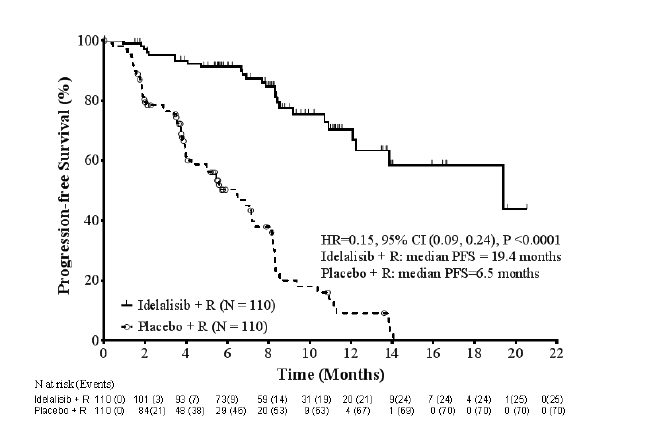
At the final analysis, with a median follow-up of 8.3 months for the Zydelig + R group, and 5.6 months for the placebo + R group, the median PFS for the Zydelig + R group was 19.4 months (95% CI: 12.3, Not Reached) versus 6.5 months (95% CI: 4.0, 7.3) for the placebo + R group (HR: 0.15, 95% CI [0.09, 0.24], p < 0.0001).
Updated efficacy results are shown in Table 7, and the Kaplan-Meier curve for PFS is shown in Figure 1.
Table 7 Efficacy Results from Study 312-0116 | | Zydelig + R
N=110 | Placebo + R
N=110 |
|---|
| PFS: progression-free survival; NR: not reached; ORR: overall response rate; PR: partial response; DOR: duration of response |
| PFS | Median (months) (95% CI) | 19.4 (12.3, NR) | 6.5 (4.0, 7.3) |
| Hazard ratio (95% CI) | 0.15 (0.09, 0.24) |
| P-value | < 0.0001 The p value for PFS was based on stratified log-rank test. |
| ORR ORR defined as the proportion of patients who achieved a complete response (CR) or PR. All PRs achieved; none of the patients achieved a CR. | (All PRs) | 92 (83.6%) | 17 (15.5%) |
| 95% CI | 75.4, 90.0 | 9.3, 23.6 |
| Odds Ratio (95% CI) | 27.8 (13.4, 57.5) |
| P-value | <0.0001 |
| DOR | Median (months) (95% CI) | NR (12, NR) | 6.2 (2.8, 6.5) |
Figure 1 Kaplan-Meier Plot of IRC-Assessed PFS for Study 312-0116
Study 101-09
The safety and efficacy of Zydelig in patients with FL was evaluated in a single-arm, multicenter study 101-09 (NCT01282424) which included 72 patients with follicular B-cell non-Hodgkin lymphoma who had relapsed within 6 months following rituximab and an alkylating agent and had received at least 2 prior treatments. The median age was 62 years (range 33 to 84), 54% were male, and 90% were Caucasian. At enrollment, 92% of patients had a baseline ECOG performance status of 0 or 1. The median time since diagnosis was 4.7 years and the median number of prior treatments was 4 (range 2 to 12). The most common prior combination regimens were R-CHOP (49%), BR (50%), and R-CVP (28%). At baseline, 33% of patients had extranodal involvement and 26% had bone marrow involvement.
Patients received 150 mg of Zydelig orally twice daily until evidence of disease progression or unacceptable toxicity. Tumor response was assessed according to the revised International Working Group response criteria for malignant lymphoma. The primary endpoint was Independent Review Committee-assessed overall response rate (ORR). Efficacy results are summarized in Table 8.
Table 8 Overall Response Rate (ORR) and Duration of Response (DOR) in Patients with Relapsed Follicular Lymphoma | N=72 |
|---|
| CI = confidence interval; CR = complete response; PR = partial response |
| ORR | 39 (54%) |
| 95% CI | (42, 66%) |
| CR | 6 (8%) |
| PR | 33 (46%) |
| Median Kaplan-Meier estimate DOR, months (range) | median not evaluable (0.0+, 14.8+) |
The median time to response was 1.9 months (range 1.6–8.3).
Study 101-09
The safety and efficacy of Zydelig in patients with SLL was evaluated in a single-arm, multicenter study 101-09 (NCT01282424) which included 26 patients with small lymphocytic lymphoma who had relapsed within 6 months following rituximab and an alkylating agent and had received at least 2 prior treatments. The median age was 65 years (range 50 to 87), 73% were male, and 81% were Caucasian. At enrollment, 96% of patients had a baseline ECOG performance status of 0 or 1. The median time since diagnosis was 6.7 years and the median number of prior treatments was 4 (range 2 to 9). The most common prior combination regimens were BR (81%), FCR (62%) and R-CHOP (35%). At baseline, 27% of patients had extranodal involvement.
Patients received 150 mg of Zydelig orally twice daily until evidence of disease progression or unacceptable toxicity. Tumor response was assessed according to the revised International Working Group response criteria for malignant lymphoma. The primary endpoint was Independent Review Committee-assessed overall response rate (ORR). Efficacy results are summarized in Table 9.
Table 9 Overall Response Rate (ORR) and Duration of Response (DOR) in Patients with Relapsed Small Lymphocytic Lymphoma | N=26 |
|---|
| CI = confidence interval; CR = complete response; PR = partial response |
| ORR | 15 (58%) |
| 95% CI | (37, 77%) |
| CR | 0 |
| PR | 15 (58%) |
| Median Kaplan-Meier estimate DOR, months (range) | 11.9 (0.0+, 14.7+) |
The median time to response was 1.9 months (range 1.6–8.3).
- Hepatotoxicity
Advise patients that Zydelig can cause significant elevations in liver enzymes, and that serial testing of serum liver tests (ALT, AST, and bilirubin) are recommended while taking Zydelig [see Warnings and Precautions (5.1)]. Advise patients to report symptoms of liver dysfunction including jaundice, bruising, abdominal pain, or bleeding.
- Severe Diarrhea or Colitis
Advise patients that Zydelig may cause severe diarrhea or colitis and to notify their healthcare provider immediately if the number of bowel movements in a day increases by six or more [see Warnings and Precautions (5.2)].
- Pneumonitis
Advise patients of the possibility of pneumonitis, and to report any new or worsening respiratory symptoms including cough or dyspnea [see Warnings and Precautions (5.3)].
- Infections
Advise patients that Zydelig can cause serious infections that may be fatal. Advise patients to immediately report symptoms of infection (e.g. pyrexia) [see Warnings and Precautions (5.4)].
- Intestinal Perforation
Advise patients of the possibility for intestinal perforation and to notify their healthcare provider immediately if they experience severe abdominal pain [see Warnings and Precautions (5.5)].
- Severe Cutaneous Reactions
Advise patients that Zydelig may cause severe cutaneous reactions and to notify their healthcare provider immediately if they develop a severe skin reaction [see Warnings and Precautions (5.6)].
- Anaphylaxis
Advise patients that anaphylaxis can occur during treatment with Zydelig and to notify their healthcare provider immediately if they experience symptoms of anaphylaxis [see Warnings and Precautions (5.7)].
- Neutropenia
Advise patients of the need for periodic monitoring of blood counts. Advise patients to notify their healthcare provider immediately if they develop a fever or any signs of infection [see Warnings and Precautions (5.8)].
- Embryo-Fetal Toxicity
Advise females to inform their healthcare provider if they are pregnant or become pregnant. Inform female patients of the risk to a fetus and potential loss of the pregnancy [see Use in Specific Populations (8.1)].
Advise females of reproductive potential to use effective contraception during treatment and for 1 month after receiving the last dose of Zydelig [see Warnings and Precautions (5.9) and Use in Specific Populations (8.1, 8.3)].
Advise lactating women not to breastfeed during treatment with Zydelig and for at least 1 month after the last dose [see Use in Specific Populations (8.2)].
- Instructions for Taking Zydelig
Advise patients to take Zydelig exactly as prescribed and not to change their dose or to stop taking Zydelig unless they are told to do so by their healthcare provider. Zydelig may be taken with or without food. Zydelig tablets should be swallowed whole. Advise patients that if a dose of Zydelig is missed by less than 6 hours, to take the missed dose right away and take the next dose as usual. If a dose of Zydelig is missed by more than 6 hours, advise patients to wait and take the next dose at the usual time.
Manufactured and distributed by:
Gilead Sciences, Inc.
Foster City, CA 94404
GSI and Zydelig are trademarks or registered trademarks of Gilead Sciences, Inc., or its related companies. All other trademarks referenced herein are the property of their respective owners.
© 2018 Gilead Sciences, Inc. All rights reserved.
205858-GS-003-PI