The adverse reactions observed were consistent with those observed in clinical trials of VEKLURY in adults. Adverse reactions (all grades) were reported in 8 (15%) subjects. The most common adverse reaction occurring in at least 5% of subjects was ALT increased (6%). No subjects experienced serious adverse reactions. Two (4%) subjects permanently discontinued treatment due to adverse reactions (ALT increased [n=1], ALT increased and AST increased and hyperbilirubinemia [n=1]). Laboratory abnormalities (Grades 3–4) occurring in at least 3% of subjects with COVID-19 receiving VEKLURY in Trial 5823 and who had at least one post-baseline value for the specified test were hemoglobin decreased (18%, 9/51), eGFR decreased (18%, 7/40), creatinine increased (10%, 5/52), direct bilirubin increased (9%, 2/23), prothrombin time increased (7%, 3/46), APTT increased (7%, 3/45), lymphocytes decreased (6% 2/33), proteinuria (6%, 2/36), WBC decreased (4%, 2/51), ALT increased (4%, 2/51), glucose increased (4%, 2/52), glycosuria (4%, 2/46), potassium decreased (4%, 2/52).
The following adverse reactions have been identified during use of VEKLURY under Emergency Use Authorization:
- General disorders and administration site conditions: Administration site extravasation
- Skin and subcutaneous tissue disorders: Rash
- Immune system disorders: Anaphylaxis, angioedema, infusion-related reactions, hypersensitivity
- Investigations: Transaminase elevations
Pregnancy Exposure Registry
There is a pregnancy exposure registry that monitors pregnancy outcomes in individuals exposed to VEKLURY during pregnancy. Pregnant and recently pregnant individuals can go to https://covid-pr.pregistry.com to enroll or call 1-800-616-3791 to obtain information about the registry.
Risk Summary
Available data from published case reports and compassionate use of remdesivir in pregnant women are insufficient to evaluate for a drug-associated risk of major birth defects, miscarriage, or adverse maternal or fetal outcomes. In nonclinical reproductive toxicity studies, remdesivir demonstrated no adverse effect on embryo-fetal development when administered to pregnant animals at systemic exposures (AUC) of the predominant circulating metabolite of remdesivir (GS-441524) that were 4 times (rats and rabbits) the exposure in humans at the recommended human dose (RHD) (see Data). There are maternal and fetal risks associated with untreated COVID-19 in pregnancy (see Clinical Considerations).
The estimated background risk of major birth defects and miscarriage for the indicated population is unknown. All pregnancies have a background risk of birth defect, loss, or other adverse outcomes. In the U.S. general population, the estimated background risk of major birth defects and miscarriage in clinically recognized pregnancies is 2 to 4% and 15 to 20%, respectively.
Clinical Considerations
Disease-associated maternal and/or embryo-fetal risk
COVID-19 in pregnancy is associated with adverse maternal and fetal outcomes, including preeclampsia, eclampsia, preterm birth, premature rupture of membranes, venous thromboembolic disease, and fetal death.
Data
Animal Data
Remdesivir was administered via intravenous injection to pregnant rats and rabbits (up to 20 mg/kg/day) on Gestation Days 6 through 17, and 7 through 20, respectively, and also to rats from Gestation Day 6 to Lactation/Post-partum Day 20. No adverse effects on embryo-fetal (rats and rabbits) or pre/postnatal (rats) development were observed in rats and rabbits at nontoxic doses in pregnant animals. During organogenesis, exposures to the predominant circulating metabolite (GS-441524) were 4 times higher (rats and rabbits) than the exposure in humans at the RHD. In a pre/postnatal development study, exposures to the predominant circulating metabolite of remdesivir (GS-441524) were similar to the human exposures at the RHD.
Risk Summary
There are no available data on the presence of remdesivir in human milk, the effects on the breastfed infant, or the effects on milk production. In animal studies, remdesivir and metabolites have been detected in the nursing pups of mothers given remdesivir, likely due to the presence of remdesivir in milk (see Data). The developmental and health benefits of breastfeeding should be considered along with the mother's clinical need for VEKLURY and any potential adverse effects on the breastfed child from VEKLURY or from the underlying maternal condition. Breastfeeding individuals with COVID-19 should follow practices according to clinical guidelines to avoid exposing the infant to COVID-19.
Data
Animal Data
Remdesivir and its metabolites were detected in the plasma of nursing rat pups, likely due to the presence of remdesivir and/or its metabolites in milk, following daily intravenous administration of remdesivir to pregnant rats from Gestation Day 6 to Lactation Day 20. Exposures in nursing pups were approximately 1% that of maternal exposure on Lactation Day 10.
Specific Populations
Pharmacokinetic differences based on sex, race, age, renal function, and hepatic function on the exposures of remdesivir were evaluated using population pharmacokinetic analysis. Sex and race did not affect the pharmacokinetics of remdesivir and its metabolites (GS-704277 and GS-441524).
Pediatric Patients
Population pharmacokinetic models for remdesivir and its circulating metabolites (GS-704277 and GS-441524), developed using pooled data from studies in healthy subjects and in adult and pediatric patients with COVID-19, were used to estimate pharmacokinetic exposures in pediatric patients aged ≥28 days to <18 years and weighing ≥3 kg (Study 5823). Geometric mean estimated exposures (AUCtau, Cmax, and Ctau) for these patients at the doses administered were higher for remdesivir (33% to 129%), GS-441524 (0% to 60%), and GS-704277 (37% to 124%) as compared to those in adult patients with COVID-19; however, the increases were not considered clinically significant [see Use in Specific Populations (8.4)].
The multiple dose PK parameters of remdesivir and metabolites in pediatric patients with COVID-19 are provided in Table 14.
Table 14 Multiple Dose PK ParametersPopulation PK estimates for 30-minutes IV infusion of remdesivir for up to 10 days (Study GS-US-540-5823).
of Remdesivir and Metabolites (GS-441524 and GS-704277) Following Intravenous Administration of VEKLURY 100 mg (Cohorts 1 and 8) or 2.5 mg/kg (Cohorts 2–4) to Pediatric Patients with COVID-19 | Cohort 1 | Cohort 8 | Cohort 2 | Cohort 3 | Cohort 4 |
|---|
Parameter
MeanGeometric mean estimates. (95% CI) | 12 to <18 Years and Weighing ≥40 kg
(N=12) | <12 Years and Weighing ≥40 kg
(N=5) | 28 Days to <18 Years and Weighing 20 to <40 kg
(N=12) | 28 Days to <18 Years and Weighing 12 to <20 kg
(N=11) | 28 Days to <18 Years and Weighing 3 to <12 kg
(N=10) |
|---|
| CI=Confidence Interval |
| Remdesivir | | | | | |
| Cmax (nanogram per mL) | 3910 (3140, 4870) | 3920 (2270, 6790) | 5680 (4660, 6930) | 5530 (4240, 7210) | 4900 (3790, 6340) |
| AUCtau (nanogram∙h per mL) | 2470 (1940, 3150) | 2280 (1200, 4300) | 3500 (2570, 4780) | 3910 (2140, 7160) | 2930 (1900, 4520) |
| GS-441524 | | | | | |
| Cmax (nanogram per mL) | 197 (123, 316) | 162 (57.4, 458) | 181 (132, 248) | 158 (116, 215) | 202 (171, 238) |
| AUCtau (nanogram∙h per mL) | 3460 (2010, 5960) | 2640 (772, 9030) | 2870 (2020, 4080) | 2400 (1740, 3320) | 2770 (2230, 3450) |
| Ctau (nanogram per mL | 98.3 (59.0, 164) | 76.2 (24.0, 242) | 73.8 (49.9, 109) | 69.4 (48.1, 100) | 78.4 (58.5, 105) |
| GS-704277 | | | | | |
| Cmax (nanogram per mL) | 307 (212, 443) | 278 (145, 532) | 423 (309, 578) | 444 (336, 585) | 390 (305, 500) |
| AUCtau (nanogram∙h per mL) | 815 (474, 1400) | 537 (203, 1420) | 754 (547, 1040) | 734 (513, 1050) | 691 (494, 966) |
Drug Interaction Studies
Clinical drug-drug interaction studies have not been performed with VEKLURY.
In vitro, remdesivir is a substrate for drug metabolizing enzyme CYP3A4, and is a substrate for Organic Anion Transporting Polypeptides 1B1 (OATP1B1) and P-glycoprotein (P-gp) transporters. In vitro, remdesivir is an inhibitor of CYP3A4, OATP1B1, OATP1B3, and MATE1. GS-704277 is a substrate for OATP1B1 and OATP1B3. The clinical relevance of these in vitro assessments has not been established.
Remdesivir is not a substrate for CYP1A1, 1A2, 2B6, 2C9, 2C19, or OATP1B3. GS-704277 and GS-441524 are not substrates for CYP1A1, 1A2, 2B6, 2C8, 2C9, 2D6, or 3A5. GS-441524 is also not a substrate for CYP2C19 or 3A4. GS-704277 and GS-441524 are not substrates for OAT1, OAT3, OCT1, OCT2, MATE1, or MATE2k. GS-441524 is also not a substrate for OATP1B1 or OATP1B3.
Mechanism of Action
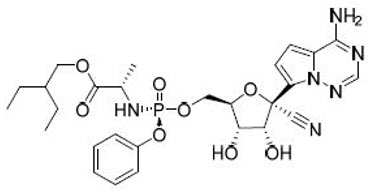
Remdesivir is an inhibitor of the SARS-CoV-2 RNA-dependent RNA polymerase (RdRp), which is essential for viral replication. Remdesivir is an adenosine nucleotide prodrug that distributes into cells where it is metabolized to a nucleoside monophosphate intermediate by carboxyesterase 1 and/or cathepsin A, depending upon the cell type. The nucleoside monophosphate is subsequently phosphorylated by cellular kinases to form the pharmacologically active nucleoside triphosphate metabolite (GS-443902). Remdesivir triphosphate (RDV-TP) acts as an analog of adenosine triphosphate (ATP) and competes with high selectivity (3.65-fold) over the natural ATP substrate for incorporation into nascent RNA chains by the SARS-CoV-2 RNA-dependent RNA polymerase, which results in delayed chain termination (position i+3) during replication of the viral RNA. In a biochemical assay assessing RDV-TP incorporation by the MERS-CoV RdRp complex, RDV-TP inhibited RNA synthesis with an IC50 value of 0.032 µM. RDV-TP can also inhibit viral RNA synthesis following its incorporation into the template viral RNA as a result of read-through by the viral polymerase that may occur at higher nucleotide concentrations. When remdesivir nucleotide is present in the viral RNA template, the efficiency of incorporation of the complementary natural nucleotide is compromised, thereby inhibiting viral RNA synthesis. Remdesivir triphosphate is a weak inhibitor of mammalian DNA and RNA polymerases, including human mitochondrial RNA polymerase.
Antiviral Activity
Cell Culture Antiviral Activity
Remdesivir exhibited cell culture antiviral activity against a clinical isolate of SARS‑CoV‑2 in primary human airway epithelial (HAE) cells with a 50% effective concentration (EC50) of 9.9 nM after 48 hours of treatment. Remdesivir inhibited the replication of SARS-CoV-2 in the continuous human lung epithelial cell lines Calu-3 and A549-hACE2 with EC50 values of 280 nM after 72 hours of treatment and 115 nM after 48 hours of treatment, respectively.
Remdesivir EC50 values for SARS-CoV-2 in A549-hACE2 cells were not different when combined with chloroquine phosphate or hydroxychloroquine sulfate at concentrations up to 2.5 μM. In a separate study, the antiviral activity of remdesivir was antagonized by chloroquine phosphate in a dose-dependent manner when the two drugs were co-incubated at clinically relevant concentrations in HEp-2 cells infected with respiratory syncytial virus (RSV). Higher remdesivir EC50 values were observed with increasing concentrations of chloroquine phosphate. Increasing concentrations of chloroquine phosphate or hydroxychloroquine sulfate reduced formation of remdesivir triphosphate in A549-hACE2, HEp-2, and normal human bronchial epithelial cells.
Based on cell culture susceptibility testing by virus yield reduction assay and/or N protein ELISA assay, remdesivir retained similar antiviral activity (<2.5-fold change) against clinical isolates of SARS-CoV-2 variants containing the P323L substitution in the viral polymerase including the Alpha (B.1.1.7), Beta (B.1.351), Gamma (P.1), Epsilon (B.1.429), Kappa (B.1.617.1), Lambda (C.37), Iota (B.1.526), and Zeta (P.2) variants compared to earlier lineage SARS-CoV-2 (lineage A) isolates. For the clinical isolates of the Delta (B.1.617.2) and Omicron (B.1.1.529/BA.1 and BA.2) variants, remdesivir maintained antiviral activity (<0.6-fold change).
Clinical Antiviral Activity
SARS-CoV-2 RNA shedding results from GS-US-540-5776 (ACTT-1) indicate that remdesivir does not significantly reduce the amount of detectable SARS-CoV-2 RNA in oropharyngeal or nasopharyngeal swabs or plasma samples in hospitalized patients compared to placebo, and SARS-CoV-2 RNA shedding results from GS-US-540-9012 indicate that remdesivir does not significantly reduce the amount of detectable SARS-CoV-2 RNA in nasopharyngeal swabs in non-hospitalized patients compared to placebo.
Resistance
Cell Culture Resistance
SARS-CoV-2 isolates with reduced susceptibility to remdesivir have been selected in cell culture. In a selection with GS-441524, the parent nucleoside of remdesivir, virus pools emerged expressing amino acid substitutions at V166A, N198S, S759A, V792I, C799F, and C799R in the viral RNA-dependent RNA polymerase (nsp12). When these substitutions were individually introduced into a wild-type recombinant virus by site-directed mutagenesis, 1.7- to 3.5-fold reductions in susceptibility to remdesivir were observed. In a cell culture resistance selection experiment with remdesivir, nsp12 amino acid substitution E802D emerged, resulting in a 2.5-fold reduction in susceptibility to remdesivir. In another selection with remdesivir using a SARS-CoV-2 isolate containing the P323L substitution in the viral polymerase, a single amino acid substitution at V166L emerged. Recombinant SARS-CoV-2 with substitutions at P323L alone or P323L+V166L in combination exhibited 1.3- and 1.5-fold reductions in remdesivir susceptibility, respectively.
Cell culture resistance profiling of remdesivir using the rodent CoV murine hepatitis virus identified two substitutions (F476L and V553L) in the viral RNA-dependent RNA polymerase at residues conserved across CoVs. Introduction of the corresponding substitutions (F480L and V557L) into SARS-CoV resulted in 6-fold reduction in susceptibility to remdesivir in cell culture and attenuated SARS-CoV pathogenesis in a mouse model. When individually introduced into a SARS-CoV-2 recombinant virus, the corresponding substitutions at F480L and V557L each conferred 2-fold reduced susceptibility to remdesivir.
Treatment-Emergent Resistance
SARS-CoV-2 nsp12 E802D substitution has emerged in one individual treated with remdesivir. The E802D substitution resulted in a 2.5-fold increase in the remdesivir EC50 value.
Carcinogenesis and Mutagenesis
Given the short-term administration of VEKLURY for the treatment of COVID-19, long-term animal studies to evaluate the carcinogenic potential of remdesivir were not conducted.
Remdesivir was not genotoxic in a battery of assays, including bacterial mutagenicity, chromosome aberration using human peripheral blood lymphocytes, and in vivo rat micronucleus assays.
Impairment of Fertility
Nonclinical toxicity studies in rats demonstrated no adverse effect on male fertility at exposures of the predominant circulating metabolite (GS-441524) approximately 2 times the exposure in humans at the RHD.
Reproductive toxicity, including decreases in corpora lutea, numbers of implantation sites, and viable embryos, was seen when remdesivir was administered by daily intravenous administration at a systemically toxic dose (10 mg/kg) in female rats 14 days prior to mating and during conception; exposures of the predominant circulating metabolite (GS-441524) were 1.3 times the exposure in humans at the RHD.
How Supplied
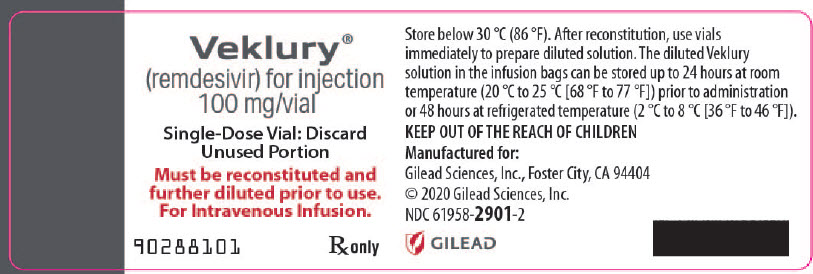
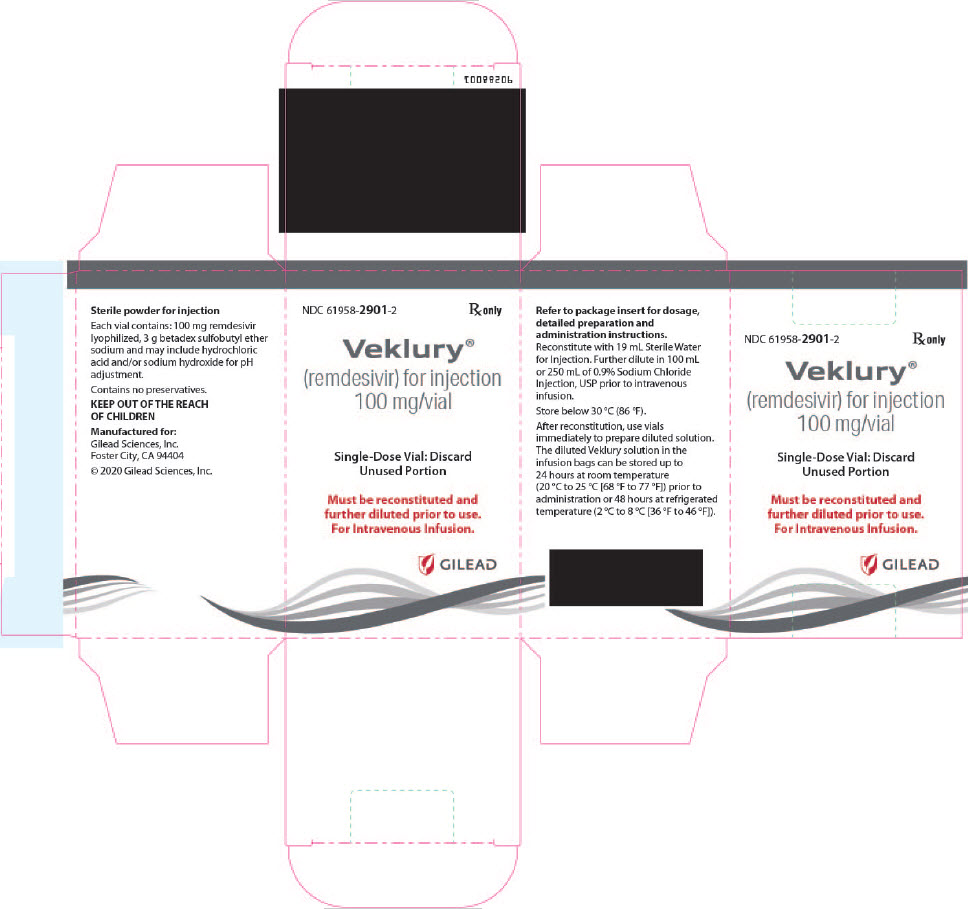
VEKLURY for injection: 100 mg (NDC 61958-2901-2), is supplied as a single-dose vial containing a sterile, preservative-free white to off-white to yellow lyophilized powder. It requires reconstitution and further dilution prior to administration by intravenous infusion [see Dosage and Administration (2.4)]. Discard unused portion. The container closure is not made with natural rubber latex.
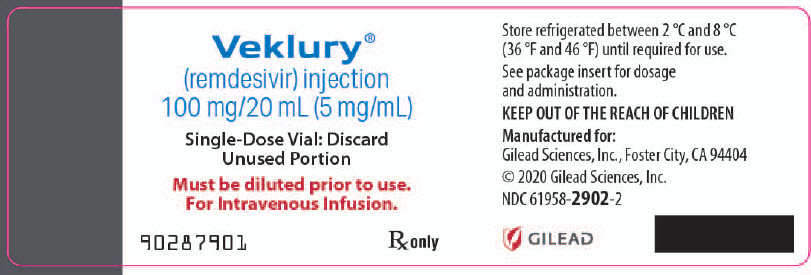
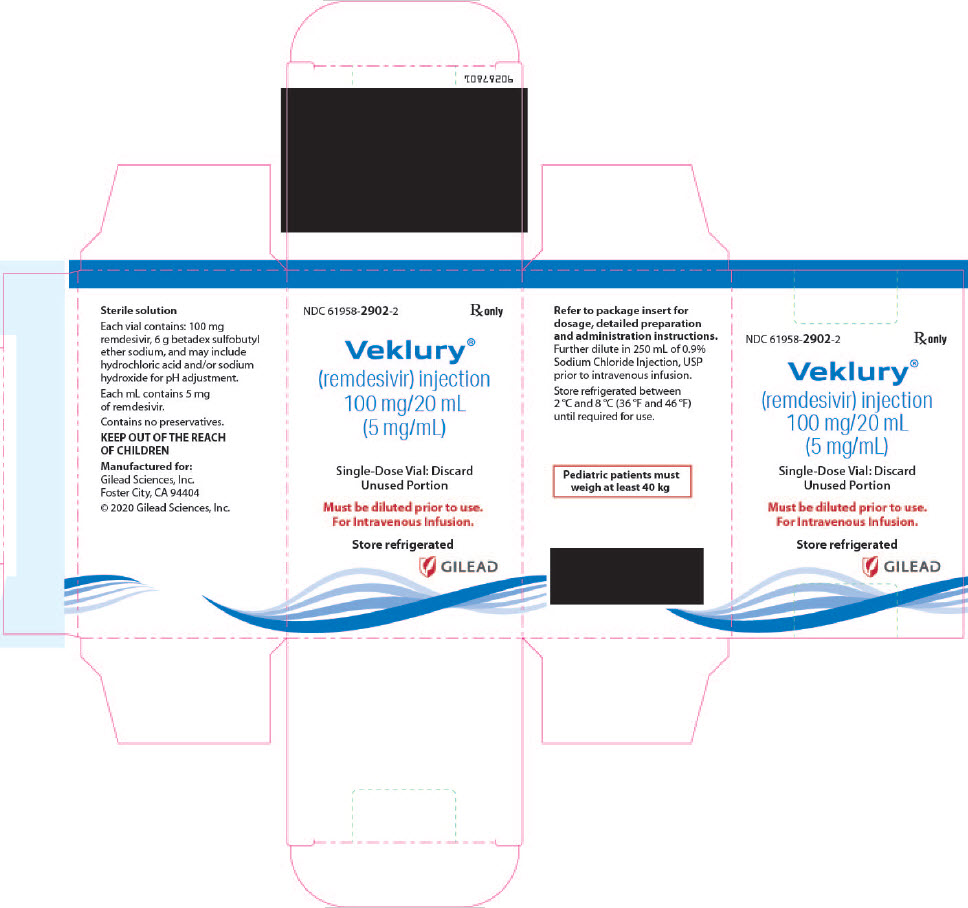
VEKLURY injection: 100 mg/20 mL (5 mg/mL) (NDC 61958-2902-2), is supplied as a single-dose vial containing a sterile, preservative-free, clear, colorless to yellow aqueous-based solution. It requires dilution prior to administration by intravenous infusion [see Dosage and Administration (2.4)]. Discard unused portion. The container closure is not made with natural rubber latex.
VEKLURY for Injection
Store VEKLURY for injection, 100 mg vials below 30°C (below 86°F) until required for use.
After reconstitution, use vials immediately to prepare diluted solution. Dilute the reconstituted solution in 0.9% sodium chloride injection, USP within the same day as administration. The diluted VEKLURY solution in the infusion bags can be stored up to 24 hours at room temperature (20°C to 25°C [68°F to 77°F]) prior to administration or 48 hours at refrigerated temperature (2°C to 8°C [36°F to 46°F]).
VEKLURY Injection
Store VEKLURY injection vials at refrigerated temperature (2°C to 8°C [36°F to 46°F]) until required for use.
Dilute within the same day as administration. Prior to dilution, equilibrate VEKLURY injection to room temperature (20°C to 25°C [68°F to 77°F]). Sealed vials can be stored up to 12 hours at room temperature prior to dilution. Store VEKLURY injection after dilution in the infusion bags for no more than 24 hours at room temperature (20°C to 25°C [68°F to 77°F]) or 48 hours at refrigerated temperature (2°C to 8°C [36°F to 46°F]).
Hypersensitivity Reactions
Inform patients that hypersensitivity reactions have been seen in patients receiving VEKLURY during and after infusion. Advise patients to inform their healthcare provider if they experience any of the following: changes in heart rate; fever; shortness of breath, wheezing; swelling of the lips, face, or throat; rash; nausea; sweating; or shivering [see Warnings and Precautions (5.1)].
Increased Risk of Transaminase Elevations
Inform patients that VEKLURY may increase the risk of hepatic laboratory abnormalities. Advise patients to alert their healthcare provider immediately if they experience any symptoms of liver inflammation [see Warnings and Precaution (5.2)].
Drug Interactions
Inform patients that VEKLURY may interact with other drugs. Advise patients to report to their healthcare provider the use of any other prescription or nonprescription medication or herbal products, including chloroquine phosphate or hydroxychloroquine sulfate [see Warnings and Precautions (5.3), Drug Interactions (7), and Microbiology (12.4)].
Pregnancy Registry
Advise patients that there is a pregnancy registry that monitors pregnancy outcomes in individuals exposed to VEKLURY during pregnancy [see Use in Specific Populations (8.1)].
Pregnancy
Inform patients to notify their healthcare provider immediately in the event of a pregnancy [see Use in Specific Populations (8.1)].
Lactation
Inform mothers that it is not known whether VEKLURY can pass into their breast milk [see Use in Specific Populations (8.2)].
VEKLURY is a trademark of Gilead Sciences, Inc., or its related companies. All other trademarks referenced herein are the property of their respective owners.
© 2022 Gilead Sciences, Inc. All rights reserved